Vocabulary Strategies That Work
eBook - ePub

Vocabulary Strategies That Work

Do This—Not That!

  1. 144 pages
  2. English
  3. ePUB (mobile friendly)
  4. Available on iOS & Android
eBook - ePub

Vocabulary Strategies That Work

Do This—Not That!

About this book

Update your vocabulary practices to meet the Common Core and improve students' word knowledge! This new, clearly-structured guide shows you how. It's packed with engaging, research-based, classroom-ready strategies for teaching vocabulary.

Topics include...

  • Selecting meaningful words for direct instruction
  • Strategies for engaging students in word study
  • Helping students come up with their own definitions
  • Authentic vocabulary assessment
  • Greek and Latin word study
  • Bringing vocabulary to life using symbols and pictures
  • Using a word wall effectively
  • Teaching vocabulary all the time
  • Creating opportunities for wide reading
  • Using and expecting academic language

For each vocabulary recommendation, you'll learn the research behind it, how it relates to the Common Core, and how to implement it in your classroom. The practical ideas for teaching vocabulary will benefit all of your students, including your English language learners, with specific connections to ELLs included throughout the book. This is a must-have resource for teaching vocabulary and meeting the Common Core standards!

Frequently asked questions

Yes, you can cancel anytime from the Subscription tab in your account settings on the Perlego website. Your subscription will stay active until the end of your current billing period. Learn how to cancel your subscription.
No, books cannot be downloaded as external files, such as PDFs, for use outside of Perlego. However, you can download books within the Perlego app for offline reading on mobile or tablet. Learn more here.
Perlego offers two plans: Essential and Complete
  • Essential is ideal for learners and professionals who enjoy exploring a wide range of subjects. Access the Essential Library with 800,000+ trusted titles and best-sellers across business, personal growth, and the humanities. Includes unlimited reading time and Standard Read Aloud voice.
  • Complete: Perfect for advanced learners and researchers needing full, unrestricted access. Unlock 1.4M+ books across hundreds of subjects, including academic and specialized titles. The Complete Plan also includes advanced features like Premium Read Aloud and Research Assistant.
Both plans are available with monthly, semester, or annual billing cycles.
We are an online textbook subscription service, where you can get access to an entire online library for less than the price of a single book per month. With over 1 million books across 1000+ topics, we’ve got you covered! Learn more here.
Look out for the read-aloud symbol on your next book to see if you can listen to it. The read-aloud tool reads text aloud for you, highlighting the text as it is being read. You can pause it, speed it up and slow it down. Learn more here.
Yes! You can use the Perlego app on both iOS or Android devices to read anytime, anywhere — even offline. Perfect for commutes or when you’re on the go.
Please note we cannot support devices running on iOS 13 and Android 7 or earlier. Learn more about using the app.
Yes, you can access Vocabulary Strategies That Work by Lori G. Wilfong in PDF and/or ePUB format, as well as other popular books in Éducation & Éducation générale. We have over one million books available in our catalogue for you to explore.

Information

Why This Item Is Important
José was pointing out to me in his direct way the fallacy the middle school I taught at had fallen into. As teachers, we were relying heavily on our textbooks to tell us which words to teach, and in doing so, we were completely inundating our students with words to know. José simply gave up, realizing that there was no way he could learn all those words in one week. The ideal number of words that students can handle cognitively is eight to ten a week for deep teaching (Scott, Jamieson-Noel, & Asselin, 2003); José had almost 80 words to learn!
Textbooks commonly identify several words in either the teacher manual or the student edition that are central to the meaning of the text, yet the thinking behind these selections is not clear. Nagy (2008) points out that publishers don’t have a consistent rule for selecting important vocabulary; rather, they go with words that are multisyllabic or repeated in later chapters. While it is easy to rely on textbooks to make this instructional decision, selecting which words to teach is too important for teachers to not give their input into the words they teach; they must consider the diversity of their students, students’ background knowledge, and which words are truly central to the reading and learning students are expected to do in the classroom.
The strategies and the research on selecting words join together in this chapter. There are several ways teachers can select words for instruction. The resulting words will differ from the words that students will pick up through conversation and reading; in fact, we know we need to rely on students to participate in several reading opportunities to increase their vocabularies exponentially beyond what we are able to achieve in the classroom (addressed in Chapter 8).
Do This–Not That principle #1: DO thoughtfully choose words to teach students; DON’T assign long lists predetermined by a textbook or publisher.
Updated Strategy #1: Tiering Words
A good beginning strategy to use when selecting vocabulary is to think about the “tiers” or “levels” of words that educators can identify for instruction. Beck, McKeown, and Kucan (2002) tier words like this:
Tier 1—General
Commonplace; learned from interactions with texts and people
Tier 2—Specialized
Change meaning with context (polysemic)
Tier 3—Technical
Specific to the discipline
Content Area Example: An example of this can be done with words and terms related to Memorial Day, such as freedom, war, picnic, hot dog, veteran, no school, and memorial. Tiered, they look like this:
Tier 1—General
♦ hot dog
♦ no school
♦ picnic
Tier 2—Polysemic
♦ freedom
♦ war
♦ veteran
♦ memorial
Tier 3—Content Specific
None
The focus on instruction for these words is on the polysemic words—words that have multiple meanings in different contexts. If I am teaching in a social studies class about Memorial Day, the Tier 2 words are important for me to focus on. I introduce students to their meaning in my class, but I would also have them brainstorm meanings for those words in other contexts, too. Polysemic words allow students to have power over academic language!
Updated Strategy #2: Answering Questions
Fisher and Frey (2011) developed a list of questions to assist teachers in deciding if a certain word is truly worthy of their teaching time.
1. Representative
Is the word critical to understanding?
2. Repeatability
Will it be used again?
3. Transportable
Is it needed for discussions or writing?
4. Contextual analysis
Can students use context to figure out the word?
5. Structural analysis
Can they use structure?
6. Cognitive load
Have I exceeded the number of words they can learn?
Content Area Example: A group of fifth-grade science teachers used this list of questions to analyze the set of words the textbook designated for instruction in the classroom, shown in Figure 1.1. The text book had thirty-three words designated for study across five lessons.
Figure 1.1 Words to Teach (Recommende...
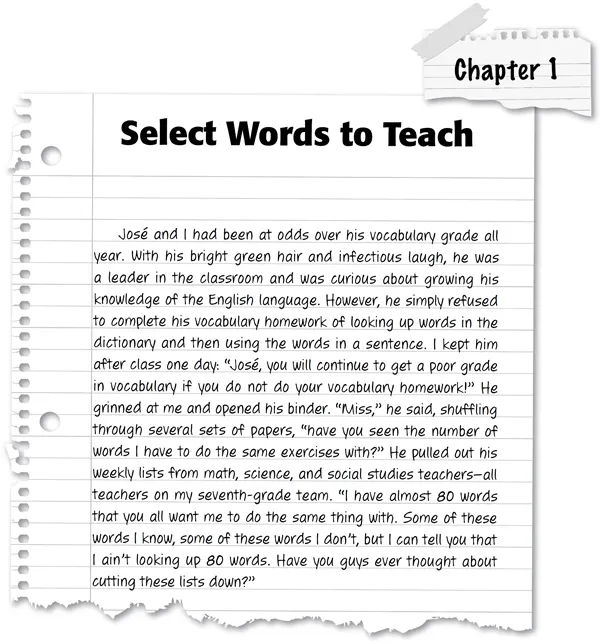
Table of contents

  1. Cover
  2. Title Page
  3. Copyright Page
  4. Contents
  5. Supplemental Downloads
  6. Meet the Author
  7. Foreword
  8. Introduction
  9. 1 Select Words to Teach
  10. 2 Use Strategies to Engage Students in Word Study
  11. 3 Help Students Come Up with Their Own Definitions
  12. 4 Assess Student Use of Words in Authentic Writing and Speaking
  13. 5 Teach Students Morphological Strategies to Figure Out Words They Do Not Know, in Addition to Context-Clue Strategies
  14. 6 Use Symbols and Pictures to Help Bring Vocabulary to Life
  15. 7 Highlight and Use a Word Wall in Classroom Instruction
  16. 8 Use and Apply Vocabulary Words Regularly (versus Isolated Practice)
  17. 9 Allow Opportunities for Wide Reading so Students Are Exposed to Words All the Time in a Variety of Books
  18. 10 Model the Use of Academic Language at All Times, Setting High Expectations for Language Use
  19. References