Half a century after the collapse of the Nazi regime and the Third Reich, scholars from a range of fields continue to examine the causes of Nazi Germany. An increasing number of young Americans are attempting to understand the circumstances that led to the rise of the Nazi party and the subsequent Holocaust, as well as the implication such events may have for today as the world faces a resurgence of neo-Nazism, ethnic warfare, and genocide.
In the months following World War II, extensive psychiatric and psychological testing was performed on over 200 Nazis in an effort to understand the key personalities of the Third Reich and of those individuals who "just followed orders." In addressing these issues, the current volume examines the strange history of over 200 Rorschach Inkblot protocols that were administered to Nazi war criminals and answers such questions as:
* Why the long delay in publishing protocols?
* What caused such jealousies among the principals?
* How should the protocols be interpreted?
* Were the Nazis monsters or ordinary human beings?
This text delivers a definitive and comprehensive study of the psychological functioning of Nazi war criminals -- both the elite and the rank-and-file. In order to apply a fresh perspective to understanding the causes that created such antisocial behavior, these analyses lead to a discussion within the context of previous work done in social and clinical psychology. Subjects discussed include the authoritarian personality, altruism, obedience to authority, diffusion of responsibility, and moral indifference. The implications for current political events are also examined as Neo-Nazism, anti-Semitism, and ethnic hate are once again on the rise. While the book does contain some technical material relating to the psychological interpretations, it is intended to be a scholarly presentation written in a narrative style. No prior knowledge of psychological testing is necessary, but it should be of great benefit for those interested in the Rorschach Inkblot test, or with a special interest in psychological testing, personality assessment, and the history of psychology. It is also intended for readers with a broad interest in Nazi Germany.
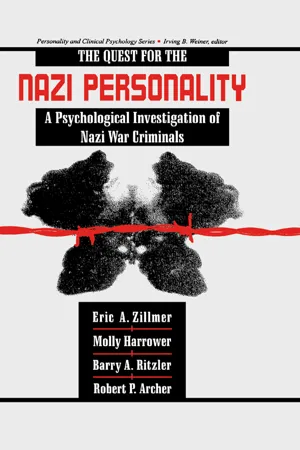
eBook - ePub
The Quest for the Nazi Personality
A Psychological Investigation of Nazi War Criminals
- 272 pages
- English
- ePUB (mobile friendly)
- Available on iOS & Android
eBook - ePub
The Quest for the Nazi Personality
A Psychological Investigation of Nazi War Criminals
About this book
Information
Chapter 1
The Quest for the Nazi Personality
I insist … that we are capable of learning from carefully examining past evil.
—Robert J. Lifton (1986)
THE LAST NAZI?
A hush falls over the crowd as the 79-year-old Josef Schwammberger teeters into a courtroom located in Stuttgart, Germany. Spectators stretch for a glimpse of the former Nazi commander whose war crimes trial may well be Germany’s last courtroom confrontation with its past. Twice a week, for 4 hours a day, Schwammberger is brought from his prison cell into Room 1 at the Stuttgart State Court where he retreats silently to his solitary place at a long table at the side of the room. He stares vacantly while survivors of the Polish town of Przemsyl recount their memories of the commandant of Ghetto A, a human corral in a town that housed 28,000 Jews before Schwammberger arrived in 1943, and no more than 100 when he left.
Schwammberger, an Austrian with Argentine citizenship, is accused of murdering at least 43 people and being an accessory to the murder of thousands of predominantly Jewish victims in wartime Poland. In 1945, French soldiers arrested Schwammberger after they found him carrying eight sacks stuffed with diamonds and gold tooth-fillings. He confessed to killing 27 Jews and was charged with war crimes, but 3 years later he escaped to Argentina where he lived under his own name, protected by Argentine authorities. Since 1973 the West German government has sought extradition of Schwammberger from Argentina for the atrocities he committed as a Nazi SS captain in charge of two Jewish ghettos and a work camp in occupied Poland (Freiwald & Mendelsohn, 1994).
The witnesses come from Canada, Australia, Israel, and the United States. One after another they report having seen Schwammberger shoot innocent men, women, and children, or of hearing him order thousands to their deaths, simply because they were Jews.
On Wednesday, January 29, 1992, it was Samuel Nussbaum’s turn to tell what he knows about Schwammberger. Nussbaum, a retired plumber who just arrived in Stuttgart, now lives in Kansas City. Forty-nine years after Nussbaum and Schwammberger last met, they are separated by only several feet as accuser and accused in the courtroom. Two men stiffened by age, each with a horseshoe of white hair. Each returning to Germany after four decades of absence. Nussbaum steps up to an easel and points to a precise location on a map. He takes a deep breath and summons all the detail his mind can muster about the man he knew from February to November of 1943. In a clear, strong voice, the 72-year-old plumber recalls the last time he had been so close to the commandant (Freiwald & Mendelsohn, 1994):
He [Schwammberger] called for me one time to walk with him. Him, his wife and his dog, Prince. Nobody walked with us. There was an injured Jew lying on the street, shot in the lower part of the body. We stopped, me, him, his wife and [the] dog. That person in the street could say only “Wasser, Wasser, Wasser [water].” Schwammberger took his right foot and flipped him over on his stomach. He took out his pistol, and I was looking at Mrs. Schwammberger to see how she looked. She turned back. She did not look. And then he shot him. Right in the head.
“Dead?” asked Judge Herbert Luippold.
“Dead,” Nussbaum answered.
Nussbaum then went on to recall other horrors of the past—stories that had gone untold for decades. Once he explained, Schwammberger ordered him to lock the car doors on a train carrying Jews to the Auschwitz extermination camp. Only later did Nussbaum learn that his entire family was inside one of those cars. He also tells of an incident where Schwammberger shot 25 Jews one after another, because they had been hiding during a roundup.
“I expected a beast,” Nussbaum said after his testimony. But what he saw was a slight man wearing a crisp new cream-colored golf jacket, a fellow who joked with his guards, but who never showed the slightest sign of emotions during the trial. Later Nussbaum added, “he [Schwammberger] looks old … like a human being.”
Schwammberger, who was listed on the top of the “10 Most Wanted” list by the Wiesenthal Center, admits he was a labor camp commander but denies killing anyone. When confronted with witness after witness he calmly says that he does not recognize any of them and that they are simply lying. At one point during the trial, the judge, obviously exasperated by Schwammberger’s blanket rejection of testimony from one witness after another, said: “But here is yet another witness who says, Mr. Schwammberger, I knew you well.” Schwammberger replied, “there were 10,000 or 15,000 of them. The 15,000 can know one, but that does not mean the one knew 15,000.” At this point his attorney cut him off, declaring that he was too exhausted to continue.
Now at the age of 79 Schwammberger is facing a sentence of life in prison. The trial is the first major Nazi war crime proceeding since German unification in October 1990. It well could be the last. Only one major Nazi fugitive, Alois Brunner (chief deputy to Adolf Eichman), is thought to be alive. Brunner, described by Eichman during his trial as “my most consistently effective aide,” is believed to be living in Damascus, Syria;1 he is said to have been responsible for the murder of more than 100,000 Jews and 60,000 others.
The scale of involvement by members of Hitler’s regime, including the leadership corps of the Nazi party, the Gestapo,2 the SS, the SD, the SA,3 and of certain others is astounding. Conservative estimates indicate that between 150,000 and 200,000 Germans were actively responsible for committing war crimes before and during the war years. It is estimated that more than 35,000 (20% of those believed responsible for major war crimes) have been captured, brought to trial, and convicted. The most publicized of these trials was the one held in 1945–1946 at the Palace of Justice at Nuremberg, where 24 high-ranking Nazi leaders were charged with war crimes before an International Military Tribunal.
Since the 1960s, there have been additional highly publicized trials such as those of Adolf Eichmann in Israel and Klaus Barbie in France. There has also been intense media interest surrounding former Nazis who escaped (e.g., the death of Josef Mengele), those who just fell through the cracks (e.g., Kurt Waldheim’s questionable involvement in the Third Reich; Herzstein, 1988), alleged Nazis (i.e., the 71-year-old John Demjanjuk, a retired Cleveland autoworker, believed by Israeli authorities to be the dreaded “Ivan the Terrible”), as well as the deaths of some very well-known Nazis who served long prison sentences at Spandau prison in Berlin (e.g., Albert Speer and Rudolf Hess).
Although Schwammberger, “The Mass Murderer of Poland,” was well known for the atrocities he committed as a Nazi SS captain in Poland, the significance of his trial may very well be the realization that, 47 years after the collapse of the Nazi regime, one of the last of Hitler’s henchmen is being brought to justice. Thousands of Nazi criminals may still be alive but the Nazis who had responsibilities during the war were already in their 40s at the time, which means they are about 90 years old today. We are now entering a new era in which the last Nazi war criminals are either dead or are too old to be tried (in fact, Schwammberger may avoid prison on grounds of illness4). Furthermore, many of the victims who were eyewitnesses to World War II atrocities have passed away or, as occurred during Schwammberger’s trial, are now tending to give contradictory or confusing accounts of what happened.5 Even Nazi hunters themselves admit that both suspects and witnesses are becoming too feeble to undergo the strenuous rigors of a war crimes court trial.
The balding and frail-looking Schwammberger is a reminder that as Nazi war criminals and their victims succumb to old age, an era of German history is ending. From now on, only history will judge the Nazis.
RANK-AND-FILE NAZIS
In discussing Third Reich war crimes, and specifically the probability of recurrence of similar crimes, there are at least two important questions that stand out and that deserve further scholarly examination. One is that of understanding the involvement of numerous rank-and-file personnel in crimes against humanity. The second is related to the analysis of Nazi leadership in World War II atrocities.
The first issue focuses on the involvement of the man in the street,6 the member of Hitler’s National Socialist party or NSDAP.7 How could so many seemingly average and otherwise unremarkable citizens have been motivated to participate in cruel, inhumane, and antisocial actions? What could have inspired so many people, many of whom were decent and quite ordinary citizens themselves, to carry out orders that resulted in the deaths of millions of similarly decent and ordinary people?
Clearly, many who participated in the Nazi regime were not necessarily involved in war crimes directly, and some even lost their lives resisting the government, but those responsible for many of the atrocities of the Third Reich do represent quite a large number of Nazi officials, guards, military personnel, bureaucrats, and others that claim to have “just followed orders.” Did they all exhibit a common personality style in which the essential feature was a pervasive pattern of dependent and submissive behavior? Did they all tend to subordinate themselves to others because they were unable to make any decisions for themselves? Or did they perhaps volunteer to engage in inhumane actions in a bizarre attempt at receiving recognition from their superiors? These questions, of course, cover familiar ground and have been asked before. For example, the psychological functioning of rank-and-file Nazis has been investigated in a number of comparative experimental psychological studies, most notably in Asch’s (1952) experiments on social conformity, Milgram’s (1963, 1974) studies of obedience to authority, and Zimbardo’s (1972) investigation of prison life.
Briefly, Asch, a social psychologist, showed how powerful the tendency to conform to others can be, even in regard to simple perceptual judgments. Faced with a simple, unambiguous task (i.e., matching the length of a line with one of three unequal lines), a large majority of the subjects ignored their own senses and agreed with the obviously incorrect choice made by a group of strangers (actually confederates of the experimenter). The subjects reported later that they had started doubting their own eyesight or had thought they had misunderstood the instructions. Interestingly, the subjects who did not conform reported feeling uncomfortable about disagreeing with the other members of the group. The “Asch effect” shows how readily most people will go along with a decision that their own judgment tells them is wrong, even when no coercion or force is used.
Guessing the length of a line is, of course, not comparable to participating in war crimes. However, Milgram (1963, 1974), a Yale psychologist, showed that obedience to authority relieves many people of moral responsibility, thus making them more likely to behave with considerable cruelty. Milgram had originally designed his experiment in response to the Adolf Eichmann trial, in part to understand why “ordinary people” in Germany (like Eichmann) had participated in murdering millions of innocent victims during World War II. Milgram had initially planned to bring to perfection his experiment in the United States and then travel to Germany to continue his studies, assuming that Germans may be more prone to obedience than Americans. The results he obtained in the United States, however, made it clear that he did not have to leave home. Milgram recruited subjects through advertisements in a local newspaper for a study in memory. The subjects were then asked to participate in a teaching exercise. The volunteers operated a “learning apparatus” that supposedly delivered “shocks that can be extremely painful” to a learner in an adjacent room (in reality an ally of the experimenter). With considerable verbal coercion by the experimenter, the majority of the subjects gave the “learner” what they believed to be a 450-volt shock labeled “Danger: Severe Shock,” despite the “learner” having pounded on the wall twice and then having stopped responding altogether. In later experiments, almost one third was willing to hold the “learner’s” hand against a metal plate to force him to receive the shock. Milgram’s study clearly demonstrated that, under certain circumstances, the tendency to obey an authority figure can be very strong.8
In yet a different experiment, psychologist Zimbardo (1972) asked a group of ordinary college students to spend time in a simulated prison. Some were randomly assigned as guards, given uniforms, billy clubs, and whistles and were instructed to enforce certain rules. The remainder became prisoners, were asked to wear humiliating outfits, and were locked in barren cells. After a short time the simulation became very real as the guards devised cruel and degrading routines. The prisoners, one by one, either broke down, rebelled, or became passively resigned. After only 6 days Zimbardo had to call the study off demonstrating that for many of us, what we do is what we gradually become.
The rank-and-file Nazis performed a very special role in the evolution of the Third Reich, because it was more likely that they, compared with upper echelon participants, were the direct perpetrators of many of the atrocities. This volume examines a relatively large group of nearly 200 psychological protocols of rank-and-file Nazis, many of which have been previously unavailable. The issue of whether rank-and-file Nazis present a heterogeneous or homogeneous personality pattern can only be addressed within the context of a relatively large sample, because it allows for the separation of specific subgroups (e.g., those who participated in episodes of brutality and murder compared to those who did not; see chap. 7).
THE NAZI ELITE
A second related question, but one deserving equal attention, is that of whether Hitler’s “henchmen” were mad or insane. Can one equate evil behavior with psychiatric abnormality? These questions are related to the personalities and motivations of those high-ranking persons who were considered to have been members of the “Nazi elite.”9 The men closest to Hitler constituted a group of perhaps 100 individuals. For the most part, these individuals were responsible for not merely following orders, but also for issuing them. These Nazis were charged with such conspiracies as the “final solution,” the creation of concentration camps, the initiation of aggressive warfare, and slave labor. In short, they created an environment in which the atrocities of the Third Reich were allowed to occur, and they and many of their subordinates had the managerial freedom to make it happen. Many of these Nazis could be classified as administrative facilitators who seldom, if ever, committed acts of violence themselves and were, as a group, rather far removed from the incidents of death and torture perpetrated by their rank-and-file subordinates.
A psychological study of Nazi leadership is undertaken by examining the Rorschach data of high ranking members of the Third Reich who stood trial during the International Military Tribunal in Nuremberg. Twenty-four of them were brought to trial for their involvement in the Third Reich and of these, the majority were administered psychological tests, several of which have remained unpublished; these are reviewed in subsequent chapters.
THE SEARCH FOR A GERMAN NATIONAL CHARACTER
How could Nazism become the ruling passion of the German people? Why are the Germans so unreasonably aggressive? What accounts for their brutal treatment of non-Germans? Such questions are typically asked by individuals who blame a Nazi personality, a German enigma, or a National Character for the shameful occurrences under the Third Reich (e.g., Brickner, 1943). They argue that Nazism is merely an expression of a German culture that has existed for more than 100 years. They take comfort in describing a Nazi personality as aggressive, militaristic, disciplined, undemocratic, and anti-Semitic in nature.
Particularly during the war and postwar years, there was much activity in the search for a Nazi personality or that of a German national character. For example, British psychiatrist Dicks, who in 1941 was appointed to take over the psychiatric care of Rudolf Hess after his flight to England, evaluated more 1,000 German prisoners of war. Dicks (1950, 1972) defined national character as the broad, frequently recurring regularities of certain prominent behavior traits and motivations of a given ethnic or cultural group. He proposed that the identification of such a Nazi personality would assist “future Allied Administrators of Germany … to distinguish Nazis from non-Nazis without recourse to the very crude and fallacious criteria of reference to formal membership of the Party.” He concluded in his research of German POWs that Nazism was distributed normally in the German population (i.e., in the form of a Gaussian distribution) and that 36% were “hard active” or “near Nazis” (something Dicks referred to as active carriers of this ideology). Dicks reported that the “average” member of the Wehrmacht could be described as tense, earnest, industrious, meticulous, overrespectful to authority, and anxious to impress. Indeed, one is left to wonder if Dicks’ description of the “German character” does not, in fact, fit the military personnel of most nations. Dicks himself never attempted to use a control group to explore this, however, excluding all subjects from his study that were foreign born and not German.
If there is not a uniform German national character, perhaps the rank-and-file Nazis and the Nazi elite share...
Table of contents
- Cover
- Half Title
- Title Page
- Copyright Page
- Table of Contents
- About the Authors
- Foreword
- Preface
- Chronology of Historical Events Related to the Psychological Studies on Nazi War Criminals
- Chapter 1 The Quest for the Nazi Personality
- Chapter 2 Historical and Psychological Perspectives of the Nuremberg Trials
- Chapter 3 Evaluating the Prisoners at Nuremberg
- Chapter 4 Delays in the Publication of the Nazi Rorschach Records
- Chapter 5 The Rorschach Inkblot Technique
- Chapter 6 Interpreting the Nazi Records: The Nazi Elite
- Chapter 7 Danish Collaborators and German Occupation Personnel: A New Sample
- Chapter 8 Two Case Studies of Nazi War Criminals
- Chapter 9 The Myth of the Nazi Personality
- Appendix
- References
- Author Index
- Subject Index
Trusted by 375,005 students
Access to over 1.5 million titles for a fair monthly price.
Study more efficiently using our study tools.
Frequently asked questions
Yes, you can cancel anytime from the Subscription tab in your account settings on the Perlego website. Your subscription will stay active until the end of your current billing period. Learn how to cancel your subscription
No, books cannot be downloaded as external files, such as PDFs, for use outside of Perlego. However, you can download books within the Perlego app for offline reading on mobile or tablet. Learn how to download books offline
Perlego offers two plans: Essential and Complete
- Essential is ideal for learners and professionals who enjoy exploring a wide range of subjects. Access the Essential Library with 800,000+ trusted titles and best-sellers across business, personal growth, and the humanities. Includes unlimited reading time and Standard Read Aloud voice.
- Complete: Perfect for advanced learners and researchers needing full, unrestricted access. Unlock 1.5M+ books across hundreds of subjects, including academic and specialized titles. The Complete Plan also includes advanced features like Premium Read Aloud and Research Assistant.
We are an online textbook subscription service, where you can get access to an entire online library for less than the price of a single book per month. With over 1.5 million books across 990+ topics, we’ve got you covered! Learn about our mission
Look out for the read-aloud symbol on your next book to see if you can listen to it. The read-aloud tool reads text aloud for you, highlighting the text as it is being read. You can pause it, speed it up and slow it down. Learn more about Read Aloud
Yes! You can use the Perlego app on both iOS and Android devices to read anytime, anywhere — even offline. Perfect for commutes or when you’re on the go.
Please note we cannot support devices running on iOS 13 and Android 7 or earlier. Learn more about using the app
Please note we cannot support devices running on iOS 13 and Android 7 or earlier. Learn more about using the app
Yes, you can access The Quest for the Nazi Personality by Eric A. Zillmer,Molly Harrower,Barry A. Ritzler,Robert P. Archer in PDF and/or ePUB format, as well as other popular books in Psychology & Clinical Psychology. We have over 1.5 million books available in our catalogue for you to explore.