A Preface to Hardy remains the best introduction to one of the most important and popular writers in English literature. The first section concentrates on Hardy the man and outlines the intellectual and cultural context in which he lived. The author then moves on to examine a wide range of Hardy's work, with particular reference to The Mayor of Casterbridge. There is new material on Hardy's short stories and their relation to the major novels, and on The Dynasts, which accompanies a study of a range of Hardy's other poetry.
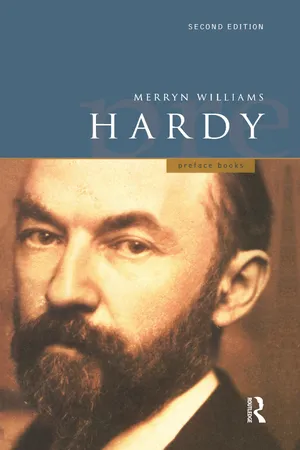
- 214 pages
- English
- ePUB (mobile friendly)
- Available on iOS & Android
eBook - ePub
About this book
Information
Part One
The Writer and his Setting
Chronological table
HARDY’S LIFE | LITERARY AND HISTORICAL EVENTS | |
1840 | Born at Higher Bockhampton, Dorset, 2 June. | |
1846 | Repeal of Corn Laws. | |
1847 | Railway to Dorchester. | |
1848 | Chartist petition. ‘The Year of Revolutions’. | |
1849 | At Isaac Last’s school, Dorchester. | |
1851 | Great Exhibition. | |
1854 | Cholera epidemic in Dorchester. | |
1856 | Apprenticed to architect, John Hicks. | |
1858 | First poems; friendship with Horace Moule. | |
1859 | Darwin’s Origin of Species. | |
1860–1 | Read Greek and helped with church restoration. | |
1862 | Moved to London to work as assistant architect. | |
1865 | Planned to train for the Church at Cambridge; gave up plan owing to religious doubts. | |
1866 | Swinburne’s Poems and Ballads. | |
1867 | Returned to Dorchester. Began The Poor Man and the Lady. | |
1870 | Met Emma Gifford at St Juliot in Cornwall. | Education Act. Dickens died. Franco-Prussian war. |
1871 | Desperate Remedies published. | |
1872 | Designed schools for London Board. Under the Greenwood Tree. | Joseph Arch’s Union. George Eliot’s Middlemarch. |
1873 | A Pair of Blue Eyes. Suicide of Horace Moule. | |
1874 | Far from the Madding Crowd appeared in Cornhill Magazine. Married Emma Gifford in London; they moved to Surbiton. | |
1875 | The Hand of Ethelberta. | |
1876–8 | Lived in Sturminster Newton, Dorset; wrote The Return of the Native. | |
1878–80 | At Upper Tooting; The Trumpet-Major. | |
1880–1 | Wrote A Laodicean during a serious illness. | George Eliot died. |
1881 | Moved to Wimborne, Dorset. | |
1882 | Went to Darwin’s funeral. Two on a Tower. | |
1883 | Moved permanently to Dorchester; wrote The Dorsetshire Labourer. | |
1885 | The Mayor of Casterbridge | |
1886 | William Barnes died. | |
1887 | The Woodlanders | D. H. Lawrence born. |
1888 | Wessex Tales | |
1891 | Tess of the d’Urbervilles. | |
1892 | Father died. | |
1894 | Life’s Little Ironies. | |
1895 | Jude the Obscure. | |
1898 | Wessex Poems. | |
1899 | Boer War began. | |
1901 | Poems of the Past and the Present. | Queen Victoria died. |
1902 | End of Boer War. | |
1904 | First part of The Dynasts. | |
1905 | Honorary degree from Aberdeen University. | |
1906 | Second part of The Dynasts | Liberals won general election; Labour Party got 30 seats. |
1908 | Third part of The Dynasts. | |
1909 | Time’s Laughingstocks. President of Society of Authors. | Swinburne died. |
1910 | Awarded Order of Merit. First revision of Wessex Novels. | |
1912 | Emma Hardy died on 27 November. | |
1913 | Honorary degree from Cambridge University. | |
1914 | Married Florence Dugdale. Satires of Circumstance. On war committee of writers. | Great War began. |
1915 | Sister Mary died. | |
1916 | Visited German prisoners of war in Dorchester. | |
1917 | Moments of Vision. | Russian Revolution. |
1918 | End of war. | |
1920 | Honorary degree from Oxford University. | |
1922 | Late Lyrics and Earlier. | |
1925 | Human Shows. Honorary degree from Bristol University. | |
1928 | Died, 11 January. Winter Words published later the same year. |
1 | Hardy’s life |
Childhood and youth
Thomas Hardy was born on 2nd June 1840, in a small thatched cottage in the hamlet of Higher Bockhampton three miles from Dorchester. It was a picturesque place. There were several quaint-looking houses, with ‘trees, clipped hedges, orchards, white gate-post-balls’ in the avenue of cherry trees which led to the cottage, and behind it stretched the vast expanse of Egdon or Puddletown Heath. The cottage is still standing, and is used as a Hardy museum, but the other houses, the cherry trees and much of the heath have gone.
Fifty years earlier the heath had come up to the door, and bats had flown in and out of the house when the first Thomas Hardy moved in with his wife. This was the novelist’s grandfather. He is said to have used the house for smuggling brandy, a tradition that plays its part in Hardy’s story ‘The Distracted Preacher’. His son, the second Thomas Hardy, was a skilled violinist and a ‘master mason’, self-employed in 1840 but later to expand his business and employ other men. They became a modestly well-off family, but his brother remained an ordinary labourer, and his wife, Jemima Hand, had had a deprived childhood:
By reason of her parent’s bereavement and consequent poverty under the burden of a young family, Jemima saw during girlhood and young womanhood some very stressful experiences of which she could never speak in her maturer years without pain, though she appears to have mollified her troubles by reading every book she could lay hands on.
(The Life of Thomas Hardy, F.E. Hardy, 1962, p. 8)
Her own mother, a prosperous farmer’s daughter, had married a servant, been disinherited and spent the rest of her life in poverty. Class barriers, marriage between classes and the rise and fall of individuals would loom large in the novels of Thomas Hardy.
After moving about Dorset and London working for various families as a cook, Jemima became involved with the young mason and at the end of 1839 found herself pregnant. A marriage was fixed up, and five months later the third Thomas was born. Hardy naturally did not mention these facts, but in ‘A Tragedy of Two Ambitions’ he makes the hero discover that ‘his father had cajoled his mother in their early acquaintance, and had made somewhat tardy amends.… It was the last stroke, and he could not bear it’. As a writer he would show constant sympathy for the illegitimate child.
The mother had a difficult labour, and the baby was thought to be dead at first, but the nurse revived him just in time. There were three more children, Mary, born in 1841 and her brother’s special friend, Henry born in 1851 and Katharine in 1856. None of them married, and there were no Hardys in the next generation.
Hardy often seems to have felt that there was something wrong with his family and that it was doomed to die out. At one time the Hardys had been well known in Dorset; one ancestor had founded Hardye’s Grammar School in Elizabethan times and another had been the Admiral Hardy who was with Nelson when he died. They had owned a good deal of land, but lost it. Hardy noted in 1888, ‘The decline and fall of the Hardys much in evidence hereabout … So we go down, down, down’, and he would discover that the outside world regarded him and his family as peasants. Possibly that is why he brooded over the decline of ancient families in The Woodlanders and Tess of the D’Urbervilles, and created a family marked down by fate and unfit for marriage in Jude the Obscure.
Little Thomas remained a sickly child; for the first few years his parents did not expect him to live and apparently he heard them say so. He was precocious, ‘being able to read almost before he could walk, and to tune the violin when of quite tender years’. The musical talent came from his father, the love of words from his mother. She was, he said, ‘essentially a literary woman – nearly blinded herself by reading’, and she bought him all the books she could afford, for example Dryden’s translation of Virgil, Johnson’s Rasselas and Bunyan’s Pilgrim’s Progress. He enjoyed dressing up in a tablecloth and reciting services from the prayer book, and everyone thought that as he was no good at anything else he would have to be a parson. The family went regularly to Stinsford church, which Hardy would immortalize under the name of Mellstock, and this church, where many of his ancestors were buried, was ‘to him the most hallowed spot on earth’:
In this connection he said once – perhaps oftener – that although invidious critics had cast slurs upon him as Nonconformist, Agnostic, Atheist, Infidel, Immoralist, Heretic, Pessimist, or something else equally opprobrious in their eyes, they had never thought of calling him what they might have called him much more plausibly – churchy; not in an intellectual sense, but in so far as instincts and emotions rule. As a child, to be a parson had been his dream; moreover, he had had several clerical relatives who had held livings; while his grandfather, father, uncle, brother, wife, cousin, and two sisters had been musicians in various churches over a period covering altogether more than a hundred years.
Life. p. 376)
Unconscious of religious controversy, he soaked in the atmosphere of this small country church and gradually acquired a deep knowledge of the Bible. At eight he was sent to the village school and learned arithmetic and geography. After a year he seemed much stronger, and his mother, who wanted him to ‘get on’, moved him to Isaac Last’s Academy in Dorchester. He walked the three miles there and back through the country lanes every day.
It was a Nonconformist school but took pupils from all kinds of backgrounds. Isaac Last was ‘an exceptionally able man, and a good teacher of Latin’, and it seems that the boy was lucky to find so good a school in a quiet country town. He became an outstanding pupil, won a Latin prize, and learned advanced mathematics and French. But he shunned the other schoolboys. He ‘loved being alone’, and he was already showing signs of the extreme sensitivity which would plague him later in life. He has recorded that, like his character Jude, he ‘did not wish to grow up … to be a man, or to possess things, but to remain as he was, in the same spot, and to know no more people than he already knew (about half a dozen)’. He also saw things, as a boy, which he remembered for the rest of his life: a frozen bird, a shepherd boy who later starved to death, and two public hangings. One was of a woman who had killed her husband, and it is likely that this was in his mind when he wrote Tess.
He left school in 1856. His parents had been concerned about what to do with him, for although he was obviously highly intelligent it was not normal for one of their background to progress to public school and then one of the ancient universities. But a family friend, John Hicks, an architect who practised in South Street, Dorchester, offered to take the boy into his office, and this was agreed. Even that offended the local parson. According to Michael Millgate’s biography ‘he never forgot … the humiliation of sitting in Stinsford Church at his mother’s side in that early summer of 1856 while the Reverend Mr Shirley preached against the presumption shown by one of Hardy’s class in seeking to rise, through architecture, into the ranks of professional men’ (p. 55).
Hicks was a genial man who encouraged him to go on studying the classics. Hardy would get up at four or five and read Greek or Latin for a few hours before walking to work; he also discussed theology with another of Hicks’s pupils, and he had a remarkably helpful friend who saw that he did not stagnate mentally.
This was Horace Moule, a young man eight years older than himself who had just left Cambridge to become a freelance writer. His father, Henry Moule, the vicar of Fordington, was a devoted clergyman who had saved hundreds of lives when cholera broke out in the Dor...
Table of contents
- Cover Page
- Series Page
- Fm Chapter
- Title Page
- Copyright Page
- Contents
- List of illustrations
- Acknowledgements
- Foreword to The First Edition
- Preface to the second edition
- Dedication
- Part One The Writer and his Setting
- Part Two Critical Survey
- Part Three Reference Section
- Short Biographies
- 8 Gazetteer
- Further Reading
- Serialization and Hardy's texts
- Index
Trusted by 375,005 students
Access to over 1.5 million titles for a fair monthly price.
Study more efficiently using our study tools.
Frequently asked questions
Yes, you can cancel anytime from the Subscription tab in your account settings on the Perlego website. Your subscription will stay active until the end of your current billing period. Learn how to cancel your subscription
No, books cannot be downloaded as external files, such as PDFs, for use outside of Perlego. However, you can download books within the Perlego app for offline reading on mobile or tablet. Learn how to download books offline
Perlego offers two plans: Essential and Complete
- Essential is ideal for learners and professionals who enjoy exploring a wide range of subjects. Access the Essential Library with 800,000+ trusted titles and best-sellers across business, personal growth, and the humanities. Includes unlimited reading time and Standard Read Aloud voice.
- Complete: Perfect for advanced learners and researchers needing full, unrestricted access. Unlock 1.5M+ books across hundreds of subjects, including academic and specialized titles. The Complete Plan also includes advanced features like Premium Read Aloud and Research Assistant.
We are an online textbook subscription service, where you can get access to an entire online library for less than the price of a single book per month. With over 1.5 million books across 990+ topics, we’ve got you covered! Learn about our mission
Look out for the read-aloud symbol on your next book to see if you can listen to it. The read-aloud tool reads text aloud for you, highlighting the text as it is being read. You can pause it, speed it up and slow it down. Learn more about Read Aloud
Yes! You can use the Perlego app on both iOS and Android devices to read anytime, anywhere — even offline. Perfect for commutes or when you’re on the go.
Please note we cannot support devices running on iOS 13 and Android 7 or earlier. Learn more about using the app
Please note we cannot support devices running on iOS 13 and Android 7 or earlier. Learn more about using the app
Yes, you can access A Preface to Hardy by Merryn Williams in PDF and/or ePUB format, as well as other popular books in Literature & English Literary Criticism. We have over 1.5 million books available in our catalogue for you to explore.