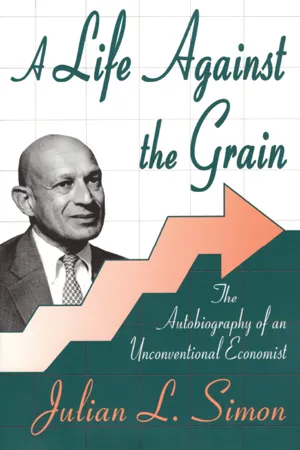
In his long and distinguished career as a writer and scholar Julian Simon came to be known as one of the leading--and most controversial--authorities on population economics. An immensely productive writer, his work is unified by a basic core belief: that human intellect and ingenuity are ever-renewable resources in the use and preservation of natural resources. Inevitably, Simon's position provoked the hostility of doctrinaire environmentalists, both in academia and in the movement at large. However, Simon's arguments were invariably built from facts and powerful evidence that stood him well in many high-profile public debates. The first part of Simon's autobiography takes the reader through his childhood, his years as a midshipman and then as an officer in the Navy, plus a stint in the Marines, and his experiences as a copywriter in an advertising firm. Simon's plan after receiving his Ph.D. from the University of Chicago was to be an entrepreneur, which would afford him enough money to care for his parents and allow him free time for writing fiction. He ran a small mail-order business for two years, during which time he wrote his first book, How to Start and Operate a Mailorder Business, which has since gone through seven editions. Deciding to seek a professional career, in 1963, he accepted a position at the University of Illinois. Although he spent thirty-five years of his life as a faculty member at three universities, his autobiography contains almost no discussion of departmental affairs or university politics, topics about which Simon had little or no interest. Rather, after the personal chronology and experiences, the book includes substantive chapters on research methods, population economics, and immigration. It also explains how Julian Simon became the economist he was. He analyzes crucial periods in his life when he developed his ideas on fundamental issues. Written in an engaging and amusing manner, Julian Simon's autobiography is a combination of personal memoir and professional contribution to important ideas in economics, research methods, and demography. His observations and personal reflections will interest the general reader on a humanitarian level as well as environmentalists, sociologists, and economists on a professional level.
eBook - ePub
A Life against the Grain
The Autobiography of an Unconventional Economist
- 360 pages
- English
- ePUB (mobile friendly)
- Available on iOS & Android
eBook - ePub
A Life against the Grain
The Autobiography of an Unconventional Economist
About this book
Information
Table of contents
- Cover
- Half Title
- Title Page
- Copyright Page
- Table of Contents
- Comment
- Preface
- 1. Newark, New Jersey: 1932-1937
- 2. Newark, 1937-1941: Old Enough for School
- 3. The Family I Come From
- 4. Millburn I: Until High School, 1941-1945
- 5. Millburn II: Until High School, 1941-1945
- 6. High School Years in Millburn
- 7. My Mind as a Young Person
- 8. On the Job as a Kid
- 9. College
- 10. College Summers and Midshipman Cruises
- 11. In the Fleet
- 12. Troopin’and Stompin’with the Girenes
- 13. Working in the Advertising Business
- 14. Chicago and the University of Chicago: I
- 15. The University of Chicago: II
- 16. In and Out of the Mail-Order Business
- 17. Urbana and the University of Illinois I: Starting 1963
- 18. Teaching at the University
- 19. Research 1963-1967: Advertising Economics, Research Methods, and Other Topics
- 20. Research on Population Economics
- 21. Reaching the Public with Facts about Population and Resources
- 22. Philosophical Analyses of Basic Conceptual Issues: Causality
- 23. The Joy of Studying Immigration
- 24. The Airline Oversales Auction System
- 25. My Depression and the Theory of Negative Self-Comparisons: The Story
- 26. Why do so Few Nonreligious (and Religious) People Enjoy a Sabbath?
- 27. How did My Economics Get to be What It Is?
- 28. This I Believe: Values and Attitudes
- Index
Trusted by 375,005 students
Access to over 1.5 million titles for a fair monthly price.
Study more efficiently using our study tools.
Frequently asked questions
Yes, you can cancel anytime from the Subscription tab in your account settings on the Perlego website. Your subscription will stay active until the end of your current billing period. Learn how to cancel your subscription
No, books cannot be downloaded as external files, such as PDFs, for use outside of Perlego. However, you can download books within the Perlego app for offline reading on mobile or tablet. Learn how to download books offline
Perlego offers two plans: Essential and Complete
- Essential is ideal for learners and professionals who enjoy exploring a wide range of subjects. Access the Essential Library with 800,000+ trusted titles and best-sellers across business, personal growth, and the humanities. Includes unlimited reading time and Standard Read Aloud voice.
- Complete: Perfect for advanced learners and researchers needing full, unrestricted access. Unlock 1.5M+ books across hundreds of subjects, including academic and specialized titles. The Complete Plan also includes advanced features like Premium Read Aloud and Research Assistant.
We are an online textbook subscription service, where you can get access to an entire online library for less than the price of a single book per month. With over 1.5 million books across 990+ topics, we’ve got you covered! Learn about our mission
Look out for the read-aloud symbol on your next book to see if you can listen to it. The read-aloud tool reads text aloud for you, highlighting the text as it is being read. You can pause it, speed it up and slow it down. Learn more about Read Aloud
Yes! You can use the Perlego app on both iOS and Android devices to read anytime, anywhere — even offline. Perfect for commutes or when you’re on the go.
Please note we cannot support devices running on iOS 13 and Android 7 or earlier. Learn more about using the app
Please note we cannot support devices running on iOS 13 and Android 7 or earlier. Learn more about using the app
Yes, you can access A Life against the Grain by Julian L. Simon,Julian Simon in PDF and/or ePUB format, as well as other popular books in Social Sciences & Social Science Biographies. We have over 1.5 million books available in our catalogue for you to explore.