- 244 pages
- English
- ePUB (mobile friendly)
- Available on iOS & Android
eBook - ePub
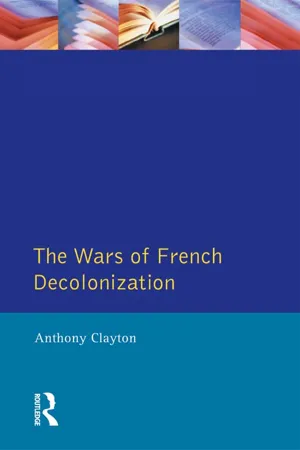
The Wars of French Decolonization
About this book
This ambitious survey draws together the two major wars of decolonization fought by France in Indochina and Algeria (as well as the lesser but far from insignificant military operations in Madagascar, Tunisia and Morocco) into a single integrated account. It examines traditional French attitudes to empire, and how these changed under the pressure of events; the military operations themselves; the collapse of the Fourth Republic and the return of de Gaulle; and the final drama of French withdrawal from Algeria and the 'ethnic cleansing' of its European settler population.
1 INTRODUCTION: THE HISTORICAL PERSPECTIVE
Nothing in her history, recent experience, institutions or politics prepared France for any voluntary withdrawal from empire after the end of the Second World War. A study in perspective of France’s wars of decolonization must, therefore, briefly return to the roots of the history of France herself, as deep in these roots lay major causes of the refusal of the general public and political figures alike, for so long, to acknowledge the anti-colonialism of the post-1945 world. This refusal led to large-scale and bloody conflict, far more costly in men and money than any decolonization campaign waged by Britain.
A brief comparison is useful. The British national tradition, as it evolved from the post-Roman Empire Anglo-Saxon era, had developed a loose, at times collegiate and generally anti-centralist style with as its main features Common Law, in which law grows out of custom, the break with Rome, the progressive erosion of royal central power – and a volunteer Army. In imperial affairs this style began to be reflected in the 1839 Durham Report envisaging self-governing Dominions with their own legislatures, and the 1931 Statute of Westminster confirming their full independence. The path for nationalist leaders in India and the larger colonies was, therefore, clearly marked out.1 If they could convince Britain at some London conference of their responsibility, they too could claim dominion status through their developing legislatures. British political leaders, particularly in the Labour Party which was returned to power in 1945, knew Indian nationalist leaders personally and were prepared to trust, and be trusted by, them. There were also lobbies openly critical of empire, and a much wider proportion of the population who could see no further useful purpose in bearing its burdens. Political leaders, too, were very much aware of wider international criticism from the two superpowers, the Soviet Union and the United States, both anti-colonial though for different reasons, and also at the newly formed United Nations. Even if the end of the process, still less its gathering speed, was not foreseen in 1945, there was a general willingness to talk to nationalist leaders, whose co-operation was also seen as essential for economic development. Major military campaigns, for example to maintain a sovereignty over India, were not considered seriously. In any case the military force was not available; it was hoped to end wartime conscription quickly. The campaigns that were fought, Palestine, Malaya, Kenya, Cyprus, Borneo and Aden, were or became attempts to ensure that the independent successor regimes were acceptable to British political and commercial interests, generally successfully so in all except the first and last cases. Further, although regional strategic considerations played some part in policies towards particular colonies, the move towards and grant of independence to any imperial possession was never seen to present any direct strategic military threat to the metropole itself. Empire was far off and the worst possible damage to the metropole would be indirect and economic. Finally, for the imperial-minded sections of the populace, the rhetoric of ‘Empire to Commonwealth’ served in the 1940s and early 1950s to assuage pique and resentment over loss of prestige and formal flag sovereignty. Only the 1956 Suez crisis was to reveal the Emperor stripped of his clothing, a severe shock for many, and the first real intrusion of the consequences of imperial withdrawal into domestic politics. But by then decolonization was irreversible and consensus for it was not impaired.
The French national tradition and perceptions were very different. France’s approach to constitution-making and law was that of the Roman Empire, jus gentium, the law for all peoples, based on a set of principles given out from the hub of the empire and applicable to all within it. This unitary concept of authority was complemented by Roman Catholicism which inherited from the Roman Empire the philosophy of doctrine prescribed by a superior authority, also for all to follow. The French Revolution changed particulars but not the general centralist approach. Jacobins and Bonapartists alike saw the French nation as one endowed with particular truths and wisdom, and also one entrusted with a mission to pass on these truths and wisdom to others, even if necessary by force. Behind all the differing policies pursued by France in different parts of her Empire lay, firmly rooted, this common mentality; France and French possessions must form an indivisible whole, and related to this, thinking on problems in absolute, rather than compromise, terms. Secession to the French mind was not an emancipation, it was a heresy.
French perceptions of the nation’s history served to reinforce this attitude. Resentment over the loss of French Canada and French India in the eighteenth century set off a paranoiac attitude towards Britain, and later also the United States. It became the more important to acquire, and make French, areas of Africa and Asia. This perception was reinforced by the disaster of 1870; colonies were now held to be sources of military manpower as well as sources of international prestige and economic strength (the latter a mistaken view). Although the Revolution profoundly divided the nation, the need for empire and belief in a French mission civilisatrice spanned the divide. The French saw no paradox, apart from the question of the role of missionaries, in the working together of Republican and radical colonial soldiers and administrators alongside those of more conservative and Catholic, even royalist, views.
The legacy of the Second World War served only to strengthen these national perceptions. The bitterness of 1940 led, predictably, to a post-war wish to put the clock back to the pre-1939 era, and a belief in respect of empire that victor nations had every right to retain them. In 1940–42 the Vichy regime had drawn acceptance and a measure of legitimacy from the on-going French military and imperial control of West, and above all, North Africa, and both then and later French recovery was launched from the Empire.2 The provisional government for the liberation had been formed in Algiers. Maghreb and colonial troops had formed the core of French military renaissance in large numbers, to be noted later. The French public went on to draw the comforting but false conclusion that this liberation was proof of their territories’ loyalty to France. A weighty new factor to emerge was French fear of the Anglo-American partnership. It was argued that if France was to remain a world power she had to retain the Empire in order to resist subordination to les anglo-saxons, whatever the rest of the world might think. This view was for long held by the political Right and, in the early post-war months, on the political Left where Communists supported initial post-war French imperial re-assertion. Such sentiments were fuelled by deep suspicion over American political activity in North Africa encouraging nationalists, and paranoia over the British presence in Syria and Lebanon.
These views were, of course, also ones that found generous support in the Army, whose structure needs explanation. France’s organization of her imperial forces reflected the integrative nature of the French Empire just as Britain’s organization reflected the devolved. The end of the British-officered Indian Army with its own general staff, Staff College, and career structure might bring the British Army nostalgia over the loss of agreeable postings (for officers but not for soldiers), and the loss of a number of battalions, but it brought no crisis of identity or confidence. The French case was, again, very different.
The French Army, although one institution, fell into three main components. The metropolitan Army was composed of conscripts whose service liability was limited to the homeland, and after 1945 Germany, unless they agreed to serve elsewhere. The Armée d’Afrique existed to garrison French North Africa and provide strategic reserves, some stationed in France, for the defence of the metropole. Its regiments were a mix, some like the Zouaves and Chasseurs d’Afrique largely white, some, notably the Spahis and Tirailleurs, indigenous with large French cadres, together with the Foreign Legion (Légion Etrangère). In addition there were the Troupes de Marine, from 1900 to 1958 styled La Coloniale, who existed to garrison colonies other than North Africa. Some of its regiments were white, others were indigenous, notably the Tirailleurs Sénégalais, despite the name recruited in all of French Sub-Saharan Africa. The Armée d’Afrique and Coloniale could be used anywhere. The officers of both were also often closely associated with colonial administration. The cadres, officers and NCOs of the Armée d’Afrique were metropolitan personnel, spending tours, sometimes whole careers, in North Africa while those of Coloniale served their entire careers in colonial soldiering.
Algerian Tirailleurs first figured in Europe in the 1870 campaign. A progressive ‘drug effect’ upon the French Army then followed, enhanced by the generally excellent combat performance of the Armée d’Afrique and Coloniale units. In the First World War 172,000 Algerians, of whom 158,000 were in combat units, served in the French Army, together with 54,000 Moroccans, 37,000 Tunisians, 160,000 Black Africans and 45,000 Malgaches. Most served in France, though many of the Black Africans were in second-line units.
The inter-war years saw massive use of Maghreb troops for imperial purposes and policing; the Algerian Tirailleurs became the work-horse of the Empire. In the 1930s’ metropolitan birth-rate trough, numbers of Maghreb units were used for garrisoning France. Overall, prior to the 1939 mobilization 38.6 per cent of serving French Army infantry were Maghreb; of these Algeria provided 28 per cent. Twelve Armée d’Afrique divisions and eight Coloniale divisions participated in the May–June 1940 campaign; in these formations taken overall, a large majority of the soldiers were indigenous. The collapse of France heightened the drug addiction for Gaullists and Vichy alike. The 100,000-strong metropolitan army permitted by the Germans was totally unreal, but the North African Armée d’Afrique carefully tended by Generals Weygand and Juin was substantial. It was to form the bulk of the French Army’s contributions to the Tunisian and Italian campaigns and provide the best of the formations of General de Lattre de Tassigny’s 1st French Army that fought on the eastern flank of the Allied armies in the North-west Europe campaign.
Coloniale too found itself well placed at the end of the war. Coloniale officers were often more adventurous – and further removed from the decayed atmosphere of the metropole; the Communist spectre that appeared to haunt others in 1940 was less real to them. Almost all the first Gaullist units were Coloniale, from Equatorial Africa. At the end of the war 25 out of 100 serving (and politically acceptable) French generals were Coloniale, steeped in colonial ethos and tradition.3
In 1944–45 unit after unit of North or Black African troops crossed or recrossed France. Sometimes the movements had been especially arranged to impress the French populace that they were being liberated by themselves and not entirely by les anglo-saxons; sometimes also they were deliberately deployed in a role that British or US troops could not discharge, the curbing of left-wing insurrection. The pre-1939 years had also revealed the need to have troops of ‘obéissance totale’ – more certainly reliable than conscripts – for internal security.4 Paris in the 1930s was shielded by two of the best Coloniale infantry regiments (long-service white regulars) and the best Zouave (white Armée d’Afrique) regiment. Elsewhere other colonial units had served in this role – Tirailleurs Sénégalais, for example, intervening in a Marseille dock strike in 1939. Eight years later Sénégalais were again keeping order in Nice. And in September 1944 two regiments of horsed Spahis had been deployed in the Toulouse area to restore order in places where Communists and anarchists, many Spanish, had established ‘no-go’ areas and rule based on terror. Both for great power status and in emergency domestic order, then, an on-going supply of soldiers from the Empire seemed indispensable and any loss unthinkable.
For the Army itself, there was no breathing space for any proper post-war consolidation, despite the desperate need for one. The need was particularly noticeable in the absence of any thought-out internal security doctrine or training. The French pattern of thinking in absolutes led too easily to overreaction, in contrast to the wiser British minimum force approach. The Second World War had opened with the trauma of defeat and division. One consequence of the defeat, to be played out again in the 1950s, was de Gaulle’s belief that defence of national honour could in certain circumstances justify military disobedience to lawful constitutional commands, an extension of the beliefs – and practices – of generals serving in Africa from the 1890s onwards who frequently ignored or disobeyed instructions from Paris. The later renaissance had involved a welding together of de Gaulle’s Free Frenchmen, the Vichy Armée d’Afrique that had joined the Allies in November 1942, and the French Forces of the Interior Resistance Groups inspanned into the Army in the winter of 1944–45. This difficult process was far from complete when the Indochina war began.5 In addition there were acute shortages of money and equipment.
The immediate post-war months in France were ones of austerity even more depressing than that in Britain. The traditional pull factors of colonial soldiering made a renewed appeal – better pay, promotion and medals, an agreeable life style, particularly attractive after the 1947 pay reduction, and the lure of the frontiers of Empire and of the exotic; the French Army had long possessed a colonial, largely Maghreb institutional sub-culture of words, attitudes and concepts such as baraka, or personal luck. To these were added two new pull-factors, an escape into the purity of the bled for those who came to fear the incoming metropolitan consumer society, and lastly an escape to simple old-fashioned soldiering, for those who did not enjoy or could not master new technology. These attitudes were personified by Alphonse Juin, the outstanding French Commander in the 1944 Italian campaign, a soldier born and brought up in Algeria and with long North African service from 1910 onwards. Juin was Chief of the Defence Staff from 1945 to 1947, Resident-General in Morocco from 1947 to 1951 and Inspector-General of French forces from 1951. From 1952 onwards he enjoyed a unique status as France’s only living Marshal, giving him considerable influence in political conditions already unstable.6
Finally in respect of the French Army, many, notably Juin, held the view that nationalism in North Africa would and did equate with Soviet Communism, posing a direct strategic threat to France herself.7 Some were to go further and argue that if Indochina fell, then in turn would follow Asia, the Middle East and North Africa, with finally a challenge to southern Europe. This pattern of thinking obscured the reality; France’s metropolitan defence burden was increasingly shouldered by America, Britain and later West Germany under Western European Union and North Atlantic Treaty Organization arrangements. If France had had a potential enemy on her northern frontier in the years 1947 to 1962, she could never have spared the soldiers or resources for the imperial periphery.
These great-power status and military linkages with empire were more significant than economic resources. France enjoyed a well-balanced economy, whose basic strength was to be proved by a remarkable post-war recovery despite severe war damage, political mismanagement and two vastly expensive military campaigns. In commercial terms, certain French companies prospered from manufacturing for or trading with overseas possessions, but the national economy was in no way dependent on them, and their lobby power, while vocal, was not decisive. The French commercial companies in Indochina had begun to prepare for change from the 1930s onwards, but those in Algeria, the other possession of substantial commercial profit, saw no such need.8 Only in the late 1950s did a factor of national resource importance to metropolitan France appear, oil in Saharan Algeria. Preservation of French interests in this was to prove very significant in the ending of the Algerian war.
Of much greater street-level political significance were the human economic links, French residents in the overseas territories. The colon population in Algeria was approximately 975,000, in Tunisia 150,000 (mostly Italian in origin) and in Morocco 300,000. The vast majorit...
Table of contents
- Cover
- Half Title
- Title Page
- Copyright Page
- Table of Contents
- List of maps
- Acknowledgements
- 1 Introduction: the historical perspective
- 2 The French Union and emerging nationalism
- 3 Indochina, 1945–50
- 4 Indochina, 1951–55
- 5 Madagascar, 1947–49
- 6 North Africa, 1945–56
- 7 Algeria, 1957
- 8 Algeria, 1958
- 9 Algeria, 1959–62
- 10 Conclusion
- Chronology
- Abbreviations
- Biographical notes
- Notes on further reading
- Maps
- Index
Trusted by 375,005 students
Access to over 1.5 million titles for a fair monthly price.
Study more efficiently using our study tools.
Frequently asked questions
Yes, you can cancel anytime from the Subscription tab in your account settings on the Perlego website. Your subscription will stay active until the end of your current billing period. Learn how to cancel your subscription
No, books cannot be downloaded as external files, such as PDFs, for use outside of Perlego. However, you can download books within the Perlego app for offline reading on mobile or tablet. Learn how to download books offline
Perlego offers two plans: Essential and Complete
- Essential is ideal for learners and professionals who enjoy exploring a wide range of subjects. Access the Essential Library with 800,000+ trusted titles and best-sellers across business, personal growth, and the humanities. Includes unlimited reading time and Standard Read Aloud voice.
- Complete: Perfect for advanced learners and researchers needing full, unrestricted access. Unlock 1.5M+ books across hundreds of subjects, including academic and specialized titles. The Complete Plan also includes advanced features like Premium Read Aloud and Research Assistant.
We are an online textbook subscription service, where you can get access to an entire online library for less than the price of a single book per month. With over 1.5 million books across 990+ topics, we’ve got you covered! Learn about our mission
Look out for the read-aloud symbol on your next book to see if you can listen to it. The read-aloud tool reads text aloud for you, highlighting the text as it is being read. You can pause it, speed it up and slow it down. Learn more about Read Aloud
Yes! You can use the Perlego app on both iOS and Android devices to read anytime, anywhere — even offline. Perfect for commutes or when you’re on the go.
Please note we cannot support devices running on iOS 13 and Android 7 or earlier. Learn more about using the app
Please note we cannot support devices running on iOS 13 and Android 7 or earlier. Learn more about using the app
Yes, you can access The Wars of French Decolonization by Anthony Clayton in PDF and/or ePUB format, as well as other popular books in History & European History. We have over 1.5 million books available in our catalogue for you to explore.