This fascinating work is the first overview of its subject to be published in over half a century. The issues it deals with are key to early modern political, religious and cultural history.
The seventeenth century is traditionally regarded as a period of expanding and extended liberalism, when superstition and received truth were overthrown. The book questions how far England moved towards becoming a liberal society at that time and whether or not the end of the century crowned a period of progress, or if one set of intolerant orthodoxies had simply been replaced by another.
The book examines what toleration means now and meant then, explaining why some early modern thinkers supported persecution and how a growing number came to advocate toleration. Introduced with a survey of concepts and theory, the book then studies the practice of toleration at the time of Elizabeth I and the Stuarts, the Puritan Revolution and the Restoration. The seventeenth century emerges as a turning point after which, for the first time, a good Christian society also had to be a tolerant one.
Persecution and Toleration is a critical addition to the study of early modern Britain and to religious and political history.
- 256 pages
- English
- ePUB (mobile friendly)
- Available on iOS & Android
eBook - ePub
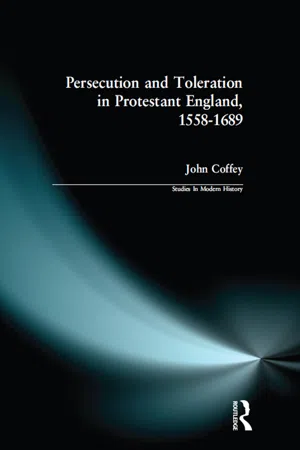
Persecution and Toleration in Protestant England 1558-1689
About this book
CHAPTER 1
Introduction
The Whig history of toleration
Historians of Stuart England have often been impressed by its modernity. Although their emphases differ, Whigs, Marxists, and Weberians alike have maintained that the modern world was forged in the furnace of seventeenth-century England. It was here, argued Marxist and Weberian writers, that one must look for the rise of the bourgeois mentality, the first of the great modern revolutions, the birth of modern science and modern capitalism.1 Here too, suggested Whig historians, was the seedbed of modern political liberalism, with its twin ideals of popular sovereignty and religious toleration.2
For nineteenth-century Whigs, the Act of Toleration in 1689 was a liberal landmark. In the words of Lord Macaulay, the Act
put an end, at once and for ever … to a persecution which had raged during four generations, which had broken innumerable hearts, which had made innumerable firesides desolate, which had filled the prisons with men of whom the world was not worthy, which had driven thousands of those honest, diligent, godfearing yeomen and artisans, who are the true strength of a nation, to seek a refuge beyond the ocean among the wigwams of red Indians and the lairs of panthers.
Yet Whig historians were by no means as naive in their celebration of the Toleration Act as is often supposed. Macaulay freely confessed that its provisions were ‘cumbrous, puerile, inconsistent with each other, inconsistent with the true theory of religious liberty’. But its genius lay in the fact that it ‘removed a vast mass of evil without shocking a vast mass of prejudice’.3
As well as emphasising the achievement of 1689, Whig historians of freedom also accorded an important role to the ‘Puritan Revolution’. The great Victorian scholar S. R. Gardiner argued that ‘the idea [of toleration] had been laid before the world’ during the 1640s and 1650s, and ‘could not be buried out of sight’. Oliver Cromwell and John Milton had prepared the ground for the Act of Toleration.4 The American historian William Haller began his study of the period in order to contextualise Milton’s famous defence of the liberty of the press, Areopagitica (1644). Haller hailed Milton as an ‘apostle of freedom’,5 and agreed with Gardiner that the 1640s were of ‘the greatest significance’. ‘Here, in a word’, he wrote, ‘are revealed the beginnings of democracy, of economic individualism, and of modern English prose’.6 A. S. P. Woodhouse took the same view in the introduction to his collection of texts, Puritanism and Liberty. ‘Puritans of the Left’, he suggested, had laid down the key principles of modern liberal democracy, including individualism, egalitarianism, and the separation of church and state.7
But the most ambitious attempt to chronicle the rise of religious toleration in the seventeenth century was W. K. Jordan’s monumental work The Development of Religious Toleration in England, 1558–1660, 4 vols (London, 1932–40). Like Haller and Woodhouse, Jordan wrote as the shadow of fascism fell across Europe, and his magnum opus was an apologia for the fragile values of humanity and tolerance. In over 2000 pages of text, he described the rise of toleration in England and lovingly catalogued the opinions of hundreds of writers. Fifty years on, his books remain essential reading for anyone working on the subject of toleration in early modern England.
Yet despite its admirable qualities, Jordan’s work is more problematic than that of Haller and Woodhouse. The sheer scale of his four volumes makes it exceedingly difficult to see the wood from the trees. Rather than synthesising his reading in a digestible form, Jordan compiled an exhaustive list of everyone who had anything to say about toleration, and his lengthy descriptions of their pamphlets are often tediously repetitive. More seriously, Jordan illustrates the cardinal failings of Whig historiography. His is a strongly teleological narrative, one which seems to progress inexorably (though rather laboriously) towards a predetermined end, the triumph of the ideal of toleration in England by 1660.8
The dangers of this kind of historical writing are well known. The contingency of historical developments is forgotten and the story takes on a certain inevitability; ‘reactionary’ aspects of the past are overlooked as the historian focuses on the winners, those who had ‘history on their side’ and successfully ‘anticipated’ modern ideals; anachronism strikes with a vengeance. In his desire to discover and celebrate tolerationist heroes, for example, Jordan tends to turn his subjects into modern, secular liberals. Whereas Haller and Woodhouse had edited valuable collections of primary texts and shown real sensitivity to the theological context of seventeenth-century tolerationism, Jordan persistently secularises his subjects. Milton is pigeonholed with the ‘rationalists and sceptics’, and described as ‘only vaguely religious’,9 something that will come as a surprise to most readers of his poetry and prose. We are told that Sir William Cecil was a man who ‘discounted the importance of religion in public affairs’,10 though a recent historian informs us of Cecil’s firm belief that the Pope was the Antichrist.11 The same tendency to paint things in modern colours can be detected in Jordan’s broader conclusions. He claims, for instance, that the Elizabethan settlement ‘was a long step towards toleration’,12 even though the Act of Uniformity made it possible to prosecute individuals for failing to attend church. When he suggests that by 1660 ‘responsible opinion in England was …persuaded of the necessity, if not of the positive virtue, of religious freedom’,13 he ignores the mass of evidence which suggests that much ‘responsible opinion’ in Restoration England was far from convinced of the need for toleration.
The revisionist reaction
The strongly teleological and anachronistic tendencies of Whig historians like Jordan have provoked a revisionist reaction. Instead of modernising the past, recent historians have been intent on recapturing its strangeness, and understanding mentalities radically different to our own. Political historians have been stressing the centrality of religious intolerance to the history of early modern England. In particular, they have identified anti-popery as perhaps the most powerful and visceral force in English politics, one which helped to topple Charles I and his son James II. The most famous events of this period – the Spanish Armada, the Gunpowder Plot, the English Civil War, the Popish Plot, the Glorious Revolution – were events driven along by religious intolerance. Indeed, it is tempting to say that the fear of popery was almost the ground bass in the nation’s political life between the Act of Uniformity in 1559 and the Act of Toleration in 1689.14
Besides emphasising the power of anti-Catholicism, historians have highlighted the mutual hostility between different sorts of Protestants. According to John Morrill and Conrad Russell, religion was the crucial polarising factor in the months leading up to the English Civil War, a conflict which Morrill has described as the last of the European wars of religion.15 For most of the seventeenth century the prospects for toleration looked bleak, not least after 1660, and historians of the Restoration period have argued that the bitter rift between church and Dissent was at the heart of political conflict in the period.16 Moreover, when legal toleration was finally achieved, it fell far short of religious equality, and was the result of fortuitous circumstance rather than the triumph of an ideal in the minds of the English. Even after 1689, strident voices deplored the concessions made to Dissenters and the Act of Toleration seemed vulnerable. According to Jonathan Clark, England remained a confessional state whose Protestant Dissenters were second-class citizens.17 The triumph of tolerance was neither assured nor complete.
In this new revisionist paradigm, historians have also emphasised the limits of seventeenth-century tolerationism. Blair Worden, for example, has highlighted the limits of Cromwellian toleration, and argued that when Puritans like Cromwell and John Owen talked about ‘liberty of conscience’ they meant liberty for conscientious Protestants, not licence for ungodly and false religions.18 William Lamont has suggested that Puritans like Roger Williams and John Milton were ‘not interested in wishy-washy nineteenth-century concerns such as personal freedoms and equality’, and J. C. Davis has examined the conception of freedom held in the 1640s, and concluded that Puritans longed for a godly rather than a liberal society, and sought not the freedom of the sinner, but the freedom of Almighty God.19 Others have pointed out that England’s most famous tolerationist, John Locke, explicitly excluded Roman Catholics and atheists from toleration, and have compared him unfavourably to more radical figures like the Huguenot Pierre Bayle. More importantly, historians have demonstrated the relative isolation of seventeenth-century tolerationists, and the continuing vitality of theories of persecution.20 Richard Ashcraft emphasises that even the Latitudinarians, the ‘liberal’ Anglicans of their day, usually opposed toleration for groups outside the established church.21 In place of Jordan’s vision of a nation bustling with earnest progressives, we have a picture of a land still dominated by traditional defenders of religious uniformity.
Historians of European religion have also questioned the simplicity of the traditional Whig narrative. In Toleration and the Reformation, the Jesuit scholar Joseph Lecler destroyed any idea of a simple dichotomy between a tolerant Protestantism and an intolerant Catholicism. By 1600, Lecler pointed out, the Catholic lands of Poland and France had established toleration, whilst most Protestant countries still enforced uniformity.22 Despite its rather Whiggish title, Henry Kamen’s The Rise of Toleration also offered a more complex picture of Catholic attitudes and argued that ‘toleration has pursued not a linear but a cyclic development; it has not evolved progressively but has suffered periodic and prolonged reverses’.23 A recent collection of essays on Tolerance and Intolerance in the European Reformation casts further doubt on the Whig identification of Protestantism and liberty, and on the traditional opposition between a persecutory medieval period and an increasingly tolerant early modern era. Several contributors argue that early modern tolerationists were interested in Christian concord rather than in modern religious liberty, and they replace grand narratives centred on rising tolerationist conviction with detailed case studies of particular cities and territories.24
But the most iconoclastic assault on the traditional Whig story has been mounted by John Laursen and Cary Nederman. They criticise the grand narrative ‘describing a unilinear progression from darkness to light, from persecution to toleration, from all that was old and backward to all that is new and modern’. They set out to debunk liberal myths: ‘the Inquisition cliché’, which portrays medieval Europe as a benighted, persecuting society; the ‘Enlightenment stereotype’ of a benevolent modernity; and ‘the Locke obsession’, which attributes the rise of toleration to the intellectual achievements of a great and lonely thinker. By contrast, they argue that toleration was practised and theorised in medieval and early modern Europe on a scale few have realised. The history of toleration, it is implied, should focus on continuities rather than on a dramatic break with the past in the late seventeenth and eighteenth centuries.25
A post-revisionist approach
Thus the revisionist scholarship of the past generation has created a far richer and more complex picture of the history of persecution and toleration. Yet despite the provocative presence of Jordan’s massive work, there has been no revisionist survey of persecution and toleration in Tudor and Stuart England. My goal, therefore, is to close that gap by providing a synthesis of some of the most significant historical research undertaken on the topic since the 1930s. Obviously, this book cannot hope to rival Jordan in terms of comprehensiveness; as Blair Worden once remarked, ‘any subsequent account can be no more than a footnote’.26 But this footnote should prove more accessible than Jordan’s tomes, and it will temper his Whiggish optimism with a dose of revisionist realism. This book has more to say about persecution than about toleration, and it emphasises the power of religious intolerance in early modern England. However, it also reasserts the unfashionably Whiggish claim that seventeenth-century England did indeed witness a dramatic movement from persecution to toleration and from religious uniformity to pluralism.
This claim is still widely accepted by scholars who do not specialise in the period. In his book Liberalism, for instance, the political theorist John Gray argues that the liberal tradition was born in seventeenth-century England, in the debates of the English Civil War, the work of Locke, and the period of Whig ascendancy following the Glorious Revolution.27 Historians of the period, however, are more reticent about making broad claims for the significance of their subject, and many have spent their careers fleeing from the exaggerated modernisation narratives of earlier Whig and Marxist writers. Yet in reacting against Whiggish ex...
Table of contents
- Cover
- Half Title
- Title Page
- Copyright Page
- Dedication
- Table of Contents
- List of tables
- Preface
- 1. Introduction
- 2. The Protestant Theory of Persecution
- 3. The Protestant Theory of Toleration
- 4. Elizabeth I and Protestant Uniformity, 1558–1603
- 5. The Early Stuarts, 1603–40
- 6. The Puritan Revolution, 1640–60
- 7. The Restoration, 1660–88
- 8. 1689 and the Rise of Toleration
- Glossary
- Select Bibliography
- Index
Trusted by 375,005 students
Access to over 1.5 million titles for a fair monthly price.
Study more efficiently using our study tools.
Frequently asked questions
Yes, you can cancel anytime from the Subscription tab in your account settings on the Perlego website. Your subscription will stay active until the end of your current billing period. Learn how to cancel your subscription
No, books cannot be downloaded as external files, such as PDFs, for use outside of Perlego. However, you can download books within the Perlego app for offline reading on mobile or tablet. Learn how to download books offline
Perlego offers two plans: Essential and Complete
- Essential is ideal for learners and professionals who enjoy exploring a wide range of subjects. Access the Essential Library with 800,000+ trusted titles and best-sellers across business, personal growth, and the humanities. Includes unlimited reading time and Standard Read Aloud voice.
- Complete: Perfect for advanced learners and researchers needing full, unrestricted access. Unlock 1.5M+ books across hundreds of subjects, including academic and specialized titles. The Complete Plan also includes advanced features like Premium Read Aloud and Research Assistant.
We are an online textbook subscription service, where you can get access to an entire online library for less than the price of a single book per month. With over 1.5 million books across 990+ topics, we’ve got you covered! Learn about our mission
Look out for the read-aloud symbol on your next book to see if you can listen to it. The read-aloud tool reads text aloud for you, highlighting the text as it is being read. You can pause it, speed it up and slow it down. Learn more about Read Aloud
Yes! You can use the Perlego app on both iOS and Android devices to read anytime, anywhere — even offline. Perfect for commutes or when you’re on the go.
Please note we cannot support devices running on iOS 13 and Android 7 or earlier. Learn more about using the app
Please note we cannot support devices running on iOS 13 and Android 7 or earlier. Learn more about using the app
Yes, you can access Persecution and Toleration in Protestant England 1558-1689 by John Coffey in PDF and/or ePUB format, as well as other popular books in History & British History. We have over 1.5 million books available in our catalogue for you to explore.