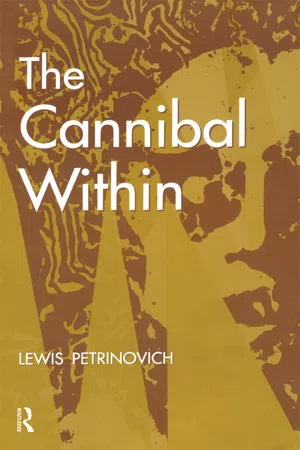
The Cannibal Within offers an evolutionary account of the propensity of human beings, in extreme circumstances to eat other human beings, despite the strong Western taboo against such practices. What sets this volume apart from the large body of literature on cannibalism, both popular and anthropological, is the underlying premise: cannibalism as an alternative to starvation is tacitly condoned by the same biological morality that would condemn cannibalism of other sorts in non-threatening situations. Deep as the taboos may be, the survival instinct runs even deeper.
The title of the book reflects the author's belief that cannibalism is not a pathology that erupts in psychotic individuals, but is a universal adaptive strategy that is evolutionarily sound. The cannibal is within all of us, and cannibals are within all cultures, should the circumstances demand cannibalism's appearance and usage. Petrinovich's work is rich in historical detail, and rises to a level of theoretical sophistication in addressing a subject too often dealt with in sensationalist terms.
The major instances in which survival cannibalism has occurred convinced the author that there is a consistent pattern and a uniform regularity of order in which different kinds of individuals are consumed. In considering who eats whom, when, and under what circumstances, this regularity appears, and it is consistent with what would be expected on the basis of evolutionary or Darwinian theory. In short, he concludes that starvation cannibalism is not a manifestation of the chaotic, psychotic behavior of individuals who are driven to madness, but reveals underlying characteristics of evolved human beings.
- 232 pages
- English
- ePUB (mobile friendly)
- Available on iOS & Android
eBook - ePub
The Cannibal within
About this book
Information
1
Introduction to People Eating
Cannibalism is one of the primordial mores. It dates from the earliest existence of man on earth. It may reasonably be believed to be a custom which all people have practiced.
—Sumner (1940)
STORY OF THE FRANCIS MARY
In 1826, the timber ship Francis Mary, with 21 people aboard, crashed en route to Liverpool. As survivors died they were eaten, and some of the living were killed and eaten. This is one of several cases of survival cannibalism to be discussed; it is a real and common phenomenon, rather than a myth as some have claimed. Survival cannibalism is a fact of human nature, and I open this chapter with this case to introduce the essence of cannibalistic events.
The tribulations of the Francis Mary began when a severe gale stove in the stem of the ship on February 5, and the crew was able to save only a little bread and cheese (Simpson, 1984). Although the captains of two vessels spoke with the crew of the derelict shortly after the disaster, they offered no assistance because of severe adverse weather conditions. At that time the rule of the sea was that no ship had a legal obligation to aid other vessels in distress. This seemingly heartless behavior was reasonable because rescue activities could jeopardize the safety of the rescuers, and might even leave the rescue ship shorthanded should any disaster occur while part of the crew was taking the victims off—not too far fetched given that commercial sailing vessels of that time carried crews of minimal size to reduce costs. Also, if a number of survivors were rescued, the limited supplies of food and water might not be sufficient to support the increased number of people, particularly if unforeseen delays were encountered. Another tradition of the sea was that if members of the crew were cast adrift in a lifeboat they had no obligation to obey officers; authority was determined only by the personal qualities of the captain (Simpson, 1984).
For the survivors of the Francis Mary, both provisions and water were nearly depleted by February 6. On February 12, a crewman died, followed 10 days later by another. By the time the second sailor died the 18 people still alive had not eaten for 10 days, and had only a biscuit and a half during each of the 6 days before that (Leslie, 1988). The second sailor to die was quartered, hung up for food, cut in slices, and dried. The meat was divided among the survivors, and one survivor described it as a “sweet morsel.” The next day another person died and his liver and heart were eaten. In the next few days 7 more died, including the cook, leaving 11 still alive—9 men and both of the women who were on board.
The cook was accompanied by his betrothed, Ann Saunders, and Simpson (1984) wrote that as he was dying (she claimed he was already dead) she cut his throat and claimed prior property rights to his blood. Simpson (1984, p. 126) characterized her as “a particularly tough character” who assumed the duty of cutting up and cleaning the dead bodies thereafter.
Ann Saunders (1827) recounted a similar version in a narrative she published, only she gives her role a slightly better spin. She wrote that as hunger increased, “we eyed each other with mournful and melancholy looks.” She acknowledged she did “plead her claim to the greater portion of his [the betrothed cook’s] precious blood,” but having been reduced to that horrid alternative by hunger and thirst, she did so to preserve her own life. She wrote (p. 101): “Oh, this was a bitter cup, indeed!,” and emphasized the importance of her strength of character, which enabled her to unite the group in prayer to prepare their precious souls for eternity. The six survivors rescued on March 7 included the captain, his wife (who had sustained herself on the brains of an apprentice for 2 days), and Ann Saunders.
The lieutenant of the British frigate who was sent to rescue them remarked: “You have yet, I perceive, fresh meat.” He was informed: “No, it is part of a man, one of our unfortunate crew.” The survivors claimed that all the dead had expired gradually and naturally, usually driven mad by drinking sea water, but it was suspected some may have been killed.
The story of the Francis Mary is typical of what is encountered in shipwreck disasters: In the beginning, attention is devoted to securing the vessel and available provisions and tending to the needs of the survivors. Supplies usually are rationed and order prevails until people begin dying from exposure, starvation, and dehydration. At first the dead are buried at sea, but soon their blood is drunk and they are eaten; if there are no dead available for consumption, killing begins. In most survival stories, the survivors attest to the natural death of all who were eaten. When someone is killed for the purpose of being eaten, the survivors almost always swear that a fair lottery was held. However, as we shall find, the loser is usually the obvious choice: a boy (apprentice seaman), a foreigner, or a slave, never an officer and seldom a cook. And who is going to represent the case of the eaten fairly; certainly not the diners. There may be many unreported cases in which cannibalism occurred, but the evidence was thrown overboard and the survivors denied all.
In almost none of the cases of seagoing cannibalism were any charges brought against anyone, and only in the case of the Mignonette (discussed fully in Chapter 3) were charges brought against officers for killing a young, dying seaman. These charges were brought only because the officers stated publicly that no lottery had been held. The authorities and general public usually accept the utilitarian argument that it was necessary for one (or a few) to die so that any (or more) could live. The survivors were often hailed as brave heroes who had suffered horribly and should be acclaimed, and they were usually provided with financial support. Such acclaim and support are particularly strong from other seamen.
As I searched the literature, I was struck by the widespread occurrence of cannibalism (the term I will use for all types of anthropophagy—the eating of humans by other humans) throughout prehistory and recorded human history, and became impressed by the wide range of circumstances under which it occurs. Rawson (1992) pointed out that cannibalism is often considered by many writers to be too horrible to mention (and others have described it as unthinkable). Yet there is an immense literature that not only mentions this “unthinkable” aspect of human nature, but dwells on it profusely. Cannibalism is not practiced only by maddened people at the edge of their wits because of starvation or severe mental derangement. As abhorrent as cannibalism seems to many, it is as ubiquitous as other “uncivilized” practices that have characterized human societies throughout their existence, such as torture, murder, incest, infanticide, and war. To a Darwinist, the suggestion that a behavior is universal sparks interest because it might signal unexplored aspects of an evolved human nature, and such universals could place limits on the conceptions of some anthropologists who stress cultural relativism (see Brown, 1991; Cook, 1999).
In this book I will discuss a number of cases of survival cannibalism that have been documented extensively. I sketched this one instance of seafaring cannibalism here to highlight some of the issues that will concern us throughout this book. I will challenge the view that cannibalism is rare; it is not in the realm of mythology and has occurred throughout human history. This discussion introduced the type of events that occurs in such instances; these events exhibit a regularity and patterning consistent with expectations based on evolutionary theory.
When sailing vessels provided the major mode of sea travel, before the development of radio communication, the survivors of a shipwreck often had to spend many days on disabled ships or in lifeboats with little in the way of food or water. On such occasions a decision often had to be made as to whether to throw some individuals overboard because there were inadequate provisions for all. When it was necessary to abandon the ship there often were not enough lifeboats to accommodate all of the crew and passengers. Lifeboats were therefore overloaded and often leaked due to poor construction, inadequate maintenance, or damage during launching. In many instances humans who died were eaten and their blood was drunk; in other instances the survivors killed and ate some of their fellows. These cases will be considered in detail in Chapter 3 because they provide historical instances similar to those involved in the lifeboat fantasy dilemmas we have used in empirical studies of moral intuitions—studies that will be discussed briefly below.
THE CANNIBAL AGENDA
Some have claimed there are almost no tidy historical accounts of people eating people, and there even are disagreements about the derivation of the term cannibal; some commentators question both the trustworthiness of accounts of various authorities and observers as well as their motivations in presenting the accounts as they do. There has been disagreement regarding how prevalent cannibalism has been throughout human existence, although there are many myths about its significance throughout recorded time, as well as a lively industry in fictional representations of cannibalism. Lestringant (1997), a French Professor of Renaissance Literature, surveyed the writings of European explorers, intellectuals, and missionaries in order to understand the mythic thinking contained in Western ideas regarding cannibalism. His survey, discussed in Chapter 9, begins with Christopher Columbus, discusses Montaigne’s famous essays (Book One published in 1580), and includes discussions of the fictional representations of Dickens, DeFoe, Melville, and Swift, among others. Cannibalism has been the focus of a wide range of writers, and the fascination with cannibalism has occasioned extensive discussions that are more open than many discussions regarding certain human sexual practices.
A few words are in order regarding the origin of the term cannibalism. Strictly speaking, we should use the more neutral, descriptive word anthropophagy, derived from a combination of the Greek words anthropos (man) and phagein (to eat), and broadly defined as the eating of human flesh by human beings. Lestringant (1997) noted that the noun cannibal derives from the Arawak caniba, which is universally accepted to be a corruption of cariba, meaning “bold,” the term the Caribbean Indians of the Lesser Antilles applied to themselves. When used by the neighboring, peace-loving Arawak, the term caniba carried the pejorative connotation of extreme ferocity and barbarity.
Lestringant (1997) credited Christopher Columbus with not only the discovery of America but also with the use of the term cannibal during his voyage of 1492. Columbus noted that his informants told him there were men with only one eye and others with dogs’ snouts who are men, and he promoted the use of the insulting name the victim Arawak tribes had bestowed on their cannibalistic neighbors. Natives of many tribes throughout the Americas were construed to be much “like starving wolves” who greedily drank the blood of their enemies. These views led to the demonization of the natives; they were characterized as lacking religion, laws, rulers, and private property and as violating the incest taboo. Lestringant (1997; pp. 28–29) noted that these views represented a shift “back towards savagery and away from the tranquillity of Paradise lost… fathers have been seen to eat their wives and children… with their ferocious appetites and unrestrained sexuality, [being] the precise opposite of Christian society, as conceived by the Renaissance.”
This characterization was used by the Spaniards to mount what they termed to be a just war against the Caribs, and, incidentally, to justify selling Carib prisoners as slaves. The cannibal label was applied to even the most peaceable Indian tribes to justify their enslavement (in the interest of financing expeditions in search of gold) and to permit the annihilation of such savages. The negative connotations of the term cannibal continue to the present time, and are used to express horror and indignation whenever acts of anthropophagy take place.
Although I will offer evolutionary interpretations throughout this book, I emphasize that it is not possible to make evolutionary predictions with great certainty regarding who eats whom, when, why, and in what order. There are too many unique exigencies and fortuitous circumstances involved in each particular case. What can be done is to construct an explanation that is consistent with the way evolutionary predispositions are known to affect better understood complex organic systems, and to ask whether the sequence of cannibalistic events can be fitted into the evolutionary mold without making too much of an adaptationist stretch.
In the section “Suspending Societal Norms” we have been successful in empirical attempts to understand moral intuitions—although we have shifted several of our emphases as data accumulated. Now, I have moved toward a more reasonable and parsimonious model than entertained originally. I will offer what I think is a defensible evolutionary interpretation of cannibalism, but I am certain it is wrong in some details. However, the episodes of survival cannibalism add another converging line of evidence regarding the role of evolved processes in the working of human nature. Concerning an ecological and evolutionary model to understand ritual cannibalism, I hope that far more competent and informed people than I will develop and elaborate it for the many cultures that exhibit such cannibalism.
Finally, I am reminded of one of my favorite quotations from Darwin (1871, p. 909): “False facts are highly injurious to the progress of science, for they often endure: but false views, if supported by some evidence, do little harm, for every one takes a salutary pleasure in proving their falseness; and when this is done one path towards error is closed and the road to truth is often at the same time opened.”
TYPES OF CANNIBALISM
Several types of cannibalism have been described in terms of their purpose (Salmon, 1995):
- to satisfy hunger, provide a supplement to the regular diet (gastronomic cannibalism), or to survive under conditions of extreme starvation (survival cannibalism);
- to cure or ward off disease (medicinal cannibalism);
- to maintain continuity with one’s dead relatives (mortuary cannibalism);
- to propitiate gods, enact revenge, or gain the strength of an enemy (sacrificial cannibalism); and
- to terrify one’s neighbors or enemies by ruthlessly and publicly consuming those you capture and kill (political cannibalism).
There is also a general classification used to refer to the relationship between eater and eaten: exocannibalism, when those eaten are outsiders, and endocannibalism, when they are members of the community.
Survival Cannibalism
Survival cannibalism tends to occur when conditions become such that the traditions, rules, and laws that regulate normal day-to-day existence are no longer effective. In these cases people are freed from constraints that have been instilled by the culture within which they have been nurtured, educated, and indoctrinated. Such conditions exist when severe and prolonged disasters drive them to the edge of starvation; then there is an almost universal tendency to engage in cannibalism. It is as though the outer coverings of society have been peeled away to reveal the basic core of human nature. If cannibalism occurs when normal societal rules break down, it has been suggested that these rules are replaced by incoherent, psychotic patterns of behavior. If so, there should be a chaotic pattern to those behaviors that occur, and that will not be seen to be the case.
The patterns of behavior that occur in cases of survival cannibalism are orderly, and make biological sense—they appear to reveal behavioral tendencies that have evolved to forward the ultimate goal of perpetuating one’s genes into future generations—an outcome known as reproductive success. I will consider some of the ecological and societal factors that predispose some groups of individuals to engage in cannibalism more readily than others in similar circumstances.
Edmonson (1984) suggested that cannibalism should be examined using an old journalistic adage: When did who do what to whom and where and how and why? This is a sensible suggestion to keep in mind as we wend our way through the literature bearing on the different types of cannibalism.
SUSPENDING SOCIETAL NORMS
One way to glimpse the basic mechanisms that regulate behavior would be to study events that take place when people must survive in times of disaster. When the disaster is severe and continues over a long term, with the survival of many individuals involved, the normal rules of civilization are no longer operable. Behavior during disasters can reveal basic patterns of coping that come into play as victims are forced to devise ways to survive. Such disasters often are those in which people starve because they are isolated and stranded, are under severe conditions of siege in wartime, have suffered shipwreck and are adrift in lifeboats, and have endured times of prolonged famine. Those disasters in which cannibalism did not occur also can be examined to try to understand the constraints that prevented the appearance of a behavior that occurs frequently, although most members of society deplore it.
Another way to peel away the layers of social convention in order to glimpse the structure of people’s moral beliefs is to ask them to resolve hypothetical dilemmas (Petrinovich, 1995). I chose to study those dimensions identified by philosophers and biologists as possibly being important factors determining the moral choices people make.
My colleagues and I investigated human moral intuitions by posing dilemmas in which people were asked to make choices between unpalatable alternatives (Petrinovich, O’Neill, & Jorgensen, 1993; Petrinovich & O’Neill, 1996; O’Neill & Petrinovich, 1998). These dilemmas were remote from anything that the respondents would have experienced, or would likely ever experience, in the course of their normal existence; but the choices had to be made, even though all available alternat...
Table of contents
- Cover
- Half Title
- Series Page
- Title Page
- Copyright Page
- Contents
- Preface
- 1 Introduction to People Eating
- 2 Cannibalism During Western Migrations
- 3 Shipwreck Disasters
- 4 Airplane and Arctic Cannibals
- 5 Osteoarchaeological Evidence
- 6 Ritual Cannibalism
- 7 Myth in Anthropology
- 8 Political Famines and Starvation
- 9 The Literary Imagination
- References
- Indexes
Trusted by 375,005 students
Access to over 1.5 million titles for a fair monthly price.
Study more efficiently using our study tools.
Frequently asked questions
Yes, you can cancel anytime from the Subscription tab in your account settings on the Perlego website. Your subscription will stay active until the end of your current billing period. Learn how to cancel your subscription
No, books cannot be downloaded as external files, such as PDFs, for use outside of Perlego. However, you can download books within the Perlego app for offline reading on mobile or tablet. Learn how to download books offline
Perlego offers two plans: Essential and Complete
- Essential is ideal for learners and professionals who enjoy exploring a wide range of subjects. Access the Essential Library with 800,000+ trusted titles and best-sellers across business, personal growth, and the humanities. Includes unlimited reading time and Standard Read Aloud voice.
- Complete: Perfect for advanced learners and researchers needing full, unrestricted access. Unlock 1.5M+ books across hundreds of subjects, including academic and specialized titles. The Complete Plan also includes advanced features like Premium Read Aloud and Research Assistant.
We are an online textbook subscription service, where you can get access to an entire online library for less than the price of a single book per month. With over 1.5 million books across 990+ topics, we’ve got you covered! Learn about our mission
Look out for the read-aloud symbol on your next book to see if you can listen to it. The read-aloud tool reads text aloud for you, highlighting the text as it is being read. You can pause it, speed it up and slow it down. Learn more about Read Aloud
Yes! You can use the Perlego app on both iOS and Android devices to read anytime, anywhere — even offline. Perfect for commutes or when you’re on the go.
Please note we cannot support devices running on iOS 13 and Android 7 or earlier. Learn more about using the app
Please note we cannot support devices running on iOS 13 and Android 7 or earlier. Learn more about using the app
Yes, you can access The Cannibal within by Lewis Petrinovich in PDF and/or ePUB format, as well as other popular books in Psychology & Evolutionary Psychology. We have over 1.5 million books available in our catalogue for you to explore.