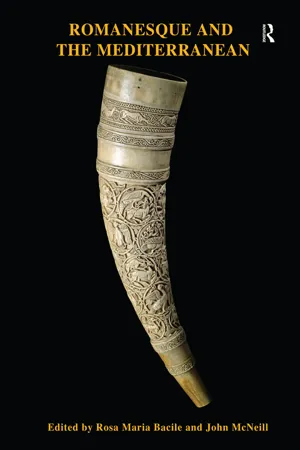
eBook - ePub
Romanesque and the Mediterranean
Patterns of Exchange Across the Latin, Greek and Islamic Worlds c.1000-c.1250
- 342 pages
- English
- ePUB (mobile friendly)
- Available on iOS & Android
eBook - ePub
Romanesque and the Mediterranean
Patterns of Exchange Across the Latin, Greek and Islamic Worlds c.1000-c.1250
About this book
"The sixteen papers collected in this volume explore points of contact across the Latin, Greek and Islamic worlds between c. 1000 and c. 1250. They arise from a conference organized by the British Archaeological Association in Palermo in 2012, and reflect its interest in patterns of cultural exchange across the Mediterranean, ranging from the importation of artefacts - textiles, ceramics, ivories and metalwork for the most part - to a specific desire to recruit eastern artists or emulate eastern Mediterranean buildings. The individual essays cover a wide range of topics and media: from the ways in which the Cappella Palatina in Palermo fostered contacts between Muslim artists and Christian models, the importance of dress and textiles in the wider world of Mediterranean design, and the possible use of Muslim-trained sculptors in the emergent architectural sculpture of late-11th-century northern Spain, to the significance of western saints in the development of Bethlehem as a pilgrimage centre and of eastern painters and techniques in the proliferation of panel painting in Catalonia around 1200. There are studies of buildings and the ideological purpose behind them at Canosa (Apulia), Feldebro (Hungary) and Charroux (Aquitaine), comparative studies of the domed churches of western France, significant reappraisals of the porphyry tombs in Palermo cathedral, the pictorial programme adopted in the Baptistery at Parma, and of the chapter-house paintings at Sigena, and wide-ranging papers on the migration of images of exotic creatures across the Mediterranean and on that most elusive and apparently Mediteranean of objects - the Oliphant. The volume concludes with a study of the emergence of a supra-regional style of architectural sculpture in the western Mediterranean and evident in Barcelona, Tarragona and Provence. It is a third volume, based on the British Archaeological Association's 2014 Conference in Barcelona, will explore Romanesque Patrons and Processes."
Information
Dress and Textiles in the 12th-Century Painted Ceilings of the Cappella Palatina in Palermo
This article presents the results of my doctoral research into the ceilings of the Palatine Chapel in Palermo, and addresses these unique works of art from a hitherto unexplored perspective; the representation of dress and textiles as worn by the participants in the royal banquet depicted in the ceilings. It both catalogues the clothing and textiles, and then carefully examines the resulting typologies in order to identify the most appropriate comparators, taking into consideration the Islamic and Christian culture of the medieval Mediterranean and Middle East. The analysis of the clothing and textiles used in the paintings offers a route to a better understanding of the paintings themselves, as well as offering a resource for future interdisciplinary research into the material culture, workshop organization, and artistic circulation in the medieval Mediterranean.
Abbreviations used in the text (excluding footnotes) for references to published images of the painted ceilings of the Palatine Chapel in Palermo and the Cathedral of Cefalù:
| CPMI | B. Brenk ed., La Cappella Palatina a Palermo [Mirabilia Italiae, volume XVII], 4 vols (Modena 2010), Testo I–II: Saggi-Schede; Atlante I–II |
| AUR | M. G. Aurigemma, Il cielo stellato di Ruggero II: il soffito dipinto della cattedrale di Cefalù (Milano 2004) |
Introduction
The nave and aisles of the Cappella Palatina in Palermo, commissioned by the first Norman King of Sicily, Roger II (1130–54), are covered by wooden ceilings painted with figural subjects, Arabic inscriptions and ornamental motifs.1 Although the principal subject of the paintings is an Islamic royal banquet (arab. sing. majlis), chaired by the sovereign who is accompanied by his ‘bon companions’ (arab. sing. nadīm) and entertained by musicians and dancers, authoritative studies over the last sixty years have also pointed to the presence of Christian themes.2 Notwithstanding any Christian dimension, the muqarna½ vault over the nave is both structurally and geometrically strikingly Islamic (18.25 × 5 m; c. 10–13 m high), and one of the most admired works of the whole chapel (Figs 1 and 2),3 while the aisles are covered by flat ceilings (18.50 × 2.50 m; 8.30 m high) made up of panels with semicircular ends.4 These three ceilings, along with the architecture and other sumptuous decorations of the building (liturgical furnishings, figurative mosaics, and opus sectile pavements and walls), are exceptionally well preserved. Indeed, the ceiling decoration constitutes the largest ensemble of monumental painting extant from the medieval Muslim world and one of the most exstensive in 12th-century Europe.5
The present essay is intended to summarize the principal findings of my doctoral research, in particular those related to the study of the costumes and headgear worn by the figures depicted on the ceiling, as well as the ornamental motifs used in the painted textiles.6 A number of studies have highlighted the importance of this subject matter not only for our understanding of the ceilings, but also for research into artistic production in Norman Sicily and the medieval Mediterranean as a whole.7 As early as the 1940s and 1950s, Ugo Monneret de Villard and Maria Accascina highlighted the importance of the painted ceilings in the Cappella Palatina for the study of the textile production and material culture in Norman Sicily.8 Subsequently, David Nicolle’s study of military costume in the Cappella Palatina paintings stressed the Islamic sources of the variety of military items depicted in the ceilings, underlining particularly close relations with Egypt, Ifriqiya and western Maghrib.9 While most recently, Lev Kapitaikin has examined some features of the dress, headgear and textiles worn by certain figures in the ceilings and suggested new interpretations of the iconography and pictorial programme, further supporting a Fatimid attribution for the paintings.10 The decision to devote a study to the appearance of dress and textiles in the paintings comes out of a desire to develop a better understanding of the ceilings from a largely unexplored perspective, and to discover whether and how the uses of dress and textile can shed light on a number of unresolved issues.11
To better achieve this aim, this article concentrates on a particular category of figures; the drinkers, musicians, dancers and ‘bon companions’ flanked by attendants (Figs 1–5). These are the main protagonists in the representations of the Islamic royal banquet. Furthermore, among the human figures depicted in the ceilings, they are the most varied in the types of dress and headgear they wear, while their dress is particularly rich in terms of embellishments and ornamental motifs. Other figures, such as the soldiers, horsemen, servants, do not generally wear such highly decorated dress.12 Conversely, the attendants represented at the side of a king or a nadīm as they take part in the banquet, are dressed in a manner that compliments that of the participants in the royal banquet, and are therefore included in this examination (Figs 1 and 2).13 My investigation also includes scenes and subjects that recent research has indicated are alien to the Islamic princely cycle, but are particularly interesting for the content they introduce in the pictorial decoration of the ceilings, and for the likely allusion they make to Roger II and to the building of the chapel and the Norman Palace.14 My research analyses 360 figures in total: 284 are in the nave ceiling — about 251 of which can be found on the muqarna½ cornice, two in the eastern side of the cavetto moulding at the base of the ceiling, and thirty-one (both busts and full-length figures) in the upper stellar domes.15 In the aisles, where much of the original painting has been lost and the ceilings have been overpainted on several occasions, seventy-six original figures are preserved.16
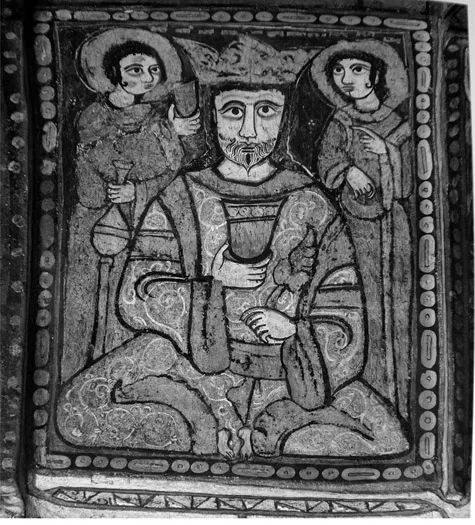
FIGURE 1 Palermo, Cappella Palatina: Crowned ruler flanked by two attendants, nave ceiling, muqarnas-cornice (south side) (© R. Longo, courtesy Cappella Palatina, Palermo)
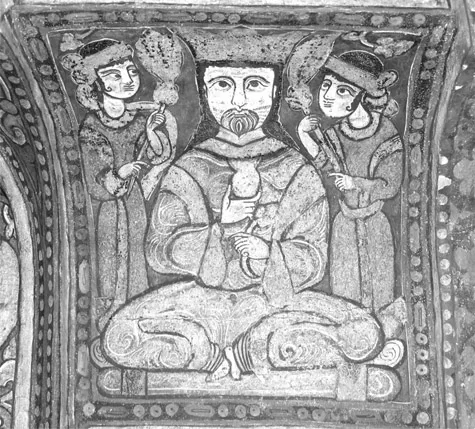
FIGURE 2 Palermo, Cappella Palatina: Crowned ruler flanked by two attendants, nave ceiling, muqarnas-cornice (south side) (© R. Longo, courtesy Cappella Palatina, Palermo)
There are also sixty-nine small figures (half-length busts) that occupy almost all the small lunettes of the upper tiers of the muqarna½ cornice of the nave ceiling (Fig. 8) and three busts enclosed in medallions (Fig. 6) which will be considered.17 These figures do not always exhibit attributes that allow them to be identified as musicians or nadīms. In some cases they held a cup or a glass (Fig. 6) or a musical instrument (specifically a flute).18 Sometimes, however, their hands, though empty, are represented in positions that suggest the act of holding an object or playing an instrument.19 As has been pointed out, these characters either employ iconographic formulae used for the nadīm, or they are musicians, and have therefore been included in the analysis.20 The same identification has been suggested for the figures painted in the eastern side of the cavetto moulding, though their presence and meaning have been interpreted by Jeremy Johns as a reference to the theme of the Three ages of man on the basis of their position at the entrance of the presbytery and their flanking a central cross.21 The survival of attributes with some of these figures, as well as in those in the stellar domes, suggests they may have been conceived as a schematized version of the nadīms and musicians, simplified, pe...
Table of contents
- Cover
- Title
- Copyright
- CONTENTS
- Advisory Panel
- Notes on Contributors
- Preface
- Colour Plates
- Twelfth-Century Pilgrimage Art in Bethlehem and Jerusalem: Points of Contact between Europe and the Crusader Kingdom
- The Oliphant: A Call for a Shift of Perspective
- Muslim Artists and Christian Models in the Painted Ceilings of the Cappella Palatina
- Dress and Textiles in the 12th-Century Painted Ceilings of the Cappella Palatina in Palermo
- A Porphyry Workshop in Norman Palermo
- The Mausoleum of Bohemund in Canosa and the Architectural Setting of Ruler Tombs in Norman Italy
- The Date, Iconography and Dedication of the Cathedral of Canosa
- Preparing for the End: Painting in the Baptistery of Parma and the Great Devotion of 1233
- Hungary, Byzantium, Italy: Architectural Connections in the 11th Century
- Building Jerusalem in Western France: The Case of St-Sauveur at Charroux
- A Western Interpretation of an Oriental Scheme: The Domed Churches in Romanesque Aquitaine
- The Migration of Mediterranean Images: Strange Creatures in Spanish Buildings and Scriptoria between the 9th and 11th Centuries
- Sculptors in Medieval Spain after the Conquest of Toledo in 1085
- The Paintings of the Chapter-House of Sigena and the Art of the Crusader Kingdoms
- Catalan Panel Painting Around 1200, the Eastern Mediterranean and Byzantium
- Catalonia, Provence and the Holy Land: Late 12th-Century Sculpture in Barcelona
- Index
Trusted by 375,005 students
Access to over 1.5 million titles for a fair monthly price.
Study more efficiently using our study tools.
Frequently asked questions
Yes, you can cancel anytime from the Subscription tab in your account settings on the Perlego website. Your subscription will stay active until the end of your current billing period. Learn how to cancel your subscription
No, books cannot be downloaded as external files, such as PDFs, for use outside of Perlego. However, you can download books within the Perlego app for offline reading on mobile or tablet. Learn how to download books offline
Perlego offers two plans: Essential and Complete
- Essential is ideal for learners and professionals who enjoy exploring a wide range of subjects. Access the Essential Library with 800,000+ trusted titles and best-sellers across business, personal growth, and the humanities. Includes unlimited reading time and Standard Read Aloud voice.
- Complete: Perfect for advanced learners and researchers needing full, unrestricted access. Unlock 1.5M+ books across hundreds of subjects, including academic and specialized titles. The Complete Plan also includes advanced features like Premium Read Aloud and Research Assistant.
We are an online textbook subscription service, where you can get access to an entire online library for less than the price of a single book per month. With over 1.5 million books across 990+ topics, we’ve got you covered! Learn about our mission
Look out for the read-aloud symbol on your next book to see if you can listen to it. The read-aloud tool reads text aloud for you, highlighting the text as it is being read. You can pause it, speed it up and slow it down. Learn more about Read Aloud
Yes! You can use the Perlego app on both iOS and Android devices to read anytime, anywhere — even offline. Perfect for commutes or when you’re on the go.
Please note we cannot support devices running on iOS 13 and Android 7 or earlier. Learn more about using the app
Please note we cannot support devices running on iOS 13 and Android 7 or earlier. Learn more about using the app
Yes, you can access Romanesque and the Mediterranean by Rosa Bacile in PDF and/or ePUB format, as well as other popular books in Social Sciences & History of Architecture. We have over 1.5 million books available in our catalogue for you to explore.