- 302 pages
- English
- ePUB (mobile friendly)
- Available on iOS & Android
eBook - ePub
About this book
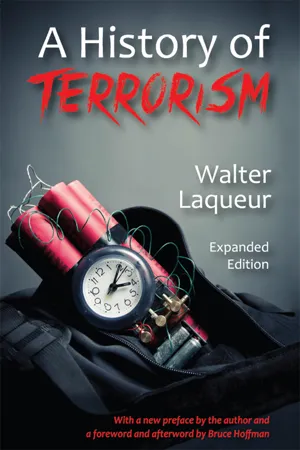
Terrorism is often mistakenly thought of as a modern phenomenon, but it goes back quite some time. A History of Terrorism charts the history of political terror from nineteenth-century Europe to the multinational operations of Arab and other groups today. The question is: What is its true impact today and in the future? Laqueur addresses long-neglected psychological issues concerning the origins of and motivations behind terrorism, and examines the sociology of terrorism in depth: funding, intelligence gathering, weapons and tactics, informers and countermeasures, and the crucial role of the media depiction of the "terrorist personality". Systematic terrorism and current interpretations of terrorism, its common patterns, motives, and aims, are unflinchingly faced and clearly explicated. Laqueur ultimately considers the effectiveness of terrorism and examines the ominous possibility of nuclear blackmail. Originally published in 1977, this book is one of the two most quoted works on terrorism. This expanded edition features a new preface and important contributions by distinguished security expert Bruce Hoffman that apply Laqueur's classic and seemingly timeless work to contemporary terrorism issues.
Information
1
The Origins
Terrorism has long exercised a great fascination, especially at a safe distance, but it is not an easy topic for discussion and explanation. The fascination it exerts (Shelley’s “tempestuous loveliness of terror”) and the difficulty of interpreting it have the same roots: its unexpected, shocking and outrageous character. War, even civil war, is predictable in many ways; it occurs in the light of day and there is no mystery about the identity of the participants. Even in civil war there are certain rules, whereas the characteristic features of terrorism are anonymity and the violation of established norms.
Terrorism has always engendered violent emotions and greatly divergent opinions and images of it. The popular image of the terrorist some eighty years ago was that of a bomb-throwing alien anarchist, disheveled, with a black beard and a satanic (or idiotic) smile, fanatic, immoral, sinister and ridiculous at the same time. Dostoevsky and Conrad provided more sophisticated but essentially similar descriptions. His present-day image has been streamlined but not necessarily improved; it certainly has not been explained by political scientists or psychiatrists called in for rapid consultation. Terrorists have found admirers and publicity agents in all ages. No words of praise are fulsome enough for these latter-day saints and martyrs, The terrorist (we are told) is the only one who really cares; he is a totally committed fighter for freedom and justice, a gentle human being forced by cruel circumstances and an indifferent majority to play heroic yet tragic roles: the good Samaritan distributing poison, St. Francis with the bomb. Such a beatification of the terrorist is grotesque, but terrorism cannot be unconditionally rejected except on the basis of a total commitment to nonviolence and nonresistance to evil. Killing, as Colonel Sexby pointed out some three hundred years ago, is not always murder and armed resistance cannot always proceed in open battle according to some chevalresque code: “Nein, eine Grenze hat Tyrannenmacht… zum letzten Mittel, wenn kein anderes mehr verfangen will, ist ihm das Schwert gegeben” (No, tyranny does have a limit, and as a last resort, one has the sword if nothing else avails). Schiller’s famous statement of the ultima ratio of free men facing intolerable persecution has been invoked by generations of rebels against tyranny. But for every Wilhelm Tell there have been many self-appointed saviors of freedom and justice, impatient men, fanatics and madmen invoking the right of self-defense in vain, using the sword not as the last refuge but as a panacea for all evils, real or imaginary. Patriotism has been the last refuge of many a scoundrel, and so has been the struggle for freedom. Horse thieves in Latin America used to claim political motives for their actions as a safeguard against being hanged. The study of terrorism is not made any easier by the fact that most terrorists have been neither popular heroes in the mold of Wilhelm Tell nor plain horse thieves but both these as well as many other things. It is a moot point whether Burke was right when he said that one only had to scratch an ideologue to find a terrorist, but it is certainly not true that scratching a terrorist will necessarily reveal an ideologue.
The interpretation of terrorism is difficult for yet other reasons. Even over the last century the character of terrorism has changed greatly. This goes not only for its methods but also for the aims of the struggle and the character of the people that were and are involved in it. Only two generations divide Sofia Perovskaya and Emma Goldman from Ulrike Meinhof and Patty Hearst, yet morally and intellectually the distance between them is to be measured in light years. The other difficulty is equally fundamental: unlike Marxism, terrorism is not an ideology but an insurrectional strategy that can be used by people of very different political convictions.
Yet terrorism is not merely a technique. Those practising it have certain basic beliefs in common. They may belong to the left or the right; they may be nationalists or, less frequently, internationalists, but in some essential respects their mental makeup is similar. They are often closer to each other than they know or would like to admit to themselves or others. And as the technology of terrorism can be mastered by people of all creeds, so does its philosophy transcend the traditional dividing lines between political doctrine. It is truly all-purpose and value-free.
Terrorism is not, as is frequently believed, a subspecies of guerrilla (or “revolutionary”) warfare and its political function today is also altogether different. “Urban guerrilla” is indeed urban, but it is not “guerrilla” in any meaningful sense of the term; the difference between guerrilla and terrorism is not one of semantics but of quality. This study grew out of a dissatisfaction with many of the current attempts to explain and interpret political terrorism, both on the popular and academic level.* According to widespread belief, the main features of contemporary terrorism are, very briefly, as follows:
1. Terrorism is a new, unprecedented phenomenon. For this reason its antecedents (if any) are of little interest.
2. Terrorism is one of the most important and dangerous problems facing mankind today.
3. Terrorism is a response to injustice; if there were political and social justice, there would be no terrorism.
4. The only known means of reducing the likelihood of terrorism is a reduction of the grievances, stresses and frustration underlying it.
5. Terrorists are fanatical believers driven to despair by intolerable conditions. They are poor and their inspiration is deeply ideological.
6. Terrorism can occur anywhere.
The intention of this study is not to refute misconceptions; for this purpose a mere juxtaposition of theories with the known facts about terrorism would be sufficient. My aim is to have a fresh look at the whole phenomenon. This presents certain difficulties of methodology: some terrorist movements have been exceedingly well documented; for every member of the Baader-Meinhof group or the Symbionese Liberation Army there have been several books and articles. The same is true, incidentally, for an infinitely more important movement, the Narodnaya Volya. On the other hand, many other terrorist groups have hardly attracted any attention at all; they have never become known outside the country in which they operated or they have been forgotten. To write a “world history” or provide a “general theory” of political terrorism is a hopeless undertaking; I have concentrated, therefore, on the main stages in the development of terrorism and terrorist doctrine and on its essential features and cardinal problems.
The terms “terrorism” and “terrorist” are of relatively recent date; the meaning of terrorism was given in the 1798 supplement of the Dictionnaire of the Académie Française as systeme, regime de la terreur.1 According to a French dictionary published in 1796, the Jacobins had on occasion used the term when speaking and writing about themselves in a positive sense; after the 9th of Thermidor, “terrorist” became a term of abuse with criminal implications.2 It did not take long for the term to reach Britain; Burke, in a famous passage written in 1795, wrote about “thousands of those hell hounds called terrorists” who were let loose on the people. Terrorism at the time referred to the period in the French Revolution broadly speaking between March 1793 and July 1794 and it was more or less a synonym for “reign of terror.” Subsequently it acquired a wider meaning in the dictionaries as a system of terror. A terrorist was anyone who attempted to further his views by a system of coercive intimidation.3 Even more recently, the term “terrorism” (like “guerrilla”) has been used in so many different senses as to become almost meaningless, covering almost any, and not necessarily political, act of violence. According to one of the arguments frequently used against the study of political terrorism, many more people have been killed throughout history, and more havoc has been wrought, as the result of crimes committed by governments than by terrorism from below. This is not in dispute, but the present study is concerned not with political violence in general or with the inequities of tyranny but with a more specific phenomenon.
No definition of terrorism can possibly cover all the varieties of terrorism that have appeared throughout history: peasant wars and labor disputes and brigandage have been accompanied by systematic terror, and the same is true with regard to general wars, civil wars, revolutionary wars, wars of national liberation and resistance movements against foreign occupiers. In most of these cases, however, terrorism was no more than one of several strategies, and usually a subordinate one. My concern in the present study is with movements that have used systematic terrorism as their main weapon; others will be mentioned only in passing. It is generally believed that systematic political terrorism is a recent phenomenon dating back to the last century. This is true in the sense that the “philosophy of the bomb” as a doctrine is indeed relatively new. Yet it hardly needs to be recalled that there have been many systematic assassinations of political enemies throughout history. Like Moliere’s bourgeois, who had talked prose all along, there have been terrorists (and terrorist movements) avant la lettre. Many countries have had their Sicilian Vespers or St. Bartholomew’s nights; foes, real and imaginary, were eliminated by Roman emperors, Ottoman sultans, Russian tsars and many others.
Terrorism “from below” has emerged in many different forms and out of such various motivations as religious protest movements, political revolts and social uprisings. One of the earliest known examples of a terrorist movement is the sicarii, a highly organized religious sect consisting of men of lower orders active in the Zealot struggle in Palestine (A.D. 66-73). The sources telling of their activities are sparse and sometimes contradictory, but it is known from Josephus that the sicarii used unorthodox tactics such as attacking their enemies by daylight, preferably on holidays when crowds congregated in Jerusalem. Their favorite weapon was a short sword (sica) hidden under their coats. In the words of the expert in De Quincey’s club considering murder as a fine art: “Justly considering that great crowds are in themselves a sort of darkness by means of the dense pressure, and the impossibility of finding out who it was that gave the blow, they mingled with crowds everywhere … and when it was asked, who was the murderer and where he was — why, then it was answered ‘Non est inventus’. “4 They destroyed the house of Ananias, the high priest, as well as the palaces of the Herodian dynasts; they burned the public archives, eager to annihilate the bonds of moneylenders and to prevent the recovery of debts. They are also mentioned in Tacitus and in the rabbinical authorities as having burned granaries and sabotaged Jerusalem’s water supplies. They were the extremist, nationalist, anti-Roman party and their victims both in Palestine and the Egyptian diaspora were the moderates, the Jewish peace party. Some authorities claim that they had an elaborate doctrine, the so-called fourth philosophy, something in the nature of a Jewish protestantism according to whose tenets God alone was considered as the Lord; political allegiance was refused to any earthly power; and priests were rejected as intermediaries. Others regarded the sicarii as a movement of social protest intent on inciting the poor to rise against the rich. Josephus doubted their idealistic motivation and claimed that they were listai, robbers, out for personal gain and manipulated by outside forces, with patriotism and the demand for freedom as a mere ideological cloak.5 But even Josephus admits that there was a frenzy of religious expectation among them, an inclination to regard martyrdom as something joyful and a totally irrational belief after the fall of Jerusalem that, as the sinful regime was no longer in authority, victory over the Romans was possible and also that God would reveal Himself to His people and deliver them. Such qualities were not that common among ordinary listai.
A similar mixture of messianic hope and political terrorism was the prominent feature of a much better known sect — the Assassins, an offshoot of the Ismailis who appeared in the eleventh century and were suppressed only by the Mongols in the thirteenth. The Assassins have fascinated Western authorities for a long time and this interest has grown in recent times, for some of the features of this movement remind one of contemporary terrorist movements. Based in Persia the Assassins spread to Syria, killing prefects, governors, caliphs and even Conrad of Montferrat, the Crusader King of Jerusalem. They tried twice to kill Saladin but failed. Their first leader, Hassan Sibai, seems to have realized early on that his group was too small to confront the enemy in open battle but that a planned, systematic, long-term campaign of terror carried out by a small, disciplined force could be a most effective political weapon.6 They always operated in complete secrecy; the terrorist fighters (fidaiin) were disguised as strangers or even Christians.7 The Assassins always used the dagger, never poison or missiles, and not just because the dagger was considered the safer weapon: murder was a sacramental act. Contemporary sources described the Assassins as an order of almost ascetic discipline; they courted death and martyrdom and were firm believers in a new millennium. Seen in historical perspective, the terrorist struggle of the Assassins was a fruitless attempt by a relatively small religious sect to defend its religious autonomy (and way of life) against the Seljuqs who wanted to suppress them. But the means they used were certainly effective for a while, and the legends about the Old Man from the Mountain deeply impressed contemporaries and subsequent generations.
Secret societies of a different kind existed for centuries in India and the Far East. The Anglo-Indian authorities denied the existence of the Thugs until Captain (subsequently Major General) William Slee-man studied the subject and ultimately destroyed the sect. The Thugs strangled their victims with a silk tie; Europeans were hardly ever affected, but otherwise their choice of victims was quite indiscriminate. Its devotees thought the origin of Thuggee was derived from an act of sacrifice to the goddess Kali. It had a fatal attraction. In the words of Feringea, a captured Thug: “Let any man taste of that goor [sugar] of the sacrifice, and he will be a Thug, though he knows all the trades and has all the wealth in the world.… I have been in high office myself and became so great a favorite wherever I went that I was sure of promotion. Yet I was always miserable when away from my gang and obliged to return to Thuggee.”8 The Thugs had contempt for death. Their political aims, if any, were not easily discernible; nor did they want to terrorize the government or population.
In a survey of political terrorism the phenomenon rates no more than a footnote. The same applies to the more militant secret societies in China that existed among river pirates and the outlaws in the hills as well as among respectable city dwellers. Each society had its “enforcer,” usually a trained boxer. Some engaged in criminal extortion; there were hired killers among them, selling themselves to the highest bidder. The societies ran gambling houses and smuggled salt. Some of the more important societies also had distinct political aims: they were anti-Manchu and loathed foreigners.9 They were behind the Boxer Rebellion and helped Sun Yat-sen in the early days of his career. The “Red Spears” of the 1920s combined politics with exercises such as deep breathing and magic formulas, rather like the counterculture of the 1960s. But politics was only one of their many activities and in this respect they resemble more the Mafia than modern political terrorist movements.10
The interest of the Ku Klux Klan in politics was perhaps more pronounced, but it was still not in the mainstream of terrorist movements. It is not always remembered that there was not one Klan, but three, which did not have much in common with each other. The first Klan, a product of the Reconstruction period, was a secret, violent association, proscribing recently emancipated Negroes. The second Klan (ca. 1915-1944) also stood for white supremacy, but at the same time it campaigned for a great many other causes such as patriotism and attacked bootleggers, crapshooters and even wife-beaters. With all the ritual mumbo-jumbo around the Great Wizard, it became very much part of establishment politics in the South, both on the local and state level. It also engaged in various business enterprises, such as dealing in emulsified asphalt for road construction. The second Klan was in fact an incorporated society, whose history ends in April 1944, not with a dramatic shoot-out with the police but with a federal suit for $685,000 in delinquent income tax. As a result its charter had to be surrendered and the Klan went out of business.11
Compared with the sicarii and Assassins, with Thugs, Red Spears and the Ku Klux Klan, contemporary terrorist groups seem to belong to another species altogether. For the starting point to the study of modern political terrorism one clearly has to look elsewhere and this takes one back to the Wilhelm Tell syndrome. Political assassinations of leading statesmen were relatively infrequent in the age of absolutism, once the religious conflicts had lost some of their acuteness. There was solidarity between monarchs whatever their personal differences or the clashes of interest between them; they would not normally have thought of killing one another. The idea of regicide also had temporarily gone out of fashion — with a few notable exceptions. This changed only after the French Revolution and the rise of nationalism in Europe. Outside Europe there were cases of political murder, as there had been since time immemorial, but these belonged, grosso modo, to the tradition of dynastic quarrels or clashes between rival groups fighting for power or of military coups or the actions of fanatics or madmen.
Systematic terrorism begins in the second half of the nineteenth century and there were several quite distinct categories of it from the very beginning. The Russian revolutionaries fought an autocratic government in 1878-1881 and again in the early years of the twentieth century. Radical nationalist groups such as the Irish, Macedonians, Serbs or Armenians used terrorist methods in their struggle for autonomy or national independence. Lastly, there was the anarchist “propaganda by the deed,” mainly during the 1890s in France, Italy, Spain and the United States. The few assassinations in France and Italy attracted enormous publicity, but they were not really part of a general systematic strategy. The character of terrorism in the United States and Spain was again different inasmuch as it had the support of specific sections of the population. In the United States there was working-class terro...
Table of contents
- Cover
- Half Title
- Title Page
- Copyright Page
- Table of Contents
- Foreword to the Expanded Transaction Edition
- Preface to the Expanded Transaction Edition
- Introduction to the Transaction Edition
- Introductory Note
- 1. The Origins
- 2. The Philosophy of the Bomb
- 3. The Sociology of Terrorism
- 4. Interpretations of Terrorism
- 5. Terrorism Today
- Conclusion
- Afterword to the Expanded Transaction Edition
- Notes
- Abbreviations
- Bibliography
- Index
Trusted by 375,005 students
Access to over 1.5 million titles for a fair monthly price.
Study more efficiently using our study tools.
Frequently asked questions
Yes, you can cancel anytime from the Subscription tab in your account settings on the Perlego website. Your subscription will stay active until the end of your current billing period. Learn how to cancel your subscription
No, books cannot be downloaded as external files, such as PDFs, for use outside of Perlego. However, you can download books within the Perlego app for offline reading on mobile or tablet. Learn how to download books offline
Perlego offers two plans: Essential and Complete
- Essential is ideal for learners and professionals who enjoy exploring a wide range of subjects. Access the Essential Library with 800,000+ trusted titles and best-sellers across business, personal growth, and the humanities. Includes unlimited reading time and Standard Read Aloud voice.
- Complete: Perfect for advanced learners and researchers needing full, unrestricted access. Unlock 1.5M+ books across hundreds of subjects, including academic and specialized titles. The Complete Plan also includes advanced features like Premium Read Aloud and Research Assistant.
We are an online textbook subscription service, where you can get access to an entire online library for less than the price of a single book per month. With over 1.5 million books across 990+ topics, we’ve got you covered! Learn about our mission
Look out for the read-aloud symbol on your next book to see if you can listen to it. The read-aloud tool reads text aloud for you, highlighting the text as it is being read. You can pause it, speed it up and slow it down. Learn more about Read Aloud
Yes! You can use the Perlego app on both iOS and Android devices to read anytime, anywhere — even offline. Perfect for commutes or when you’re on the go.
Please note we cannot support devices running on iOS 13 and Android 7 or earlier. Learn more about using the app
Please note we cannot support devices running on iOS 13 and Android 7 or earlier. Learn more about using the app
Yes, you can access A History of Terrorism by Andrew White,Walter Laqueur in PDF and/or ePUB format, as well as other popular books in Politics & International Relations & Politics. We have over 1.5 million books available in our catalogue for you to explore.