
eBook - ePub
Motivating & Inspiring Teachers
The Educational Leader's Guide for Building Staff Morale
- 288 pages
- English
- ePUB (mobile friendly)
- Available on iOS & Android
eBook - ePub
Motivating & Inspiring Teachers
The Educational Leader's Guide for Building Staff Morale
About this book
Like the best-selling first edition, this book is filled with strategies to motivate your staff and maintain a high level of energy at your school. This guide will help all educators approach work every day in an enthusiastic, focused, and positive state of mind. This book will help you:
-Motivate your faculty with the Friday Focus--a staff memo that works!
-Understand the power of praise and how to best utilize it every day
-Make sure staff meetings, teacher evaluation, and daily activities raise the energy level in your school
-Maximize the holidays, open house nights, and other special events the make your staff feel special
Information
Part 1
The Role of the Leader
1
Why It All Works
As soon as you walk into a school, any school, you can sense the level of excitement and energy, or lack thereof, in the building. The same is true when you venture into a classroom or hallway of a school. What is it that differentiates the places that are exciting to work from those that lack the energy and excitement essential to a high-functioning school? One factor is the morale and motivation of those who work at the school. How can we get our schools to be like the “high-excitement” educational centers? Once that spark of excitement is ignited, are there things we can do to build on this momentum? How can we maintain the energy of the first day of school all year long?
Whether your school is one that consistently has a high level of excitement or one where by the end of the first week someone writes the number of days until Christmas vacation on the chalkboard in the teachers’ lounge, there are several things that affect your school. One of the struggles we had in writing this book involved determining what to include in Chapter 1.
As principals, we often scoffed at theories—if we thought any in-service or article was even going to mention the word, we would readily opt out. This instinct also rang true when we were writing the book. We couldn’t wait to get to what the heart of being a principal was all about. However, we also thought it was important to lay a brief foundation of why the dynamics of schools are as they are. What is it that causes some schools to be dynamic and others to be duds? We felt that we had to include some background information in Chapter 1 that would help each of us understand where our schools are and how they got there. Thus, in this chapter we are laying out five theories that we feel are essential in developing an understanding of dynamics and morale. If that “practitioner urge” gets to be too strong, feel free to skip immediately to Chapter 2 and dive in when you are ready. If you would like to get your toes wet first, however, as you read, think about the people you work with and how they fit into these models.
The general approaches outlined in these theories can provide a rich foundation for understanding why the specifics from the rest of the book actually will work to build a dynamic environment in your school. You may have heard of some of these ideas, such as Maslow’s hierarchy of needs (1970) and Herzberg’s motivational-hygiene theory (Herzberg, Mausner, & Snyderman, 1993). Others, like the Group Norm (Mayo, 1933) or Comparison Other (Lunenburg & Ornstein, 1996) may not be so familiar. However, one thing that is critical in all settings is the role of the leader(s).
In a school, the obvious formal leader is the principal. Additionally, there may be many informal leaders, as well as others with positional power: department chairs, team leaders, grade-level leaders, and so on. Each of these people can play a significant role in the morale of those around them. Let’s apply a few theories to an understanding of how morale can be affected in a school.
Maslow’s Hierarchy of Needs
Maslow’s theory of the hierarchy of needs is a widely used study of motivation in organizations, including schools. According to Lunenburg and Ornstein (1996), Maslow identified five basic groups of human needs that emerge in a specific sequence or pattern, that is, in a hierarchy of importance. Once one need is satisfied, another emerges and demands satisfaction, and so on through the hierarchy. These five levels of need, which represent the order of importance to the individual, are physiological, safety and security, social, esteem, and self-actualization (p. 89).
These needs, arranged from lowest level to highest level, are as follows:
- Physiological needs include the basics of food, water, sleep, oxygen, and the like.
- Safety and security needs include the need for physical safety, avoidance of anxiety, order, structure, and job and financial security.
- Social needs include the need for belonging to groups, friendship, and acceptance by others.
- Esteem needs include the need for self-respect, appreciation, and recognition from others.
- Self-actualization needs include the desire for maximizing one’s own potential, autonomy, and creativity.
The reason that these are related to morale is that if the low-level physiological, safety, and social needs are not satisfied, then the individual is not likely to have a positive morale. Only when more basic needs are met can people shift their emphasis to fulfilling their esteem and self-actualization needs. This motivation for recognition, self-respect, and maximizing your potential is a critical part of being motivated.
Understanding where everyone is on the hierarchy can help a leader give people what they need to be more motivated in the workplace. A person can have certain needs met in one circumstance but not in another. A recent example involves all of the tragedies related to violence in schools across the country. Teachers who previously had little concern for their safety at work may have become much more insecure about their safety in their school. However, this may not have resulted in a diminished level of comfort at home, in social circumstances, at church, or in other situations.
Educational leaders, then, must realize that the teachers and staff members of their organizations must have their safety needs met before they can establish or reestablish a higher morale level. However, it is also important to be aware that to a large degree, these needs are experienced from the perspective of the beholder. They are not experienced from the perspective of the leader. Let’s take an example using safety and security. It is not enough for staff members just to be safe; they must also feel safe. If a teacher feels threatened by a student in class, the principal must not only be sure that the student will do no harm, but also help the teacher to feel safe. The recent highly publicized violent incidents in school did not necessarily change the safety of other schools; however, it greatly impacted the way parents, students, and staff members feel about the safety of their schools. These parents, students, and staff moved down to a basic need level, and they need satisfaction that these concerns will be addressed before they can move back up the hierarchy.
As educational leaders work to enhance morale in their organizations, one of the aspects of Maslow’s hierarchy that may come into play more than any other is the social needs of teachers. As principals wonder why teachers often sit in the teachers’ lounge and gripe, or why so many meetings can turn into whine sessions, one explanation may be the social needs of people. The concept of “fitting in” is critical. I may not inherently be a negative person, but if that dynamic is established in the teachers’ lunchroom, lounge, or workroom, then behaving like everyone else can be part of belonging. Understanding this influence can be very helpful when deciding room location, grade level, or planning time for staff members. Also, taking advantage of opportunities to build morale by having as many staff as possible associate with positive staff can be an easy way to have this productive attitude infiltrate the school.
People of all ages are similar. Think about the new student in a school who does not know anyone. When he first arrives he does not have a peer group. If the new student does not feel that he fits in at school, which group will always take the student in? It will not be the popular students or the high achievers. The group of more negative students always has room for one more. The same is true of a school staff. Rather than hoping a new teacher does not join a negative group at the staff meeting or in the lounge, make an effort to link the new teacher with productive members. This is often doubly important if gender, department, grade level, or some other natural pull is involved. Everyone wants to fit in; this can be a crucial element in our personal morale.
The Importance of Trust
We can never lose sight of the value of the feelings of others and their impact on morale. When a teacher refers a student to the office for discipline, the teacher does not just want to be supported, but wants to feel supported. If the principal who handles the discipline does not communicate effectively with the teacher what is done in support, the teacher still feels unsupported regardless of what the administrative action was. However, if the administrator can make the teacher feel supported, then the specific disciplinary action becomes much less relevant.
Similarly, when people are asked to list characteristics of an effective leader, one that often comes up is a good listener. However, I would argue that we want more than that. We do not just want a good listener; we want someone who makes us feel listened to.
I would bet that many of you have the ability to multitask very effectively. In other words, you can type on your computer while talking on the phone, or read the newspaper while watching television. However, what happens in our leadership role is that if people we work with do not feel we are good listeners, it probably does not matter whether we are or not. If someone comes to talk to you and you continue to look at the computer screen during the visit, that person will feel that you did not listen—whether you did or not. Thus, regardless of your action or response, his or her level of regard for you personally, his or her trust, is likely to diminish. However, if you look him or her in the eye and even just pretend to actively listen, his or her personal regard for you is much more likely to be positive.
It is essential that these feelings of trust continue to rise between leaders and those they work with. If these do not get established, then the leader will continually be second-guessed by others. The willingness to respond in a positive manner to ideas, suggestions, or directives from a leader was described by Chester Barnard (1938) as the “zone of indifference.” Barnard believed that all workers have a zone of indifference in which they are willing to do what their supervisor says without questioning the rationale for the decision. He also believed that different workers have different zones of indifference. In other words, a trusting worker might have a very large zone of indifference, whereas a cynical worker may have a very small zone of indifference, or even none at all (Figure 1.1).
Figure 1.1. Zone of Indifference Versus Level of Trust
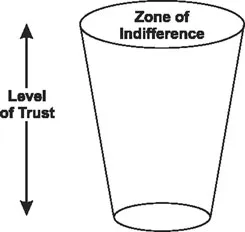
The larger the zone of indifference employees have, the more smoothly a leader’s decisions can be implemented and supported. To a leader, having workers with large zones of indifference can be very appealing. The question, of course, is “How can we influence this zone of indifference?”
The essential link between leadership and the size of others’ zones of indifference is the level of trust that the leader has established. The higher the level of trust someone has, the larger the zone of indifference.
The concept is that if people trust someone, they tend to do much less second-guessing of their everyday decisions. However, a leader has not established trust, then everyone in the organization continually questions, at least internally, every decision made. Thus, they stay at a lower point on their level of morale.
If we, as leaders, find ourselves in a situation where we are consistently being second-guessed over the most minor decisions, the solution may not be to attempt to put more energy into decision making. We may be better served by focusing on increasing the level of trust we have with those in their organization.
Again, the level of trust may be based as much on perception as reality. Although people’s trust of us may be based substantially on perceptions, the resulting impact on our ability to lead effectively is very much based in reality. And, as in many circumstances, when there is a perceived lack of leadership, everyone tries to fill the void. The school board starts to micromanage, the teacher organization begins to question everything, and morale is greatly diminished. Understanding this link between trust and indifference is essential for a leader. If we cannot establish this bond, every deci...
Table of contents
- Cover
- Title Page
- Copyright Page
- Dedication
- Table of Contents
- About the Authors
- Preface
- Introduction
- Introduction to the Second Edition
- Part 1: The Role of the Leader
- Part 2: Communication—It’s What You Say and How You Say It
- Part 3: Supervision, Evaluation, and Morale Improvement?
- Part 4: Meetings, Meetings, Meetings…You Mean These Can be Fun?
- Part 5: Special Is as Special Does
- Part 6: Focusing Outside the Staff to Affect Staff Morale
- Parting Thoughts
- References
Trusted by 375,005 students
Access to over 1.5 million titles for a fair monthly price.
Study more efficiently using our study tools.
Frequently asked questions
Yes, you can cancel anytime from the Subscription tab in your account settings on the Perlego website. Your subscription will stay active until the end of your current billing period. Learn how to cancel your subscription
No, books cannot be downloaded as external files, such as PDFs, for use outside of Perlego. However, you can download books within the Perlego app for offline reading on mobile or tablet. Learn how to download books offline
Perlego offers two plans: Essential and Complete
- Essential is ideal for learners and professionals who enjoy exploring a wide range of subjects. Access the Essential Library with 800,000+ trusted titles and best-sellers across business, personal growth, and the humanities. Includes unlimited reading time and Standard Read Aloud voice.
- Complete: Perfect for advanced learners and researchers needing full, unrestricted access. Unlock 1.5M+ books across hundreds of subjects, including academic and specialized titles. The Complete Plan also includes advanced features like Premium Read Aloud and Research Assistant.
We are an online textbook subscription service, where you can get access to an entire online library for less than the price of a single book per month. With over 1.5 million books across 990+ topics, we’ve got you covered! Learn about our mission
Look out for the read-aloud symbol on your next book to see if you can listen to it. The read-aloud tool reads text aloud for you, highlighting the text as it is being read. You can pause it, speed it up and slow it down. Learn more about Read Aloud
Yes! You can use the Perlego app on both iOS and Android devices to read anytime, anywhere — even offline. Perfect for commutes or when you’re on the go.
Please note we cannot support devices running on iOS 13 and Android 7 or earlier. Learn more about using the app
Please note we cannot support devices running on iOS 13 and Android 7 or earlier. Learn more about using the app
Yes, you can access Motivating & Inspiring Teachers by Todd Whitaker,Beth Whitaker,Dale Lumpa in PDF and/or ePUB format, as well as other popular books in Didattica & Didattica generale. We have over 1.5 million books available in our catalogue for you to explore.