In May 1997, a group of distinguished historians announced the formation of the Historical Society, an organization that sought to be free of the jargon-laden debates and political agendas that have come to characterize the profession. Eugene Genovese, Prsident of the Society, explained the commitment to form a new and genuinely diverse organization. "The Society extends from left to right and embraces people of every ideological and political tendency. The Society promotes frank debate in an atmosphere of civility, mutual respect, and common courtesy. All we require is that participants lay down plausible premises; reason logically; appeal to evidence; and prepare to exchange criticism with those who hold different points of view. Our goal: to promote an integrated history accessible to the public." From those beginnings, the Society has grown to include hundreds of members from every level of the profession, from Pulitzer-prize winning scholars to graduate students, across the ideological and political spectrum.
In this first book from the Historical Society, several founding members explore central topics within the field; the enduring value of the practice of history; the sensitive use of historical records, sources, and archives; the value of common standards; and much more. An engaging and challenging work that will appeal to scholars, students, educators, and the many public readers who have become lost in the culture wars, Reconstructing History is sure to generate the kind of civil, reasoned debate that is a foundational goal of the Historical Society.
Contributors include Walter A. McDougall, Marc Trachtenberg, Alan Charles Kors, Deborah A. Symonds, Leo P. Ribuffo, Bruce Kuklick, Elizabeth Fox-Genovese, Gertrude Himmelfarb, Edward Berkowitz, John Patrick Diggins, John Womack, Victor Davis Hanson, Miriam R. Levin, Martin J. Sklar, Eugene D. Genovese, Daniel C. Littlefield, Elisabeth Lasch-Quinn, Russell Jacoby, Rochelle Gurstein, Paul Rahe, Donald Kagan, Diane Ravitch, Sean Wilentz, Louis Ferleger and Richard H. Steckel.
- 400 pages
- English
- ePUB (mobile friendly)
- Available on iOS & Android
eBook - ePub
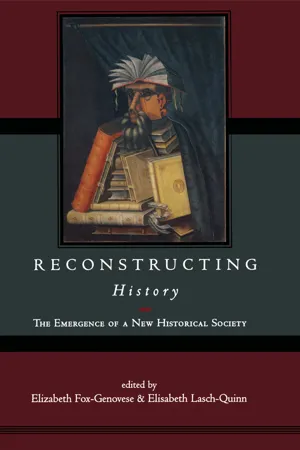
Reconstructing History
About this book
Information
Part I
The Imperative: The Historical Society as a Critique and a New Ideal
THE HISTORICAL SOCIETY has emerged in response to widespread discouragement about the dominant trends in the historical profession and a commitment to an ideal of a community of historians bound by respect for one another and their craft. The five essays in this section reflect both outlooks, albeit each with a specific balance between the two. During the early months of the society's existence in 1998, Eugene Genovese and Marc Trach-tenberg each published an opinion piece (in the Los Angeles Times and the Wall Street Journal, respectively) that explained the society's origins and goals to the general public. Notwithstanding differences, the two essays converge in emphasizing the imperative to rescue history from the overspecialization, trivialization, faddishness, and political exclusivity into which the main historical organizations and no small number of departments have fallen.
Trachtenberg, a diplomatic historian, has first-hand experience of the "marginalization" that so many groups claim for themselves. Indeed, he recently came across a reference to the "virtual disappearance" of diplomatic history from the curricula of the most prestigious departments. Prevailing fashion in history has denigrated diplomatic history, along with much political, economic, and intellectual history. The fields that were once taken to capture the main developments in the life of any nation are now widely derided as the preserves of elite white men who trod upon the sensibilities and aspirations of those less privileged than they. In their stead, curricula and conventions now feature courses and sessions that focus upon topics such as "feminist studies" and "bodyworks," neither of which acknowledges a historical dimension. Journals now publish articles entitled "A Dual-Gendered Perspective on Eighteenth-Century Advice and Behavior"; "Constructing Menstruation"; "Rationalizing the Body"; and "The Ambiguities of Embodiment in Early America." And as these examples proliferate, it is increasingly difficult to dismiss them as a fad. To the contrary, Trachtenberg argues, they have become the norm—the standard by which candidates for jobs, proposals for sessions, and article and book manuscripts are measured.
In Trachtenberg's view, the heaviest burden of these developments falls upon young scholars "who still believe in the traditional concept of what historical work should be" and "'find it much harder to get to first base in their academic careers." Ultimately, however, the cost for our society as a whole is even higher, because the way in which we understand the past directly influences the quality of our culture and our understanding of domestic and foreign relations.
Eugene Genovese deplores the neglect of diplomatic, intellectual, political, and economic history, which, because of their resistance to the ideologically loaded, formulaic claims of race, class, and gender, .. are barely tolerated when not treated with open contempt." Genovese attributes the main reasons for this disdain to political intolerance and likens the prevailing atmosphere to the McCarthy period. Chiding those who enjoin dispirited historians to reform the major professional associations "from within," he invokes the imposition of ideological conformity that the associations have tolerated or enforced, "for example by condoning the proscription of those who hold differing views—say, those who oppose abortion on religious principle." History, he reminds us, requires the intellectual freedom that can derive only from the willingness to attend respectfully to the views of others, even—indeed especially—those who hold different political and ideological views. The main rationale for The Historical Society lies precisely in fostering such a climate of intellectual and ideological openness that alone can nurture rich and challenging historical work of every variety—from social history to economic and diplomatic history.
Alan Kors, in an essay that originated as a presentation at an annual meeting of the American Historical Association, takes up similar themes, deploring the politicization that led the AHA in 1982 to pass a "we know as historians" resolution which advised the American public that "Reagan's rearmament and deployment policy would end detente, led to heightened tension between the U.S. and the—erstwhile—USSR, and that a nuclear freeze, riot deployment, alone could lead to disarmament." This is not a wisdom, Kors scathingly notes, that the general public needs. Kors shares Trachtenberg and Genovese's dismay with the presumption of those historical associations which take political stands in the name of their purportedly "diverse" members. Above all, however, Kors points to the ignorance of important topics that informs the pronouncements on them. If you disdain the study of diplomatic history, how are you to provide wisdom on the diplomatic questions of today?
All of these essays voice deep concern about historians' apparent night from the ideals of objectivity and the honest use of evidence. Recognizing history as a demanding and rewarding craft, the essays insist upon the importance of respect for common standards in the practice of that craft. The first requirement is not that historians espouse one or another political position but that they do their work as thoroughly and honestly as possible on the assumption that their colleagues will do the same. Kors further insists that the fashionable preoccupation with theory distracts historians from the intrinsic interest and significance of their work. Long after the world has forgotten prevailing theories of oppression, the nature of slavery and the fate of "nominally or truly freed slaves" will remain historical phenomena of abiding interest. Historians' choice of topics may embody one or another political inclination, but those political inclinations do not preclude a genuine commitment to knowledge for its own sake. In this respect, history invites us to move beyond the limitations of our own situation and biases rather than to wallow in them.
Daniel Littlefield takes up the problems of imposed political conformity in relation to multiculturalism, and, in accord with Diane Ravitch (Part IV), he distinguishes between its pluralistic and particularistic tendencies. Pluralist multicultural, he maintains, offers an ideal to which all historians should aspire: attention to the full range of historical actors necessarily enriches our work. Particularistic multiculturalism, in contrast, narrows our historical focus and undermines the significance of our work. Littlefield thus deplores the tendency of those who protest Eurocentrism simply to replace one centrism with another and thereby to reduce human accomplishment to a matter of gender or race. The struggles over the claims of multiculturalism, he notes, have blurred political lines by confusing its legitimate claims with the political agenda of those who most vociferously defend it. Those who acknowledge "the necessity to respond to a pluralistic society" frequently find themselves at odds with colleagues who share their respect for pluralism but feel obliged "to reject pandering to unreasonable demands of those whose primary purposes may have little to do with education." These divisions frequently lump people of very different views into a single camp, and "because we are so frequently judged by the company we keep, we sometimes avoid honest discussion of educational conundrums."
Elisabeth Lasch-Quinn underscores the importance of attending to the experience of groups that historians have often ignored and analyzes the political intolerance into which worthy initiatives have fallen. Not content to let the matter rest there, she links the particular problems of the historical profession to a general crisis of education and culture. Above all, she mourns the loss of a sense of scholarly community and of the intellectual excitement that drew so many of us to the study of history. Today, she argues, the conditions of our collective intellectual life are inexorably deteriorating under a myriad of external pressures. As the university increasingly comes to resemble one capitalist enterprise among others, historians, like other academics, face mounting pressures. The young especially confront a daunting job crisis and a pressure to "publish or perish" that discourages sustained reflection, independence of judgment, and demanding scholarship. Established scholars live with similar pressures to conform, heavy teaching loads, burdensome committee work, and a collapse of funding for research and travel to conferences. More and more, work within the university is coming to resemble work in other corporations, with the predictable results of declining intellectual courage and the erosion of bonds of collegiality.
We now live in a world in which ideas go at a discount and information is transmitted by sound bite or celluloid image. For historians, Lasch-Quinn writes, the greatest casualty has been our "sense of connection to a pulsating world of ideas, whose purpose transcends individual urges for advancement, supplies a context that adds meaning to such achievement, and provides the mixture of intellectual life and sociability that both compensates for the solitude of writing and research and continually reminds one that grappling with ideas matters here and now." Intellectuals necessarily work alone, but, she suggests, their work ultimately depends upon a sense of membership in a fellowship—a Republic of Letters that simultaneously honors individuality and fosters community. Communities, however, can foster both rigor and egalitarianism only if "dissenting voices and broader questions are not only heard or tolerated, but addressed."
Each of these essays testifies to the hopes that historians' current professional situation has too often deceived. While each member of The Historical Society carries the mark of specific experience and allegiances, including personal experience within the academy and without, some commitments and aspirations bind them all together. Above all, historians are turning to the society to find an intellectual community that simultaneously respects and fosters the vagaries of individuai difference and the fellowship of common purpose. At the heart of these aspirations and commitments lies the conviction that history—as education, as scholarship, as of concern to the general culture—is vital to our prospects for a robust and democratic society and cannot be sacrificed on the altar of any person's or group's prejudices or politics.
Chapter 1
A New Departure
Eugene D. Genovese
PUBLIC INTEREST IN HISTORY is flourishing: an enthusiastic general audience buys and reads books about history, follows the offerings of the History Channel, and applauds historical films. All the while, much of the history now practiced in the academy is becoming increasingly specialized, careerist, bureaucratized, and politically conformist. The ironies abound and merit savoring. For today's academic history has largely done its work in the name of democracy. History, it claims, must embody the experience and feelings of ordinary people, especially those who have been oppressed, exploited, and barred from the corridors of power. It claims further that a focus on peoples and their victimization should replace nations and their traditions, and that attention to wars, rulers, and political contests should give way to sexualities and personal identities. Great religious and intellectual movements have evaporated under the hot sun of "performance" and the vagaries of "cultural studies."
Few would dispute the rich contributions of much of what was once called the "new" social history. Fewer still would deny the value of the historical sensibility that evokes the variegated legacy of different cultures. The call for a renewal of historical study has little to do with the politics of left, right, or center, much less with the suppression of diversity and multiculturalism. Contemporary academic history is being systematically gutted of the breadth, the drama, and, most dangerously, the tragedy that have accounted for its abiding hold over the public imagination. What remains is a series of vignettes of everyday life that bear an eerie resemblance to the contemporary sensibilities of identity politics.
Originally published as "Restoring Dignity to the Historical Profession" in the Los Angeles Times, May 31,1998.
Since Thucydides, historians of every century and civilization have focused upon the rise and fall of empires, states, and republics, and those subjects continue to fascinate the public. But today's academic historians contemptuously dismiss this legacy as elitist—dead, white, male—history. And indeed, at least in Northern Europe and the United States, the main players in this arena have primarily been white and male—and are now dead. But to condemn them for those attributes amounts to a public confession of intellectual poverty. For better or worse—usually a measure of both—they shaped the world we have inherited. History further demonstrates that, given the opportunity, Asians, Africans, Middle Easterners—and more than an occasional woman—have done the same, sometimes with more admirable results, sometimes with less. Their behavior like ours was one aspect of the human condition. They exercised their power and authority through the wars, diplomacy, and political struggles in which they engaged, as well as through their efforts to write laws, build institutions, establish cultural and intellectual hegemony, and implement their vision of life in a specific society. In most instances, their efforts demonstrably embodied some measure of self-interest. But the alleged selfishness of individuals or ruling classes does not justify our denying their claims upon our attention.
Since diplomatic, intellectual, political, and economic history, among other subjects, prove resistant to race, class, and gender, they are barely tolerated when not treated with open contempt. No matter that, for example, diplomacy may result in a transfer of territory that reshapes the lives of ordinary people, perhaps easing or exacerbating class or ethnic conflict, perhaps inducing a new attitude toward gender roles. It is preposterous to deny the significance of high diplomacy, politics, and intellectual life in the lives of ordinary people, which they influence—and are influenced by—in countless direct and indirect ways. But historians' interest in them does not require that justification. Their real claims upon our attention lie in their intrinsic interest, and our attention to them in turn testifies to our openness to the social life of diverse peoples in its genuine complexity.
The demand that historians privilege race, class, and gender is occurring in an atmosphere that uncomfortably resembles the McCarthyism of the 1950s. It is being imposed by presiding cliques that have made ideological conformity the primary criterion for holding office. Some eminent historians are now lecturing us to "work from within" the establishment organizations rather than form a new historical society. With every respect for their good intentions, let me ask them if the establishment organizations have not imposed the extremism of "political correctness," for example by condoning the proscription of those who hold differing views—say, those who oppose abortion on religious principle. Am I being unreasonable when I ask why eminent colleagues have never uttered a word of protest, much less demanded that those responsible be called to account? For ourselves, we do not deny the right of the prevailing academic establishment to do its thing on its own turf, but we believe that we can build an organization that practices academic freedom in open debate over the large themes that lie at the heart of any history worthy of attention.
We have founded The Historical Society to foster the intellectual and ideological openness that alone nurture rich and challenging historical work of every variety—from social history to economic and diplomatic history. Our charter members include people whose politics range from the Marxist left to the traditionalist right, including every position between them, and we welcome the adherence of all who share our fundamental commitments, independent of their views on other matters. It should say enough that our board of governors includes Paul Gottfried, Gertrude Himmelfarb, Donald Kagan, Franklin W. Knight, Elisabeth Lasch-Quinn, Pauline Maier, Susan Rosa, Joel Silbey, Martin J. Sklar, Sean Wilentz, and John Womack. They have been selected solely on the basis of their professional contributions and represent themselves, not constituencies. It should come as no surprise that that leadership includes blacks and whites, men and women, gays and straights. All we ask of our members is that they lay down plausible premises; reason logically; appeal to evidence; and respect the integrity of all those who do the same.
Historians with diverse views are coming together to establish a dynamic dialogue in which history will once again attract the attention of all those who see it as more than fad or fancy. We intend to create a new community in which civilized exchange will be the pattern of intellectual discourse. For the rest, Professor John H. Roper of Emory and Henry College, a man known for his political moderation and tolerant spirit, said it all: "We simply must restore the dignity of our profession."
Chapter 2
The Past under Siege
A Historian Ponders the State of His Profession—And What to Do about It
Marc Trachtenberg
THIRTY YEARS AGO, when I first became a historian, I thought I knew what historical work should be. I had this notion that the goal was to get at the truth. It seemed obvious that to do that you had to put your political beliefs aside and frame questions in such a way that the answers turned on what the evidence showed.
As everyone knows, this concept of historical work has been under attack in recent years. We have seen the rise of a new brand of history, defined not so much by the kind of subject matter it seeks to "privilege"—above all, issues of gender—but by something more basic.
Increasingly, the old ideal of historical objectivity is dismissed out of hand. The very notion of "historical truth" is now often considered hopelessly naïve. Instead, the tendency is for people to insist that all interpretation is to be understood in essentially political terms. If objectivity is a myth, how can our understanding of the past be anything but an artifact of our political beliefs? Indeed, if all interpretation is political anyway, then why not give free rein to one's own political views? Why not use whatever power one happens to have to "privilege" one's own brand of history?
And in fact a particular brand of history is currently being "privileged." Just look at what goes on at the annual meetings of the main professional organizations, or what gets published in their journals. "A Dual-Gendered Perspective on Eighteenth Century...
Table of contents
- Cover
- Half Title
- Title
- Copyright
- Dedication
- Contents
- Acknowledgments
- Introduction
- PART I THE IMPERATIVE: THE HISTORICAL SOCIETY AS A CRITIQUE AND A NEW IDEAL
- PART II HISTORY AND THE CONTEMPORARY INTELLECTUAL MILIEU
- PART III MEDITATIONS ON THE PRACTICE OF HISTORY
- PART IV AN EDUCATIONAL MISSION: STANDARDS FOR THE TEACHING OF HISTORY
- PART V HISTORIANS AT WORK
- Contributors
- Permissions
Trusted by 375,005 students
Access to over 1.5 million titles for a fair monthly price.
Study more efficiently using our study tools.
Frequently asked questions
Yes, you can cancel anytime from the Subscription tab in your account settings on the Perlego website. Your subscription will stay active until the end of your current billing period. Learn how to cancel your subscription
No, books cannot be downloaded as external files, such as PDFs, for use outside of Perlego. However, you can download books within the Perlego app for offline reading on mobile or tablet. Learn how to download books offline
Perlego offers two plans: Essential and Complete
- Essential is ideal for learners and professionals who enjoy exploring a wide range of subjects. Access the Essential Library with 800,000+ trusted titles and best-sellers across business, personal growth, and the humanities. Includes unlimited reading time and Standard Read Aloud voice.
- Complete: Perfect for advanced learners and researchers needing full, unrestricted access. Unlock 1.5M+ books across hundreds of subjects, including academic and specialized titles. The Complete Plan also includes advanced features like Premium Read Aloud and Research Assistant.
We are an online textbook subscription service, where you can get access to an entire online library for less than the price of a single book per month. With over 1.5 million books across 990+ topics, we’ve got you covered! Learn about our mission
Look out for the read-aloud symbol on your next book to see if you can listen to it. The read-aloud tool reads text aloud for you, highlighting the text as it is being read. You can pause it, speed it up and slow it down. Learn more about Read Aloud
Yes! You can use the Perlego app on both iOS and Android devices to read anytime, anywhere — even offline. Perfect for commutes or when you’re on the go.
Please note we cannot support devices running on iOS 13 and Android 7 or earlier. Learn more about using the app
Please note we cannot support devices running on iOS 13 and Android 7 or earlier. Learn more about using the app
Yes, you can access Reconstructing History by Elizabeth Fox-Genovese,Elisabeth Lasch-Quinn in PDF and/or ePUB format, as well as other popular books in History & Teaching History. We have over 1.5 million books available in our catalogue for you to explore.