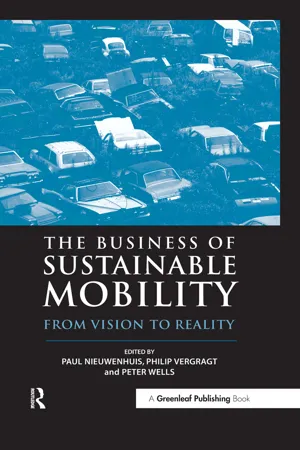
eBook - ePub
The Business of Sustainable Mobility
From Vision to Reality
- 256 pages
- English
- ePUB (mobile friendly)
- Available on iOS & Android
eBook - ePub
The Business of Sustainable Mobility
From Vision to Reality
About this book
In many parts of the world, there is a crisis of mobility. This book shows that technology may well not be enough in itself and that for a genuinely sustainable transport future far more radical change - affecting many aspects of society - is needed. It is useful for academics, practitioners, and policy-makers.
1
The business of sustainable mobility
Paul Nieuwenhuis and Peter Wells
ESRC Centre for Business Relationships, Accountability, Sustainability and Society, Cardiff University, UK
ESRC Centre for Business Relationships, Accountability, Sustainability and Society, Cardiff University, UK
Philip J. Vergragt
Tellus Institute, Boston, USA
Tellus Institute, Boston, USA
The international Greening of Industry Network (GIN) has, for more than ten years, been working to bring together experts and thinkers from business, industry, academia, government and non-governmental organisations (NGOs). Its main aim is to deal with issues of how to build a more sustainable industrial culture by combining the conceptual with the practical. The Network’s 2003 conference, held that year in San Francisco, saw sustainable mobility designated as a key theme: this book is based on that conference. It develops and updates some of the papers presented at San Francisco and includes a number of additional chapters to capture many of the themes to emerge from the 2003 conference. We hope this publication makes a significant contribution to the ongoing sustainable mobility debate.
Crisis, what crisis?
In many parts of the world, there is a crisis of mobility. The choices we have made over the past 200 years about modes and technologies of transportation have brought us unprecedented global interaction and, in many respects, increased personal freedom. However, this enhanced mobility has come at a high cost—to society, to the economy and to the environment—but few seem aware of the full extent of the mobility crisis. Though most people are aware of issues such as congestion, accidents (although this aspect is often overlooked), parking restrictions and fuel prices, few will have considered the implications of the dramatic increase in personal mobility anticipated in China, India and elsewhere. Nor do many people consider the contribution of cars to climate change or the impact of climate change on the environment.
It is often thought that technology alone can solve this problem. For some observers, salvation could be achieved by means of hydrogen fuel cells, hybrid cars, increased fuel efficiency or even by telematics to reduce congestion. This book shows that ‘technology’ may well not be enough in itself and that for a genuinely sustainable transport future far more radical change, affecting many aspects of society, is needed. It is likely that, as well as users and consumers adopting new forms of behaviour, new business models will be needed. Technological innovation may well contribute, but it will need to be induced by a combination of market forces and government regulation.
Few cultural artefacts of the modern era reflect the dilemma of sustainability as well as the car. At the social level, many people have been excluded from the advances offered by the car, and many have become its victims—in many of the poorest countries more people are killed or injured by cars and trucks than by war or famine. At the economic level, congestion, resource depletion and pollution bring significant, though largely uncertain, costs. At the environmental level, although some areas of concern, notably toxic emissions, are relatively well understood, the impact of others, such as carbon dioxide emissions on climate change, are not. As other causes of climate change begin to be addressed in the near future, car transportation will stand out as the single most intractable issue.
Even for those of us who benefit from the advances in personal and collective mobility, the costs are undeniable. In the US, more citizens have been killed on roads than in all the wars the US has ever been involved in, including terrorist acts (Williams 1991). Road building has reconfigured urban and suburban areas, creating social exclusion for many while enhancing the means of social interaction for others. Urban centres around the world have become congested with barely moving metal, while air quality has deteriorated. Urban sprawl, spreading suburbs far out into the countryside, is entirely due to individual car ownership; sprawl also makes it difficult to conceptualise a transportation alternative without the individually owned car, thus creating a situation of technological lock-in. Indeed, the environmental and social impacts of car ownership are extremely diverse, pervasive and complex (Nielsen et al. 1996; Sydbom et al. 2001).
Addressing the challenges
The recognition that we need to do something about these interconnected problems came initially with the realisation that deteriorating urban air quality, particularly in southern California, was car-related (Brilliant 1989; Mondt 2000), prompting a wave of legislation aimed at controlling automobile emissions. This has now extended into other areas, including car production and use. Regulation now applies to safety, noise, end-of-life vehicles and fuel efficiency, while in the future it is likely to take an increasingly holistic or life-cycle perspective.
The roll-out of such legislation is very much a cat-and-mouse game whereby legislators acting on the basis of political imperatives try to tighten regulation, industry claims dire consequences if the regulation goes ahead, and some kind of compromise position is reached. Not all of this regulation has been concerned with ‘control’ in the traditional sense; indeed, it was in recognition of the limitations of such regulation that initiatives such as the US Partnership for a New Generation of Vehicles were originally conceived (Wells 1996; Nieuwenhuis and Wells 1997: 54-62). Nevertheless, the regulatory approach, with successive generations of emissions standards, has created vehicles that are much improved in many respects. A modern car, driven under the right conditions, can be up to 95–99% ‘cleaner’ in terms of toxic emissions than its equivalent of 40 years ago (Mondt 2000: 213). By 2008, EU truck emissions will have improved tenfold compared with those of a truck built in the late 1980s (ACEA 2000).
So, have we solved the problem of sustainability for the automotive industry and its products? It would appear not. While individual vehicles have become cleaner, quieter, more durable, more recyclable and, in some respects, more efficient, various factors have combined to undermine these achievements. First, there is the fact that vehicle numbers have increased, distances driven have increased and growing congestion has resulted in longer periods where stationary cars continue to consume fuel and emit toxic exhaust gases. In addition, cars themselves have become heavier and more complex, with many more comfort and safety features. At the same time, there has been a move—led by the US—to generally heavier sports utility vehicles (SUVs), pick-up trucks and minivans or ‘people carriers’ for personal transport. Just as importantly, the newly motorising economies of China, India, Indonesia, Russia and Brazil are potentially markets of such magnitude that, collectively, they could easily outgrow the established ‘triad’ markets of Europe, North America and Japan within the next 20 or 30 years, thus doubling the global burden imposed by motorisation in many respects. Clearly, we need to think of more radical solutions than have been implemented so far. It was the factor x debate that first highlighted the need to improve resource efficiency by an order of magnitude if people in the emerging economies are to enjoy an equivalent standard of material welfare to those in the established economies (Vergragt and van Grootveld 1994; Ryan 1998; von Weizsäcker et al. 1997). As the single largest manufacturing sector in the world, the automotive industry is strongly implicated in this debate.
The industry has largely ignored the challenges described above and has continued to produce heavier and less efficient cars and SUVs in order to benefit financially from the high profit margins on these vehicles. Nevertheless, the large car companies have also engaged in R&D on alternative fuels and powertrains, recognising the challenges and seeing the profitable opportunities that environmentalism can offer the sector. Consequently, radical alternative technologies are under development by many of the world’s largest car-and truck-making concerns and their suppliers. However, moving these from the R&D arena to the commercial market is a bigger step than is often appreciated, especially for an essentially conservative industrial culture. The industry appears almost paralysed by its own structural condition, characterised by high capital intensity alongside low returns on capital (Nieuwenhuis and Wells 1997, 2003; Maxton and Wormald 2004). More profoundly, it is simply not possible for there to be a magicbullet solution in the form of a new car technology that can render the industry entirely sustainable. Although theoretically imaginable, the practical barriers are such as to make it impossible from the current perspective. The best that can be achieved is that the industry will become relatively more sustainable than it is today, with products that are less polluting and more resource-efficient.
Beyond the technofix
Much of the effort reflected in the chapters in this book is concerned with going beyond the technofix of designing new, more environmentally friendly cars, to confront the more difficult challenges of institutional, cultural and social change within and beyond the industry that must be resolved in the transition towards sustainability. We therefore seek to break through the conventional boundary between engineering and the social sciences, with contributors from both sides of this traditional albeit unnecessary divide, including economists, engineers, geographers and designers.
About this book
The focus of this book is on motorised land-based mobility. We consider it obvious that a world of pedestrians and cyclists would be much more sustainable, and have therefore not covered these. Air transport has also been excluded. Although we recognise that this is a growing and significant issue, research on its impact is still in progress and thinking about possible solutions is in its infancy. For these reasons we therefore focus on land transport.
The central problem is the private car—how to power it; how to build it; and how to deliver it to customers in a more sustainable way. We start with ideas of radical innovation in the propulsion system of the car, notably the hydrogen fuel cell. In this context, Chapter 3 by Renato Orsato explores why the battery electric vehicle (BEV) has once again failed to make its long-awaited breakthrough. The competition for credibility between fuel-cell cars and hybrid electric cars is explored by Marko Hekkert and Robert van den Hoed in Chapter 4, while Chapter 5, by Robert van den Hoed and Philip Vergragt, examines the gradual rise of fuel-cell technology to a more institutionalised status. Many of the chapters thus deal with particular aspects of these broader changes.Chapters 2–5 therefore have the broad theme of transition to a hydrogen economy with a focus on one of the more promising alternative powertrain technologies, the fuel cell. The issue of transition has been given considerable theoretical and empirical treatment by those concerned with sustainability, particularly academics and policy-makers. Techniques and approaches have been developed. Backcasting (Quist and Vergragt 2004), for example, sets a final target or state, and then looks backwards from that point to ask what steps have to be taken in order to reach that point from the position we are in today. An alternative approach, much favoured by those charged with disbursing public R&D funds as well as with companies, is the technology road map. This is somewhat akin to critical path analysis (and is therefore popular with those from an engineering and science tradition), as it seeks to identify the necessary features or steps that need to be in place in order for some future scenario to come to pass.Chapter 3, however, sounds a warning over the difficulties inherent in this kind of forecasting by wondering whatever happened to the BEV: just ten years ago this technology was hailed as a possible saviour. Why, then, did it fail to gain market acceptance?
We are nevertheless aware that powertrain improvements alone cannot solve the problem of sustainable mobility. The section on sustainable business and industry models (Chapters 6–7) considers the possible business models that could be used to deliver automobility in a more sustainable manner. In line with our assertion that we cannot change one element of the system without considering the impact of such change on the whole, the section looks at how the car is made and used, and at how these aspects affect the quest for sustainable mobility. So embedded are notions of status and aesthetic pleasure with car ownership, changing the culture of automobility is by no means easy. Nevertheless, it must be seriously doubted whether automobility will ever be sustainable under the current philosophy of fire-and-forget production. New business models are needed that not only allow product-service system (PSS) concepts to become reality, but that also offer an escape from relentless over-production as well as a means of realising the potential of product stewardship while enhancing customer care in the process. Chapter 5 begins to address this issue and can be seen as providing a link to Chapters 6 and 7. In Chapter 6, Andrew Williams explores the opportunities offered by the PSS concept in introducing new business models to the automotive sector. It also introduces the concept of micro-factory retailing as a possible alternative business model for delivering automobility in a more sustainable world.Chapter 7 by Peter Wells and Paul Nieuwenhuis presents this concept in more detail and highlights some of its social and economic advantages, particularly within the context of a relocalisation of economic activity, thus linking in with a debate rarely addressed in the context of the automotive manufacturing sector.
The theme of vehicle alternatives and their introduction trajectories is explored in Chapters 8–10 which consider a number of recently introduced vehicles and alternative vehicle concepts and how these might be introduced within the context of a dominant existing paradigm. The history of the automotive industry shows how extremely difficult it has been to introduce alternative technology concepts, particularly when associated with new-entrant companies with no brand identity in the market. The alternative concepts discussed vary from a powertrain exchange concept that could breathe new life into the electric vehicle (Chapter 8) to minimalist single-seater commuter vehicles (Chapters 9 and 10). Again, important lessons can be learned even where such new concepts fail to achieve market success, not least by seeking to identify the reasons for such a failure, be they ‘internal’ to the technology itself, associated with the company that sought to introduce the alternative or embedded in the operating context by virtue of existing regulations, etc. In Chapter 8, Gordon Dower presents a concept that addresses one of the key concerns of electric vehicles—battery range—but broadens this into a more universally applicable vehicle concept which could be of particular interest for certain transport niches. This is followed, in Chapter 9, by Halina Szejnwald Brown and Catherine Carbone who report on their investigati...
Table of contents
- Cover
- Half Title
- Title
- Copyright
- Contents
- Foreword
- 1 The business of sustainable mobility
- 2 Transition management for sustainable personal mobility: the case of hydrogen fuel cells
- 3 Future imperfect: the enduring struggle for electric vehicles
- 4 Competing technologies and the struggle towards a new dominant design: the emergence of the hybrid vehicle at the expense of the fuel-cell vehicle?
- 5 Institutional change in the automotive industry: or how fuel-cell technology is being institutionalised
- 6 System innovation in the automotive industry: achieving sustainability through micro-factory retailing
- 7 Business models for relocalisation to deliver sustainability
- 8 Modularity for greening the automobile
- 9 Social learning through technological inventions in low-impact individual mobility: the cases of Sparrow and Gizmo
- 10 The seven characteristics of successful sustainable system innovations
- 11 Government behind the wheel and backseat driving: co-ordination and informational challenges of voluntary partnerships as programmes for stimulating sustainable technology
- 12 Process- and product-oriented environmental policy within the car chain: examples from BMW and General Motors
- 13 The switch to CNG in two urban areas in India: how was this achieved?
- 14 Local needs in urban transport
- 15 Web-based environmental management systems for SMEs: enhancing the diffusion of environmental management in the transportation sector
- 16 The reinvention of the automobile
- 17 Conclusions: where next and when can we buy one?
- 18 Epilogue: a day in a lifein 2049
- Abbreviations
- About the contributors
- Index
Trusted by 375,005 students
Access to over 1.5 million titles for a fair monthly price.
Study more efficiently using our study tools.
Frequently asked questions
Yes, you can cancel anytime from the Subscription tab in your account settings on the Perlego website. Your subscription will stay active until the end of your current billing period. Learn how to cancel your subscription
No, books cannot be downloaded as external files, such as PDFs, for use outside of Perlego. However, you can download books within the Perlego app for offline reading on mobile or tablet. Learn how to download books offline
Perlego offers two plans: Essential and Complete
- Essential is ideal for learners and professionals who enjoy exploring a wide range of subjects. Access the Essential Library with 800,000+ trusted titles and best-sellers across business, personal growth, and the humanities. Includes unlimited reading time and Standard Read Aloud voice.
- Complete: Perfect for advanced learners and researchers needing full, unrestricted access. Unlock 1.5M+ books across hundreds of subjects, including academic and specialized titles. The Complete Plan also includes advanced features like Premium Read Aloud and Research Assistant.
We are an online textbook subscription service, where you can get access to an entire online library for less than the price of a single book per month. With over 1.5 million books across 990+ topics, we’ve got you covered! Learn about our mission
Look out for the read-aloud symbol on your next book to see if you can listen to it. The read-aloud tool reads text aloud for you, highlighting the text as it is being read. You can pause it, speed it up and slow it down. Learn more about Read Aloud
Yes! You can use the Perlego app on both iOS and Android devices to read anytime, anywhere — even offline. Perfect for commutes or when you’re on the go.
Please note we cannot support devices running on iOS 13 and Android 7 or earlier. Learn more about using the app
Please note we cannot support devices running on iOS 13 and Android 7 or earlier. Learn more about using the app
Yes, you can access The Business of Sustainable Mobility by Paul Nieuwenhuis,Philip Vergragt,Peter Wells in PDF and/or ePUB format, as well as other popular books in Business & Automobile Industry. We have over 1.5 million books available in our catalogue for you to explore.