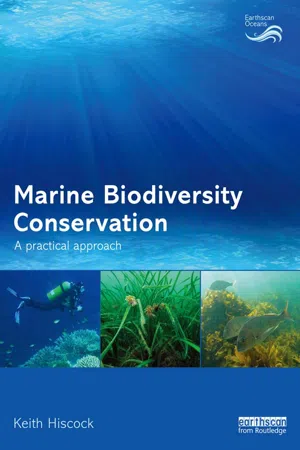
Marine Biodiversity Conservation
eBook - ePub

Marine Biodiversity Conservation

A Practical Approach

  1. 318 pages
  2. English
  3. ePUB (mobile friendly)
  4. Available on iOS & Android
eBook - ePub

Marine Biodiversity Conservation

A Practical Approach

About this book

Effective marine biodiversity conservation is dependent upon a clear scientific rationale for practical interventions. This book is intended to provide knowledge and tools for marine conservation practitioners and to identify issues and mechanisms for upper-level undergraduate and Masters students. It also provides sound guidance for marine biology field course work and professionals.

The main focus is on benthic species living on or in the seabed and immediately above, rather than on commercial fisheries or highly mobile vertebrates. Such species, including algae and invertebrates, are fundamental to a stable and sustainable marine ecosystem. The book is a practical guide based on a clear exposition of the principles of marine ecology and species biology to demonstrate how marine conservation issues and mechanisms have been tackled worldwide and especially the criteria, structures and decision trees that practitioners and managers will find useful. Well illustrated with conceptual diagrams and flow charts, the book includes case study examples from both temperate and tropical marine environments.

Frequently asked questions

Yes, you can cancel anytime from the Subscription tab in your account settings on the Perlego website. Your subscription will stay active until the end of your current billing period. Learn how to cancel your subscription.
No, books cannot be downloaded as external files, such as PDFs, for use outside of Perlego. However, you can download books within the Perlego app for offline reading on mobile or tablet. Learn more here.
Perlego offers two plans: Essential and Complete
  • Essential is ideal for learners and professionals who enjoy exploring a wide range of subjects. Access the Essential Library with 800,000+ trusted titles and best-sellers across business, personal growth, and the humanities. Includes unlimited reading time and Standard Read Aloud voice.
  • Complete: Perfect for advanced learners and researchers needing full, unrestricted access. Unlock 1.4M+ books across hundreds of subjects, including academic and specialized titles. The Complete Plan also includes advanced features like Premium Read Aloud and Research Assistant.
Both plans are available with monthly, semester, or annual billing cycles.
We are an online textbook subscription service, where you can get access to an entire online library for less than the price of a single book per month. With over 1 million books across 1000+ topics, we’ve got you covered! Learn more here.
Look out for the read-aloud symbol on your next book to see if you can listen to it. The read-aloud tool reads text aloud for you, highlighting the text as it is being read. You can pause it, speed it up and slow it down. Learn more here.
Yes! You can use the Perlego app on both iOS or Android devices to read anytime, anywhere — even offline. Perfect for commutes or when you’re on the go.
Please note we cannot support devices running on iOS 13 and Android 7 or earlier. Learn more about using the app.
Yes, you can access Marine Biodiversity Conservation by Keith Hiscock in PDF and/or ePUB format, as well as other popular books in Biological Sciences & Ecology. We have over one million books available in our catalogue for you to explore.

Information

Publisher
Routledge
Year
2014
eBook ISBN
9781317934332
Edition
1

Table of contents

  1. Cover Page
  2. Half Title Page
  3. Series Page
  4. Title Page
  5. Copyright Page
  6. Contents
  7. Preface
  8. About the author
  9. Acknowledgements
  10. A note on scientific names
  11. 1 The need for marine biodiversity conservation
  12. 2 What is where and how much of it is there? The role of science
  13. 3 Ecosystem structure, functioning and viability
  14. 4 Understanding change
  15. 5 Impacts of human activities on ecosystem composition, structure and function
  16. 6 The application of science to management: introduction
  17. 7 ‘Threatened’ and ‘sensitive’ species and habitats
  18. 8 Sampling and recording
  19. 9 Selection, design and management of marine protected areas
  20. 10 Assessing likely impacts and monitoring change
  21. 11 Recovery, restoration and replacement of habitats and species
  22. 12 Conclusions and the manager's ‘toolbox’
  23. Glossary
  24. Acronyms and abbreviations
  25. Reference
  26. Index