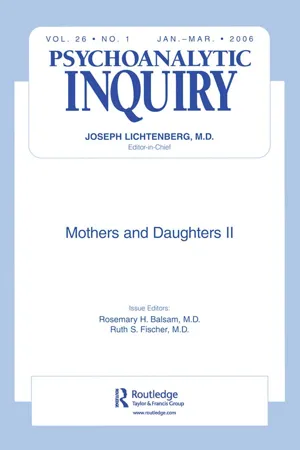
This is the second issue of Psychoanalytic Inquiry devoted to mothers and daughters. This project began as the mother-daughter bond was calling out for attention in light of the many advances in our understanding of female psychology. The goal of female development is no longer considered to be a severing of the mother-daugher bond to attain autonomy and sexual maturity. What, then, are its vicissitudes as it is revisited, reworked, and transformed as the girl and her mother grow and develop and ultimately attain a state of interdependence? The relational context of development is now considered: gender-related differences in behavior and in parental interaction; and the girl's special relationship with her mother and her mother's body and the importance to her of her own body with its special attributes, contours, and sensations.
eBook - ePub
Mothers and Daughters II
Psychoanalytic Inquiry, 26.1
- 160 pages
- English
- ePUB (mobile friendly)
- Available on iOS & Android
eBook - ePub
Mothers and Daughters II
Psychoanalytic Inquiry, 26.1
About this book
Information
Frida Kahlo and Object Choice: A Daughter the Rest of Her Life
NANCY KULISH, PH.D.
I argue that the entry into the triangular “oedipal” situation for girls does not necessitate a change in object, as Freud proposed, but an addition of object. My argument rests on different strands in contemporary psychoanalytic thinking: an appreciation of the complexity of internal objects, a reconsideration of the concept of bisexuality, an understanding of the role of multiple identifications in gender identity and object choice, and a reexamination of the triangular situation for girls. I focus on the life of Frida Kahlo—as revealed in biographies, journals, and art—to elucidate the layering of internal object choices. I conclude that object choice—heterosexual, homosexual, or bisexual—represents a composite or compromise formation.
“WHEN A MAN MARRIES HE GETS HIM A WIFE, BUT A DAUGHTER’S daughter the rest of her life.”Although this saying refers to familial relationships and the idea that a girl remains close to her mother even after she marries, it reflects the intrapsychic world as well. It implies that a daughter remains more tied to her mother internally than does a son. Indeed, psychoanalytic formulations of female development have contained such ideas that girls have more difficulty separating from their mothers and reaching sexual maturity.
According to Freud’s (1908) early formulations of female development, the path into the triangular “oedipal” phase for the girl is a tortured one, starting from an inborn masculinity to a hard-won femininity. Freud believed that to find her way into the “normal” Oedipal Complex and hetero-sexuality, three changes must occur for the girl: of sexual organ, aim, and object. She must abandon pleasures from the “masculine” clitoris; she must convert a phallic, masculine orientation to a more passive feminine one; and finally she must renounce her original sexual object, the mother, for the father. What drives this development is the girl’s discovery of sexual difference and her envy of the penis. In his 1916 “Some Character Types Met With in Psychoanalytic Work,” Freud delineated the psychological consequences of the girl’s penis envy: wounded narcissism, a lasting sense of inferiority, character traits of persistent jealousy, and deep resentment against her mother. I will argue that the entry into the triangular oedipal situation for girls does not necessitate a change in object, as Freud proposed, but an addition of object. That is, girls retain their desires toward their mothers, and they add other objects—male or female. This point is often missed, because libidinal attachments that girls hold toward their mothers are very often embedded and camouflaged in their attitudes and orientation toward male objects. This idea of multiple layers of internal objects or the complexity of object choice is stressed by contemporary psychoanalytic approaches.
Review of the Literature
Over the years, many psychoanalytic writers have questioned the sequence of female psychosexual development as originally laid down by Freud. In reviewing the literature, I will briefly address only those arguments that I believe have relevance for the issue of change of object. Among the important considerations are the timing of the discovery of sexual differences, the role of penis envy, the understanding of the importance of maternal identifications, considerations of bisexuality, and the nature of the female triangular situation.
Starting from the false premise that little girls’ original sexuality was masculine, Freud had to find explanations for their eventual femininity and entry into the oedipal phase. His logic, in keeping with clinical observations of female envy toward men, provided an internally logical, step-by-step sequence. The first step in this progression was the girl’s discovery of her “castration,” her subsequent sense of lack and penis envy, resulting in her turning away from her mother in anger and disappointment and toward the father to gain compensation for her missing penis via the promise of a baby. Thus, castration impelled her into the oedipal situation but left her there. Being already “castrated,” she lacked the motivation to resolve the oedipal conflicts compared with the boy. The boy’s castration anxiety was formulated as what motivated him to give up his incestuous wishes, identify with his rival, the father, and move out of the oedipal phase.
A long series of psychoanalytic works, based on clinical and observational research, has challenged this sequence as erroneous and skewed (Chehrazi, 1986). To begin with, the timing of children’s discovery of sexual difference is much earlier than Freud thought—eighteen months not three or four years of age (Kleeman, 1976). Thus, the discovery of the sexual difference that was thought to trigger the chain of events leading to triangulation would occur several years before the oedipal phase was thought to commence. Secondly, the role of penis envy in girl’s development has been extensively rethought and reformulated. Although subsequent analysts have observed penis envy clinically, they have, from the beginning, disagreed about its primacy and its role in change of object and initiation of the Oedipus Complex. Early on, Horney (1924) asserted that the girl’s inferiority complex and penis envy were secondary and culturally based. Through the years, many others have offered rich clinical understandings of the role of penis envy, which puts it in a different perspective vis à vis the developmental sequence for the girl (Lerner, 1976). Most clinicians have linked penis envy to problems the girl might have with her mother and conceptualize it not as inevitable or a necessary cog in a stepwise schema but as a passing experience in childhood. Penis envy will become prominent or fixed if there are particular forces within the family constellation, such as the birth of a baby brother, favoritism toward males, or problems in the mother–daughter relationship that reinforce it. Chasseguet-Smirgel (1970), for instance, focused on the anal-sadistic struggles between mother and daughter that nourish the girl’s fantasy of mother’s castrating, controlling powers and defensive idealization and envy of the paternal phallus. Frenkel (1996), in an article expressly dealing with object choice in women, presented clinical material of women and girls that demonstrated that penis envy was pathological and did not contribute to a shift in object choice to father. It is commonly agreed now that in “normal” development, the psychological consequences of penis envy that Freud originally described would more likely impede triangular development than advance it. In an influential article, Grossman and Stewart (1976) emphasized the need to analyze the meanings and functions of penis envy, when it is observed, rather than taking it as “bedrock.”
Others also have questioned the inevitability of the sequence described by Freud, and further elaborated by Nagera (1975), which pictured the girl as going through a period, the so-called “negative oedipal” phase preceding the “positive oedipal” phase; that is, of first the loving mother as a phallic boy might before she turns to her father. According to Anna Freud (1965, p. 196), the negative Oedipus Complex represents a normal “homosexual” phase in the life of both boys and girls. Edgecumbe and colleagues (1976) doubted whether a negative oedipal phase is a necessary step in normal female development. In their clinical research, they found that what is described as a negative oedipal constellation may actually be considered an arrest at, or regression to, the preoedipal phallic narcissistic level characterized by dyadic object relationships.
The Kleinians, and those closely influenced by them, have offered different theories about the impetus for the male and female child’s entry into the oedipal drama (Britton, et al., 1989). For them, the oedipal situation rests on a primitive unconscious awareness of the primal scene, known to the child much earlier than posited by Freud. Thus, there was no need to put forward a complicated explanation of how the girl finds her way into the oedipal situation. According to Klein (1928), primitive oedipal fantasies colored by oral sadism make their appearance in the first two years of life as a consequence of frustration by the mother. The acuteness of the ambivalence, the predominance of oral trends, and the uncertain choice of the love object characterize the Kleinian conceptualization of the very early stage of the Oedipal Complex. Segal (1974) noted the rudimentary dawning of oedipal dynamics as the infant becomes aware of the important link that exists between the father and mother. In a Kleinian tradition, Jones (1933) described very young girls’ fearful fantasies of rape by their fathers, giving evidence of their projected oedipal desires.
Conversely, many analytic traditions still cling closely to essential aspects of Freud’s ideas about the course of female development. Like Freud, Lacanians give primacy to the concept of a change in object. The French Lacanian analyst, Hamon (2000), posed the question, “Why do women love men and not their mothers?” The question itself reveals a theoretical assumption: that is, that girls start out with their mothers as primary objects so that there is a need to explain how they end up desiring their fathers. Hamon traced the contributions of all the early psychoanalytic pioneers to the question of the change in object for the girl and evaluated them through the lens and language of Lacanian theory. A central, defining issue for Hamon is how each theorist deals with the girl’s “castration.” According to Hamon, the necessary change of object, which she takes as a given, occurs through the girl’s recognition of the mother’s and her own castration, her acknowledgement of the father as the bearer of the “Phallus,” and submission to his “Law.” I question the necessity, in the first place, of such explanations for change of object, and, in the second place, for an insistence on the role of castration in the forward movement of female development.
Contemporary Psychoanalytic Understandings of Object Choice
I now would like to draw on several different strands in contemporary psychoanalytic thinking that add further substance to the argument that object choice in females cannot be understood as a simple matter of a change from mother to father. These trends come from many sources: first, the appreciation of the complexity and multilayering of internal objects; second, the reconsideration of the concept of bisexuality; third, the role of multiple identifications in gender identity and object choice; and fourth, a reexamination of the triangular situation for girls.
The Complexity of Internal Objects
Through the intimate study of the minds of their patients in the process of psychoanalysis, psychoanalysts have come to understand the complexity of internal object representations. Arlow (1980), with his usual clarity, reminded us of this:
From a psychological point of view the individual’s concept of a person is a conglomerate of many earlier object representations. This coherent organized concept may be dissolved regressively into its antecedent object representations [p. 118]…. The concept of the object, as well as the concept of the self and even of the superego, may undergo regressive dissolutions into their antecedent identifications. This may be observed in dreams and in psychopathology [pp. 121–122].
Thus, the final point in any individual’s choice of love object—male or female—is not the entire story. Pertinent to the subject of change of object, according to this line of thought, the girl’s sexual object choice of father may be built up of many earlier object representations, including maternal ones.
Young-Bruehl (2003) illuminated this complexity with clinical examples. Like Arlow, she suggested that everyone carries over varied representations of beloved familial figures into their love objects. She described four processes of transferential object choices in everyday life that contribute to the many and varied permutations of object choice:
1.Part objects: Part objects can stand for a whole object. If the part object happens to be gendered, such as a breast, then the whole object will correspondingly be gendered.
2.Split or doubled objects: Split or doubled objects are those objects onto which an individual places and separates desires once directed toward a single object. These doubled sets of objects can be male and female.
3.Composite objects: Composite objects blend parts, traits, and characteristics from at least two sources. These original sources can be objects of both genders.
4.Layered composite objects: Composite objects that are layered, for example, manifest and latent, may be male at one level and female at the other.
As Young-Bruehl stated, these fundamental processes, which can become manifest as male versus female, show up in object choice in the most varied combinations and are socially supported in complex ways (pp. 204–205).
Many contemporary writers have struggled with the question of what determines the end choice of object. Is object choice fixed in early childhood? Is it determined by biology or shaped by the environment? For Freud, object choice in women was the final outcome of a torturous set of circumstances. Problems in development could “fix” a female in a male orientation and a homosexual object choice (1931), whereas biological influences—an inborn “masculine” disposition in a girl—also could be at play (1920, pp. 169–172).
Kirkpatrick (2003) argued that sexual orientation is a “multivariate sequential determinism” and is more flexible in women. She asserted that female homosexuality does not appear to be influenced by biological factors. She pointed out that a specific gene for male homosexuality has not been found either, but rather character traits, influenced by biology, might enhance that possibility. In other words, object choice, especially for women, does not appear to be a once-and-for-all, preordained situation.
Fischer (2002) observed that the idea that the girl retains her ties to her mother as she turns toward her father can help to explain the comfort that girls and women appear to have with their bisexual inclinations as well as the emergence of homosexuality in midlife. Making another salient point, which she put succinctly: “Ties to each parent develop in tandem, not sequentially” (p. 278).
Bisexuality
As in indicated earlier, the current controversies about the “causes” for homosexuality intersect with ideas of bisexuality that have resurfaced in psychoanalytic discourse. As Young-Bruehl (2003) pointed out in a recent review of the subject, the term “bisexual” has changed meanings over time in psychoanalytic thinking. Beginning with Freud’s biological bisexuality, meanings then shifted to the idea of heterosexuals or homosexuals as types of people defined by their object choices, as in Kinsey’s (1948) categorizations, and now lead to a current emphasis on object choices and behaviors, which are known to be diverse, changeable, and strongly influenced by environmental factors. Young-Bruehl reviewed the research on the biological domain and concluded that none of the research has yet yielded anything that resembles a causal explanation for homosexuality or heterosexuality but that biological factors do appear to have an influence on object choice in nonspecified, indirect ways. Most researchers would also now concur that gender identity and object choice/sexual preference are not related in a simple, linear way.
Gender Identity and Object Choice
Contemporary conceptualizations of the complexity of gender identity inspire parallel careful approaches to the understanding of object choice. Balsam (2001), for example, proposed that mature gender identity in women is made up of an integrated blend of male and female identifications and bodily representations. She decried the older polarized view of female development as repudiation and overcoming masculinity. Elise (1998...
Table of contents
- Cover
- Title Page
- Copyright Page
- Prologue
- Frida Kahlo and Object Choice: A Daughter the Rest of Her Life
- Fighting With Spoons: On Caretaking Rivalry Between Mothers and Daughters
- Pathways of Growth in the Mother-Daughter Relationship
- Searching for Togetherness: The Simultaneous Treatment of a Mother and Her Early Adolescent Daughter
- Bound Together by Chronic Pain and Trauma: A Study of Two Mother-Daughter Relationships
- The Disappearing (or Ghost) Mother Transference: In Search of the Available Mother Within
- Mothers and Daughters as Adults
- Epilogue
Trusted by 375,005 students
Access to over 1.5 million titles for a fair monthly price.
Study more efficiently using our study tools.
Frequently asked questions
Yes, you can cancel anytime from the Subscription tab in your account settings on the Perlego website. Your subscription will stay active until the end of your current billing period. Learn how to cancel your subscription
No, books cannot be downloaded as external files, such as PDFs, for use outside of Perlego. However, you can download books within the Perlego app for offline reading on mobile or tablet. Learn how to download books offline
Perlego offers two plans: Essential and Complete
- Essential is ideal for learners and professionals who enjoy exploring a wide range of subjects. Access the Essential Library with 800,000+ trusted titles and best-sellers across business, personal growth, and the humanities. Includes unlimited reading time and Standard Read Aloud voice.
- Complete: Perfect for advanced learners and researchers needing full, unrestricted access. Unlock 1.5M+ books across hundreds of subjects, including academic and specialized titles. The Complete Plan also includes advanced features like Premium Read Aloud and Research Assistant.
We are an online textbook subscription service, where you can get access to an entire online library for less than the price of a single book per month. With over 1.5 million books across 990+ topics, we’ve got you covered! Learn about our mission
Look out for the read-aloud symbol on your next book to see if you can listen to it. The read-aloud tool reads text aloud for you, highlighting the text as it is being read. You can pause it, speed it up and slow it down. Learn more about Read Aloud
Yes! You can use the Perlego app on both iOS and Android devices to read anytime, anywhere — even offline. Perfect for commutes or when you’re on the go.
Please note we cannot support devices running on iOS 13 and Android 7 or earlier. Learn more about using the app
Please note we cannot support devices running on iOS 13 and Android 7 or earlier. Learn more about using the app
Yes, you can access Mothers and Daughters II by Rosemary H. Balsam, Ruth S. Fischer, Rosemary H. Balsam,Ruth S. Fischer in PDF and/or ePUB format, as well as other popular books in Psychology & Applied Psychology. We have over 1.5 million books available in our catalogue for you to explore.