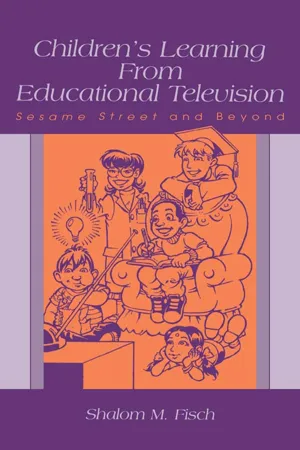
At its best, educational television can provide children with enormous opportunities and can serve as a window to new experiences, enrich academic knowledge, enhance attitudes and motivation, and nurture social skills. This volume documents the impact of educational television in a variety of subject areas and proposes mechanisms to explain its effects. Drawing from a wide variety of research spanning several disciplines, author Shalom M. Fisch analyzes the literature on the impact of educational resources. He focuses on television programs designed for children rather than for adults, although adult literature is included when it is particularly relevant. In addition, much of the discussion concerns the effects of unaided viewing by children, rather than viewing in the context of adult-led follow-up activities. The role of parent-child co-viewing and issues relevant to the use of television in school or child care also receives consideration.
This volume is intended to make the disparate literature on educational television's impact more accessible, by bringing it together into a centralized resource. To that end, the volume draws together empirical data on the impact of educational television programs--both academic and prosocial--on children's knowledge, skills, attitudes, and behavior. In addition to its emphasis on positive effects, this volume addresses a gap in the existing research literature regarding children's learning from exposure to educational television. Acknowledging that little theoretical work has been done to explain why or how these effects occur, Fisch takes a step toward correcting this situation by proposing theoretical models to explore aspects of the mental processing that underlies children's learning from educational television.
With its unique perspective on children's educational television and comprehensive approach to studying the topic, this volume is required reading for scholars, researchers, and students working in the area of children and television. It offers crucial insights to scholars in developmental psychology, family studies, educational psychology, and related areas.
- 280 pages
- English
- ePUB (mobile friendly)
- Available on iOS & Android
eBook - ePub
About this book
Information
1
Introduction
Mom! Arthur’s not letting me watch educational television!
—D. W. Read, Arthur
One day, while writing this book, my 4-year-old daughter was home with a cold. As I worked, she sat beside me, watching Mister Rogers’ Neighborhood on television. When Mister Rogers held up a photo of musician Yo Yo Ma, I sensed an opportunity to introduce my daughter to an aspect of classical music. But as I began to explain who Yo Yo Ma was, she interrupted me: “I know. I saw him before,” she said.
“He was on Arthur.”
I had to chuckle, not only at my precocious daughter, but also at what the incident said about the reach and power of educational television. My dutiful effort to use television as a springboard for expanding my preschooler’s cultural knowledge had been foiled … because she had already been introduced to the information via another educational program. And so, my daughter and I simply watched along with Mister Rogers as Yo Yo Ma played a duet with his own son.
At its best, educational television can provide children with enormous opportunities. Educational television can serve as a window to new experiences, enrich academic knowledge, enhance attitudes and motivation, and nurture social skills. This volume documents the impact of educational television in a variety of subject areas and proposes mechanisms to explain its effects.
TELEVISION IN CHILDREN’S LIVES
In the time since television first became widely available, nearly half a century ago, the medium has grown to play a major role in the lives of children. Early studies of communities recently introduced to television found that, among families that had television sets, the average amount of time children spent watching television ranged between 1 hour, 36 minutes and 2 hours, 54 minutes per day—the equivalent of approximately 11 to 21 hours per week (Schramm, Lyle, & Parker, 1961). Estimates were even higher immediately after television appeared, probably due to the novelty of the medium. Maccoby (1951) found that, when television was first introduced to a community, children watched television for 3.5 hours on weekdays and 4.5 on Sundays (a total of more than 25 hours per week); after the first few months, viewing settled down to approximately 19 hours per week.
The picture has not changed considerably over the years. In the 1980s, several researchers reported average viewing time to be between 11 and 28 hours per week; although the exact figure varied across studies, all of the studies found that American children spend more time watching television than in any other activity except sleeping (Anderson, Field, Collins, Lorch, & Nathan, 1985; Huston, Watkins, & Kunkel, 1989; Huston, Wright, Rice, Kerkman, & St. Peters, 1987). In fact, despite the recent growth of new media such as computers, video games, and the Internet, television continues to be children’s medium of choice. A 1999 study by the Kaiser Family Foundation found that American children spent nearly 20 hours per week watching television, far more time than they spent with any other medium (Roberts, Foehr, Rideout, & Brodie, 1999). According to parent reports, even children as young as 2 to 3 years old spend more than 18 hours per week watching television (Jordan & Woodard, 2001).
Nor is this phenomenon unique to the United States. Children in Japan spend more than 17 hours per week watching television (primarily commercial television), an average that has remained stable over a period of 10 years (Kodaira, 2001). A multinational comparison of data from 23 countries found that children spent an average of 18 hours per week watching television. Although individual children varied greatly in their viewing, the mean of 18 hours was 50% higher than the time spent in any other activity (Groebel, 1999). Similarly, a second multinational study revealed that the amount of time children spent with television varied across countries (e.g., a mean of slightly over 10 hours per week in France, Switzerland, and Germany, versus more than 17 in Denmark and the U.K.), but the overall range was consistent with viewing in the United States (Livingstone, Holden, & Bovill, 1999). Indeed, after reviewing 45 studies, Larson (2001) concluded that the time spent by adolescents in the United States, Europe, and Asia was essentially identical.
Given the ubiquity of television in children’s lives, it is not surprising that researchers and laypeople alike have devoted a significant amount of attention to the effects of television on young viewers. Often, these discussions of the effects of television on children focus solely on the negative. Some critics have argued that exposure to television—even educational television—can lead to outcomes such as reduced attention spans, lack of interest in school (because teachers do not sing and dance like characters on television), or children’s becoming passive “zombie viewers” (e.g., Healy, 1990; Mander, 1978; Medved & Medved, 1998; Postman, 1985; Winn, 1977). Concerns over television’s potential contribution to a broad range of problem behaviors (e.g., aggressive behavior, substance abuse, obesity, sexual activity, decreased school performance) led the American Academy of Pediatrics to recommend that children’s total time with television and other media should be limited to no more than 1 to 2 hours per day (i.e., 7 to 14 hours per week), and that television should be eliminated entirely for children under the age of 2 (American Academy of Pediatrics, 1997, 2001).
Yet, as Wartella (1995) has observed, many of these claims have been put forth with little, if any, basis in empirical data. Instead of growing out of experiments with children, some claims have been based entirely on content analyses of material shown in television programs or correlational research that cannot establish causal relationships. Other claims have been based on not much more than personal opinion, and have been directly refuted by research with children. For example, observational studies of children’s viewing of television have shown that children watch television actively, not passively (e.g., Anderson, Lorch, Field, & Sanders, 1981; Lorch, Anderson, & Levin, 1979). Moreover, numerous studies have found that educational series such as Sesame Street produce long-term benefits in school rather than boredom and reduced attention spans (see chap. 2, this volume).
This is not to say that television is completely without negative effects. Hundreds of studies have confirmed the finding that violent television programs contribute to aggressive behavior among viewers (see Wilson et al., 1997 for a review). The persuasive effects of advertising on children have also been documented (Kunkel, 2001), as has the influence of stereotyped portrayals on television in shaping children’s attitudes (Graves, 1993; Signorelli, 1993).
Nevertheless, even those negative effects that are supported by data do not present the entire picture. Often, far less attention has been devoted to the positive effects that carefully crafted, developmentally appropriate television programs can hold. If we believe that children can learn negative lessons from television, then it stands to reason that they can learn positive lessons, too. The same medium that leads children to learn product information from a commercial should also be able to help them learn science concepts from an educational program. And the same medium that influences children to act aggressively after exposure to violent programming should also be able to influence them toward cooperative behavior after watching prosocial programming. Research indicates that all of these propositions are true.
Why, then, has the literature on educational effects received so little attention? Part of the reason lies in the fact that a great deal of the research is not easily accessible. Because the literature covers such a wide variety of issues and academic subjects, published research in this area has been scattered across numerous disparate sources, ranging from the Journal of Educational Psychology to Educational Technology Research and Development to the Journal of Mathematical Behavior. Moreover, a significant percentage of the literature has never been published in scholarly circles, appearing only in conference papers, technical reports, or research reports to producers and funders.
These issues provide a central motivation for the creation of this book. It is intended to serve two main purposes. The first is to make the disparate literature on the impact of educational television more accessible by gathering it into a centralized resource. To that end, the volume draws together empirical data on the impact of educational television programs (both academic and prosocial) on children’s knowledge, skills, attitudes, and behavior.
The second is to address an equally important gap in the existing research literature. Although, as we will see, numerous studies have shown that children learn from exposure to educational television, there has been very little theoretical work to explain why or how these effects occur. The last several chapters in this volume take a first step toward correcting that situation by proposing theoretical models to explore aspects of the mental processing that underlies children’s learning from educational television.
TELEVISION VIEWING AND ACADEMIC ACHIEVEMENT
As Neuman (1991) noted, television is a common target for those seeking to lay blame for educational dilemmas such as poor national test scores, academic skills, and levels of literacy. Often, the assumption underlying such arguments is what has come to be known as the displacement hypothesis, that is, the notion that television viewing takes time away from homework and more productive leisure-time activities, such as reading. However, research has shown that, in truth, the relationship between television and academic achievement is not nearly so simple and direct.
Comparison Studies
When television was first introduced on a broad scale, early research compared thousands of children who lived in American or British towns where television was available to children living in nearby towns where it was not (e.g., Himmelweit, Oppenheim, & Vince, 1958; Schramm et al., 1961). These studies suggested that the presence of television did lead to significant changes in children’s use of their time, but that it made little difference in the amount of time that children devoted to homework. In addition, Schramm et al. found no change in the time children spent reading books, and whereas Himmelweit et al. initially found a decline in book reading (particularly among children who had shown only a marginal interest in reading in the first place), reading returned to pretelevision levels a few years after television was introduced. Where, then, did the time spent with television come from? Primarily, television took time away from activities that served similar functions, such as listening to the radio, going to movies, and reading comic books.
A similar study was conducted some years later by Williams and her colleagues (Williams, 1986; cf. MacBeth, 1996). They compared children in three Canadian towns: one in which television was unavailable (code-named Notel), one that received only one television station (Unitel), and one that received several stations (Multitel). As in the earlier studies, the researchers found that children who had access to television used their time differently from those who did not. However, they also found that second-grade children in Notel scored higher on tests of reading fluency and creative thinking than children in the other two towns. The differences disappeared 2 years after television was introduced in Notel, suggesting that the presence of television had been responsible for the effect (Corteen & Williams, 1986; Harrison & Williams, 1986).
Correlational Studies
A number of studies used correlational data to investigate relationships between children’s television viewing and their achievement in school. Williams, Haertel, Walberg, and Haertel (1982) conducted a meta-analysis using data from 23 large-scale studies, and concluded that there was a small inverse relationship between amount of viewing and achievement r = −.05). However, part of the reason why the correlation was so low was that the relationship between television viewing and achievement was not linear. Rather, it was curvilinear; children who watched 10 hours of television per week performed slightly better (not worse) than those who watched less, but as viewing increased beyond 10 hours per week, achievement declined dramatically.
Comstock and Paik’s (1991) analysis of data from the California Assessment Study argued for a more linear relationship, but further support for curvilinearity came from Neuman’s (1988, 1991) analysis of several large-scale studies. Neuman found that there was little relation between viewing and reading performance among children who watched 2 to 4 hours of television per day (i.e., 14 to 28 hours per week), but that performance was considerably lower for children who watched more than that. Similarly, some studies have suggested that there may be thresholds of viewing, beyond which excessive television viewing is associated with poorer academic achievement. Fetler (1984) found that viewing for more than 6 hours per day (i.e., 42 hours per week) was associated with lower performance in literacy and mathematics, and Potter (1987) found that television viewing was negatively related to achievement for eighth to twelfth graders who watched more than 30 hours per week.
The complexity of the relationship between television and school achievement can be attributed to several factors. One is the fact that school achievement is predicted much more strongly by variables such as IQ and socioeconomic status (both of which predict television viewing as well). Another is that the relationship between viewing and achievement differs somewhat by age (e.g., Huston & Wright, 1997; Neuman, 1991). In addition, Comstock (1989) suggested that television viewing is inversely related to achievement when it displaces intellectually richer experiences, but positively related when it supplies such experiences.
Along similar lines, I would argue for one more factor that complicates the picture and may have reduced the strength of the relationship observed in these studies. Each of the studies mentioned above looked only at how much television was viewed, and not at the nature of the television programs that children watched. Not all television programs are the same, and they do not all produce the same effects among viewers. For example, longitudinal research by Wright, Huston, and their colleagues found that preschool viewing of Sesame Street and other educational television programs predicted higher performance in subsequent tests of academic skills. By contrast, however, preschool viewing of entertainment programs predicted poorer performance (Wright, Huston, Murphy, et al., 2001; Wright, Huston, Scantlin, & Kotler, 2001; see chap. 2, this volume). As the late John Wright was fond of saying, “Marshall McLuhan appears to have been wrong. The medium is not the message. The message is the message!” (Anderson, Huston, Schmitt, Linebarger, & Wright, 2001, p. 134).
In keeping with this idea, the bulk of the research discussed in this volume focuses not on the impact of television in general, but on the impact of one kind of television in particular—namely, educational television.
BUT WHAT IS “EDUCATIONAL TELEVISION”?
Over the years, numerous terms have been used to refer to television programs that are intended to educate or benefit children: educational television, instructional television, curriculum-based programming, educational/informational programming, infotainment, edutainment, entertainment-education, and so on. Often, the terms refer to somewhat different classes of television programming; for example, instructional television often has been used in relation to television programs produced for use in classrooms, whereas infotainment has carried the connotation of “lite” educational content for consumption on broadcast television.
Definitional issues came to the fore during the debates surrounding the passage of the Children’s Television Act of 1990 and the Federal Communications Commission’s (FCC) strengthening of its regulations several years later (FCC, 1991, 1993, 1995). Because the intent of the Act was to enco...
Table of contents
- Cover Page
- Half Title page
- Series Page
- Title Page
- Copyright Page
- Dedication
- Contents
- Preface
- 1 Introduction
- I Empirical Data
- II Theoretical Approaches
- III The Future
- References
- Author Index
- Subject Index
Trusted by 375,005 students
Access to over 1.5 million titles for a fair monthly price.
Study more efficiently using our study tools.
Frequently asked questions
Yes, you can cancel anytime from the Subscription tab in your account settings on the Perlego website. Your subscription will stay active until the end of your current billing period. Learn how to cancel your subscription
No, books cannot be downloaded as external files, such as PDFs, for use outside of Perlego. However, you can download books within the Perlego app for offline reading on mobile or tablet. Learn how to download books offline
Perlego offers two plans: Essential and Complete
- Essential is ideal for learners and professionals who enjoy exploring a wide range of subjects. Access the Essential Library with 800,000+ trusted titles and best-sellers across business, personal growth, and the humanities. Includes unlimited reading time and Standard Read Aloud voice.
- Complete: Perfect for advanced learners and researchers needing full, unrestricted access. Unlock 1.5M+ books across hundreds of subjects, including academic and specialized titles. The Complete Plan also includes advanced features like Premium Read Aloud and Research Assistant.
We are an online textbook subscription service, where you can get access to an entire online library for less than the price of a single book per month. With over 1.5 million books across 990+ topics, we’ve got you covered! Learn about our mission
Look out for the read-aloud symbol on your next book to see if you can listen to it. The read-aloud tool reads text aloud for you, highlighting the text as it is being read. You can pause it, speed it up and slow it down. Learn more about Read Aloud
Yes! You can use the Perlego app on both iOS and Android devices to read anytime, anywhere — even offline. Perfect for commutes or when you’re on the go.
Please note we cannot support devices running on iOS 13 and Android 7 or earlier. Learn more about using the app
Please note we cannot support devices running on iOS 13 and Android 7 or earlier. Learn more about using the app
Yes, you can access Children's Learning From Educational Television by Shalom M. Fisch in PDF and/or ePUB format, as well as other popular books in Social Sciences & Educational Psychology. We have over 1.5 million books available in our catalogue for you to explore.