- 240 pages
- English
- ePUB (mobile friendly)
- Available on iOS & Android
eBook - ePub
About this book
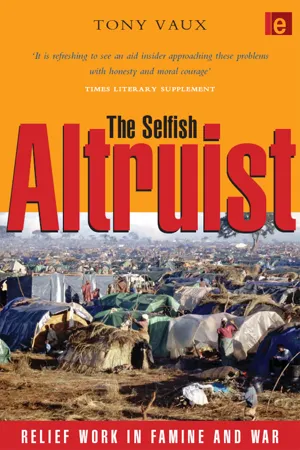
Provides an analysis of some of the most traumatic situations involving famine and war of the last two decades, helping us to understand what it takes to be an aid worker and how important humanitarian action is today. Famine and war evoke strong emotional reactions, and for most people there is a limited amount they can do. But the relief worker has to convert emotional responses into practical action and difficult choices - whom to help and how. Their own feelings have to motivate action for others. But can they separate out their own selfish feelings and prejudices in such an emotive climate? How do they avoid being partial among those they are helping? Are they motivated by altruistic concern, or the power they experience or the attention they receive? Tony Vaux brings over 20 years experience as one of Oxfam's leading emergency managers to the exploration of the conflicts between subjective impulses and objective judgements and the dilemmas relief workers contend with.
Information
Chapter 1
Kosovo: The Loss of Impartiality
Does NATO's Kosovo intervention mark a new global era in which Western power promotes the concept of humanity? Or does it show Western military power seizing hold of humanitarian principles and distorting them?
I suspect that there is nothing quite as definite as a new world order, and we are still in the modes of the past; but the tendency of the post- Cold War period seems to create winners and losers. The casualty of the new world order, if Kosovo is anything to go by, is likely to be impartiality. The main purpose of this chapter is to explain more fully why impartiality is an essential attribute of humanity.
If humanitarian responsibility rests primarily with government, as it does today, it becomes embroiled in political interests and ideology. Aid managers find the concepts of altruism and selfishness conflicting; but instead of being an issue of conscience, it now cuts into the nature of government and forces people to think clearly about their balance of interests. This may be just as well. Not all political decisions are self-interested. Ideals appeal both to politicians and to their voters. But how do politicians and governments balance their own interests with those of the people they seek to help? The lesson from Kosovo seems to be that governments are much less concerned than aid agencies about impartiality. They intervene, on one hand, and demonize on the other. Is this a reflection of our ‘first-past-the-post’ democratic system? Perhaps politicians can only cope with situations where there is a winner and a loser, a right and a wrong. If so, there will be difficult lessons to be learned. Humanitarian crises, in my experience, are never that simple, and often the reality is very different from what we first perceive. In this chapter I will analyse this problem through Oxfam's experience in Kosovo and show that concern for ‘the person in need’ must include all who are in need, not just those we happen to favour.
* * *
I changed my views about NATO when one of its bombs nearly killed one of Oxfam's staff in Belgrade. On 30 April 1999, as manager of the regional programme in Eastern Europe, I received this message:
The rocket landed 6 feet in front of the building where Gordana Rajkov lives. Gordana (Oxfam's disability adviser) needs assistance to get out of bed since she suffers from muscular dystrophy. Luckily, one of our staff, Mimica, was staying with her during the night with her little son. Otherwise Gordana would not have been able to move at all.
Mimica and Gordana heard the rocket flying over their building and then heard the detonation. The power supply was immediately cut, the window panes burst. A part of the ceiling landed on Mimica's head. The walls of surrounding buildings were severely hurt and cries were heard from the rubble. Mimica went out to help the neighbours pull some people out. Since Gordana is a wheelchair user, she could not use the elevator and they had to stay in the flat until the morning when friends called in to carry Gordana down the stairs.
When Gordana was bombed by NATO, I suddenly had the feeling that I might be on the wrong side. And then came the more chilling realization that I should not be on any side at all. All the arguments of the past began to unravel. Having worked on the problems of Kosovo since 1993 and having witnessed the brutality, I had felt relieved when the Western powers declared that enough was enough and they were going to force President Milosevic to stop violating human rights. But as the threats involved the reality of bombing, and as the bombing became more and more indiscriminate, I realized that I was not on the side of the poor and suffering but of an awesome punitive power with its own objectives, and with personal and organizational interests ravelled up in what purported to be a principled stand. This was not a cool, calculated pressure to uphold humanitarian values but an increasingly desperate attempt by NATO to preserve its own name and the credibility of Western politicians.
As President Clinton said: ‘Our mission is to demonstrate the seriousness of NATO's purpose – to deter an even bloodier offensive against innocent civilians in Kosovo.’ As shown on Alan Little's documentary for the BBC, The Death of Yugoslavia, Clinton paused halfway through the sentence, perhaps marking at that point the real reason for the mission.
Similarly, at the outset of the Kosovo action, UK Prime Minister Tony Blair spoke of ‘a new internationalism where the brutal repression of whole ethnic groups will no longer be tolerated’.
This seemed to be a categorical imperative in support of humanitarian objectives. But a few days later in Chicago, on 22 April 1999, Blair qualified his earlier words significantly: ‘The mass expulsion of ethnic Albanians from Kosovo demanded the notice of the rest of the world. But it does make a difference that this is taking place in such a combustible part of Europe.’ The ‘but’ makes all the difference.
When NATO could not achieve its objective by bombing purely military targets, it gradually widened its scope. The target in Gordana's case was, ostensibly, a military headquarters not far from Gordana's flat. But as everyone in Belgrade knew, it had been out of use for some time, and all other military installations in the city had been evacuated. Despite NATO's wonderful technology, the aim was surprisingly imprecise. I began to wonder if the people in NATO had perhaps become personally involved and were turning an action in support of humanitarian values into an opportunity to punish ‘the Serbs’ – who had been demonized throughout the Bosnia war – and were conducting a personal vendetta against Milosevic. And it was all in the name of humanitarianism. How had we got to this point?
There was no doubt about the evil nature of the Serb paramilitaries. They were groups of thugs licensed by the state who offered guns to Serbs and encouraged violence against the majority Albanian population of the tiny province. They flaunted themselves in the Grand Hotel in Pristina and unceremoniously ejected one of our partner Albanians from the lobby when he tried to meet me there. I was inside, politely attended by the waiters, and did not know why he had not arrived. After an hour or so I gave up and drove to the Oxfam office. I happened to see him on the way, walking along the street, head down. He told me that despite being roughed up he was determined to repeat the experiment and assert his rights. He was a lawyer who specialized in human rights and who risked his life every day. Over the six years before NATO's bombing I had become increasingly angry, having seen so much suffering. I visited two old disabled men in Kosovo who lived in a squalid room with the dead, damp smell of unchanged air. Because of their fear of the Serb police they had not been outside for two years. It made me angry that the West took so little notice of this tragedy, and I had been among those who called for the threat of force. It all seemed reasonably obvious at the time.
It would have been easy, and perhaps natural, to focus on the Albanians of Kosovo as symbols of humanitarian concern. If so, we might not worry too much about the bombing of Belgrade. But we would also have to ignore the Albanian paramilitaries, who were beginning to put pressure on the Albanian community long before NATO launched its offensive. They were carefully orchestrating international horror, and may have organized events including the massacres that caused the international intervention. Naturally, people inside Kosovo did not like to talk about such things, and there was a difference between the image projected to outsiders and the reality. Perhaps it was these ‘enforcers’ who so rapidly expanded the Kosovo Liberation Army (KLA) under NATO's protective onslaught. After their victorious return to Kosovo, they began to copy the Serb paramilitaries and to enact the same violations of human rights against similarly vulnerable Serbs.
As I discovered when I returned to Kosovo in September 1999, three months after NATO's victory, the Albanian leadership in Kosovo had quickly cornered the markets, and prices had shot up in Kosovo. The rich and powerful were exploiting the poor and weak. The price of petrol in Pristina was double the price in Macedonia, a couple of hours’ drive away. But the new officials protected the racket and kept the price up. As Oxfam staff told me from the experience of their relatives, all paid jobs were being reserved for supporters of the KLA, and employers who did not contribute to the KLA would find themselves in deep trouble. It was not the victory of the Albanian people but of a new elite, which began to create its own apartheid under the protective arm of Western power.
I found my sympathies changing and began to realize that it was not simply a matter of recognizing the needs and rights of individuals from the ‘other side’, but also of viewing these individuals in relation to their interests. Impartiality means distinguishing one person from the next, and being aware that many people have an interest in the vulnerability of others. Indeed, humans appear to be a good deal more interested in exerting power over others than in anything else. Therefore when analysing needs, we have to see them as being at the centre of a mass of predatory interests, including some that may come from within ourselves.
* * *
It puzzles me now that I was not more cautious about advocating the use of force. But when I think of the sequence of events, each stage seems to make sense. Perhaps it was the same for the Western politicians and NATO's generals.
A year before the NATO bombing, in mid-1998, Serb security forces moved from sporadic harassment to large-scale destruction of Albanian homes. Over 200,000 people, 10 per cent of the population, were displaced. Most went to live with relatives in places that were less devastated, but some fled across the borders to Albania, Montenegro and Macedonia. Staff at Oxfam were deeply worried about the prospect of people being homeless and cold in the winter. The opportunity to use military force was irresistible. In August, Oxfam released a statement regretting that ‘the threat of military force by NATO over the summer has not prevented major offensives or the systematic abuse of civilians... Oxfam believes action to enforce a ceasefire must be taken’.
There was considerable debate. Some felt that Oxfam should never call for the use of force in any circumstances. But Oxfam had done so in the case of Somalia in 1992, breaking with a long tradition of pacifism which had been part of the Quaker influence from the earliest days. Although the Somalia intervention had been a failure (as I describe in Chapter 6) NATO's intervention in Bosnia in 1995 had finally brought an end to three years of appalling war. We expected something similar in Kosovo.
In August 1998, Oxfam wrote to UK Foreign Secretary Robin Cook, asserting the need to use the threat of force: ‘As Dayton demonstrated, after all diplomatic initiatives have failed, this is the only remaining option to uphold citizens’ rights in war. This may not be an ideal option, but from Oxfam's perspective, it is the least worst option.’
Staff members in the region were uneasy about this position. They pointed out that the immediate effect of a NATO intervention would be to push Milosevic to extremes and might make matters far more difficult for people in Kosovo. Oxfam and other aid agencies would have to withdraw. The mood in Kosovo itself was more buoyant; staff believed that NATO could force Milosevic to back down. Part of the argument for favouring the threat of force (and I was one who used it) was that NATO's power was so obviously overwhelming that it would never have to be used.
Initially, this seemed to have been proved right. On 13 October 1998, a crisis was averted when US envoy Richard Holbrooke signed an agreement with President Milosevic that promised an end to violence and the deployment of an international monitoring mission. But as time went on it became apparent that the violence had not stopped and that NATO's threat was being flaunted. By the spring of 1999, Western politicians were conscious that they had been cheated, not for the first time, by Milosevic; there was an element of personal pride in the confrontation. British and American representatives Robin Cook and Madeleine Albright made no secret of the fact that they were very angry. In his BBC documentary The Death of Yugoslavia, Alan Little stated: ‘high ideals walked hand in hand with revenge.’
As well as the personal pride of Western politicians, there was NATO's pride too. Coming up to its birthday celebrations, NATO was being ridiculed. In the early months of 1999, the peace talks dragged on interminably at Rambouillet in France. The last straw was the massacre at Racak in March 1999. Images of a scattered line of mangled bodies in a gully above the village and the remains of people shot repeatedly as they tried to flee shocked the world. But there was an air of stage management about the filming of Racak, and it later transpired that the head of the Kosovo Monitoring Mission had been on the phone to Washington and NATO while still viewing the bodies. There is doubt today about whether the KLA deliberately provoked the Serb forces and created the highly publicized conditions for war. Alan Little is among those who have questioned whether it was deliberately given prominence by those in the West who wanted an excuse to launch the NATO offensive.
Having made a threat, NATO and Western political leaders found it extremely difficult to back down. The momentum of events pushed them forward into escalating their threats. Similarly, Oxfam found it difficult to reconsider the basis of its statement in August 1998. Throughout the early months of 1999 there was intense debate in Oxfam about the issue of force. However, retreat was difficult not only because it is always difficult to reverse a previous decision, but also because the grounds for doing so would have to question whether all diplomatic means had been exhausted. Since the actual proceedings at Rambouillet were held in secret, this would entail calling into question the truthfulness of senior politicians such as Robin Cook. This would be difficult for Oxfam in that highly-charged political environment.
Eventually the Rambouillet talks broke down and on 24 March the inconceivable use of force became high-level bombing. Oxfam found itself, rather unusually, unable to agree a public position. Although various policy statements were drafted that supported the use of force but with various riders and qualifications, they were not released. It was clear by this time that the press would only want to know ‘does Oxfam support NATO’ and a ‘cadged’ statement expressing concern might not be reported accurately.
Oxfam realized that any hint of opposition to the bombing would put it in direct confrontation with the political establishment on its most crucial issue of the time. And rather late in the day, on the insistence of field staff, Oxfam also realized that any statement in favour of the bombing would endanger staff in Kosovo (still under Serb control) and Belgrade. Two staff members from another aid agency CARE were arrested in Belgrade and accused of spying. Oxfam's regional representative described the situation there:
We have seen a steadily deteriorating security situation and an increase in the paranoia of security and government authorities. This includes all forms of communication being tapped and monitored, most international NGOs being removed from the country or asked to leave, people being arrested and held without cause or notice, and charged with acts of sedition ranging from taking notes in the street to reporting bomb damage over the Internet. An increase in civilian hostility to the international community and local people who worked for international agencies has also been experienced... To date, Oxfam has had to hand over six vehicles to the authorities and has had 100,000 deutschmarks appropriated from our bank account. Several of our staff have been called in for information interviews, and one associate of Oxfam was held and questioned over three separate periods of up to 72 hours for having parked an Oxfam vehicle in his yard.
The problem beginning to emerge for Oxfam was that the attempt to express its views impartially and objectively was impossible because it operated from Britain, and Britain was part of NATO. Public opinion itself was so polarized that a qualified view would antagonize both sides. In particular, anything less than enthusiasm for the bombing might have been taken as an attack on the government. In some parts of the organization there was dismay that the UK's biggest international charity, with a long history in the region, was silent on what was probably the greatest humanitarian event of the decade – especially with a British prime minister declaring that concern for the people of Kosovo was a prime issue of national policy.
Interestingly, no other UK agency, as far as I am aware, made any direct comment on the rights and wrongs of the situation. The initiative on this massive humanitarian issue was taken up by the government and NATO. The impossibility of articulating a public position left Oxfam, and other agencies, unusually pragmatic in their humanitarian responses. Everything became a matter of what works, and what is funded. To my great regret, Oxfam did not take stock of its relationship with NATO and Western governments but simply responded as events proceeded.
The immediate consequence of the NATO bombing was as Oxfam field staff had predicted. The Serb forces conducted a vicious campaign of ethnic cleansing against the Albanians. Instead of stopping human rights violations, NATO's actions had made them worse. Suddenly the question being debated in the press was a different one. ‘Was the NATO bombing a terrible mistake?’ journalists asked Oxfam, wondering if Oxfam would challenge NATO. Staff in the field began to ask: what principles does Oxfam stand for? By this time refugees were arriving in Macedonia and Albania, reporting the terrible violence and atrocities of the Serb forces. But the debate was about military strategy. Should the West deploy ground troops as the only way to stop ethnic cleansing?
Oxfam felt uneasy about challenging military tactics. Military experts were always ready to pour scorn on the advice of amateurs. NATO's bombing campaign had triggered a humanitarian disaster, but Western aid agencies could not make loose comments or even express concern without finding themselves opposing their own governments and many of their supporters.
Because NATO would not back up the bombing by action on the ground, they had to increase the range of bombing targets. The aim was also to turn the people of Serbia against the war by devastating Serbia's economy and causing fear. The infrastructure of Serbia was attacked on the grounds that it was pro-military. NATO's policy was within a whisker of being an attack on civilians and illegal under the Geneva Convention. This was what led to Gordana being bombed.
Inside Oxfam the debate continued to be dominated by pragmatic considerations. What could Oxfam add which was not already known? Finally, Oxfam's directors decided that Oxfam could not engage in the public debate ‘without endangering some ...
Table of contents
- Front Cover
- Title Page
- Copyright
- Contents
- Foreword by Jean Drèze
- Acknowledgements
- List of Acronyms and Abbreviations
- Introduction
- 1 Kosovo: The Loss of Impartiality
- 2 Ethiopia: A Golden Age of Humanitarianism?
- 3 Sudan: Impartiality and Self-respect
- 4 Mozambique: Vulnerability and Power
- 5 Afghanistan: Pride and Principle
- 6 Somalia: Emotion and Order
- 7 Azerbaijan and Bosnia: Responsibility and Rights
- 8 The Rwanda Genocide: Man's Inhumanity
- 9 The Selfish Altruist
- Notes on the Sources
- Index
Trusted by 375,005 students
Access to over 1.5 million titles for a fair monthly price.
Study more efficiently using our study tools.
Frequently asked questions
Yes, you can cancel anytime from the Subscription tab in your account settings on the Perlego website. Your subscription will stay active until the end of your current billing period. Learn how to cancel your subscription
No, books cannot be downloaded as external files, such as PDFs, for use outside of Perlego. However, you can download books within the Perlego app for offline reading on mobile or tablet. Learn how to download books offline
Perlego offers two plans: Essential and Complete
- Essential is ideal for learners and professionals who enjoy exploring a wide range of subjects. Access the Essential Library with 800,000+ trusted titles and best-sellers across business, personal growth, and the humanities. Includes unlimited reading time and Standard Read Aloud voice.
- Complete: Perfect for advanced learners and researchers needing full, unrestricted access. Unlock 1.5M+ books across hundreds of subjects, including academic and specialized titles. The Complete Plan also includes advanced features like Premium Read Aloud and Research Assistant.
We are an online textbook subscription service, where you can get access to an entire online library for less than the price of a single book per month. With over 1.5 million books across 990+ topics, we’ve got you covered! Learn about our mission
Look out for the read-aloud symbol on your next book to see if you can listen to it. The read-aloud tool reads text aloud for you, highlighting the text as it is being read. You can pause it, speed it up and slow it down. Learn more about Read Aloud
Yes! You can use the Perlego app on both iOS and Android devices to read anytime, anywhere — even offline. Perfect for commutes or when you’re on the go.
Please note we cannot support devices running on iOS 13 and Android 7 or earlier. Learn more about using the app
Please note we cannot support devices running on iOS 13 and Android 7 or earlier. Learn more about using the app
Yes, you can access The Selfish Altruist by Tony Vaux in PDF and/or ePUB format, as well as other popular books in Social Sciences & Development Economics. We have over 1.5 million books available in our catalogue for you to explore.