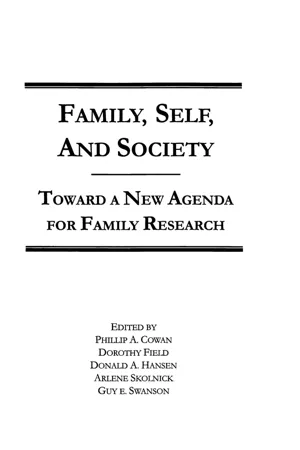
Any agenda for family research in the 1990s must take seriously a contextual approach to the study of family relationships. The editors and contributors to this volume believe that the richness in family studies over the next decade will come from considering the diversity of family forms -- different ethnic groups and cultures, different stages of family life, as well as different historical cohorts. Their goal is to make more explicit how we think about families in order to study them and understand them. To illustrate the need for diversity in family studies, examples are presented from new and old families, majority and minority families, American and Japanese families, and intact and divorcing families. This variety is intended to push the limits of current thinking, not only for researchers but also for all who are struggling to live with and work with families in a time when family life is valued but fragmented and relatively unsupported by society's institutions. Students and researchers interested in family development from the viewpoint of any of the social sciences will find this book of value.
eBook - ePub
Family, Self, and Society
Toward A New Agenda for Family Research
- 516 pages
- English
- ePUB (mobile friendly)
- Available on iOS & Android
eBook - ePub
Family, Self, and Society
Toward A New Agenda for Family Research
About this book
Information
I | Rethinking Our Conceptual Models |
1 | Bringing the Institution Back In |
University of California, Berkeley
Literature abounds on the incipient demise of the family in advanced industrial societies, but children continue to be born and raised by adult members of these societies. Somehow, then, the institution’s function is fulfilled; families continue to exist. Why the pessimism? Clearly, the form families have taken and the constellation of values and roles centered on biosocial reproduction have undergone drastic transformation. The social consensus on what families are and ought to be, so strong in the 1950s and before, has weakened. If a stability of expectations around the social norms and roles relevant to any societal function is the hallmark of its institutionalization, then one can advance the view that the family as the institution concerned with the biosocial reproduction of society is in a state of flux. The reasons for this situation are multiple and complex. Among them are the changes in the social and economic position of women occasioned by the increase in women’s level of education and employment and the liberalization of the laws on marriage and divorce, which have given women more freedom of choice in matrimonial and reproductive matters. But other cultural and demographic trends have contributed to the weakening of the social consensus on the values and norms sustaining family roles and prerogatives. My purpose here is to examine the impact of these wider social changes on the familial institution: to treat not only their effects on social understandings of what families are supposed to be but also on the understanding by real families and their members of socially acceptable familial roles and of the norms guiding their relationships and their lives as collectivities.
Introduction
The decrease in the degree of institutionalization of the family is reflected in the uncertainty regarding its empirical definition. That leads some analysts to conclude that efforts to define the family are futile. These efforts were considered hopeless by a good number of the participants at the conference which gave birth to the present volume. But a proposal for bringing back an institutional approach to family studies cannot avoid the problem of defining its subject matter.
A useful definition must present the distinctive and general characteristics of this institution. Families are primarily the units of biological and cultural reproduction of societies. At the cultural level, the family institution “focuses on the regulation of the procreation and biological relations between individuals in a society and on the initial socialization of the new members of each generation” (Eisenstadt, 1968, p. 410). At the social level, in postindustrial societies, the family is
a relatively small domestic group of kin (or people in a kinlike relationship), consisting of at least one adult and one dependent person, the adult … being charged by society with carrying out … the social function of procreation and socialization of children, provision of care, affection and companionship, sexual regulation, and economic cooperation. (Popenoe, 1988, p. 6).
For Malinowski (1962) the cross-cultural and diachronical multiplicity of family forms confirms the fundamental universality of the institution. His injunction to the typical anthropologist of his day is still relevant: “He must show where the family comes in, whence it draws its forces, how far it is inevitable and where it can be dispensed with” (p. 87).
The present-day diversity of family forms in the United States makes it more difficult to get on with Malinowski’s task than does the diversity evoked by cross- cultural studies. This is so because, in the United States, a heterogeneity of family forms has developed in a situation where major cultural parameters and other institutions concerned with family life assume its uniformity. Governmental programs to help the family have foundered on this problem (Steiner, 1981), and it remains a stumbling block for all policies and studies regarding the institution at the societal level.
Popenoe’s minimal operational definition of a family reflects the changes that have occurred in most Western countries in the last 20 years and covers the one- parent family as both the fastest growing form of socialization milieu and the most problematic. His approach was already adopted by policy makers in European countries in the 1960s (Kamerman & Kahn, 1978), and by scholars at the Royal Society of Medicine in London meeting to discuss the situation of the family in Britain in the early 1980s (Franklin, 1983). But such a minimalist definition of the family raises questions: Does it mean that, as a workable definitional and analytical tool, the family as a concept can dispense with the second adult who hitherto was included as a necessary biological and social component of the human institution? Can one safely assume that the functions fulfilled by what is called the “traditional” family can be and are fulfilled by this restricted group?
In order to address these questions, I shall systematically review the changes that have occurred since the 1950s, changes that have led to the need for a minimalist family definition. I choose the ’50s because of the meaning of this decade both demographically and culturally, and also because it saw the publication by Parsons and Bales (1955) of the last major scientific analysis that fits the family into the larger societal system.
The “Traditional” Institutional Model
In the ’50s and early ’60s, many who did not read Parsons and who would not have recognized his name would have basically described the family and its functions in his terms. In Parsons’ view, the family was a private enclave that needed protection from the encroachment of the public sphere in order to fulfill its role as a haven of psychic renewal for the breadwinner. His assessment of the nuclear family household composed of a working father, a homemaker mother and their children as the adaptive family form of the period after World War II, was correct for a time of economic expansion and high fertility. The generalization of the functionality of this family form for advanced industrial societies was questionable.
What is now called the traditional family was both the most frequent family form and the cultural ideal (Bianchi & Spain, 1986; Huber & Spitze, 1983; Van Horn, 1988). Parsons was criticized for seeing the family unit as isolated from other kin and primary networks (Kanter, 1977) but he was right in seeing that the nuclear family household was expected to be economically and emotionally self- sufficient. The consensus on what constituted a family and its place in society was so strong that scholars turned their attention to the inner functioning of family units and generally abandoned studies of the forms that families were taking in changing socioeconomic environments.
The rise in divorce and single parenthood since the ’50s has rendered normative some forms of families that once were culturally and statistically deviant. The expansion of the service sector has increased the demand for female labor, thus opening up jobs for the increasing number of female heads of household. The economic slowdown and high inflation rates of the ’70s have made double wage-earning mandatory for families to maintain their living standards or to reach the living standards of their families of origin (Van Horn, 1988). The strains that have occurred with regard to the place of the family in public policy decisions, and that have been denounced by countless scholars and politicians (Moynihan, 1986), are partly the result of the survival in public programs of the traditional view of the familial institution and of its relations to the society at large at a time of changed economic conditions.
As a case in point, I consider the Parsonian view of the role of the family in social stratification. This role is summarized by Mulkay (1971) in two points:
1. In America nuclear families are the main units of social ranking.
2. family’s rank depends primarily upon the husband’s occupational role. (p. 84)
Point 1 is still mostly valid both culturally and as a matter of policy. The maintenance of the nuclear family criterion for allocation of benefits, services, and for taxation is one point of contention between policy makers and the social welfare agencies that deal with the consequences of redistribution of wealth. When only 28% of all households are constituted of nuclear families with children, and only 15% of homemaker mother and working father (Merrick & Tordella, 1988), the traditional model loses relevance as criterion for the assessment of economic needs and social placement. Nevertheless, nuclear families remain the point of reference for the assessment of economic progress, for the definition of compensatory programs, and for the evaluation of members’ status.
In a curious, indirect way, Point 1 remains valid despite the disparity between reality and what this statement presupposes in terms of family forms to which a majority of people belong. It remains invidiously important to the extent that failure to belong to a nuclear family unit is very likely to entail a lower social ranking, all other things—such as race, religion, education—being equal. So, if one is not a member of a nuclear family unit, one tends to fall through the cracks twice: first because one is not counted as a member of a mainstream social category that serves as a basis for evaluating many other aspects of life, especially needs and resources; and second, serendipitously, because if one is not counted among those that are established mainstream members of society, one tends not to count when resources are allocated.
Point 2 of Mulkay’s summary of Parsons’ scheme is not valid anymore for the 23% of families which at any point in time are headed by women (Cherlin, 1988). But again in a subtle way, and because of the persistence of the validity of the first point in policy making, the absent husband’s occupational role is an extremely potent indicator of a family’s social rank. Of all families where a husband role is not fulfilled, over 50% are at or below the poverty level (Hacker, 1988). For most of these families, this placement results from downward mobility after the husband-father withdraws from the family unit. Thus, the persistence, despite considerable economic and social changes, of a Parsonian model of family life in public debate partly explains why previously “deviant” family forms are at a disadvantage in society. I think that these developments foster the misperception of an institutional decline of the family.
In the core of the paper I search for the meaning of basic institutional transformations through (1) examining change in crucial normative dimensions of family life; (2) assessing the social controls and levels of institutionalization of these changes; and (3) evaluating the functionality of new family forms.
Institutional Transformations
Normative Dimensions
Recent demographic and cultural changes have affected three institutional aspects of the family: family definition, family boundaries, and family values.
Family Definition
An implicit assumption in social and academic circles is that people share the same sense of what makes up families. In fact, there is no consensus among social agencies or professionals or ordinary people on what currently constitutes a family (Grubb & Lazerson, 1988; Steiner, 1981). Current conceptions reveal disagreements concerning the number of people that need to be involved in a family, who they should be, and what determines the creation of a family and its boundaries. Some tend to define the family primarily as a place where a group of people share means of subsistence and tasks associated with producing them (Smith, 1968; Mintz & Kellogg, 1988). This approach conflates the concepts of household and family. Communes or live-in partnerships become families. Others define the family by its function but disagree on what this function primarily is: either the socialization of children or the psychological nurture of adults. Still others define the family strictly in terms of biological and legal bonds or of socioemotional bonds. The legal view relies on the biological and cognate ties between people, or legal adoption, to determine who belongs to a family and what that family is. The social view tends to extend familial status to groups formed by the sharing of responsibilities in the task of rearing children, whether or not the adults involved are biologically related or have legally adopted the children.
The task of defining the family comes recurrently to the fore of public debates because cultural changes have specifically affected people’s notions of what is crucial in the institution. There are two aspects to the debates. The first is a matter of the empirical description of a domestic unit which will fall under the category of family for the purpose of ascribing social rights and benefits. The second, following on the first, is the identification of the basic function fulfilled by this unit which justifies its being considered a family (Allen, 1979; Stack, 1979). Both aspects are found in recent efforts to gain legal familial status or socioeconomic prerogatives by groups hitherto excluded from the traditional understanding of what families are:
Eliminating the Child. The claim that nonprocreative partnerships are families and should therefore benefit from the legal dispositions concerning the property, decision-making, and visiting rights of family members with regard to each other specifically highlights the current questioning of the social function of families. The issues are whether families are primarily legally sanctioned sets of relationships whose aim is the material and emotional well-being of adults or are groups organized around the bearing and rearing of children. (Note that a child adopted by a homosexual couple turns the relationship into a family under this latter understanding.)
The necessity of the presence of children or linked generations has hitherto been generally accepted for a family to exist. At an academic level, a discussion of whether the concept of marriage might be extended to homosexual forms of adult intimacy would be more meaningful than an extension of the use of family terminologies. The extension of the concept of family to permanent intimate relationships between adults would void it from analytical as well as descriptive usefulness. One would have to find a new concept that would describe units of procreation and socialization and the intergenerational transfer of property, and differentiate them from other intimate groups (Popenoe, 1988, pp. 6–7).
One of the arguments advanced by social welfare advocates in favor of public support for families with dependent children is that groups that are taking charge of the reproduction of society—the procreation and socialization of the next generation—deserve special societal consideration and some compensation for the financial burden of doing so. This crucial function which concerns society as a whole and in the long run affects all of its members cannot be left to fall exclusively on the resources of the discrete private groups that are de facto in charge of its fulfillment. A basic misunderstanding, willful or not, of the difference between the notion of the family as a social institution responsible for the reproduction of society and of the family as a private institution made of persons with all the rights and prerogatives of private individuals accounts for most of the fruitless debate in social policy between advocates and adversaries of supportive family programs (McCathren, 1981).
Eliminating the Second Parent. Less radical perhaps in its consequences for the transformation of the family than the disappearance of children from its definition is the disappearance of a second adult. Family agencies in Western Europe and some American social welfare advocates and scholars have found it productive to use a minimal operational definition of the family as made up of at least one adul...
Table of contents
- Cover
- Half Title
- Title Page
- Copyright Page
- Table of Contents
- Preface
- Part I: Rethinking Our Conceptual Models
- Part II: Rethinking Research On Nuclear Families
- Part III: Rethinking Research On Family Networks in Middle and Old Age
- Part IV: Case Studies: Their Role in Theory and Research
- Part V: Toward A New Agenda For Family Research
- Author Index
- Subject Index
Trusted by 375,005 students
Access to over 1.5 million titles for a fair monthly price.
Study more efficiently using our study tools.
Frequently asked questions
Yes, you can cancel anytime from the Subscription tab in your account settings on the Perlego website. Your subscription will stay active until the end of your current billing period. Learn how to cancel your subscription
No, books cannot be downloaded as external files, such as PDFs, for use outside of Perlego. However, you can download books within the Perlego app for offline reading on mobile or tablet. Learn how to download books offline
Perlego offers two plans: Essential and Complete
- Essential is ideal for learners and professionals who enjoy exploring a wide range of subjects. Access the Essential Library with 800,000+ trusted titles and best-sellers across business, personal growth, and the humanities. Includes unlimited reading time and Standard Read Aloud voice.
- Complete: Perfect for advanced learners and researchers needing full, unrestricted access. Unlock 1.5M+ books across hundreds of subjects, including academic and specialized titles. The Complete Plan also includes advanced features like Premium Read Aloud and Research Assistant.
We are an online textbook subscription service, where you can get access to an entire online library for less than the price of a single book per month. With over 1.5 million books across 990+ topics, we’ve got you covered! Learn about our mission
Look out for the read-aloud symbol on your next book to see if you can listen to it. The read-aloud tool reads text aloud for you, highlighting the text as it is being read. You can pause it, speed it up and slow it down. Learn more about Read Aloud
Yes! You can use the Perlego app on both iOS and Android devices to read anytime, anywhere — even offline. Perfect for commutes or when you’re on the go.
Please note we cannot support devices running on iOS 13 and Android 7 or earlier. Learn more about using the app
Please note we cannot support devices running on iOS 13 and Android 7 or earlier. Learn more about using the app
Yes, you can access Family, Self, and Society by Philip A. Cowan, Dorothy Field, Donald A. Hansen, Arlene Skolnick, Guy E. Swanson, Philip A. Cowan,Dorothy Field,Donald A. Hansen,Arlene Skolnick,Guy E. Swanson in PDF and/or ePUB format, as well as other popular books in Psychology & Developmental Psychology. We have over 1.5 million books available in our catalogue for you to explore.