This book is based on research and scholarship produced by the Meyerson Disability Research Project (MDRP) at the University of Arizona. Its chapters are divided into two major sections: 1) Disability Research Areas and 2) Disability Policy Areas. The first section addresses some relatively new areas of research and scholarship with adults and children, such as the use of technology (e.g., videoconferencing and computer technology) in service delivery, whereas the second section critically examines various public policy and legal areas that impact the daily lives of many persons having a disability.
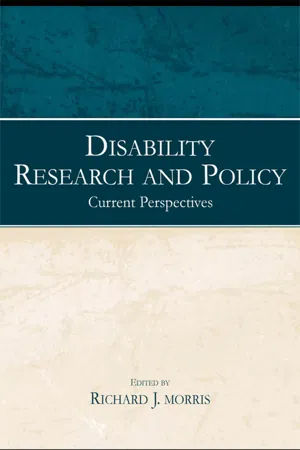
- 384 pages
- English
- ePUB (mobile friendly)
- Available on iOS & Android
eBook - ePub
About this book
Information
II
Disability Research Areas
2
Physically Disabled Offenders in Prison
Nicole S. Kitei and Bruce D. Sales
There are laws in effect to protect prisoners with disabilities. Title II of the Americans With Disabilities Act (ADA, 1990), The Architectural and Transportation Barriers Compliance Board (ADAAG, 1994), the Rehabilitation Act (1973), Civil Rights of Institutionalized Persons Act (1980), and the Eighth Amendment to the U.S. Constitution are the most common laws referred to by physically disabled inmates bringing lawsuits. Although it may appear that physically disabled (PD) inmates have sufficient legal protection, numerous lawsuits brought by these individuals suggest otherwise (discussed later).
Why might this be the case? Perhaps these laws are not being applied to inmates with disabilities or not being implemented appropriately. Perhaps they are not having their intended effects, or are having unintended negative consequences. Unfortunately, there is no empirical literature examining these possibilities, the specific and unique problems PD inmates encounter in prison, the psychological sequelae of these problems, and the types and quality of service programs and other interventions offered to this population. To partially address this void in the scholarly literature, this chapter considers the epidemiology of PD inmates; the problems these people experience in prison that non-PD inmates do not encounter; the services and accommodations prisons provide for PD inmates so that they can operate as well as non-PD inmates; and what scientific research must do to understand the PD inmate experience in prisons.
EPIDEMIOLOGY OF PD OFFENDERS
For the purposes of understanding PD offenders in prison, the following distributional issues must be considered: the definition of physical disability for purposes of epidemiological classification, the prevalence or proportion of the prison population that is physically disabled, the characteristics of these PD offenders (e.g., age, sex, race), the number of these individuals in need of special services, and the correctional environments in which they are placed. For example, as the number of persons in need increases, budget planning, treatment planning, and the pressure for special services will increase, creating new administrative complexities. Identifying the location of these inmates becomes critical for developing a sound financial plan. Age information is required to understand the changing needs of the individual across the life span, whereas socioeconomic factors may be relevant to treatment strategies (Schneider & Sales, 2004). Finally, epidemiological information can be instrumental in prevention. If almost all PD inmates incur their specific disorder prior to incarceration, it becomes important to ask questions about whether their disorder contributed to their antisocial behavior, and, if so, what prevention strategies reduce the likelihood of criminality. If almost all PD inmates become disabled following incarceration, other questions arise.
An individual with a disability is defined by the ADA as a person who has a physical or mental impairment that substantially limits one or more major life activities, a person who has a history or record of such an impairment, or a person who is perceived by others as having such an impairment. Unfortunately, epidemiological research has not adopted this definition nor adhered to any other specific one. The result is that the research does not accurately tell us the exact number of PD offenders in prison. Additionally, many correctional institutions have extremely poor reporting and record-keeping procedures, and overlook the special needs of PD inmates during intake and subsequently. Although data do exist on PD prisoners, they are often inaccurate and must be interpreted cautiously.
Keeping in mind these limitations, let us take a look at what the extant literature suggests. Inmates with physical disabilities make up 29.6% of the total number of state inmates and 26.5% of federal inmates (Maruschak & Beck, 2001). In raw numbers, this constitutes 371,773 state inmates and 28,325 federal inmates with either a hearing, speech, visual, or other physical disability. Broken down by disability, this includes: 60,054 (5.7%) state inmates and 4,921 (5.6%) federal inmates with a hearing disability; 39,166 (3.7%) state and 1,956 (2.2%) federal inmates who reported having a speech disability; 87,242 (8.3%) state and 6,688 (7.6%) federal inmates who reported having a visual disability; and 125,257 (11.9%) state and 9,839 (11.1%) federal inmates who reported having another type of physical disability (Maruschak & Beck, 2001). If learning disabilities were included among the statistical inventory of physical disabilities in prison, this population would constitute 103,789 or 9.9% of state inmates and 4,477 or 5.1% of federal inmates within the United States prison system. Learning disabilities are not considered further in this chapter because the category is arguably not a physical disability.
How do these numbers compare to the prevalence of physical disability in the general population? Standardizing the general population to simulate the age and gender distribution of state inmates, Maruschak and Beck (2001) found the following. The prevalence of speech impairment among state inmates (3.7% or 39,166) is more than three times higher than in the U.S. general population (1.3% or 3,802,427). If we compare the rates of hearing impairment in the prison population (5.7% or 64,975) to the general population (6.6% or 19,304,633), however, we find that the rate of impairment is higher in the general population. The prevalence of visual impairment in prison (8.3% or 93,930) is more than twice as high as in the U.S. general population (3.5% or 10,237,305) (U.S. Department of Health and Human Services, National Health Interview Survey, 1996). In summary, the rates of speech and vision impairment are higher among inmates than in the U.S.general population.
Excluding reports of a cold, virus, or the flu, the most commonly reported medical problems fell into nine categories: HIV/AIDS, heart problems (e.g., heart attack, angina), circulatory problems other than heart (e.g., anemia, aneurysm, vascular, blood clots/transfusions), cancer, kidney/liver problems (e.g., hepatitis), respiratory disorders (e.g., emphysema, asthma), neurological disorders (e.g., seizures, epilepsy), skeletal problems (e.g., back/spine, muscle/tendon, joint, fracture), and diabetes. In 1998, there were 1,299,096 state and federal prisoners in the United States (U.S. Department of Justice, 2002). Since the time of their admission, 2.2% (28,580) of inmates reported having HIV/AIDS, 2.4% (31,178) reported a heart condition, 4.8% (62,356) reported a circulatory impairment, 5% (6,495) reported cancer, 2.3% (29,879) reported kidney or liver problems, 2.6% (33,776) reported a respiratory problems, 1.1% (14,290) reported a neurological impairment, 5.7% (74,048) reported a skeletal disability, and 2.4% (31,178) reported having diabetes.
In regard to the prevalence of physical injury occurring in prison, whether accidental or due to a fight, 318,000 state and federal inmates reported being injured since admission to the facility. This is constituted by 28% (294,683) of state and 26% (23,038) of federal inmates reporting being injured in an accident since admission, versus 10% (105,244) of state and 3% (2,658) of federal inmates who reported that they had been injured in a fight. Inmates who had reported having a physical disability were more likely to report an injury than were other non-physically disabled inmates. More specifically, among those who reported having a physical disability, 22% (231,537) of state and 25% (22,151) of federal inmates reported being injured in an accident, compared to 19% (199,963) of state and 22% (19,463) of federal inmates without such a disability.
Finally, what level of medical treatment do inmates receive in the correctional facility at the time of admission and subsequently? The only reported data cover state inmates. Approximately 60% of them reported that they had been checked by staff to see if they were sick, injured, or intoxicated at the time of admission, while 80% of them reported having a medical exam since their admission. The problem with these data is that because no criteria were provided to guide respondents, it is not clear what constitutes a medical exam and whether PD inmates received one whenever it was needed.
Moreover, all of the data are suspect because they fail to address a number of relevant characteristics. For example, the data was derived from one to two questions at most per disability on a self-report survey that was given to inmates regarding their physical and mental well-being. To assess the presence of a speech disability, inmates were asked, “Do you have a speech disability, such as a lisp or stutter?” (Maruschak & Beck, 2001, p. 2). One potential problem with the use of such a question is that there are myriad variations in the presenting pathology of speech, and to ask only one question that exemplifies only two types of speech disability is by no means comprehensive. To assess the presence of a visual impairment, inmates were asked, “Do you have difficulty seeing ordinary newsprint even when wearing glasses?”(Maruschak & Beck, 2001, p. 2). In this case, not only are the researchers assuming that the condition of the inmate’s eyewear is up to medical standards, they are neglecting the various degrees of visual impairment that may not be detected by such a question (e.g., disorders affecting peripheral vision).
Additionally of concern is the fact that because the survey was given in paper and pencil format, those answering the question must have been able to read the print. Six words are used to assess physical disability in the sample that they used to generalize to the entire prison population, namely, “Do you have a physical disability?” (Maruschak & Beck, 2001, p. 2). Not only are most inmates unaware of what constitutes a disability, but the researchers themselves provided no means of standardizing or of operationalizing their own definition of what it means to have a physical disability. The only other question employed to assess physical disability reads, “Do you have a physical, mental, or other health condition which limits the kind or amount of work you can do?”(Maruschak & Beck, 2001, p. 2). Obviously there may be ulterior motivation in such a population to answer this question affirmatively (e.g., expectation that prison officials would remove them from a work assignment). Further epidemiological research is therefore crucial to understand the true state of affairs for members of this population whose numbers appear substantial.
UNIQUE PROBLEMS PD INMATES FACE IN PRISON1
Even for the physically healthy offender, prison life is often an intimidating, violent, and grueling experience. Boredom, anger, abuse, domination, and fear permeate the lives of all prisoners (Ruiz v. Estelle, 1980). The negatives of prison life are often exacerbated for the PD inmate. Not only do these offenders need to become accustomed to the brutalities encountered in prison, but they also must learn how to be at a greater physical disadvantage in a hierarchical and dangerous environment. For example, an inmate with a disabled leg can fall in the shower area because of the slippery floors and lack of hand rails, fall while trying to carry his food tray and operate his crutches at the same time, or injure himself trying to navigate a large number of stairs if no special assistance is provided (Frost v. Agnos, 1998). This section addresses the two most important problem areas affecting PD prisoners and their consequences: the inaccessibility of prison programs and opportunities, and the potential for being emotionally and/or physically abused.
Inaccessibility of Prison Programs and Opportunities
In some prisons, various programs and services are available to inmates with special needs. For example, drug and alcohol treatment programs are available for inmates seeking treatment for substance abuse problems (Mumola, 1999); psychotropic medications are available to inmates meeting criteria for a mental disorder; individual therapy is available for inmates who prefer one-on-one counseling (Beck & Maruschak, 2001); sex offender therapy is often mandatory for inmates convicted of sexual offenses (e.g., Key v. Grayson et al., 2001); and educational opportunities and skills training workshops are available to help the offender obtain a job upon release (see Harlow, 2003). Often these same programs and services are inaccessible to PD offenders. For example, in some prisons, the meeting rooms for group therapy sessions may be on the third or fourth floors of the facility. A wheelchair-bound inmate may be unable to participate in the session due to accessibility limitations (Evans v. Dugger, 1990).
Prison work programs present an opportunity for offenders to reduce boredom and loneliness. Although participation is contingent on good behavior and the willingness of prisoners to follow rules, PD prisoners may be excluded for several reasons. They may feel incapable of performing the work because of their impaired skills. For example, an offender with a speech disability may beoffered a job serving food in the prison cafeteria, but may decline the offer because of the potential humiliation and ridicule that may ensue when attempting to communicate. The offender also may be afraid to be in an open area where he or she could be easily confronted or attacked. An inmate with a visual impairment, for example, may feel vulnerable working in the library out of fear of not being able to do the job efficiently, or of being unprotected and potentially more exposed to attack.
Decreased ability to work can exacerbate the problems of boredom and loneliness that exist in prison. To address these latter concerns, inmates are often permitted (depending on the level of security in the facility) time to exercise, play sports, watch TV, listen to the radio, use the library, day rooms, and chapel, and visit with friends and relatives. Inmates also often make friends during group activities, to provide relief from what can be overwhelming solitude. Many of these avenues of potential boredom alleviation fail the PD offender. For example, in some facilities, the visiting rooms are in another part of the prison and inmates must be transported back and forth in a van. For wheelchair-bound inmates in some institutions, accommodations cannot be made because the vans are not wheelchair accessible (Candelaria v. Greifinger, 1998). In other cases, PD offenders have a difficult time making social contacts as the stigma of befriending a PD inmate can dissuade another offender from becoming close. Inmates with ambulatory disabilities are unable to take advantage of the exercise or sport activities, and if an institution’s day rooms, libraries, or chapels are inaccessible, the boredom alleviation tactics employed by non-PD offenders fail the PD offender.
Reading material, for example, is of no or limited use to a blind or visually impaired offender, leaving radio or other auditory material as the only distraction. Even if Braille is available in some texts, not all blind or visually impaired inmates ...
Table of contents
- COVER PAGE
- TITLE PAGE
- COPYRIGHT PAGE
- PREFACE
- LIST OF CONTRIBUTORS
- I: INTRODUCTION
- II: DISABILITY RESEARCH AREAS
- III: DISABILITY POLICY AREAS
Trusted by 375,005 students
Access to over 1.5 million titles for a fair monthly price.
Study more efficiently using our study tools.
Frequently asked questions
Yes, you can cancel anytime from the Subscription tab in your account settings on the Perlego website. Your subscription will stay active until the end of your current billing period. Learn how to cancel your subscription
No, books cannot be downloaded as external files, such as PDFs, for use outside of Perlego. However, you can download books within the Perlego app for offline reading on mobile or tablet. Learn how to download books offline
Perlego offers two plans: Essential and Complete
- Essential is ideal for learners and professionals who enjoy exploring a wide range of subjects. Access the Essential Library with 800,000+ trusted titles and best-sellers across business, personal growth, and the humanities. Includes unlimited reading time and Standard Read Aloud voice.
- Complete: Perfect for advanced learners and researchers needing full, unrestricted access. Unlock 1.5M+ books across hundreds of subjects, including academic and specialized titles. The Complete Plan also includes advanced features like Premium Read Aloud and Research Assistant.
We are an online textbook subscription service, where you can get access to an entire online library for less than the price of a single book per month. With over 1.5 million books across 990+ topics, we’ve got you covered! Learn about our mission
Look out for the read-aloud symbol on your next book to see if you can listen to it. The read-aloud tool reads text aloud for you, highlighting the text as it is being read. You can pause it, speed it up and slow it down. Learn more about Read Aloud
Yes! You can use the Perlego app on both iOS and Android devices to read anytime, anywhere — even offline. Perfect for commutes or when you’re on the go.
Please note we cannot support devices running on iOS 13 and Android 7 or earlier. Learn more about using the app
Please note we cannot support devices running on iOS 13 and Android 7 or earlier. Learn more about using the app
Yes, you can access Disability Research and Policy by Richard J. Morris in PDF and/or ePUB format, as well as other popular books in Education & Inclusive Education. We have over 1.5 million books available in our catalogue for you to explore.