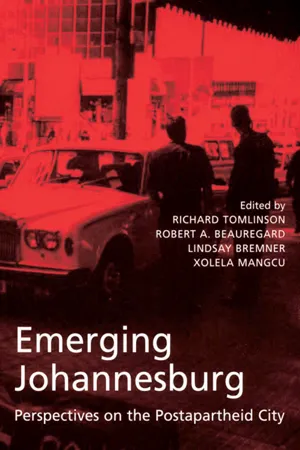
Johannesburg is most often compared with Sao Paulo and Los Angeles and sometimes even with Budapest, Calcutta and Jerusalem. Johannesburg reflects and informs conditions in cities around the world. As might be expected from such comparisons, South Africa's political transformation has not led to redistribution and inclusive social change in Johannesburg. In Emerging Johannesburg the contributors describe the city's transition from a post apartheid city to one with all too familiar issues such as urban/suburban divide in the city and its relationship to poverty and socio-political power, local politics and governance, crime and violence, and, especially for a city located in Southern Africa, the devastating impact of AIDS.
- 240 pages
- English
- ePUB (mobile friendly)
- Available on iOS & Android
eBook - ePub
Emerging Johannesburg
About this book
Information
Section III
GOVERNING AND INSTITUTION BUILDING
Resistance to apartheid was resistance to the state. The demise of apartheid required universal citizenship—with voting rights a necessity—and a rethinking of the structure and function of national, provincial, and local governments. This rethinking has been going on for over a decade and has yet to be resolved. A new South Africa requires legitimate institutions.
Heller points out the tensions inherent to the quest for new local governments. Central to these tensions are the African National Congress and civic associations, whose role in the dismantling of apartheid is unquestioned. Civics have become sites of legitimacy for democratic practices and mechanisms for accountability of local government. They have not passed into history. Often in conflict with the ANC, they continue to reflect popular aspirations.
Governance is not only fraught with internal tensions. The HIV/AIDS epidemic poses numerous problems, as Thomas notes, ranging from health issues to housing and service provision. HIV/AIDS is severely altering the demography of the city and creating a large group of seriously ill people (not to mention orphans). Local government struggles to respond to backlogs still in place from the apartheid era even as it faces new demands.
Beall, Crankshaw, and Parnell continue the theme of local politics and its connection to housing and service delivery. They look at how increasing social differentiation in a former township in Soweto is creating new lines of cleavage: between homeowners and tenants and between elderly households and youth. These tensions are forcing local governments to pay more attention to a divided constituency.
In addition, local governments have to adjust to recent laws that give more rights to citizens. Emdon points out how the shift from a parliamentary democracy to a constitutional democracy has led not just to political rights but also legal rights that enable people to protect themselves from discrimination and the arbitrary behavior of landlords and government. Throughout its existence, the apartheid state had maintained a commitment to the law (even unjust ones). Today, those laws have been strengthened and augmented.
This section ends with a chapter on the history of the Johannesburg Art Gallery. Built early in the city’s history, the Gallery was an institution white in its conception but never explicitly a part of the apartheid regime. Over many decades, it has served as a “cultural recorder and resource,” as Carman describes in detail. To survive, however, it will have to foster strong relations with its immediate environment and the changing social mix of Johannesburg.
9
Reclaiming Democratic Spaces
CIVICS AND POLITICS IN POSTTRANSITION JOHANNESBURG
The posttransition period in Johannesburg has witnessed a dramatic reconfiguration in the relationship between political and civil society. The African National Congress (ANC) has rapidly consolidated its control by either incorporating or marginalizing the popular movements that brought it to power. In addition, the imperatives of a top-down vision and strategy of transformation have resulted in the increasing centralization and insulation of the institutions of municipal governance. A number of observers have read into these trends a decline in the autonomy and vitality of civil society. Indeed, it has become something of a cliché to claim that the civic movement in Johannesburg—celebrated not so long ago as the most vibrant urban social movement in the world—is in complete disarray.
Reports of the death of the civic movement in South Africa are premature. First, as Cherry et al. (2000) argue, there has been a conflation of the demobilization of the civic movement with a generalized crisis of civics. Although it is true (and hardly surprising) that civics no longer engage in the kind of broad-based mass actions that marked the height of their power, ample evidence exists that civic associations continue to play an important role in the lives of the urban poor.
Second, many analysts have judged the civics movement against a narrow and instrumentalist measure of how civil society organizations (CSOs) contribute to democracy; they focus on governance questions and the extent to which CSOs shape state policy and assist state intervention. But CSOs, and social movements in particular, often have their most lasting and democracy-enhancing effects in civil society by promoting horizontal (rather than vertical) ties of association and creating new spaces of voice and participation.1 Independently of whether such efforts are successfully scaled up (that is, impact on the state), they have the valuable cumulative effect of enhancing citizen capacities and cultivating (or recultivating) solidarities (Cohen and Arato, 1995). The particularly strong brand of fiscal conservatism and technicism that has marked the transformation process in Johannesburg has seen the civic movement displaced from the center to the periphery of the organized political forces reconfiguring the city. Despite this political marginalization, and in part because of it, local civics continue to strengthen citizenship.
Third, social movements are, almost by definition, cyclical in nature. Their strength waxes and wanes in terms of their capacity to mobilize resources (internal and external) and with respect to the political opportunity structure.2 In reviewing a number of cases of democratic transition, Hipsher (1998) found that in all those in which a dominant posttransition party emerged, urban social movements experienced rapid demobilization. Township civics that once made Johannesburg ungovernable have explicitly abandoned the politics of contention in deference to the authority and legitimacy of the ANC.
The consolidation of representative democracy has led many commentators, as well as the ANC, to question the very raison d’être of civic structures. But although the civic movement in Johannesburg is now ineffective and virtually invisible as a corporate actor, civics in Johannesburg at the branch level continue to play an important role in community life.3 Based on research conducted between March and December 2000,4 we found that a large number, and quite possibly a majority, of townships and informal settlements in and around Johannesburg have active civic branches, most of which are affiliated with the South African National Civic Organization (SANCO).
In this chapter we explore three factors that explain why civics in Johannesburg have persisted. First, civics represent an important means of bridging the gap between communities and the increasingly distant centers of authoritative decision making. Second, they provide important social protection functions in local economies that are exposed to the dislocating effects of liberalization and global integration. Third, they embody a powerful civic imaginary that represents an ongoing search and struggle to define workable and virtuous communities against a tide of socially disintegrative forces.
The political position of civics is fast undergoing significant changes. Throughout the transition period and through much of the democratic period, civics in Johannesburg affiliated with SANCO have enjoyed a close and almost symbiotic relationship with the ANC. This relationship reflects the strategic decision by SANCO to forgo the social movement politics of building autonomous civic structures in favor of a politics of incorporation. The latter has led to a unitary, hierarchical, and formal organizational structure designed to maximize SANCO’s leverage in corporatist structures. Both politically and organizationally the strategy has failed. But somewhat paradoxically, the decline of SANCO has been accompanied by a revitalization of local civics. The most significant manifestation of this revitalization has been the increasing tension between local civics and the ANC. In many cases local conflict amounts to little more than intraelite struggles for political ascendancy or control over development resources. In most instances, though, this assertion of civic autonomy marks a revival of participatory democratic traditions as a reaction to the increasing centralization and insulation of representative structures. Specifically, this revitalization embraces the idea of a solidaristic, civic community in the face of the clientelization of politics and asserts a public moral economy in the face of the commodification of life chances.
A BRIEF HISTORY
There have been two peak moments for civics. During the mid-1980s the civics reached their height as a movement. They mobilized and contested state authority across hundreds of communities with the thinnest of organizational infrastructure. This was a movement in the classic sense: mobilizational, contestatory, and loosely and horizontally organized. Under apartheid, the civics initially arose in direct response to local grievances and functioned primarily as self-help organizations. As one Soweto civics leader explains, “We did not see civics as political structures—the majority of members were not ANC members, although many of the activists were. Organising was primarily around bread and butter issues like leaky roofs, water bills and rent.”5 But the civics soon became the fulcrum of an incipient urban revolt against the illegitimacy of Black Local Authorities.6 As civics mushroomed across the country, regional civic structures—most notably Civic Association of the Southern Transval (CAST)—provided critical coordination functions. Direct, issue-based local protest actions were scaled-up into political actions that challenged apartheid directly. In this respect, this civics movement transformed local, immediate, and largely inchoate moments of protest and resistance into a cohesive, self-sustaining structure that produced its own distinct modes of contention (the boycotts) and its own ideology and vision of transformation.7
Organized movement capacity was rapidly brought into play with the political opening of 1990. The Soweto Accord of that year ended the civics-led boycott and resulted in the establishment of the Central Witswatersrand Metropolitan Chamber (CWM) “which aimed to set in place processes of remedying the apartheid city” (Tomlinson, 1999:8) and in many ways prefigured national constitutional negotiations (Friedman, 2000). The Chamber became the model for the 1993 Local Government Transition Act, which set the stage for local negotiations based on principles of nonracialism, democracy, and a single tax base to establish new local government structures (Tomlinson, 1999). The civics were so central to this process that Chris Heymans could remark that it was “well-nigh impossible to discuss, plan or implement development in South Africa without engaging with, or at least having to take into account of, civic associations” (quoted in Seekings, 1997:10). However, tensions were already emerging between the ANC and the civics movement. As the role and legitimacy of the CWM expanded, so did apprehensions among ANC provincial leaders that the chamber was a “threat to their own desire to centralise political control of the transition” (Swilling and Boya, 1997:182).
This period marked the civic movement’s second peak, one that was distinctly corporatist. With the opening in the political opportunity structure and the unbanning of resistance organizations, the power equation shifted from mobilization to negotiation. In 1992 the civics responded by creating SANCO, a unitary structure designed to centralize the civics movement into a corporatist interest group.8 The immediate payoff was significant. SANCO was given the lead role in shaping the Local Government Transition Act and granted representation in the peak corporatist chamber, the National Economic Development and Labour Council (NEDLAC). SANCO authored key sections of the Reconstruction and Development Programme (RDP) (the new government’s blueprint for economic and social transformation), notably the chapter on housing. Civics were assigned a direct and critical role in the transformation process.9
SANCO’s corporatist moment was short-lived. Two factors undermined its efforts to institutionalize its influence. First, SANCO never had the organizational capacity to translate a conjunctural opportunity into a sustainable presence. Second, despite popular support, in the absence of a formal membership base SANCO could neither deliver nor withdraw support for government policy in a credible fashion. This problem was compounded by the rapid absorption of SANCO’s leadership into ANC and government structures, blurring SANCO’s identity and emasculating its independence. The 1995 local government elections dealt the civics a particularly harsh blow as most local councillors were plucked from the ranks of the civics movement. Not only did this virtually deplete the civics regional leadership, but by creating what were presumed to be robust and direct links between communities and local government the need to sustain independent civic structures outside of political society was all but obviated.10 SANCO’s corporatist stature and its ability to influence government policy were rapidly eviscerated, a turn of events most dramatically illustrated in SANCO’s failure to stop the government’s abandonment of the RDP’s housing program in favor of a more market-and-bank friendly policy in 1995.11 To make matters worse, the endemic violence of the transition period, in which civic leaders and structures were often directly targeted, saw many civic structures lapse into inactivity.
CRITICALLY ASSESSING THE CIVICS MOVEMENT
The civic movement’s potential for deepening democracy in the posttransition period can be conceptualized along four dimensions. First, local civics provide a space in which ordinary residents of townships and informal settlements can associate and deliberate around community issues. Not only can common issues and needs be identified, but solidarities can be nurtured. Second, local civics can provide the resources and the framework for collective action, whether this involves self-help activities, various forms of social protection and development, or engaging the state. These roles have the potential to close the institutional and political gap that exists between the state and society and create modes and channels of participation outside formal political society. Third, civics can act as a “watchdog” by monitoring the actions of the state and holding public authorities accountable. Fourth, SANCO can proactively shape and influence policy as an organized interest group.
If the role of the civics movement in the antiapartheid struggle has generally been celebrated, its posttransition role has been the subject of controversy and criticism. Critics have focused on three legitimacy problems. As a peak organization, SANCO was created to scale-up the civics movement. In doing so it exposed itself to the classic dilemma faced by a maturing social movement: the need ...
Table of contents
- Cover
- Title Page
- Copyright Page
- Table of Contents
- Acknowledgments
- Introduction
- Section I REORGANIZING SPACE
- Section II EXPERIENCING CHANGE
- Section III GOVERNING AND INSTITUTION BUILDING
- Section IV REREPRESENTING
- About the Editors
- Contributing Authors
- Index
Trusted by 375,005 students
Access to over 1.5 million titles for a fair monthly price.
Study more efficiently using our study tools.
Frequently asked questions
Yes, you can cancel anytime from the Subscription tab in your account settings on the Perlego website. Your subscription will stay active until the end of your current billing period. Learn how to cancel your subscription
No, books cannot be downloaded as external files, such as PDFs, for use outside of Perlego. However, you can download books within the Perlego app for offline reading on mobile or tablet. Learn how to download books offline
Perlego offers two plans: Essential and Complete
- Essential is ideal for learners and professionals who enjoy exploring a wide range of subjects. Access the Essential Library with 800,000+ trusted titles and best-sellers across business, personal growth, and the humanities. Includes unlimited reading time and Standard Read Aloud voice.
- Complete: Perfect for advanced learners and researchers needing full, unrestricted access. Unlock 1.5M+ books across hundreds of subjects, including academic and specialized titles. The Complete Plan also includes advanced features like Premium Read Aloud and Research Assistant.
We are an online textbook subscription service, where you can get access to an entire online library for less than the price of a single book per month. With over 1.5 million books across 990+ topics, we’ve got you covered! Learn about our mission
Look out for the read-aloud symbol on your next book to see if you can listen to it. The read-aloud tool reads text aloud for you, highlighting the text as it is being read. You can pause it, speed it up and slow it down. Learn more about Read Aloud
Yes! You can use the Perlego app on both iOS and Android devices to read anytime, anywhere — even offline. Perfect for commutes or when you’re on the go.
Please note we cannot support devices running on iOS 13 and Android 7 or earlier. Learn more about using the app
Please note we cannot support devices running on iOS 13 and Android 7 or earlier. Learn more about using the app
Yes, you can access Emerging Johannesburg by Richard Tomlinson,Robert Beauregard,Lindsay Bremmer,Xolela Mangcu in PDF and/or ePUB format, as well as other popular books in Scienze sociali & Pianificazione e sviluppo urbano. We have over 1.5 million books available in our catalogue for you to explore.