- 112 pages
- English
- ePUB (mobile friendly)
- Available on iOS & Android
eBook - ePub
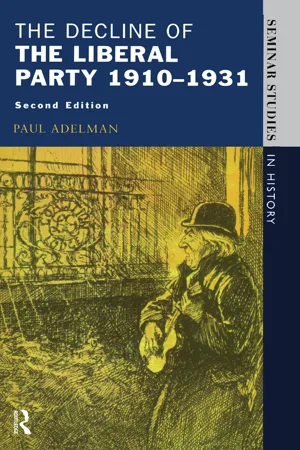
The Decline Of The Liberal Party 1910-1931
About this book
Paul Adelman seeks to explain the Liberal Party's dramatic transformation in political fortune. This clear, objective up-to-date account of the history of the Liberal Party covers the key period, 1910-1931. Focusing on liberal decline and drawing upon the different views forwarded by historians to account for this phenomenon, it discusses liberal decline before World War 1, the impact of the war on the liberals and the divisions that grew in the party after December 1916 between followers of Asquith and Lloyd George. A number of general factors are also covered, the impact of social and economic change, the effects of the Reform Act of 1918 and the rise of the Labour party. An ideal text for A-level and undergraduate students of history and politics.
PART ONE: THE CRISIS OF LIBERALISM
1 LIBERALISM UNDER STRAIN, 1910–14
A new phase began in the history of the Liberal government of 1906 with the emergence of the constitutional crisis over the powers of the House of Lords. As a result of the Lords’ rejection of Lloyd George’s ‘People’s Budget’ in November 1909, in an act of suicidal folly, the ending of their absolute veto over Commons’ legislation, which had been used with such blatant partisanship during the previous three years, became inevitable. In the general election fought on this issue in January 1910 the enormous Liberal majority of 1906 was cut down by some hundred seats, and Asquith became leader of a minority government; but he was able to carry on as Prime Minister with firm support from Labour and the Irish. In April the Commons passed three famous resolutions, the most important of which stated that a Bill passed by the Commons in three successive sessions should become law despite the opposition of the Lords. This became the basis of a Parliament Bill, and shortly afterwards the Lords, resignedly, passed the Budget.
Yet it took the government another exhausting and depressing year, marked by the death of Edward VII and a further general election which was virtually a re-enactment of the first, before Asquith could obtain from the new sovereign, George V, those secret ‘guarantees’ involving the creation of Liberal peers, which he now believed were vital to his task. That alone would make it possible to checkmate the Conservative majority in the House of Lords if they chose yet again to defy the will of the Commons and reject the proposed Parliament Bill. The Bill easily passed through the Lower House in June 1911, and was finally debated in the House of Lords in a broiling August in an atmosphere of mounting tension and excitement. There, the majority of Conservative peers, the ‘Ditchers’, led by the aged Halsbury, decided to oppose the Bill, even after the revelation of the King’s firm commitment to create enough Liberal peers if necessary to get it through. ‘The question is’, said Lord Selbourne, a leading Ditcher, ‘shall we perish in the dark, slain by our own hand, or in the light, killed by our enemies?’ [66 p. 15]. In the end, the ‘Hedgers’, the small group of moderate Conservative peers led by Curzon and Lansdowne, realising the futility of resistance, were able to whip up enough support for the government to get the Bill passed by the narrow majority of seventeen. In this way the long-drawn-out constitutional crisis came to an end, though its short-term consequences were to plague the Liberals until the outbreak of the First World War.
It left the government ‘exhausted but unable to rest’ [35 p. 187], beset with problems much more serious than had faced it in its conflict with the House of Lords. On the very day that George V gave his approval to the new Parliament Act, 18 August 1911, the country was faced with its first national railway strike, an indication of the new spirit of ‘labour unrest’ and trade-union resurgence, which seemed to typify the four years preceding the First World War. Labour unrest was marked by major industrial disputes between 1910 and 1912 on the railways and in the mines and docks over pay, conditions, and (for the railwaymen and dockers) union recognition as well, disputes which spilled over into other industries up to 1914. Contemporaries were alarmed not only by the extent of strike action (more days were lost through strikes during these years than at any time since the 1890s) but also, in the words of one historian, by its ‘violent, unofficial and insurgent character’ [33 p. 11]. This was seen in the legendary rioting at Tonypandy in November 1910 during the bitter South Wales coal strike, the prelude to the national strike of 1912; and in the sporadic looting and rioting in some of the ports during the dock strikes of 1911–12. Moreover, the temper of the industrial movement of the period seemed to many Edwardian men of property to smack of the revolutionary syndicalism preached by its main exponent in England, Tom Mann, who was certainly active as a strike leader in the docks during these years. These fears were given credence also by the publication in 1912, by a group of Welsh miners, of the most famous of British syndicalist pamphlets, ‘The Miners’ Next Step’, and the formation a year later of the Triple Alliance of miners, railwaymen and dockers to coordinate industrial action.
In addition to this unprecedented outburst of industrial unrest after 1910, the government was tormented by the outbreaks of Suffragette militancy organised by the formidable and publicity-conscious Mrs Emmeline Pankhurst and her daughters, through their Women’s Social and Political Union, founded in 1903. Their campaign began after 1905 in a fairly moderate way with the interruption of Liberal political meetings and the harassment of ministers, in an attempt to coerce the government into granting ‘Votes for Women’. In the years following the rejection of the Franchise Bills of 1912 (which allowed the possibility of female franchise) it reached a new crescendo of violence and hysteria marked by arson, outrage and attacks on property [47, 48]. The government replied with the harsh and distasteful weapons of imprisonment, forcible feeding, and the ‘Cat and Mouse’ Act which allowed Suffragettes on hunger strike to be released and then re-arrested once they were fit again. Yet however embarrassing and irritating the Suffragette campaign was to Liberal ministers, it remained to all of them, even to the most sympathetic, like Grey and Lloyd George, a peripheral issue. This was not true of the last and most difficult of the problems that faced them before August 1914, that of Ireland.
In 1912 the Liberal government, committed in principle to the granting of Home Rule for Ireland and partly dependent after 1910 on Irish Nationalist votes in the House of Commons, introduced its Home Rule Bill [121]. This was a moderate measure, similar in many respects to Gladstone’s Bill of 1893 and, like its predecessor, based on a policy of Home Rule for all Ireland. But in the intervening period the divisions between Catholics and Protestants in Ireland had hardened; and the Liberals now found themselves opposed by the stubborn resistance of the Ulster Unionists, prepared to push their opposition – as the formation of the Ulster Volunteers soon showed – to the point of armed revolt. In this they were in effect backed up by the Conservative party in Britain, who were tempted to use Ulster extremism, as they had once tried to use the Lords, to destroy the hated Liberal government. ‘I can imagine no length of resistance’, said Bonar Law, the Conservative leader, in July 1912, ‘to which Ulster will go, which I shall not be ready to support’ [31 p. 551]. This and similar sentiments expressed by Irish Unionist leaders like Carson were denounced by Asquith as a ‘Grammar of Anarchy’ [31 p. 558]. But Anarchy (as the Suffragette campaign had also shown) was not something that Asquith could either comprehend or master. Faced with intransigence and subversion by the Unionists both at Belfast and at Westminster, and unwilling or unable to impose a more compromising policy upon his Irish Nationalist allies, Asquith adopted his old policy of ‘Wait and see’. By a display of ‘massive calmness’ (in his admiring biographer’s phrase) and the conviction that the Irish question remained a suitable case for parliamentary treatment, the Prime Minister hoped to bring his opponents to their senses [103 p. 279]. Yet the ultimate effect of this policy of ‘drift’ was to exacerbate rather than relieve the growing tensions in Ireland, tensions which were bound to increase anyway during the two-year waiting period between the introduction of the Home Rule Bill and the moment when, in 1914 – the Lords having exhausted their powers of rejection under the new Parliament Act – it would become law. Hence, these years saw a mounting menace in Ireland: the formation of private armies north and south of the border, the growing grip on the province of the Ulster Unionist Council, the Curragh ‘Mutiny’, and the Larne gun-running incident which so inflamed Catholic opinion. By July 1914 the country had been brought to the verge of civil war [121].
In March, however, bowing to harsh facts, Asquith had offered the opposition an Amending Bill which would have postponed the application of Home Rule to Ulster for six years. This was dismissed by Carson as merely ‘a stay of execution’ [121 p. 203]. Nevertheless, the party leaders made one final if half-hearted effort to agree on a solution at the Buckingham Palace Conference held in July. This was, almost inevitably, a failure, and with its collapse and Britain’s entry into the First World War about a week later, the Irish constitutional problem was shelved for the duration.
The crises that dominated the history of the Liberal government between 1910 and 1914 have been seen by one distinguished historian as a period of ‘domestic anarchy’ [31 p. 441]; another writer, George Dangerfield, regards them as marking the ‘Strange Death of Liberal England’. The latter, in his influential book with this title, argued that during these years the old Liberal values of toleration, moderation and reason, bruised and battered even in 1906, were mercilessly done to death by an unholy alliance of peers, Suffragettes, syndicalists and Unionists, linked only by their hatred of Liberalism and commitment to unreason and extremism, and the result was that ‘by the end of 1913 Liberal England was reduced to ashes’ [66 p. 14].
But in terms of historical analysis, without underestimating the seriousness of the problems that faced the Liberal government during these years, it is as well to see them in less dramatic and more realistic terms, as problems not essentially different in kind from those that have faced nearly all peacetime governments in this country from Gladstone onwards [59, 73].
From this point of view it cannot be said that the government’s record was wholly unsuccessful or, from a party point of view, demoralising. The outcome of the Lords’ crisis was ultimately victory for the Liberals, particularly for Asquith who, in the later stages at least, displayed superb parliamentary mastery and control. It is true that in his attitude towards the Suffragette campaign the Prime Minister showed the other side of his political character: a timidity and condescension, an inability to respond imaginatively to what Gladstone earlier called a ‘virtuous passion’ which infuriated his feminist opponents at the time and has been condemned by their supporters since. Yet, in terms of maintaining party unity and pushing through the Liberals’ programme after 1910, a case can be made for Asquith’s reluctance to give priority to the franchise issue [80]. However misguided the government’s motives may have been and however illiberal their methods, the militant Suffragette campaign was contained during this period without, as far as one can tell, having any disastrous effects on the Liberal party itself or its electoral support.
A similar point may be made about the effects of the ‘labour unrest’. Whatever the causes of strike action or the fears of middle-class opinion about the spread of syndicalism as a contributory factor, for the government it was an intrusive practical problem because of the disruptive effects that protracted strikes in the railway or coal industries particularly would have on society and the economy. Hence the government’s policy when faced with such industrial action was one of cautious intervention, aimed at bringing about negotiations between the two sides, compromise, and a speedy settlement.
Lloyd George was the main instrument of this policy, partly because of Asquith’s ineptness in dealing with trade unionists compared with the Welshman’s negotiating skill and sympathy with the working men. In 1907, when he was still at the Board of Trade, Lloyd George had achieved a brilliant coup by settling the railways dispute. Now, in 1911, as Chancellor of the Exchequer, by a similar mixture of threats and soothing syrup, he was able to get the railway men to call off their strike after only two days. It was Lloyd George, too, who was heavily involved in the settlement of the miners’ strike the following year by his support for the Miners Minimum Wages Act [95]. It is true that these settlements were purely ad hoc and temporary; and, as far as the miners’ was concerned, largely fraudulent. Nor did they imply any clear conception by the Liberals of the role of the state in industrial disputes; no attempt was made to intervene, for example, in the London dock strike of 1912. Nevertheless, in the short run the government coped with industrial unrest reasonably successfully.
The Liberals’ greatest failure by 1914 was over Ireland. Even here, however, owing to the grim luck of the outbreak of the First World War, the government was able to stop the slither towards anarchy in Ireland, at least temporarily. What would have happened if Britain had not entered the war, with the support of both Irish Nationalists and the Unionists, it is difficult to tell. It is possible that in the end some compromise solution on the lines of Asquith’s ‘Exclusion’ policy of 1914 might have been accepted.
The real barometer of the success or failure of Edwardian Liberalism lies perhaps not with these pre-war crises, but in the cold record of electoral statistics. In 1906 the Liberals achieved a landslide victory, winning 400 seats and an overall majority of 130. Their Labour allies gained 30 seats in the House of Commons, while the Conservatives lost more than 200 seats and were reduced to 157 MPs. What was especially significant in the results was that the Liberals not only regained ‘traditional’ seats in the ‘Celtic fringe’, the industrial North, and parts of the Midlands lost in the later nineteenth century, but also made inroads into the Conservative heartland in the South, and, for the first time, won over industrial Lancashire and many working-class areas of London. The general election of 1906 thus marked a profound shift in the political geography of Liberalism [91], a shift which was to be modified but not substantially altered by the elections of 1910.
These elections were largely fought, as Asquith intended them to be, on the symbolic issue of House of Lords reform, an issue which he felt would rally all the anti-Conservative forces to the government. In this he was only partially successful, and the electoral results were disappointing. The Liberals lost more than 100 seats and, with 272 seats after December 1910, were reduced to exactly the same total as the Conservatives in the House of Commons; only support from Labour and the Irish enabled them to continue as the governing party. Thus the great Liberal tidal wave of 1906 receded drastically in 1910, though not back to the low-water mark of 1900 [22]. Though the middle classes, especially in southern England, returned to the Conservative fold as a result of their fear of ‘Lloyd Georgeism’, and especially of their worries about tax increases, the new gains made by the Liberals in the industrial North and the poorer areas of London were largely retained. This represented a working-class vote for radicalism [61, 43]. Hence, Peter Clarke argues that the elections of 1910 mark the culmination of ‘class politics’ (that is, working-class recognition of the primacy of social and economic issues) which had been gradually building up in the early twentieth century and was emphasised in 1910 by the profound electoral gulf between the Liberal North, Scotland, and Wales, and the Conservative South [25]. It was this new outlook, he contends, that drove the urban working class towards the Liberal party, with which Labour was associated as a junior partner in a ‘Progressive Alliance’; and it was upon this electoral base that Edwardian Liberalism could continue to thrive.
Yet working-class support for the Liberals was not as great in 1910 as might have been expected, given the issues on which the government fought the election. It seems that, apart from the introduction of old age pensions in 1908, working people were not all that favourably disposed towards the state-sponsored social reforms introduced or projectd by the government. The Liberal record in winning working-class seats in 1910 was in fact slightly worse than it had been in the 1892 general election, at the time of Gladstone [126].
Moreover, between 1910 and 1914 the Liberal party was faced with an insidious decline in terms of by-election results. During these years the Liberals lost fifteen seats to the Conservatives, and won two from Labour. Most of these were lost in straight fights with their main opponents; but – a particularly worrying feature for the Liberal leaders – the Labour party put up third-party candidates in eleven constituencies, and five Liberal seats were lost due to this intervention. This reflected the growing breakdown of the Lib/Lab alliance at grass-roots level, particularly in parts of industrial Yorkshire and the mining areas of South Wales, much to the distress of Ramsay MacDonald, its main architect and supporter on the Labour side. By the eve of the First World War, the Miners’ Federation of Great Britain was planning to sponsor twenty-one Labour candidates against the Liberals [29]; one estimate (by Ross McKibbin) suggests that the Labour party would have fielded between 150 and 170 candidates at the next election, compared with seventy-eight in January 1910, its highest pre-war tota...
Table of contents
- Cover Page
- Half Title Page
- Title Page
- Copyright Page
- Contents
- Note on referencing system
- Acknowledgements
- Editorial Foreword
- Foreword
- Note on the Second Edition
- PART ONE: The Crisis of Liberalism
- 1. Liberalism Under Strain, 1910–14
- 2. The Impact of War
- PART TWO: Liberals Decline
- 3. Liberals Divided
- 4. Liberals United
- 5. Lloyd George as Liberal Leader
- PART III: Assessment
- PART FOUR: Documents
- Appendix: The Liberal Vote
- Bibliography
- Index
Trusted by 375,005 students
Access to over 1.5 million titles for a fair monthly price.
Study more efficiently using our study tools.
Frequently asked questions
Yes, you can cancel anytime from the Subscription tab in your account settings on the Perlego website. Your subscription will stay active until the end of your current billing period. Learn how to cancel your subscription
No, books cannot be downloaded as external files, such as PDFs, for use outside of Perlego. However, you can download books within the Perlego app for offline reading on mobile or tablet. Learn how to download books offline
Perlego offers two plans: Essential and Complete
- Essential is ideal for learners and professionals who enjoy exploring a wide range of subjects. Access the Essential Library with 800,000+ trusted titles and best-sellers across business, personal growth, and the humanities. Includes unlimited reading time and Standard Read Aloud voice.
- Complete: Perfect for advanced learners and researchers needing full, unrestricted access. Unlock 1.5M+ books across hundreds of subjects, including academic and specialized titles. The Complete Plan also includes advanced features like Premium Read Aloud and Research Assistant.
We are an online textbook subscription service, where you can get access to an entire online library for less than the price of a single book per month. With over 1.5 million books across 990+ topics, we’ve got you covered! Learn about our mission
Look out for the read-aloud symbol on your next book to see if you can listen to it. The read-aloud tool reads text aloud for you, highlighting the text as it is being read. You can pause it, speed it up and slow it down. Learn more about Read Aloud
Yes! You can use the Perlego app on both iOS and Android devices to read anytime, anywhere — even offline. Perfect for commutes or when you’re on the go.
Please note we cannot support devices running on iOS 13 and Android 7 or earlier. Learn more about using the app
Please note we cannot support devices running on iOS 13 and Android 7 or earlier. Learn more about using the app
Yes, you can access The Decline Of The Liberal Party 1910-1931 by Paul Adelman in PDF and/or ePUB format, as well as other popular books in History & Modern British History. We have over 1.5 million books available in our catalogue for you to explore.