The papers presented in this volume, written by active and well- known researchers, discuss experimental research that has validated the importance of infancy in individual development over the age continuum.
In addition, a diverse overview section contains informative chapters on conceptual models for individual differences during infancy including:
individual differences from the perspective of dynamical systems theory
the logic of behavioral genetic designs and their use in the delineation of genetic contributions to individual differences
coverage of basic statistical treatments for individual difference data focussing on cluster analytic techniques
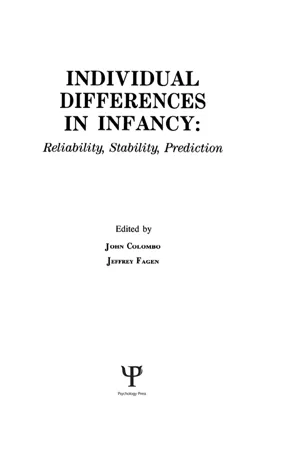
eBook - ePub
individual Differences in infancy
Reliability, Stability, and Prediction
- 480 pages
- English
- ePUB (mobile friendly)
- Available on iOS & Android
eBook - ePub
About this book
Information
Publisher
Psychology PressYear
2014Print ISBN
9781138882720
9780805803693
Edition
1eBook ISBN
9781317784845
I
INDIVIDUAL DIFFERENCES IN INFANCY: OVERVIEWS
1 | Developmental Models of Individual Differences1 |
The story of development, as Wohlwill (1973), McCall (1977), and others have noted, is the story of change. Whether the search for the laws that tell that story is made in the context of an organismic or behaviorist model, it is a search dominated by the desire to discover the generic laws that account for the phenomena of development and those that tell us the rules by which change occurs. Developmentalists, by the very definition of their enterprise, focus on what changes and how the changes occur. By contrast, the study of individual differences involves looking for stabilities across time, stabilities that persist in the face of change, characteristics that endure as constants even as the rules governing change may vary over time. Perhaps that is why the traditional study of individual differences has been a largely “adevelopmental” field, even though some attention has been given to interindividual variation and individual differences (e.g., Baltes & Nesselroade, 1973).
In opening this volume, devoted to a discussion of individual differences in infancy, it is useful to describe some of the traditional adevelopmental approaches to individual differences, to discuss the possible distinctions that can be made if individual differences are considered in a developmental context, and then to suggest how one might incorporate individual differences into a comprehensive model of development.
TRADITIONAL VIEWS OF INDIVIDUAL DIFFERENCES
The topic of individual differences has a long history and several grand traditions. The one that is probably the most familiar to psychologists who have had significant statistical training is to regard individual differences as a source of error. The second most familiar approach to individual differences is in the context of tests and measurements. Another approach involves an interest in individual differences as typologies. The recent emphasis and interest in behavior genetics also proceeds from an individual-difference strategy. Brief discussions of these four “traditional” views of individual differences follow.
Individual Differences as Error
According to Anastasi (1965), the first record of systematic interest on individual differences was reported by astronomers in the late 18th and early 19th centuries. As early as 1796 it was noted that two astronomers, making the same observations, would differ by as much as seven-tenths of a second. When it was clear that this was the result of “individual differences” in reaction time, a method to correct for these “errors” was developed in order to make the observations of different observers comparable. Thus, one of the earliest approaches to individual differences was to try to compensate for them. This was done by developing strategies that eliminate individual differences to better approximate the general laws that govern the phenomena.
A similar strategy has been adopted for much of general experimental psychology where the interest is in establishing general laws of behavior. Whether the experimental methodology involves group or single-subject designs, the assumption is made that individual differences in response to the stimulus conditions are basically error variance (Horowitz, 1969). In the group design approach one deals with error variance by statistical methods; in the single-subject design approach one deals with individual differences as error variance by ignoring subject to subject variation. The general form of the stimulus-response relationship is sought in replications using different subjects.
Individual differences are also ignored, or diminished in importance, in the normative tradition. Normative research involves describing the “average” course of development, be it in terms of an ages and stages description or in terms of the typical sequence of events. Indeed, individual-difference questions have been deemed orthogonal to developmental questions (Wohlwill, 1973).
A waggish characterization of these strategies might be one of “see no individual differences.” The “see no individual differences” efforts have been productive. They have yielded considerable information about general laws of behavior and also about general topographies of development. We made good use of the results whether it be in knowing average age when walking begins, the average age when the first word is spoken, or the general laws of reinforcement. Unquestionably, regarding individual differences as error or noise in the system is a strategy that has advanced our knowledge about the laws of behavior.
Individual Differences as Tests and Measures
Individual differences is a topic with its own tradition of investigation in the context of tests and measurements. Anastasi noted that James McKeen Catell was the one who first introduced the term mental test to the English psychological literature in his 1890 article entitled “Mental tests and measurements” (Anastasi, 1965; Catell, 1890). Although tests designed to measure individual differences evaluate many different kinds of behaviors, the testing world has been heavily dominated by the construction of tests of intelligence and associated behaviors.
The study of individual differences in relation to testing has become highly sophisticated. It has been very dependent for some of its progress on collateral developments in psychometrics. A large body of accepted standards and procedures and of data analysis now exists for application to the study of individual differences. This approach to the study of individual differences can be thought of as a “product” approach. The test is used to sort individuals on a particular dimension. The test measure is the product of their performance in the area of intelligence, personality, creativity, etc.
The central theme in the study of individual differences as tests and measurements has been the search for stability. The stability is adevelopmental. It can be defined by test–retest criteria, in terms of test–test relationships, or in terms of test measures to other kinds of measures. The interest here is the degree to which stability is observed over time. However, because of the particular nature of the psychometrics applied, the approach to stability has been more in terms of stability of an individual’s performance in relation to the performance of other individuals. This is reflected in the use of correlations to answer the question of how well performance on one test relates to performance on another test or task. The magnitude of the correlation provides an index of the extent of the relationship. As all students of elementary statistics know, this underdescribes the degree to which an individual stayed or changed places in a rank order of the scores on one measure compared to where that same individual was in the rank order of the scores on the second measure.
The industry of investigation into the reliability and validity of tests and measurements has produced considerable knowledge and many useful tools for the study of human behavior. Much of this knowledge is descriptive in nature and not developmentally oriented. Indeed, as in the search for the earliest infant test that would predict later intelligence, the quest has been to identify unchanging rather than changing characteristics—at least in terms of the individuals’ relative positions within a group.
Individual Differences as Typology
A subsidiary enterprise in the study of individual differences and one somewhat related to tests and measurements is the study of individual differences as typology. Although there have been typological interests in the area of intelligence (e.g., cognitive styles or verbal as compared with spatial intelligence), the most fully typological efforts have occurred in the areas of personality and psychopathology. Frequently this work is done using standard tests and measurement strategies. But as Tyler (1978) noted, the typological investigations could lie as well outside of the tests and measurements traditions. She cited Kelly’s “personal construct” theory as generating a different kind of measuring instrument—a sorting approach as opposed to looking for the rank order of individuals in relation to one another.
The typology approach is typified by Q-sort strategies and checklist observations that ultimately sort individuals into groups. There are tasks that can be used to differentiate individuals as field dependent/field independent, as extroverted or introverted, as reflective or impulsive. Interestingly, these strategies are typically most informative only when the extremes of the dimension are extracted and further studied. Subjects in the top and bottom quartiles of a particular scale (e.g., extroversion/introversion) are selected for study, leaving the equally large middle group unstudied. Traditionally, typological research has not been strongly developmental though there are a few exceptions (e.g., the work of Block & Block, 1980).
Individual Differences and Behavioral Genetics
The source of individual differences is a topic of considerable debate. In 1869 Francis Galton’s publication on “hereditary genius” used familial relationships to study the role of heredity with respect to particular traits and abilities in individuals. Galton’s claims, and those made subsequently by others, as well as the counterclaims, have continually fueled the nature-nurture controversy even into the present. The basic question: To what degree can individual differences be attributed to hereditary influences and to what degree can they be accounted for by environmental experience.
This debate has waxed and waned. It became clear that hereditary and environmental influences were difficult to separate given the relatively unsophisticated techniques of inquiry available until the late 1950s (Anastasi, 1958; Anastasi & Foley, 1948). With the development of more sophisticated statistical techniques and the use of stronger comparative strategies, the questions have taken on new life in the field labeled behavioral genetics. Particularly popular are studies of twins reared together and apart, and children reared by adoptive and biological parents (Plomin, 1986, 1989; and see Thompson, this volume).
Questions of individual differences in the context of the study of behavioral genetics are really subordinated to the larger issue of parceling out the percentage of influence attributable to the influence of heredity and environment with respect to behavior. The typical estimate of “heritability” in which a certain percentage of the variance is assigned to genetic factors is an estimate for a group of individuals and not for the individuals themselves. Thus, in the strictest sense, behavioral genetics is more the study of group differences than of individual differences, even though the groups are constituted by individuals who differ in comparison to one another on an individual-difference dimension.
The importance of behavioral genetics in a discussion of individual differences has a historical basis. Galton’s work and that of others, trumpeting the hereditarian position, was displaced by environmentalists from the 1930s to the early 1960s. Biological and genetic factors were all but dismissed as having any relevance to behavior and behavioral development. As current evidence has accumulated, showing genetic contributions to behavior, a more balanced view has developed. Plomin (1989), recognizing this, had commented: “As the pendulum swings from environmentalism, it is important that the pendulum be caught mid-swing before its momentum carries it to biological determinism.” (p. 110).
Genetic influences obviously account for a portion of the variance in human behavior. But so do environmental influences. This is abundantly the case in experimental explorations of the role of environment on the anatomy of the brain in rats (Diamond, 1988). In the instance of most of the human behavioral repertoire it would appear that, even as genetic determinants are demonstrable and significant, they are often accounting for less than half of the variance. In other words, genetic contributions are significant and substantial but the same is true of environmental contributions. As Thompson (this volume) notes, recent behavior genetic studies are increasingly studies of both environmental and genetic influences.
INDIVIDUAL DIFFERENCES AND DEVELOPMENTAL THEORIES
Even though the direct study of individual differences typically occurs in an adevelopmental context, it is a fact that all models and theories of development take note of individual differences. Gesell (1954) regarded them as hereditary factors that controlled the rate of development. As such, they were unlikely to be impacted by environmental experience. He believed personality and temperament as well as different rates of development in motor, language, and learning behavior were due primarily to hereditary influences. His own data longitudinal studies convinced him that by and large children remained in essentially the same place within a group over a period of time, and that individual developmental trajectories were basically stable individual-difference characteristics.
Most “organismic” theorists make similar assumptions. Gruber and Voneche’s (1977) referential compendium on Piaget does not even contain the term individual differences in the subject index. Piaget’s work is the quintessential example of the developmentalist’s interest in the orderly changes that constitute development. Like Gesell, Piaget and his followers consider individual differences in rate of development a reflection of hereditary influences. When asked about whether intervention programs could speed up the rate of intellectual development, Piaget is reported to have said that he regarded such preoccupation with rate of development as an “American” problem.
Behaviorists have focused on development more in the context of the laws that account for changes in the behavioral repertoire while generally ignoring the more traditional developmental phenomena that make up the stuff of most child development textbooks. Interestingly however, Clark Hull, in his elaborate hypothetico—deductive equational strategies, included individual differences (“i”) as a parameter in the theoretical formula that was to account for response acquisition (Hull, 1945). Little research on the role and function of this parameter appears to have been done. As noted earlier, the quest for these general laws tends to relegate individual differences to error variance. In the Skinnerian single-subject design strategy, individual differences are essentially ignored in favor of finding a replicated functional relationship across subjects.
The strong emphasis on environmental controls puts most behaviorists in the position of rejecting individual differences as reflecting hereditary influences. Rather, if pressed,...
Table of contents
- Cover
- Title Page
- Copyright Page
- Table of Contents
- Preface
- PART I: INDIVIDUAL DIFFERENCES IN INFANCY: OVERVIEWS
- PART II: INDIVIDUAL DIFFERENCES IN NEUROBEHAVIORAL DEVELOPMENT
- PART III: INFORMATION PROCESSING AND OUTPUT
- PART IV: TEMPERAMENT AND SOCIOEMOTIONAL DEVELOPMENT
- Author Index
- Subject Index
Trusted by 375,005 students
Access to over 1.5 million titles for a fair monthly price.
Study more efficiently using our study tools.
Frequently asked questions
Yes, you can cancel anytime from the Subscription tab in your account settings on the Perlego website. Your subscription will stay active until the end of your current billing period. Learn how to cancel your subscription
No, books cannot be downloaded as external files, such as PDFs, for use outside of Perlego. However, you can download books within the Perlego app for offline reading on mobile or tablet. Learn how to download books offline
Perlego offers two plans: Essential and Complete
- Essential is ideal for learners and professionals who enjoy exploring a wide range of subjects. Access the Essential Library with 800,000+ trusted titles and best-sellers across business, personal growth, and the humanities. Includes unlimited reading time and Standard Read Aloud voice.
- Complete: Perfect for advanced learners and researchers needing full, unrestricted access. Unlock 1.5M+ books across hundreds of subjects, including academic and specialized titles. The Complete Plan also includes advanced features like Premium Read Aloud and Research Assistant.
We are an online textbook subscription service, where you can get access to an entire online library for less than the price of a single book per month. With over 1.5 million books across 990+ topics, we’ve got you covered! Learn about our mission
Look out for the read-aloud symbol on your next book to see if you can listen to it. The read-aloud tool reads text aloud for you, highlighting the text as it is being read. You can pause it, speed it up and slow it down. Learn more about Read Aloud
Yes! You can use the Perlego app on both iOS and Android devices to read anytime, anywhere — even offline. Perfect for commutes or when you’re on the go.
Please note we cannot support devices running on iOS 13 and Android 7 or earlier. Learn more about using the app
Please note we cannot support devices running on iOS 13 and Android 7 or earlier. Learn more about using the app
Yes, you can access individual Differences in infancy by John Colombo,Jeffrey Fagen in PDF and/or ePUB format, as well as other popular books in Psychology & Developmental Psychology. We have over 1.5 million books available in our catalogue for you to explore.