- 366 pages
- English
- ePUB (mobile friendly)
- Available on iOS & Android
eBook - ePub
About this book
How do children emotionally heal and regain equilibrium after suffering trauma? How do adults understand and help them in a therapeutic relationship? These questions are at the heart of Violet Oaklander's approach to play therapy and her methods for training adults to work with children and adolescents. In this text, Peter Mortola uses qualitative and narrative methods of analysis to document and detail Oaklander's work in a two-week summer training attended by child therapists from around the world.
Information
Subtopic
Education in PsychologyIndex
Psychology6
Day Six: Monday
Sand Tray Day
Description, experience, and comments
The second Monday of this two-week training is a uniquely different experience for the twenty-four participants from any other day in the training. Instead of meeting in the hotel conference room as usual, they have car-pooled up the hill to Violet’s house to meet at the office where she sees clients. Her office is in a private studio in her backyard, attached to, but separate from, the rest of her house. This office is usually a revelation for participants: Violet has consciously filled it up with just about every “play therapy” object imaginable to serve as a kind of ideal model of what such an office might look like. The participants make lots of exclamatory comments as they enter through the waiting room doors and begin to look around such as “Wow, this is impressive!” and, “I love all the stuffed animals!”.
Inside the office, there is a sitting area toward the back wall arranged with two arm chairs and a small table a couch. Various stuffed animals are slung atop the back of the couch: a black and white cow, a couple of bears, and a fat kangaroo with babies. In the closet next to this seating area are shelves of boxed games — The Storytelling Card Game™, Trouble™, Blockhead™, Chutes and Ladders™, Knock-out™ — and other shelves containing a play telephone, a cash register, some Lincoln Logs™, a pig puppet, a toy clown, a Mickey Mouse™ doll, and a little girl doll.
There is also a large basket on the floor near the closet that contains about sixty puppets of all kinds: a stern looking teacher puppet, a fairy princess puppet, a bumble-bee, a ghoul, a seal, and many others. Next to the puppet basket are two miniature garbage cans with tight lids that contain both gray and red pottery clay.
A bookshelf against the opposite wall holds many volumes with titles like “Put Your Mother on the Ceiling: Children’s Imagination Games” (De Mille, 1955) and “The Gestalt Art Experience” (Rhyne, 1973). There is a puppet stage that is propped behind the door, and a doll house that Violet says children like to use a lot. Standing near the center of the room is Boppo the Clown™ an inflatable punching toy that looks like a sports referee.
In the corner of the room opposite the seating area, there are six vertical rows of small shelves that are built into the walls and that hold hundreds of sand tray objects. These objects and figurines are very colorful and range in size, shape, and appearance though they tend to be about two inches high or less. Amazingly, they are all organized by type: there are shelves with scary stuff (witches, tombstones, skeletons, etc.), shelves with ocean-related objects (shells, rocks, fish, and octopus), and shelves with fantasy figures (knights, dragons, princesses, etc.). Additionally, there are snakes, lions, birds, animals, toy children of all sizes, and families of all colors and shapes. There are also houses, bridges, fences, army-men, nuns, ghosts, horses, gorillas, a Batman™ figure, dinosaurs, trees, miniature coffins, glass stones, boats — you name it, she’s got it.
Before the participants arrived, Violet set up eight “sand tray stations” around the room and out on the shaded patio. These stations are composed of 3 chairs positioned around one sand tray. The sand trays are either made of wood or plastic and are approximately two feet wide by three feet long and about six inches deep. These trays are filled with about two inches of white sand and each of them has a blue bottom that, with a little imagination, can become a lake, river, or ocean. The three chairs will be used by small groups of participants as they take on the roles of “therapist,” “client,” and “observer” throughout the day while working with the sand-trays. Because participants will spend most of the day in these roles and less time listening to presentations or watching demonstrations by Violet, this day will become the most deeply experiential one for the participants thus far in the training — a day to put into practice all that they have been taking in over the past week.
When the participants have settled onto the couch, into seats or upon pillows on the floor and the buzz of excitement has died down, Violet says she would like to tell them about her approach to working with the sand tray. She describes to the participants that sand tray work follows many of the same principles that frame her other projective and expressive experiences involving drawing, clay, or musical instruments. That is, the work begins with a child creating an imagined scene in the sand which then becomes the centerpiece and starting point for discussion in the session. In a handout entitled “Notes on sand tray work” that is provided to the participants, Violet writes about the process in this way:
I usually say to the child, “I would like you to make a scene in the sand. You can use any of the objects you see here, and if there is something you don’t see, ask me — maybe I have it. Your scene doesn’t have to make sense, or it can. You can choose things because you like them and want to use them. Or you might want to make something special. It can be real or imaginary or like a dream. Anything.” I usually show the child some photographs of sand trays to give them the idea of what I mean. Sometimes I will ask the child to do a special theme. For example, “Do a scene representing the divorce in your family,” or “Make a scene that shows how you feel these days”…
Violet also describes in the handout that there are multiple “levels of the work” that can take place with a child and the sand tray. Some of these levels include paying attention to the child’s process in making the sand scene (e.g. “Is the child slow and methodical or fast and frenzied?”), the general look of the sand tray that the child has created (e.g. “Is it organized? Chaotic?”), and what Violet calls the “making sense level” which she describes in this way:
Children always attempt to make sense out of the scene, just as they try to make sense of their lives. I will say, “Tell me about your scene.” They’ll look at it and then say, “Well, this is a…”
As with the clay and drawing techniques presented in the first week of the training, another level of the work is reflected in helping the child to “own” any of their projections that they may have put into the sand tray scene. Violet writes in her handout that she may ask, “Does anything here remind you of you or anything in your life?” or, “Do you ever feel like you need a place to hide like the rabbit in your story?”
Violet goes on to explain that today the participants will have a lot of time and many opportunities to practice working at these various levels of the sand tray experience. When they are in the role of therapists, she explains, they will try to help their “client” make sense out of the scene that they have created by starting a dialogue or having the client tell a story about what they see before them. As clients, they will have the opportunity to experience what this kind of therapeutic work is like first-hand. As an observer, their job will be to watch the unfolding dynamics of the work between the client and therapist and foster a discussion after the session as a kind of processing of the work done. The therapist may also stop the session to consult with the observer if the therapist is feeling stuck or in need of advise. The focus, asserts Violet, is on the role of the therapist and on the practice of this approach.
After this overview of her approach to working with sand trays, Violet says that she would like to do a short demonstration session with one participant in front of the group. Nicolas, a child and family psychotherapist from Montana, raises his hand first and Violet then hands him a small, red, plastic bucket. Violet asks Nicolas to take a few moments collecting sand tray toys and objects that he would like to use in creating his sand tray scene. After a few minutes in which Nicolas silently looks over the many figurines, picking some, leaving others, he rejoins Violet in the center of the room and the two of them sit on the floor on either side of a blue plastic container partly filled with sand. Violet then asks Nicolas to “create a scene in the sand” and without more prompting, he begins to do so.
Nicolas almost immediately asks Violet if he can “take a little of the sand out. It’s too much sand.” Violet gives Nicolas a container with which he scoops out some of the sand and pours it into a nearby sand tray. In this process of removing some of the sand from his tray, Nicolas uncovers more of the blue bottom the tray and then begins to create his scene. Quietly, Nicolas moves the sand around with his hands, smoothing it out in some places. He then begins adding the figures and objects that he has chosen for his scene. Eventually, a scene emerges in which a house sits near the edge of a large body of water. The house is protected by a large tree, and a male and female figure stand outside the house. An angel figure occupies one corner of the sand tray, with bright bits of glass and a few beads scattered around its feet. In another part of the sand tray are a number of animal figurines, some cows and dogs and a horse. At the edge of the water is a small, white boat with a sail that looks damaged and which lies flat across the hull of the boat.
When Nicolas has finished his scene and sits back, seemingly pleased with his efforts, Violet says: “Okay. Would you tell me a little bit about this, as much as you can right now?” Nicolas tells Violet that, “As I started laying it out it became clear to me what it was”. He goes on to say that the scene is composed of the comforting things in his life now, an angel to represent his spiritual side, a cow to represent his grandmother’s farm where he spent a lot of time as a child, and a female figure to represent his supportive wife.
Violet then asks Nicolas to “be” a number of the figures in the scene. For example, at one point Violet refers to the angel figure and says to Nicolas, “What I would like you to do then is be her and speak as her.” After a few more moments, Violet then asks Nicolas to “be one of these cows.” In the process of exploring a number of the sand tray figures together with Nicolas, Violet points to the boat down near the water’s edge and the following dialogue ensues:
| Violet: | Be the boat. |
| Nicolas: | I am the boat [Laughs]. I was the boat the other day with the clay. Somehow the clay became a boat, and it was in need of repair, and I notice this boat is in need of repair too. I am the boat, and I have a sail here in need of repair. But I enjoy being on the water. It’s very calm. It’s very soothing. It’s rocking. It’s just very peaceful on the water. I like being on the water, and riding around in the harbor, and going out to sea, actually. I like going out to sea too. And I like taking people places. I need to get repaired. |
| Violet: | You need to get.repaired. |
| Nicolas: | I need to get repaired. Yes. |
| Violet: | What are you thinking about as you say that? Now, what are you thinking about now? |
| Nicolas: | Its kind of the same thing that came up with the Clay work. That I need to take better care of myself, take more time for myself. Get to the gym [Laughs]. Get repaired so I can continue on the journey. |
After Violet has asked Nicolas to speak as most of the figures in the sand tray, she returns to something that Nicolas said earlier in their discussion. Nicolas had said that halfway through making his scene, he decided that he would not be able to fit all the objects and figures into the sand tray without it looking too crowded. He decided instead to leave some of the figurines out, including ones that represented all four of his now almost fully-grown children and two of their spouses. Returning to this theme, Violet asks Nicolas to speak to these figures that he has left out of the sand tray scene. Violet later asks Nicolas to incorporate back into the sand tray one figure that was initially left out. Nicolas identifies this figure as “the working Nicolas,” and begins to have a dialogue with it.
In his fifteen-minute, demonstration session with Violet, Nicolas ends up exploring aspects of his life that give him support as well as aspects of his life that worry and challenge him. In his sand tray scene, most of the objects that he included represented supportive and peaceful aspects of his life (e.g. his spirituality, his house, his wife) while the objects that were not included in the scene represented some of the more worrisome aspects of his life (e.g. his working self and one of his daughters who has recently left the family home).
In the group processing of Violet’s demonstration session with Nicolas that follows, one participant says, “I was real curious to hear from those parts that weren’t in the tray. So I was really glad that came up in the process.” Another participants asks Nicolas, “As you were going through picking the figures, did you start out with an image in your mind of what you were going to create, and if not, when did that begin to take shape for you?” Nicolas responds that as he put the scene together he started to be conscious of how he was including “peaceful” objects and excluding the objects that represented more difficulty for him. As the brief processing time comes to a close, Violet states that the process of putting together the sand tray scene is just as important as the product itself. She adds that when she is working with children in particular, she will watch the way they pick objects, work with the sand, and place objects in the different parts of the tray, sometimes asking the child about this aspect of the work later in the session.
At 10:15 a.m., after the demonstration with Nicolas, Violet asks the participants to count off into eight groups of three. She then has each member of the eight groups decide if they will be the client first, second, or third. She then points out the schedule on the wall which outlines the flow of the day (Figure 8).
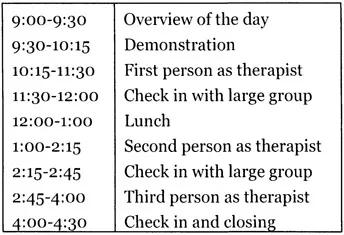
Figure 8: Sand Tray Day Schedule
Before sending the small groups of participants off to work with the sand trays at their stations, Violet describes the steps of the process that each session should take. She describes that the client should first take approximately twenty minutes to choose the objects and compose a sand tray scene. The client and the therapist will then work together on the sand tray scene for approximately thirty minutes. This work will be followed by a fifteen-minute period of time when the observer shares feedback and the client and therapist can process how the experience went for them. Lastly, before the client cleans up the sand tray, Violet will walk around and take a Polaroid shot of each scene for the client to keep. After each round, the whole group will regather for a check in and report back about what was learned, particularly by the person in the role of therapist.
The rest of the morning and early afternoon are a quieter time for Violet as she sits in close proximity to most of the small groups and makes herself available for questions and concerns. The participants in the small groups spend concentrated moments picking out figures and objects from the many shelves around the room, placing t...
Table of contents
- Cover Page
- Half Title page
- Title Page
- Copyright Page
- Dedication
- Contents
- List of Figures and Tables
- Foreword
- Introduction
- Week One
- Week Two
- References
Trusted by 375,005 students
Access to over 1.5 million titles for a fair monthly price.
Study more efficiently using our study tools.
Frequently asked questions
Yes, you can cancel anytime from the Subscription tab in your account settings on the Perlego website. Your subscription will stay active until the end of your current billing period. Learn how to cancel your subscription
No, books cannot be downloaded as external files, such as PDFs, for use outside of Perlego. However, you can download books within the Perlego app for offline reading on mobile or tablet. Learn how to download books offline
Perlego offers two plans: Essential and Complete
- Essential is ideal for learners and professionals who enjoy exploring a wide range of subjects. Access the Essential Library with 800,000+ trusted titles and best-sellers across business, personal growth, and the humanities. Includes unlimited reading time and Standard Read Aloud voice.
- Complete: Perfect for advanced learners and researchers needing full, unrestricted access. Unlock 1.5M+ books across hundreds of subjects, including academic and specialized titles. The Complete Plan also includes advanced features like Premium Read Aloud and Research Assistant.
We are an online textbook subscription service, where you can get access to an entire online library for less than the price of a single book per month. With over 1.5 million books across 990+ topics, we’ve got you covered! Learn about our mission
Look out for the read-aloud symbol on your next book to see if you can listen to it. The read-aloud tool reads text aloud for you, highlighting the text as it is being read. You can pause it, speed it up and slow it down. Learn more about Read Aloud
Yes! You can use the Perlego app on both iOS and Android devices to read anytime, anywhere — even offline. Perfect for commutes or when you’re on the go.
Please note we cannot support devices running on iOS 13 and Android 7 or earlier. Learn more about using the app
Please note we cannot support devices running on iOS 13 and Android 7 or earlier. Learn more about using the app
Yes, you can access Windowframes by Peter Mortola in PDF and/or ePUB format, as well as other popular books in Psychology & Education in Psychology. We have over 1.5 million books available in our catalogue for you to explore.