eBook - ePub
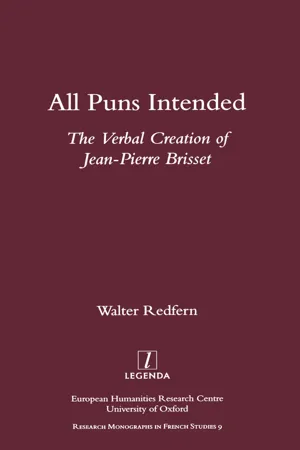
All Puns Intended
The Verbal Creation of Jean-Pierre Brisset
- 198 pages
- English
- ePUB (mobile friendly)
- Available on iOS & Android
eBook - ePub
About this book
"The 19th century in France spawned numerous 'fous litteraires, one of them being Jean-Pierre Brisset (1837-1919). An individualist among individualists, he dismantled the existing French tongue, reshaping it to suit his own grandiose purposes, which were to explain afresh the development of human beings (from frogs) and of their language (from croaks). Continuous and ubiquitous punning was a unique feature of his writing. In this study, Redfern examines such themes as the nature of literary madness, the phenomenon of deadpan humour, the role of analogy, and the place of institutional religion in Brisset's creative rewriting of the creation."
Information
Chapter 1
The Motivating Force: Etymology
When the boy Brisset first noticed what he took to be startling resemblances between frogs and human beings, he began the process of referring back (or back formation), which was to dictate the whole course of his thinking life. People recall frogs; frogs forecast people. Derivation (etymology) and prophecy conjoin in a tight dialectic. Of course, before our amphibian ancestors was God, but, as He precedes and lies behind all else, and will not go away, we can justifiably shelve Him for later consideration. For the atheist, naturally, God is the most far-fetched back-formation of them all. Brisset, then, is a retrospective prophet. He bends backwards to explain the here-and-now. As his universe is word-centred, indeed word-haunted, I must start with verbal origins: etymology.
Etymology is self-evidently backward-turned. Its premiss is that perfection or truth ('etymology', etymologicaily speaking, means 'true meaning') belong in the past, and that the present represents some form of degeneration, deviation or unholy complication.1 Etymologists want to get back to basics, back to nature, in order to refind purity, to strip away current and intermediate accretions and to reach the thing itself. In so doing, they may well invent origins for the present. Creativity can work in reverse, as some babies do when learning to crawl. It is the verbal counterpart to the cinematic double-take, a second bite at the cherry. 'It is strange', said one Hollywood magnate, 'what some authors auth.'2
The seeker opposite to Brisset is ready to confess ignorance: Origin unknown'. Brisset, and those of comparable ilk before or after him, would never settle for such intellectual humility. A.-J. Veyrier, professeur at Angers, etymologist and comic-opera composer, once interviewed Brisset. 'Pour lui un mot s'expliquait par le son même de ses syllabes.' When Veyrier tested him with the word 'Israélite', Brisset came up trumps, disdainfully: 'I (pour il) sra (sera) élite! Il sera l'élite de toutes les nations!' Quoting some frank pages from La Science de Dien, Veyrier sees fit to warn susceptible readers: 'I1 s'y trouve des pages, des chapitres d'un cru à faire rougir les singes. M. Brisset expliquait, de l'air le plus candide et le plus ingénu, les énormités les plus monstrueuses.' The man himself, however, seems to have charmed his interlocutor: 'Il supportait la contradiction sans se fâcher, avec une commisération, une pitié manifestes. Imaginez-vous, si possible, Dieu le père consentant à discuter avec un simple élève de petit séminaire. Mais il ne cédait pas un pouce de son terrain.' After citing La Grande Nouvelle, Veyrier concludes his exclusive interview: 'M Brisset n'était pas, comme vous pournez le penser, un fumiste, un mystificateur, un pince sans rire, tels Willy et Alphonse Allais; c'était un convaincu, j'allais dire un apôtre en son genre.'3
Brisset's etymologizing was of the creative kind, just as we talk of creative accountancy, or cooking the books. In La Science de Dieu, playing with pagne and campagne, which lead on to vache and Espagnol, Brisset arrives by a circuitous route at this: 'L'italien spagnollegiare correspond à notre ancien verbe se pagnoler ou espagnoler [...]. Le verbe espagnoler n'était pas mort, il dormait et nous l'avons ressuscité. Il est trap parlant pour ne pas revenir en usage, dans le lieu convenable' (SD 312—13). The Italian verb ('to strut in Castilian fashion') does exist, but the French verbs never have. Brisset, who denied the very possibility of neology, here coins, and not for the first time, source-words of the most homespun variety, in order to reinforce his evidence. Already, in La Grammaire logique (1883), he was convincing himself with small effort that the syllable mor helps to explain the following pseudo-cognates: 'Morahser, diriger l'esprit vers la mort; morbide, couleur de mort; morceau, partie d'un tout mort ou détruit; morceler, partager ce qui est mort ou détruit; mordant, ce qui peut causer la mort; morfondre, s'en aller comme mort; amorcer, disposer pour la mort' (GL(2) 148). And so on: once started, there is no stopping him. Fie is both dogged and marsupial in his bounds. Wanting to prove, uncontroversially but incontrovertibly, that all life originated in water, he finds beginnings in the word 'origin' itself: 'Il est amplement démontré que elle ou èle et aile ont une même origine dans les eaux; origine-èle, originel; origine-ale, original; origine-eaux, originaux; èle = ale = eau et eaux' (SD 249).
In addition to those fabricated but inventive derivations, Brisset's hostility to Latin propels him into indisputably false etymologies, as when he spans three languages (French/Italian/Spanish) in order to link pouce / puce, pollice / pulice, and pulgar / pulga (SD 167). In fact, police comes from pollex, and puce from pulex.
Cullard neatly pinpoints Brisset's idiosyncratic goal: 'Depuis Von Wartburg, à qui nous devons le dictionnaire étymologique de la langue française, s'est substituée, à la notion d'étymologie-origine, celle d'étymologie-histoire du mot, à laquelle Brisset eût sans doute préféré celle d'histoire dans le mot.'4 Brisset, indeed, does concentrate meaning, telescoping past and present, miscegenating different sources, but all in the cause of discovering family trees. Children want to know where babies come from; adults ask the same poser about words and, more widely, about language itself. Brisset looks for origins in the belief that they will elucidate all subsequence. How eccentric was he in all this?
As Pierre Guiraud has so well expressed it: 'Les mots engendrent la fable là où la réalité devrait engendrer les mots: procès linguistique d'une grande généralité et dont il faut bien comprendre qu'il n'est pas l'apanage d'une "pensée sauvage" et pré-scientifique bien qu'il joue, évidemment, un grand rôle dans la création populaire.' Guiraud calls this 'rétro-signification' or 'rétro-motivation', and m the process provides a good description of Brisset's habitual strategy: 'Alors, croyant penser aux choses, nous ne faisons que raisonner sur les mots.'5
Back-formation is tightly linked with 'popular' or 'folk' etymology, which eagerly reinterprets words, remotivates them with whatever heave or wrench, so as to explain the present by the past, the here by the there. Since the mistiest of times, both amateur and learned philologers, or truffle-pigs, have snuffled up tubers of inspired daftness. This is the Cratylist tradition, first serioludically investigated by Plato: the tenacious belief in a necessary connection between the phonic or graphic form of words and what they designate. As Humpty Dumpty explains: 'My name means the shape I am.'6 And Alice finds it difficult to gainsay him.
Cratylism has a strong teleological charge: names are foreordained; but it rarely strays very far from playfulness, po-faced or otherwise. 'Folk' etymology, for its part, is practised at all levels, from the deconstructionist at the bottom to the person in the street at the top. Just as many people, confronted with non-figurative art, or flames in the grate, read familiar shapes into the amorphous scene, so as many again abhor 'the vacuum of an unmeaning word'.7 'Popular' etymology is the opposite of the mainly high-literary tactic of defamiliarization, or making strange, because it attempts to naturalize the alien. It is the spark jumping the gap between supposedly unrelated words.
'Folk' etymologists assume that coincidences of sound are not accidental or meaningless; and so the demon of analogy works overtime. Brisset telt the same about the universe and human history. The more unsnobbish professional linguists, such as John Orr, acknowledge that 'even a wrong etymology is a sound and sense association, and therefore a linguistic fact'.8 Stephen Ullmann follows up in similar anti-puristic vein: 'Whether [the initial error] was a semi-learned misinterpretation or a mere malapropism, it had its roots in a purely synchronic association with a word similar in sound, in meaning, or in both. The term "associative etymology" suggested by Professor Orr [...] would be an admirable description of the mechanism at work.'9 Brisset himself elevates malapropisms to a fine art. Wrongness rules: OK? It is linguistic hijacking. Like folk-tales, 'folk' etymology such as Brisset's creates a fable out of the re-analysed word. This is the mythic impulse widely operative and visible in various kinds of discourse and mentalities. Is Brisset so crackpot, then? Such reconstruction via manipulation of sub-parts is related to adhocism: recycling, cannibalization, hybridization. At the very least, it honours language, which is felt to be richly layered and saturated with significance. Whereas an orthodox etymologist lists the evolving meanings of words over the centuries, the punning variety such as Brisset makes them coexist, as indeed they do in fact. Any word secretes its various senses, and is thus composite, polysemous, stacked.
Brisset had countless predecessors in what Eco has called 'etymological furor', as in Isidore of Seville's claim that agnus is a lamb 'because it recognises [agnoscit] its own mother'.10 Eco distinguishes between retrospective etymologizing, which aims to show how the mother tongue is harmoniously related to the nature of things, and prospective etymologizing, which projects Hebrew words forwards to show how they transmitted and transmuted themselves into the words of other languages. As Lecercle notes, Isidore of Seville, like Brisset, offers variant explanations, notoriously concerning bees, apes, so called because they hold on to one another by the feet, or maybe because they have no feet: 'A(DLIGANT SE) PE(DIBU)S, or A (=sine) PE(DIBU)S.' This example is blatantly selective, lacunary anagrammatizing; any proof is feasible by such a method. Lecercle rightly sees nothing amiss in converging Isidore and Brisset, for, like the great medieval theologian and encyclopaedist, 'in the midst of his delusions, Brisset does believe he is telling the truth about the world, man, God, and the cosmos'.11
A comparable instance of global thinking allied with intense parochialism is Goropius Becanus (Jan van Gorp), who, in his Origenes Antwerpianae of 1569,
agreed with all claims made about the divine inspiration of the original language, about its motivated and non-arbitrary relation between words and things. According to him, there was only a single living language in which this motivated concordance existed to an exemplary degree; that language was Dutch, particularly the dialect of Antwerp.
Goropius produced 'a string of arguments whose level of etymological wishful thinking matched that of Isidore; they later became known as "...
Table of contents
- Cover
- Half Title
- Title
- Copyright
- Contents
- Acknowledgements
- Abbreviations
- Bare Bones
- Proem
- 1 The Motivating Force: Etymology
- 2 Frogs on Frogs
- 3 Creation Myths
- 4 God and Company
- 5 Language and Tongues
- 6 The Sexual Imperative
- 7 Methods in his Madness
- 8 The Play of Language
- 9 Varieties of Madness
- 10 Seriously Funny
- 11 Heading for the Last Round-Up
- The Last Round-Up
- In a Burst: Appendix
- Bibliography
- Index
Trusted by 375,005 students
Access to over 1.5 million titles for a fair monthly price.
Study more efficiently using our study tools.
Frequently asked questions
Yes, you can cancel anytime from the Subscription tab in your account settings on the Perlego website. Your subscription will stay active until the end of your current billing period. Learn how to cancel your subscription
No, books cannot be downloaded as external files, such as PDFs, for use outside of Perlego. However, you can download books within the Perlego app for offline reading on mobile or tablet. Learn how to download books offline
Perlego offers two plans: Essential and Complete
- Essential is ideal for learners and professionals who enjoy exploring a wide range of subjects. Access the Essential Library with 800,000+ trusted titles and best-sellers across business, personal growth, and the humanities. Includes unlimited reading time and Standard Read Aloud voice.
- Complete: Perfect for advanced learners and researchers needing full, unrestricted access. Unlock 1.5M+ books across hundreds of subjects, including academic and specialized titles. The Complete Plan also includes advanced features like Premium Read Aloud and Research Assistant.
We are an online textbook subscription service, where you can get access to an entire online library for less than the price of a single book per month. With over 1.5 million books across 990+ topics, we’ve got you covered! Learn about our mission
Look out for the read-aloud symbol on your next book to see if you can listen to it. The read-aloud tool reads text aloud for you, highlighting the text as it is being read. You can pause it, speed it up and slow it down. Learn more about Read Aloud
Yes! You can use the Perlego app on both iOS and Android devices to read anytime, anywhere — even offline. Perfect for commutes or when you’re on the go.
Please note we cannot support devices running on iOS 13 and Android 7 or earlier. Learn more about using the app
Please note we cannot support devices running on iOS 13 and Android 7 or earlier. Learn more about using the app
Yes, you can access All Puns Intended by Walter Redfern,Walter D. Redfern in PDF and/or ePUB format, as well as other popular books in Languages & Linguistics & Languages. We have over 1.5 million books available in our catalogue for you to explore.