![]()
1
Competitiveness vs. protectionism
Is local content a road to economic competitiveness or a pathway to protectionism?
The problem
In January 2011, the Folha de São Paulo newspaper in Brazil reported that Petrobras—the state-owned international oil company—might consider reducing its expenditure on locally produced content in the supply of goods and services from 65% to 35%.1 This claim was rapidly refuted by the company.2 The incident demonstrates the tensions that can exist around local content targets, and the question of whether they are a rational public policy for development of nascent or re-emergent domestic industries, or on occasions excessive and represent a form of unjustified protectionism.
Of course, it is not the setting of local content targets per se that carries the potential for protectionism. It is whether the targets themselves might lead to levels of local procurement that exceed the capability of national suppliers to win work on an internationally competitive basis. The basis for setting local content targets is a choice between options. Either targets are established within the capabilities of domestic suppliers to win orders or service contracts against international competition; or, targets are set knowing that local suppliers are not sufficiently competitive to win contracts on a level playing field, but that this is deemed justifiable as a public policy in order to protect domestic industry, create local jobs or develop local capabilities over time. Alternatively, regulatory authorities may genuinely (or disingenuously) believe that targets are being set on an internationally competitive basis, when in reality this is not the case.
Defining competitiveness and protectionism
It would be helpful at this juncture to define what is meant by international competitiveness and protectionism as these terms relate to local content in the procurement of goods and services in the oil and gas industry. In this book we consider competitiveness as a comparative concept, specifically: the ability of a domestic supplier or contractor to supply goods or services in an international market. Importantly, this market could be entirely within the domestic economy, with foreign and local firms competing against each other in open competition. Or, it can mean a market in a foreign country accessible to domestic suppliers.
The term protectionism refers to the intended or unintended economic policy of restraining trade between countries through methods such as tariffs (taxes) on imported goods, or restrictive import quotas and regulations designed to discourage imports. The setting of local content targets would fall within the category of restrictive import quotas. Regulations that give preference to domestic suppliers over foreign suppliers (e.g. through domestic-only tender lists or price advantages to local suppliers) could be deemed a form of import discouragement.
Under World Trade Organisation rules for Trade-Related Investment Measures (TRIMs), local content measures are explicitly prohibited if these oblige the purchase or use by an enterprise of products of domestic origin or from a domestic source, whether this is specified in terms of particular products, the volume or value of products, or in terms of a proportion of volume or value of local production. Similar prohibitions are contained in pan-regional and bilateral trade agreements.
This interpretation of protectionism as an anticompetitive obligation on an individual firm suggests the need for some further refinement of the aforementioned definition for competitiveness. The World Economic Forum refers in its annual Competitiveness Report to ‘national competitiveness’, and includes in this definition not only the capability of domestic firms in terms of their business sophistication and technological readiness to penetrate foreign markets and compete with imports in the domestic market, but also the competitiveness of the nation state as a whole: for example, the quality of its education system and training institutions, extent of physical infrastructure, degree of macroeconomic stability and the general health of its citizens.
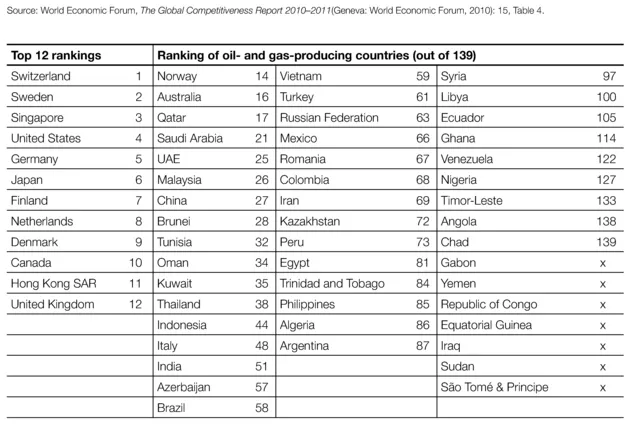
Table 1.1 compares the national competitiveness of oil-and gas-producing countries against the top 12 most competitive countries. (This ranking is based on a composite weighted average, and the reader is advised to refer to the detailed report for rankings associated with the different criteria on firm competitiveness.)
Whether looking at international competitiveness through the lens of the individual firm, or the economic and industrial characteristics of an entire nation, an important test of a nation’s competitiveness is whether domestic suppliers are able to win work in international markets on a competitive basis. In other words, if engaged in a full and fair process of contractor selection, are domestic suppliers able to beat the competition to win contracts?
Table 1.1 Global competitiveness index ranking, 2010 to 2012, oil-and gas-producing countries
Whether a process of contractor selection can ever be truly ‘full’ and ‘fair’ is of course open to challenge. Even if the contract award process itself is genuinely competitive, with pre-qualification and tender evaluation processes applied equally to all prospective bidders, and contracts awarded strictly on tender submissions, there is still the question of the advantages and disadvantages that lie outside of the immediate control of the supplier.
For example, foreign and domestic vendors may be exposed to very different tax regimes. A prospective foreign supplier may be subject to import tariffs and withholding tax, which disadvantages its price competitiveness. But then a domestic supplier may be disadvantaged because of local value added tax that is not applicable to the foreign supplier. The USA, for example, does not participate in a VAT system, and can argue that it is disadvantaged when exporting equipment to countries that then add this type of tax to the sales price.
Conversely, a foreign supplier may be advantaged by export subsidies from its own government, such as export credit guarantees, or by a public policy of the host government to attract inward investment through relief on import duties. Likewise, local suppliers may benefit from access to subsidised sources of domestic credit: for example, from national development banks, or from subsidised energy costs.
These competitive externalities are difficult to overcome, which is why they often form key themes within international and bilateral trade n...