- 344 pages
- English
- ePUB (mobile friendly)
- Available on iOS & Android
eBook - ePub
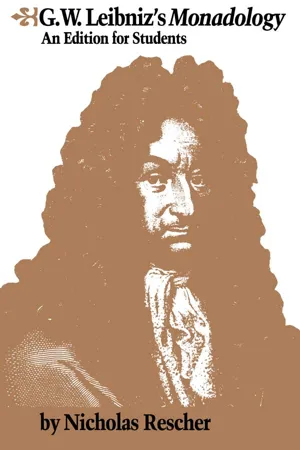
G.W. Leibniz's Monadology
About this book
G.W. Leibniz's Monadology , one of the most important pieces of the Leibniz corpus, is at once one of the great classics of modern philosophy and one of its most puzzling productions. Because the essay is written in so condensed and compact a fashion, for almost three centuries it has baffled and beguiled those who have read it for the first time. Nicholas Rescher accompanies the text of the Monadology section-by-section with relevant excerpts from other Leibnizian writings. Using these brief sections as an outline, Rescher collects together some of Leibniz's widely scattered discussions of the matters at issue. The result serves a dual purpose of providing a commentary on the Monadology by Leibniz himself, while at the same time supplying an exposition of his philosophy using the Monadology as an outline.
Information
 | Introduction |
A. Gottfried Wilhelm Leibniz (1646–1716)
Gottfried Wilhelm von Leibniz was born on July 1, 1646, at Leipzig in Germany, where his father was professor of moral philosophy at the university. Although he attended the finest school in his native city, he loved working on his own and was largely self-taught from the German and Latin books of his father’s library. A child prodigy with an insatiable appetite for learning, he launched into an intensive study of logic, scholastic philosophy, and Protestant theology already in his early teens. At 15 he entered the University of Leipzig. During the first preparatory years, one semester of which he spent at the University of Jena, he studied principally philosophy, natural philosophy, and mathematics. His baccalaureate dissertation of 1663 (Deprincipio individui) was devoted to the principle of individuation, a topic to which he was to give lifelong attention. The next three years were largely devoted to legal studies, and in 1666, Leibniz applied for the degree of doctor of law at Leipzig. Since he was still only 20 years of age, his application was rejected on the grounds of youth by the university of his native city, but was immediately granted at the University of Altdorf (near Nuremberg), where his highly original dissertation “On Difficult Problems in the Law” [De casibus perplexis in jure) secured him the offer of a university post. This he declined, his goal being to enter into public service rather than academic life.
Before reaching age 21, Leibniz had not only earned his doctorate in law, but had published several original studies in logic and legal theory. The presence of such a prodigy in Nuremberg was brought to the attention of Baron Johann Christian von Boineburg (1622–72), a former prime minister to the elector of Mainz, and one of the most prominent political figures in Germany. Through his aid, Leibniz entered the service of the elector of Mainz in 1668, after some months in Frankfurt seeing a legal book through the press. Apart from travels to conduct research, the rest of his life was spent in residence in various courts.
At Mainz, Leibniz was set to working on writings of a political nature. The most important was a memorandum for Louis XIV suggesting that Holland, as a merchant power with extensive trade in the East, might be seriously injured through France’s conquest of Egypt—a scheme which would incidentally serve Germany’s interests by diverting French expansion from Europe. Nothing came of the project at the time, but the idea somehow stayed alive in French official circles until it came to fruition in the time of Napoleon. In 1672, Leibniz was sent from Mainz to Paris to promote the Egyptian scheme. Although the mission failed to realize its objective, it, and the trip that Leibniz made to London in conjunction with it, proved crucially important to his intellectual development, for he now came into direct contact with the wider world of European learning.
In 1672, when Leibniz was 26, Descartes’s followers and disciples were in possession of the philosophical arena, and some who had personally known and corresponded with him were still alive—for example, Thomas Hobbes (1588–1679). Leibniz was able to establish personal contact with such important Cartesian followers as Antoine Arnauld (1612–94), Nicolas Malebranche (1636–1715), and Spinoza (1632–77), whom Leibniz visited in the Netherlands in 1675.
Modern physical science was then in its lusty infancy. Robert Boyle (1627–91) still had many years before him. Isaac Newton (1642–1727), with whom Leibniz was to enter into a fateful correspondence, was only at the beginning of his career. The mathematician-physicist Christian Huygens (1629–95) became Leibniz’s mentor and friend in the course of the Paris visit. The scientific firmament was replete with such luminaries as von Guerike, Mariotte, Papin, and Perrault in physics, van Leeuwenhoek in biology, and the Bernouillis, Sturm, Wallis, and Varignon in mathematics. Leibniz entered into contact and correspondence with virtually all of these scholars. (He came to collect correspondents on scientific and scholarly topics as another person might collect rare books.) The doors to this far-flung realm of European learning were first opened to Leibniz in the course of his Parisian mission.
In January 1673, Leibniz traveled to London as attaché on another political mission for the elector of Mainz. There he became acquainted with Henry Oldenburg, secretary of the Royal Society, and other of its members. He exhibited to the Royal Society a calculating machine of his own devising, more versatile than the earlier machine of Pascal. In April 1673, shortly after returning to Paris, Leibniz was elected a fellow of the Royal Society. In Paris he devoted himself intensively to higher mathematics, especially geometry, largely under the tutelage of Huygens, and at this point began a series of original studies that culminated in his invention of the differential and integral calculus.
While still in Paris, Leibniz transferred from the service of the elector of Mainz to that of Duke John Frederick of Brunswick-Lüneburg. In 1676, now aged 30, he settled in Hanover at the duke’s request, traveling there via London and Amsterdam, where he held conversations with Spinoza, of whose (then unpublished) Ethics he was able to make notes.
For the forty remaining years of his active life, Leibniz continued— under three successive princes—in the service of the Hanoverian Brunswick dukes. He was on excellent terms with the Duke John Frederick (d. 1679) and his son and successor Ernest August (d. 1698), but with the accession of George Louis—later George I of Great Britain— his position was much less favorable, and Leibniz eventually dropped from favor at court, although he always remained on excellent personal terms with the princesses of the house. In his heyday Leibniz was for all practical purposes a minister without portfolio in charge of historic-legal, cultural, and scientific affairs. He managed the royal libraries and archives, conducted legal and historical researches, composed polemical tracts to justify various rights and claims of the dukes of Hanover, and he planned a reformation of the coinage and tried to reorganize the mines. Though Leibniz lived in the atmosphere of petty politics in a small German principality, his interests and outlook were always wide-ranging and international.
Leibniz’s dedicated service to the court of Hanover was matched with an intense commitment to the furtherance of learning, scholar-ship, and science. Regularly laboring in his workroom late into the night hours, Leibniz produced an astounding variety of original ideas in logic, mathematics, physics, natural science, historical studies, and philosophy. He published only a fraction of his work, with most of it set aside to await the attention of later generations of scholars. In particular, the philosophical system sketched in the Monadology, though almost fully developed during the 1684–86 period, was never systematically set down on paper. (The Monadology, itself, written when Leibniz was almost 70, was, as it were, a last-minute attempt to provide a systematic sketch of his overall system.)
From 1687 to 1690, Leibniz traveled extensively through Germany, Austria and Italy searching public records and archives to gather information for an official history of the house of Brunswick, and gathering materials for his extensive collections on European diplomatic and political history. After returning from Italy in 1690, he also became librarian of the important library at Wolfenbüttel established by Duke Anton of Brunswick-Wolfenbüttel. He now organized material collected in his travels for a code of international law into two great books.
The electress Sophia, wife of Ernest August and heir apparent to the British throne, as well as her daughter, Sophie Charlotte, who became queen of Prussia, were particular friends of Leibniz. Some of his philosophical writings, including the Théodicée, grew out of his discussions with these influential princesses. When Sophie Charlotte reigned in Berlin, Leibniz frequently visited there, but after her death in 1705 his visits to Berlin became less frequent.
After the accession of George Louis in 1698, Leibniz was pressed to concentrate his official efforts on his history of the house of Brunswick (which at his death had gone no further than the period 768–1005). As the seventeenth century drew toward it close, he began to feel increasingly constricted. To one correspondent he wrote: “But here [in Hanover] one hardly finds anyone to talk to, or rather one does not count as a good courtier in this country if one speaks of scientific matters. Without the Electress [Sophia] one would speak of them even less” (G HI, 175).
Leibniz now looked increasingly in other directions. He used his influence at the court of Berlin to promote the establishment there in 1700 of the royal academy [Akademie der Wissenschaften), of which he was elected president for life. Founding academies modeled on those of Paris and London was a favorite project with Leibniz. He urged upon Peter the Great the plan for an academy at St. Petersburg which was not carried out until after the czar’s death. In the course of an official visit to Vienna from 1712 to 1714 he promoted (unsuccessfully) a plan for establishing an academy there. This Viennese visit did give Leibniz some satisfaction, however, for he received the honor of an imperial privy councillorship and ennoblement. However, these démarches in other directions caused annoyance at the Hanoverian court, where Leibniz came into increasing disfavor and his long absence in Vienna was much resented.
Upon the death of Queen Anne in August 1714, Leibniz’s master, the elector George Louis of Hanover, succeeded to the throne of En-gland as King George I. Leibniz returned to Hanover in mid-September, but his master had already departed for England. Leibniz was eager to follow him to London and play a greater role on a larger stage, but he was by now persona non grata with the king. He was instructed to remain at Hanover and finish his history of the house of Brunswick, working in the vacuum left by the general exodus of important courtiers. He died on November 14, 1716 aged 70, his last years made difficult by neglect, illness, and the distrust of the local public. (Some Hanover clergymen called him “Lövenix”—believer in nothing—and the reputation of an unbeliever made him locally unpopular.) Despite this, he retained to the end his capacity for hard work in the pursuit of active researches in many fields of learning.
Leibniz possessed an astounding range of interests and capacities. Mathematics, physics, geology, philosophy, logic, philology, theology, history, jurisprudence, politics, and economics are all subjects to which he made original contributions of the first rank. The universality of the range of his abilities and achievements is without rival in modern times. And his work in philosophy (including logic) is of a caliber to put him on a par with the very greatest: Plato, Aristotle, Aquinas, and Descartes.
By prodigious energy, ability, and effort, Leibniz managed to be three persons in one—a scholar, a public servant and man of affairs, and a courtier—without letting any one suffer at the expense of the others. He possessed amazing powers for swift and sustained work, sometimes taking meals at his desk and spending days on end there, except for a few occasional hours of sleep. He was fond of travel, and even while traveling in the rough conveyances of the day he worked at mathematical problems. The interpersonal interaction which another might have found in family life, Leibniz derived from his vast correspondence.
Leibniz was a man of middling height, pale complexion, and rather slender build, his bald pate always covered by a huge wig of the type popular in the Paris of his youth. Though he lived a sedentary life, he was generally in good health—a sound sleeper with a good digestion and an even temper. He was a night-worker who did not like to rise early, generally having worked late into the morning hours. While reading was a favored activity, he also loved to mingle with people in society and hoped to learn something from everyone. He was somewhat irascible and did not suffer fools gladly. Contemporary accounts describe Leibniz as being of moderate habits, quick in temper but easily appeased, very self-assured, and impatient of contradiction, his irascibility no doubt the result of chronic overwork. Although somewhat impractical in the management of his own affairs, he nevertheless was, by all evidence, a person of wise understanding in human affairs, wide-ranging in interests, charitable in judgment of others, and tolerant of differences in customs and opinions. His secretary said that he spoke well of everybody and made the best of everything. He is said to have been money-conscious and somewhat tightfisted. He was perhaps overanxious to secure the recognition he believed to be his due for his work and services. But behind this lay an inseparable mixture of personal ambition and public-spirited desire to be in a position to advance the general good, which could, then as now, only be done from a position of influence.
Leibniz’s interests imbued him with a thoroughly cosmopolitan point of view. In discussing resumption of the work of the French Academy after the Peace of Ryswick (1697), he wrote: “Provided that something of consequence is achieved, I am indifferent whether this is done in Germany or in France, for I seek the good of mankind. I am neither a phi-Hellene nor a philo-Roman, but a phil-anthropos” (G VII, 456). Leibniz’s services to the advancement of learning were indefatigable and incredibly many-sided. In learned controversy and correspondence he was immensely patient and good tempere...
Table of contents
- Cover
- Half Title
- Title Page
- Copyright Page
- Table of Contents
- Preface
- 1. Introduction
- 2. Translation of the Monadology
- 3. The Thematic Structure of the Monadology
- 4. Leibniz's Use of Analogies and Principles
- 5. Text and Commentary
- Index of Key Terms and Ideas
- Index of French Terms and Expressions
- Index of References
Trusted by 375,005 students
Access to over 1.5 million titles for a fair monthly price.
Study more efficiently using our study tools.
Frequently asked questions
Yes, you can cancel anytime from the Subscription tab in your account settings on the Perlego website. Your subscription will stay active until the end of your current billing period. Learn how to cancel your subscription
No, books cannot be downloaded as external files, such as PDFs, for use outside of Perlego. However, you can download books within the Perlego app for offline reading on mobile or tablet. Learn how to download books offline
Perlego offers two plans: Essential and Complete
- Essential is ideal for learners and professionals who enjoy exploring a wide range of subjects. Access the Essential Library with 800,000+ trusted titles and best-sellers across business, personal growth, and the humanities. Includes unlimited reading time and Standard Read Aloud voice.
- Complete: Perfect for advanced learners and researchers needing full, unrestricted access. Unlock 1.5M+ books across hundreds of subjects, including academic and specialized titles. The Complete Plan also includes advanced features like Premium Read Aloud and Research Assistant.
We are an online textbook subscription service, where you can get access to an entire online library for less than the price of a single book per month. With over 1.5 million books across 990+ topics, we’ve got you covered! Learn about our mission
Look out for the read-aloud symbol on your next book to see if you can listen to it. The read-aloud tool reads text aloud for you, highlighting the text as it is being read. You can pause it, speed it up and slow it down. Learn more about Read Aloud
Yes! You can use the Perlego app on both iOS and Android devices to read anytime, anywhere — even offline. Perfect for commutes or when you’re on the go.
Please note we cannot support devices running on iOS 13 and Android 7 or earlier. Learn more about using the app
Please note we cannot support devices running on iOS 13 and Android 7 or earlier. Learn more about using the app
Yes, you can access G.W. Leibniz's Monadology by Nicholas Rescher in PDF and/or ePUB format, as well as other popular books in Philosophy & Philosophers. We have over 1.5 million books available in our catalogue for you to explore.