eBook - ePub
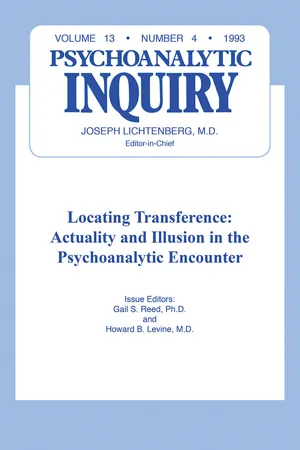
Locating Transference
Psychoanalytic Inquiry, 13.4
- 142 pages
- English
- ePUB (mobile friendly)
- Available on iOS & Android
eBook - ePub
Locating Transference
Psychoanalytic Inquiry, 13.4
About this book
First published in 1993. This is Volume 13, No 4 of the Psychoanalytic Inquiry which focuses on locating transference: actuality and illusion in the psychoanalytic encounter. The interrelation between actuality and illusion within the clincal encounter is a subject that has influenced the tehory and pratcice of psychoanalysis since its beginnings, particulary with regard to how clinicians identify and construe the transference.
Information
Aspects of Reality, and the Focus of Interpretation
IN THIS PAPER I DISCUSS some of the difficulties associated with the notion of a dichotomy between physical and psychic reality, and the way in which the analyst’s judgment concerning the nature of either influences his choice of interpretation. After briefly offering an alternative approach based on the concept of different versions of the history of physical reality and of psychic reality, I present clinical material to illustrate how the analyst may make use of information of different kinds – derived from his knowledge of the patient’s history, his observations in the session of her tone and manner of speaking, as well as the contents of her material, and particularly his experience of the atmosphere and nature of the relationship that is being lived out between himself and the patient. Rather than trying to determine the nature of the patient’s psychic reality as distinct from the material reality, the analyst can recognize, as the session unfolds, different versions of reality and can begin to build up a picture of that version which is most clearly manifested in the consulting room at the time, and which is probably the most useful focus for our understanding and our interpretive efforts.
Freud’s delineation of the concept of psychic reality represented an important conceptual advance: “It remains a fact that the patient has created these phantasies for himself, and this fact is of scarcely less importance for his neurosis than if he had really experienced what the phantasies contain. The phantasies possess psychical as contrasted with material reality, and we gradually learn to understand that in the world of the neurosis it is psychical reality which is the decisive kind” (1916–1917, p. 368).
This formulation may lead the analyst to try to discover the nature of the patient’s psychical reality, to contrast it with the view of material reality he has arrived at. The analyst derives the latter from the history, his own observations, and constructions. He derives the former from the evidence of the patient’s unconscious wishes and fantasies, as manifested in verbal material, behavior, dreams, and the wishes and anxieties that arise in the transference. The patient and the analyst may arrive at common convictions regarding the nature of this “reality,” or they may develop different sets of convictions.
Bion (1963) has given a vivid illustration of the complexity of the relationship that may exist. He described a patient who reported a dream, which led the analyst to believe that the patient had had a dream. The patient, however, did not believe that he had had a dream but that he was giving a straightforward recital of a horrifying experience. He expected that, if he reported it as a dream requiring interpretation the analyst would confirm his daydream that it was only a dream, thus keeping at bay his conviction that the dream not only had been, but was still the reality of his experience.
The pressure on the analyst to make these distinctions derives not only from his own interest and curiosity and his more theoretical views of the requirements of the analytic process; it may also reflect the anxieties, uncertainty, or confusion aroused by the material the patient has brought, and the emotional impact of the unconscious currents present in the session, such as the one just described.
There will of course often be conscious or unconscious demands from the patient to attend to the “reality” of the situation, and it is vital for the patient to have a sense that the analyst is open to the realities of his current life, or his history, and the ways he is affected by the analytic setting. It is inevitable that the analyst will become drawn into having opinions, making judgments, apportioning responsibility or blame, basing these on his own experience and bias and on what he judges to be the “reality” of the situations with which he is presented. These forces may result in both patient and analyst becoming apparently quite reasonably concerned with facts, and history, with what the mother or father or partner was actually like, how they interacted with the patient, and with what effect. There will be similar concerns about the analyst’s personality, technique, and conduct, and how these affect the patient.
The focus of the analyst’s attention often does become drawn toward making judgments about either material reality or the patient’s psychic reality – trying to assess, for example whether the patient’s mother was actually cruel, whether she behaved in a seductive or intrusive fashion on a particular occasion. In that frame of mind, it is often difficult to attend closely to the reality of what is being enacted between the analyst and patient: the way the patient might be using the communication about his mother to subtly draw the analyst into an alliance with him against the mother or drive the analyst into an alliance with the mother against him, thus seeking to re-create important aspects of the oedipal configuration that exist in his internal world.
I am suggesting that the effective functioning of the analytic process depends, in part, on the analyst’s capacity to recognize and to tolerate some of these pressures, to avoid forming premature (and often defensive) judgments concerning the nature of the patient’s psychic reality or his material reality which have not emerged out of an understanding of the situation that is lived out in the analytic relationship.
In any case, the notion of a unitary “reality” may in itself be a defensive oversimplification, and we may have to tolerate the discomfort and uncertainty connected with the idea of different, co-existing “versions” of psychic reality, of material reality, and of history. In his account of fetishism, Freud (1940, p. 204) refers to “incomplete attempts at detachment from reality.” This may result in two versions of psychic reality co-existing in the patient. There may be one, for example, based on his perception that the woman does not have a penis, the other based on the disavowal of such a perception.
In studying the complex relationship to reality in neurosis and psychosis, Freud (1924) suggested that although the distinction was not absolute, and the processes involved not completely successful, in psychosis there was an attempt to create a new reality in place of an unbearable old one. In neurosis, on the other hand, the subject creates “a world of phantasy … a domain which became separated from the real external world … kept free from the demands of the exigencies of life, like a kind of ‘reservation’; it is not inaccessible to the ego, but is only loosely attached to it” (p. 187).
Money-Kyrle (1968, 1971) further explored the individual’s relationship to psychic reality. He pointed out the distinction, on the one hand, between our capacity to discover the truth, when our perceptions and understanding of “the essential facts of life” correspond with some innately predetermined concepts (or class notions) and on the other hand, the distortions, misconceptions, or delusions which our emotional needs may give rise to. “Among the many innate preconceptions we may be endowed with, two are of particular analytic importance: the good breast, and the good creative intercourse.” They are of particular importance because there are such emotional obstacles to establishing the corresponding concepts. The child may, instead, create a misconception either of the nature of the parental intercourse, or the source of goodness on which he depends (the mother’s breast). Instead, “an object falsely recognised as the lost good object comes into being as the apparent object of desire” (1971, pp. 105–106).
Britton (1992, p. 4) describes how the individual may be driven to deny the painful and threatening reality of the parental sexual relationship. “If this denial threatens to sever the individual’s hold on reality, then the Oedipal romance may be preserved, by splitting it off into an area of thinking protected from reality and preserved, as Freud described, like Indians in a reservation. This reservation, which may be an area of day-dream or masturbatory fantasy, can become the place where some people spend most of their lives, in which case their external relationships are only used to enact these dramas to give a spurious claim of reality to their fantasies which lack ‘psychic reality.’ In other people the reservation may be preserved as an island of activity, such as a perversion, separated from the mainstream of the individual’s life.”
Schafer (1983) has taken this argument further, suggesting that the positivistic model, where “Reality is ‘out there’ or ‘in there’ in the inner world, existing as a knowable, certifiable essence” is unsatisfactory. He maintains that the “epistemological assumptions inherent in psychoanalytic inquiry limit us always to dealing with versions of reality.” We define situations and invest events with multiple meanings, and we are limited to “constructing some version or some vision of the subject in the world” (p. 234).
We need not adopt a purely relativistic approach to the idea of psychic reality, however. Money-Kyrle suggests there are concepts which are experienced as “true” by virtue of their relationship to certain innately predetermined concepts. Bion was also concerned with the relation between truth and psychic reality. He suggested that a sense of truth depended on the convergence of different “emotional views” of an object, derived from a variety of sources, and viewed from a variety of perspectives. “A similar correlation, made possible by bringing conscious and unconscious to bear on the phenomena of the consulting room, gives to psycho-analytic objects a reality that is quite unmistakable” (Bion, 1962, p. 310).
In the consulting room we may aim to facilitate the convergence not only of aspects of the patient’s internal and external reality, with different “emotional views” of the transference object present, but the convergence between the experience of the patient and the analyst in relation to the phenomena that are being lived out, which lend the experience a particular sense of “truth.”
Recent developments in our understanding of the mechanism of projective identification provide a further reason why the distinction between reality and fantasy in the analytic relationship may be difficult to maintain (Klein, 1946, 1952; Bion, 1957, 1959, 1962; Joseph, 1987; Rosenfeld, 1987). Insofar as this mechanism results in the object’s coming to contain projected parts of the self, the patient’s reality is that the object is identified with such projected elements. It has become increasingly apparent that this mechanism not only influences the patient’s perception of reality in relation to the analyst, but that the subtle unconscious projections may have a real and direct effect on the analyst’s affective state, his thoughts and actions (Sandler & Sandler, 1978; Ogden, 1979; Joseph, 1987, 198; Sandler, 1987).
In other words, the patient’s “illusions,” based on the complex interplay of experience and fantasy, manifest themselves not only in the patient’s material, his perceptions and reactions, but also in their influence on the analyst and the analytic relationship. These phenomena, which are important means by which the analyst comes to understand the nature of the patient’s internal object relationships, point to the fascinating complexity of the relationship between fantasy and reality in the transference.
The analyst’s actual involvement in the transference-coun-tertransference interaction in the consulting room offers him a unique means of access to the significant and vivid aspects of the patient’s psychic reality enacted there. As Freud (1912) pointed out in a well-known passage, “This struggle between the doctor and the patient, between intellect and instinctual life, between understanding and seeking to act, is played out almost exclusively in the phenomena of transference. It is on that field that the victory must be won.… It cannot be disputed that controlling the phenomena of transference presents the psycho-analyst with the greatest difficulties. But it should not be forgotten that it is precisely they that do us the inestimable service of making the patient’s hidden and forgotten erotic impulses immediate and manifest. For when all is said and done, it is impossible to destroy anyone in absentia or in effigie” (p. 108).
We might similarly argue that only on the field of the transference (and, one might add, the countertransference) can the analyst gain access to those aspects of the patient’s psychic life which demonstrate their presence and force by manifesting themselves in the patient’s object relations. He is otherwise forced to make judgments about them in absentia.
Schafer (1983, p. 124) describes the development, in the transference, of “a shared reality … in which new transference interpretations, jointly developed, stated by the analyst and uniquely modified by the analysand, become the basis of enriched, intensified modes of constituting experience in the life of the analysand.… The major transference phenomena represent the achievement of such simplified, focused ways of defining and acting within the analytic relationship that there can be no mistaking their meanings or avoiding their emotional manifestations or implications.”
Joseph (1985, p. 448) stresses that transference is a living, changing set of relationships to which the patient brings the patterns of unconscious fantasy, impulse, conflict, and defense that constitute his psychic life. She suggests that it is important to get the patient’s underlying assumptions into the open, for he often communicates his problems and lives out his early history in ways that are beyond his individual associations and beyond what he can express in words. “Interpretation dealing only with the individual associations would touch only the adult part of the personality, while the part that is really needing to be understood is communicated through the pressures brought to bear on the analyst.” We may be able to capture these experiences which are “beyond words” only through the reactions and feelings the patient unconsciously attempts to arouse in the analyst. Joseph regards the subtle and complex ways in which the patient acts out in the session as our richest source of information about his internal world, his object relationships, and his history.
As Freud was aware, however, this approach also involves the analyst in a difficult and stressful process. The intensity of the work, the particular demands on his attention which flow from having to recognize and try to think about intense emotional experiences in which he or she is directly involved, with all the anxieties this arouses, may reinforce an approach in which the analyst defensively turns toward a more detached view of the nature of the patient’s psychic reality, or material reality.
The analyst’s version of the reality that exists between himself and the patient will, of course, not only be determined by his own perceptions, judgment, and theories, but influenced by his own anxieties and needs, which manifest themselves as his own fantasies concerning the relationship between himself and his patient. One of the difficult but essential tasks he is faced with is trying to gain some awareness of his own assumptions, which may carry the force of “reality,” and furthermore to try to differentiate those elements which belong predominantly to himself from those which have been significantly determined by the patient’s projections.
In trying to recognize and understand what is functionally most available and significant for the patient at that moment, and to frame an interpretation accordingly, I would suggest that the analyst’s primary task is not to sort out the “reality” from the fantasy or distortions associated with any particular issue such as the patient’s history or her experience of the weekend. It is rather to attempt to explore the patient’s psychic reality as it is manifested in the analytical situation, which we assume reflects the significant and active dynamics of her internal world, and which it is essential to address in order to achieve psychic change.
The way the patient talks, the way she brings her problems, and what is evoked in the analyst, as well as the contents of her material, reflect vital aspects of the patient’s internal reality. Naturally this latter arises both out of her early history and object relationships and her more recent experiences, including the ways in which the analyst’s version of reality, how he communicates this, and how he behaves, impinge upon her.
In the transference and countertransference interaction we are inevitably confronted with the interaction of these different elements, thus gaining privileged access to the reality of the patient’s internal world, rather than being forced to make judgments about the reality of experiences “in absentia.” The impasse that may arise in the clinical situation, which may appear to revolve around the patient and analyst having different “versions” of the reality, say, of the patient’s relationship with her parents, or some interaction in the analysis, may actually involve a quite different kind of issue. The...
Table of contents
- Cover
- Copyright Page
- Table of Contents
- Dedication
- Prologue
- Countertransference Strain and the Use of the Analyst
- Aspects of Reality, and the Focus of Interpretation
- The Analyst’s Experience in the Psychoanalytic Situation: A Continuum Between Objective and Subjective Reality
- Structural Actualities of the Transference and Their Effects on the Analyst’s Functions
- Unconscious Fantasy and Theories of Technique
- Is Love in the Analytic Relationship “Real”?
- Slaying the Dragons of the Past or Cooking the Hare in the Present: A Historical View on Affects in the Psychoanalytic Encounter
- Reality and Psychic Reality in Ernst Kris’s Last Papers: An Attempt to Update His Findings
- Actuality and Illusion in the Transference: A Brief Discussion
- Epilogue: Actuality, Illusion, and Clinical Authority
Trusted by 375,005 students
Access to over 1.5 million titles for a fair monthly price.
Study more efficiently using our study tools.
Frequently asked questions
Yes, you can cancel anytime from the Subscription tab in your account settings on the Perlego website. Your subscription will stay active until the end of your current billing period. Learn how to cancel your subscription
No, books cannot be downloaded as external files, such as PDFs, for use outside of Perlego. However, you can download books within the Perlego app for offline reading on mobile or tablet. Learn how to download books offline
Perlego offers two plans: Essential and Complete
- Essential is ideal for learners and professionals who enjoy exploring a wide range of subjects. Access the Essential Library with 800,000+ trusted titles and best-sellers across business, personal growth, and the humanities. Includes unlimited reading time and Standard Read Aloud voice.
- Complete: Perfect for advanced learners and researchers needing full, unrestricted access. Unlock 1.5M+ books across hundreds of subjects, including academic and specialized titles. The Complete Plan also includes advanced features like Premium Read Aloud and Research Assistant.
We are an online textbook subscription service, where you can get access to an entire online library for less than the price of a single book per month. With over 1.5 million books across 990+ topics, we’ve got you covered! Learn about our mission
Look out for the read-aloud symbol on your next book to see if you can listen to it. The read-aloud tool reads text aloud for you, highlighting the text as it is being read. You can pause it, speed it up and slow it down. Learn more about Read Aloud
Yes! You can use the Perlego app on both iOS and Android devices to read anytime, anywhere — even offline. Perfect for commutes or when you’re on the go.
Please note we cannot support devices running on iOS 13 and Android 7 or earlier. Learn more about using the app
Please note we cannot support devices running on iOS 13 and Android 7 or earlier. Learn more about using the app
Yes, you can access Locating Transference by Gail S Reed, Howard B. Levine, Gail S Reed,Howard B. Levine in PDF and/or ePUB format, as well as other popular books in Psychology & Mental Health in Psychology. We have over 1.5 million books available in our catalogue for you to explore.