Donald W. Fiske's professional life and collaborations are themselves a textbook in the development of the field of personality. From the field's early origins in personnel selection, rating accuracy, and psychotherapy outcomes, to its current status of theoretical and methodological maturity -- complete with mid-life crises -- the field has been fundamentally changed by Fiske's work, and the changes have influenced generations of scholars.
This festschrift is a celebration of Fiske's impact, but not merely of his impact on the history of personality research. Instead, the volume focuses on ongoing debates and issues that have been framed or influenced by Fiske's work. The festschrift's three sections are organized around three themes in Fiske's writings -- themes that also correspond to three periods in his career.
This volume examines current thinking about what can be known about personality, how constructs relevant to personality psychology are best measured, and how to approach specific research problems in personality and related fields. The contributors create an eminent cross-section of the development and current status of personality methods. In addition to Fiske's eminent contemporaries, the contributors to this volume include Fiske's former students, collaborators, and his two children, both of whom are behavioral scientists. The accomplishments of his students, colleagues, and children testifies to the range of psychologists who have benefited from his scholarly and practical wisdom.
This collection is a valuable textbook for an advanced graduate course as well as appealing as a scholarly resource. Many of the contributors are renown psychological leaders who have made available their latest original thoughts. The book concludes with an essay by Fiske offering his perspective on the central themes: behavioral and social science metatheory, methods, and strategies.
eBook - ePub
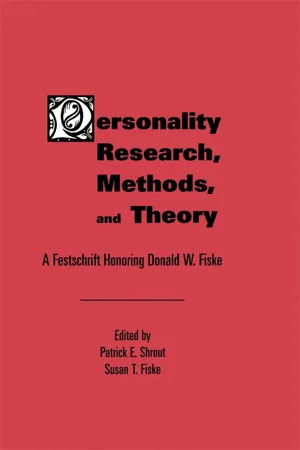
Personality Research, Methods, and Theory
A Festschrift Honoring Donald W. Fiske
- 392 pages
- English
- ePUB (mobile friendly)
- Available on iOS & Android
eBook - ePub
Personality Research, Methods, and Theory
A Festschrift Honoring Donald W. Fiske
About this book
Information
Publisher
Psychology PressYear
2014Print ISBN
9780805812718
9780805812701
Edition
1eBook ISBN
9781317781660
PART
I
I
METATHEORY IN PERSONALITY AND BEHAVIORAL RESEARCH: CRITIQUES OF THEORETICAL APPROACHES TO BEHAVIORAL RESEARCH
CHAPTER
1
1
WHITHER OR WITHER PERSONALITY RESEARCH
Philip Holzman
Jerome Kagan
Jerome Kagan
The study of personality occupied “the broad center” in most American departments of psychology in the early 1950s, when the two of us chose this domain of inquiry for a life itinerary. There was a high level of excitement surrounding the study of persons, which embraced the extraordinary variation in motivation, the nature of inner conflict, and mental health. The era of the great systematists had not yet faded, and psychology seemed more simple and unified than it does today; the broad center seemed a congenial camp from which to study individual lives. The most popular methods—the Rorschach test, Thematic Apperception Test, Draw-A-Person Test—also seemed powerful, glamorous, and even exotic. Although they lacked the conventional standards of reliability and validity, they promised a peek into the mysteries of unconscious psychological processes, and the secret wishes that lay behind daily habits and symptoms.
This romantic view of the past by two aging observers may remind readers of Wordsworth bemoaning that “there was a time when meadow, grove, and stream/ The earth in every common sight/to me did seem/apparelled in celestial light,/… It is not now as it hath been of yore ….”
THE ERA OF GRAND THEORY
The predictions generated by the many personality theories were neither precise nor usually valid, but their centrist position was reassuring. Personality was concerned with most of the processes that dominated the curiosity of the narrower psychological disciplines, including the evaluation of social interactions, expression of behavior and emotion, and subjective experience. The study of personality encompassed almost all of psychology using a variety of methods, including introspection, recall, and observations of behavior in ecologically natural settings or clever laboratory situations.
Sad to say, there has been a dramatic decline in the variety of methods and creativity of ideas that are being brought to personality study. A few more hardy strains of inquiry have endured the decline; we notice especially the effort of Block (1971) to maintain the longitudinal sample at the University of California, Berkeley. But the enthusiasm of the past seems to be missing while we observe, admiringly, the transfer of that enthusiasm to the neurosciences and cognitive psychology.
We believe that understanding personality requires the clinical examination of people, which brings to the forefront attention to dysfunction, exaggerated function, as well as diminished function in a variety of psychological systems. Psychometric sophistication, too, must be a part of personality study. A third influence must come from cognitive science, especially study of styles of thinking and perceiving. It should not be forgotten that the Gestalt psychological orientation was important in shaping the early work in personality. Gestalt investigations took a holistic view of human personality as a balance to a reductionistic strategy that celebrated a detailed study of isolated parts with very little consideration of context. The holistic view was assumed proper, even though it rested on poorly articulated theory that could not always be translated into elegant empirical tests.
THE DISILLUSIONMENT WITH GRAND THEORY
During the 1960s, a more positivistic empiricism began to dominate psychology as an accompaniment to the growing rejection of grand theory. Psychology was friendly to careful, delimited empirical study, but a bit aloof to ambitious theoretical efforts. Scientists studying cognition were parsing attention, memory, and perception into finer units with elegant methods that had no need to rely on introspection into subjective awareness. Psychoanalysis was challenged to produce experimental data that would either falsify or confirm its broad assertions and modify its theoretical structures. For example, the “new look” in perception, introduced a decade or so earlier by Jerome Bruner, then at Harvard, and George Klein, then at the Menninger Clinic, examined the power of needs and drives to steer perceptual experience. This movement also tested the view that personal style, a cognitive or perceptual Anschauung, influenced sensory thresholds, size estimations, and the perception of motion. But once experimenters were able to demonstrate that, under some situations, the estimation of size was occasionally influenced by motives, or that there was consistency in the ways that sensory data were organized, there seemed to be nothing more to demonstrate. This class of inquiry lost its attractiveness because of an inability to move further theoretically, and the absence of methods that could produce the new evidence necessary for fresh theoretical ideas beyond the documentation of personal consistencies.
By the 1980s, an enthusiasm for biology had overshadowed work in personality. The beauty of the biological methods, particularly in the neurosciences, attracted creative, energetic young scholars who began to gravitate toward the study of brain and behavior. As an effect of the positivism that dominated many areas of psychology, the concept of personality was occasionally attacked as illusory. A great deal of effort and journal space were spent refuting Mischel’s (1968) attack on the very concept of personality. Specifically, Mischel leveled an attack against the assumption underlying most personality theories at that time—that internal dispositions, which are relatively stable, express themselves in traits, which are consistent styles of behavior. Mischel argued that consistencies in behavior reflect stable environments, rather than stable hypothetical dispositions. Perhaps as a partial reaction to this attack, psychologists began to rely on questionnaire and inventory methods, which have become very popular. Although these studies have yielded replicable and psychometrically reliable results dealing with the identification of some traits (e.g., the so-called “Big-Five”), this strategy has brought with it another set of problems that concern the meaning of the dimensions studied.
DOMINANCE BY SELF-REPORT INVENTORIES
Although most scientific domains are characterized by increasing diversity of method as they mature, contemporary research in human personality has, for the most part, become less, rather than more, varied. Most personality investigations rely on self-report questionnaires as the only or principal source of evidence, and they explore the correlates of dimensions that are presumed to be reflected in the subjects’ answers. Even investigations of group processes occasionally rely on self-report evidence. By comparison, the majority of research reports on personality published 35 years earlier utilized other behavioral measures as part of the corpus of evidence.
Although this fact may appear innocent, it can have mischievous consequences. There is often a minimal correlation, or none at all, between an empirical index of a concept like anxiety based on overt behavior, impairment of cognitive function, or physiology, on the one hand and, on the other, answers to a questionnaire. This does not mean that the behavioral or physiological variables are more valid than self-report, or that self-report has no place in research on personality. We believe the proper inference is that the meaning of anxiety, or any other personality construct, may not be the same in different measurement contexts. The independence of self-report data from other indices would not be a source of concern if investigators used different constructs to summarize the different sources of empirical information. Unfortunately, many psychologists use the same term for the different classes of data, as if the theoretical meaning of a concept was unaffected by the form of evidence. This problem was recognized 40 years ago by psychologists, who, as we do here, questioned the special meaning of constructs derived from self-report data. During the 1950s, widely accepted opinion held that the statements people make about their own behavior reflect, to a large extent, their interpretation of social desirability and public value of these behaviors and traits. Fiske (1978) expressed disappointment with the poor progress of personality research that had been employing these subjective report methods exclusively.
However, in many quarters, the current view is characterized by an indifference to the relationship between the meaning of a concept and its evidential origins—a point made forcefully by Block (1977) in an essay that was also critical of modern personality research.
How did this restricted style of inquiry come to replace the use of behavioral observations, physiological evidence, and dreams, which were popular in earlier research? We believe several important factors are at work.
One of the most important historical factors was the failure of theory-guided investigations to generate data from novel methods that provided deep insights into human personality. During the period just prior to and after World War II, a number of psychologists held considerable faith in versions of psychoanalytic theory and reinforcement principles. As a result, empirical studies were guided by a priori hypotheses that traced their origins to one or both of these sets of ideas. For example, Whiting and Child (1953) tested psychoanalytic hypotheses about the consequences of childrearing practices for adult personality by coding ethnographic data—an investigation guided completely by theoretical ideas. However, a survey of studies guided by fertile psychoanalytic principles concluded that the efforts were one-way streets because the data did not influence the theory. The results of the studies were almost invariably interpreted as supportive of the theory (see Klein, 1976).
At the same time that empirical personality studies seemed circular, or at least ungenerative of new perspectives, loyalty to psychoanalytic and behavioral theory eroded because of the imperviousness of the theories to modification by data (see Holzman, 1986) and the relatively weak methods available to test the complex predictions implicated in the theories. It is almost a truism that, when theory fails, scientists become lean, tough, Baconian empiricists concerned with objectivity and reliability of evidence only. Like a disappointed lover seduced by insincere innuendos, scientists turn away from the exotic glamour of theory and novel methods for the presumed ease of gathering data and their apparent certainty. But the attraction to a lean empiricism does not explain why self-report questionnaires became the procedure of choice. That selection required other forces.
The abandonment of theory for an atheoretical approach occurred at the same time that a large number of young psychologists obtained their PhD degrees, entered academic life, and began competing for promotion and tenure. That curve began to accelerate in the 1960s, a short time before articles in the Journal of Personality and Social Psychology and the Journal of Personality began to emphasize self-report questionnaires. The increased use of questionnaires occurred just a few years after a large number of psychologists entered academic life. It may be dangerous to infer causality from this temporal correlation. However, we can construct a rationale for this relationship.
These young assistant professors perceived an intense competition for promotion at a time when research funds for personality studies were becoming difficult to obtain and promotion committees were attending more seriously to the number of published papers written by a faculty member rather than their quality. The cohort of assistant professors detected the new standard, and thus chose the strategy of quantity. Administering questionnaires to college students is easy, fast, and inexpensive, and there were many outlets for the resulting reports. As a result, journals were flooded with articles of this genre.
A second factor that made questionnaire studies attractive was the re...
Table of contents
- Cover
- Half Title
- Title Page
- Copyright Page
- Table of Contents
- Preface
- Part I Metatheory in Personality and Behavioral Research: Critiques of Theoretical Approaches to Behavioral Research
- Part II Measuring the Concepts of Personality: Analysis and Interpretation of Multitrait-Multimethod Matrices and Observer Consensus
- Part III Strategies for Personality Research: A Focus on Subjects’ and Observers’ Responses to the Measurement Process
- Part IV Closing Remarks
- Author Index
- Subject Index
Trusted by 375,005 students
Access to over 1.5 million titles for a fair monthly price.
Study more efficiently using our study tools.
Frequently asked questions
Yes, you can cancel anytime from the Subscription tab in your account settings on the Perlego website. Your subscription will stay active until the end of your current billing period. Learn how to cancel your subscription
No, books cannot be downloaded as external files, such as PDFs, for use outside of Perlego. However, you can download books within the Perlego app for offline reading on mobile or tablet. Learn how to download books offline
Perlego offers two plans: Essential and Complete
- Essential is ideal for learners and professionals who enjoy exploring a wide range of subjects. Access the Essential Library with 800,000+ trusted titles and best-sellers across business, personal growth, and the humanities. Includes unlimited reading time and Standard Read Aloud voice.
- Complete: Perfect for advanced learners and researchers needing full, unrestricted access. Unlock 1.5M+ books across hundreds of subjects, including academic and specialized titles. The Complete Plan also includes advanced features like Premium Read Aloud and Research Assistant.
We are an online textbook subscription service, where you can get access to an entire online library for less than the price of a single book per month. With over 1.5 million books across 990+ topics, we’ve got you covered! Learn about our mission
Look out for the read-aloud symbol on your next book to see if you can listen to it. The read-aloud tool reads text aloud for you, highlighting the text as it is being read. You can pause it, speed it up and slow it down. Learn more about Read Aloud
Yes! You can use the Perlego app on both iOS and Android devices to read anytime, anywhere — even offline. Perfect for commutes or when you’re on the go.
Please note we cannot support devices running on iOS 13 and Android 7 or earlier. Learn more about using the app
Please note we cannot support devices running on iOS 13 and Android 7 or earlier. Learn more about using the app
Yes, you can access Personality Research, Methods, and Theory by Patrick E. Shrout, Susan T. Fiske, Patrick E. Shrout,Susan T. Fiske in PDF and/or ePUB format, as well as other popular books in Psychology & History & Theory in Psychology. We have over 1.5 million books available in our catalogue for you to explore.