The four articles in this issue represent recent developments in the study of basic processes in L2 reading at the primary level. The research reported reflects the array of theoretical and instructional issues targeted currently by researchers who wish to understand L2 reading development in young children. Ultimately, this research should be used to help policymakers and educators make better informed decisions about how L2 literacy instruction can be enhanced across various sociocultural and linguistic boundaries.
eBook - ePub
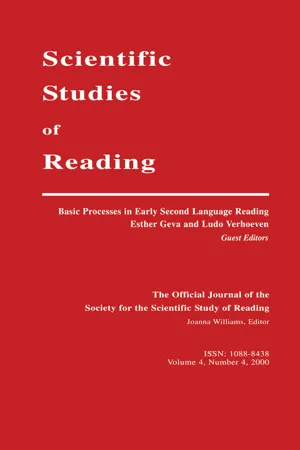
Basic Processes in Early Second Language Reading
A Special Issue of scientific Studies of Reading
- 92 pages
- English
- ePUB (mobile friendly)
- Available on iOS & Android
eBook - ePub
Basic Processes in Early Second Language Reading
A Special Issue of scientific Studies of Reading
About this book
Information
The Effects of Language of Instruction on the Reading and Writing Achievement of First-Grade Hispanic Children
This study is an exploratory investigation of the effects of teaching literacy skills to 1st graders of Hispanic background in English or Spanish. Two classes of 1 st graders who attended the same school in successive years were taught literacy in English or in Spanish. In the fall of the 1st and 2nd grades, these children were given standardized tests of language and reading. In the spring of 1 st grade, the children were given measures of comprehension (listening and reading) and writing in both Spanish and English. The children taught in Spanish did not differ from those taught in English on English reading and writing but were significantly stronger on Spanish reading and writing. In predicting performance in the fall of 2nd grade on a reading comprehension measure in Spanish and in English, the children’s vocabulary in that language made a significant contribution. In addition, being taught literacy in Spanish contributed to performance in Spanish reading comprehension, but being taught in English did not have the same positive effect on performance in English reading comprehension. Further studies are needed to determine whether initial literacy instruction in Spanish has long-term benefits for children of Hispanic background and whether similar results are found in other maintenance bilingual programs.
The study reported here is an exploratory investigation of the acquisition of literacy by children of Hispanic background who were taught to read and write either in Spanish or in English. The opportunity to carry out this study presented itself because a school attended by children of Hispanic background shifted from a maintenance program with predominantly English instruction to one with predominantly Spanish instruction. For the 2 years that bridged this change, we followed the progress of the first graders. In the 1st year, the first graders learned literacy in English; in the 2nd year, the first graders learned literacy in Spanish. The question was whether, in this initial year of literacy acquisition, instruction in Spanish would lead to different achievement levels than instruction in English.
Clearly, many factors affect the literacy acquisition of children who are becoming bilingual. Variation in language proficiency in English and Spanish is one factor known to affect the development of reading and writing skill in the initial years of schooling. What is not well understood is the ways that the language of instruction tempers this relation, as a recent report of research priorities pointed out (August & Hakuta, 1997). Although our study was limited in scope and descriptive in nature, we hoped that it would contribute useful information about the relation between language proficiency and language of instruction as they affect literacy acquisition of children who are becoming bilingual.
LANGUAGE AND LITERACY ACQUISITION OF SECOND-LANGUAGE LEARNERS
Instruction in literacy skills in their native language provides an opportunity for children to use their knowledge of oral language as a basis for learning to read and write (Cummins, 1993; Durgunoğlu, 1998). For children whose knowledge of English is limited, learning to read and write in English might present a formidable challenge. Another important consideration here is the level of proficiency in the native language. Although it is true that many children learn to read quite successfully in their second language (August & Hakuta, 1997), for a school population at risk for academic difficulties (based on such factors as family income, and education and preliteracy skills), limitations in language development might lead to relatively poor literacy achievement when the children learn to read and write in English (August & Hakuta, 1997; Brisk, 1998). Collier and Thomas (1989) reported that children who had 2 or 3 years of schooling in their native countries prior to starting school in the United States had superior achievement relative to children whose first experiences in school were in their second language.
Thus, the language used to teach children literacy skills may interact with the children’s language proficiency, for better or for worse. If there is support for the development of the children’s native language, a foundation is built not only for native-language literacy learning but also for second-language learning and second-language literacy acquisition (Cummins, 1991). However, many researchers and educators believe that school programs should provide sufficient experience with the second language to motivate cross-language transfer of literacy skills. This idea has not received universal support. Several studies have suggested that some kinds of transfer can take place early on and with relatively little exposure to the second language. For example, Durgunoğlu (1998) found significant cross-language correlations of English and Spanish word reading and spelling, which indicated that some transfer had taken place in first grade for Hispanic children learning to read and write in Spanish. Yelland, Pollard, and Mercuri (1993) found that a small amount of exposure to a second language yielded metalinguistic benefits for young children, which seemed to foster early success in word reading in their native language when compared with the case of children not exposed to a second language.
Some educators have argued that it is better for second-language-learning children to learn to read and write in English (see Brisk, 1998; Verhoeven, 1999). The rationale is that requiring students to function in English fosters their social integration. This might be particularly important in schools with multilingual populations. Having English as a common language, the children are able to engage in literacy activities with their peers. Advocates of literacy instruction in English believe that withholding such instruction creates unnecessary delays in the students’ achievement in English. Although there is some evidence that development of reading and writing skill takes place in the same way in the second language as it would in the native language (e.g., Verhoeven, 1990), as August and Hakuta (1997) pointed out, “the task of learning to read in a second language is presumably quite different at different stages of first-language reading skill” (p. 61).
BILINGUAL PROGRAMS AND BILITERACY
What is known about factors that affect the literacy acquisition of Hispanic children who are taught to read and write in English or Spanish? Three factors emerge from various studies of biliteracy. These are proficiency in the native language, proficiency in the second language, and the extent to which students have opportunities in school to develop their native- and second-language capabilities. A major influence in learning to read in the second language is facility in learning the second language itself. Verhoeven (1990) studied Turkish children taught to read in Dutch; he found that proficiency in the second language (i.e., vocabulary) was a significant predictor of reading comprehension but more so in second than in first grade. Other studies have also shown the importance of proficiency in not only the native but also the second language (e.g., Carlisle, Beeman, Davis, & Spharim, 1999).
Opportunities to become bilingual and a reason to care about doing so are also important characteristics of the educational environment in which literacy is learned. The results of studies suggest that many of the metalinguistic and metacognitive activities of reading and writing are shared across languages (Cummins, 1993). For example, English spelling might be influenced by a good foundation in phonological awareness and letter knowledge in the native language (Durgunoğlu, 1998). Bilingual experiences might be important in the development of language-specific knowledge, particularly vocabulary, which has been found to be a significant barrier for students learning to read and write in the second language (Jimenez, 1994).
Proficiency in reading in the native language also has been found to be related to the ease with which children learn to read in the second language. Saville-Troike (1984) found that children who were highly proficient readers in their native language also did well in English; the children appeared to transfer comprehension strategies, such as how to infer the meanings of unknown words, from their native- to second-language reading. For older students who were taught to read in bilingual programs, Jimenez (1994) reported that the successful Latino bilingual readers figured out how to use their knowledge and abi...
Table of contents
- Cover
- Table of Contents
- Copyright Page
- Introduction: The Development of Second Language Reading in Primary Children—Research Issues and Trends
- The Roles of Phonological and Syntactic Awareness in the Use of Plural Morphemes Among Children in French Immersion
- Processing Novel Phonemic Contrasts in the Acquisition of L2 Word Reading
- Components in Early Second Language Reading and Spelling
- The Effects of Language of Instruction on the Reading and Writing Achievement of First-Grade Hispanic Children
- Acknowledgment
Trusted by 375,005 students
Access to over 1.5 million titles for a fair monthly price.
Study more efficiently using our study tools.
Frequently asked questions
Yes, you can cancel anytime from the Subscription tab in your account settings on the Perlego website. Your subscription will stay active until the end of your current billing period. Learn how to cancel your subscription
No, books cannot be downloaded as external files, such as PDFs, for use outside of Perlego. However, you can download books within the Perlego app for offline reading on mobile or tablet. Learn how to download books offline
Perlego offers two plans: Essential and Complete
- Essential is ideal for learners and professionals who enjoy exploring a wide range of subjects. Access the Essential Library with 800,000+ trusted titles and best-sellers across business, personal growth, and the humanities. Includes unlimited reading time and Standard Read Aloud voice.
- Complete: Perfect for advanced learners and researchers needing full, unrestricted access. Unlock 1.5M+ books across hundreds of subjects, including academic and specialized titles. The Complete Plan also includes advanced features like Premium Read Aloud and Research Assistant.
We are an online textbook subscription service, where you can get access to an entire online library for less than the price of a single book per month. With over 1.5 million books across 990+ topics, we’ve got you covered! Learn about our mission
Look out for the read-aloud symbol on your next book to see if you can listen to it. The read-aloud tool reads text aloud for you, highlighting the text as it is being read. You can pause it, speed it up and slow it down. Learn more about Read Aloud
Yes! You can use the Perlego app on both iOS and Android devices to read anytime, anywhere — even offline. Perfect for commutes or when you’re on the go.
Please note we cannot support devices running on iOS 13 and Android 7 or earlier. Learn more about using the app
Please note we cannot support devices running on iOS 13 and Android 7 or earlier. Learn more about using the app
Yes, you can access Basic Processes in Early Second Language Reading by Esther Geva,Ludo Verhoeven in PDF and/or ePUB format, as well as other popular books in Education & Education Theory & Practice. We have over 1.5 million books available in our catalogue for you to explore.