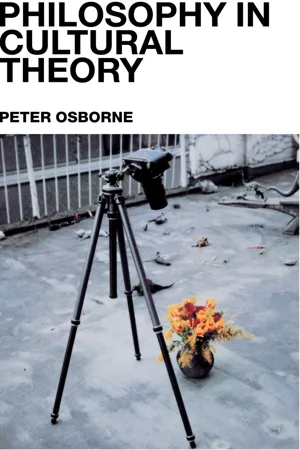
Philosophy in Cultural Theory boldly crosses disciplinary boundaries to offer a philosophical critique of cultural theory today. Drawing on the legacy of Walter Benjamin, Peter Osborne looks critically at central philosophical debates in cultural theory, such as:
* the relationship between sign and image
* the technological basis of cultural form
* the conceptuality of art
* the place of fantasy in human affairs.
It will appeal to those in philosophy, cultural studies and art theory.
- 160 pages
- English
- ePUB (mobile friendly)
- Available on iOS & Android
eBook - ePub
Philosophy in Cultural Theory
About this book
Information
1
Philosophy in Cultural Theory
What is the place of philosophy in cultural theory? The question appears straightforward, so straightforward in fact - so straightforwardly cartographical - as not actually to be a philosophical question at all. For what could be more routine, in principle at least, than surveying a particular field (cultural theory) for the signs of a particular kind of discourse (philosophy) in order to plot the path of its presence? But this is not my concern here, this mapping of the different philosophies at work in different forms of cultural theory, in different nationally specific institutional locations. Rather, my interest is at once more general, more specific, and more critical.
It is more general insofar as I am primarily concerned with the status and form of philosophical discourse per se within the field of cultural study, rather than with the reception of particular philosophies, less still particular philosophers; although the two cannot be wholly separated. It is more specific insofar as I am concerned with the theoretical trajectory of cultural studies in Britain and North America, from its origins in the post-imperial crisis of national identity in Britain in the 1950s to the transnational aspirations of its more recent 'globalized' and internationally appropriated forms. Finally, what I have to say is, hopefully, more critical than a mere typology, in the broad Kantian sense of criticism, to the extent that it is concerned with the reflective demarcation of a field of legitimacy. In this case, what is the legitimate, appropriate and most productive role for specifically philosophical modes of thought in cultural theory today?
What role could and should philosophical thought play in cultural theory, were things to be as they might? This is another way of asking: how ought cultural theory to be (philosophically) today? Such a question is as much about cultural theory as it is about philosophy. To recognize this is to open out the original question - the role of philosophy in cultural theory - onto a much broader history: the troubled history of modern philosophy's relations with its non-philosophical others, its constitution by these relations, and consequently its not infrequently tortuous relations to itself. For in its Anglo-American development, cultural studies appears as one of philosophy's most stridently wow-philosophical - indeed, proudly 'post-philosophical' - others. What is to be gained from an encounter between philosophy and so purportedly post-philosophical a field?
This chapter has five parts: a section on philosophy and non-philosophy - that is, on philosophical autonomy and disciplinarity; an account of theory in the constitution of cultural studies; a brief discussion of pragmatism; further remarks on the relationship between 'use' and 'truth'; and a concluding section on those features of cultural theory - totalization, generality and abstraction - that point towards a philosophical interpretation of its most general concepts. In each instance, I offer a snapshot of a broad, occasionally sweeping view: a condensation, a simplification, a vignette. This series of stills carries with it an argument of its own.
Philosophy and non-philosophy
It is a defining characteristic of Western philosophy since Kant that it has been preoccupied by the need to justify itself as a distinct and self-sufficient form of intellectual activity or 'discipline', while nonetheless retaining a connection to the forms of universality characteristic of its more expansive, intellectually promiscuous past, in which 'philosophy' was synonymous with theoretical knowledge in general - the terminological distinction between philosophy and the sciences being the product of the late eighteenth century, no earlier. This process of self-justification has been an anxious, contradictory and crisis-ridden affair, lurching wildly between bloated self-importance and annihilating self-depreciation, in which, as the last century progressed, professional philosophy was often reduced to narrowing down its justification to exist to its unique ability to demonstrate that it has, in fact, no right to exist, at least as previously practised and understood in the modern period: that is, as a discipline of the universality of autonomous reason. (I take this as a broad working definition of modern philosophy: the discipline of the universality of autonomous reason, which is also therefore necessarily a form of self-discipline, a discipline of the rational self.) Philosophy's sole consolation in such cases has been that this demonstration must be ongoing, must continue piecemeal, ad infinitum, philosophical utterance by philosophical utterance, if it is not to become self-refutingly generalized: a definitive result of the universality of autonomous reason.1 In such instances, philosophy lives on only negatively, yet nonetheless secure in the piecemeal character of its scepticism about itself. Such is the affinity between the late Wittgenstein and a certain practice of deconstruction, for example, marked out by Rorty, who acts here, as elsewhere, as a point of indifference between the two traditions. Thus, over the last fifty years, the stripped down, shiny new, early-century professionalisms of analytical philosophy and Husserlian phenomenology - the Anglo-American and 'continental' versions of philosophy as an independent 'science' - have been subjected to corrosive contextualist, deconstructive and pragmatist critiques, alike.
Philosophy as the philosophical critique of the idea of philosophy as an independent science was the dominant metaphilosophical tendency in the twentieth century in both European and North American professional philosophy. As MacIntyre once put it, à propos of Rorty: epitaph-writing has for some time now been working its way up the list of accepted professional activities.2 Yet this internalist, self-annihilating mode of philosophical reflection is by no means the only, or indeed the primary, way in which the idea of the universality of autonomous reason has been undermined in the period since Kant. Far from it. In fact, one might view all this as being no more than a reaction-formation, in the Freudian sense, in which the repressed desire to continue doing philosophy in the bad old way (as a discipline of the universality of autonomous reason) manifests itself only through the counter-cathexis of a will to end it, leading - as is usual in such cases - to a result directly opposite to the one consciously intended; namely, the continuation of philosophy as an autonomous discipline, albeit in ever more rarefied forms of self-negation. As a reaction-formation, the philosophical critique of philosophy possesses a symptomatic value which suggests that we look more deeply into the motives governing the necessity for the repression of the original desire: the desire to carry on philosophizing. When we do this, it quickly becomes clear that it is the internalization of externally imposed constraints on the universality of philosophical reason that underlies and motivates the profound ambivalence characteristic of twentieth-century European and North American philosophy's relationship to itself.
Two such constraints stand out as being of most general significance: the rapid growth in the independent cultural authority of the empirical sciences from the latter half of the eighteenth century onwards (and of literary study during the course of the twentieth century); and the failure of the world either to be or to become 'philosophical', in the sense of the various philosophies of the future which flourished in the wake of Hegelianism in the second half of the nineteenth century, foremost amongst which are those of Marx and Nietzsche, It was the first of these constraints that led to the self-imposed ban on philosophy's claim on empirical object-domains, its restriction to merely corrective forms of logical and methodological (later, linguistic) self-reflection on pre-given conceptual structures, and thereby, the crisis in the very idea of philosophy as an independent discipline, which continues today. The effects of the second, practical-political or more broadly historical constraint - what I have called the failure of the world to 'become philosophical' - have been more ambiguous, since this failure fuels the very need, the need for philosophy, that it simultaneously frustrates. There is thus a disjunctive relationship between the two constraints. Something of the character of this disjunction - a disjunction between the theoretical and practical functions of philosophy as a discipline of the universality of autonomous reason - can be gauged from its presence within the Kantian problematic itself.
When Kant first deployed the strategy of restricting the legitimate domain of the theoretical use of pure reason as the means for strengthening the claim for its 'control' over other disciplines, within that restricted domain, it was the traditionally defined 'higher', governmentally regulated, university faculties of theology, law and medicine with which his philosophy was thrown into conflict, as recounted in his book The Conflict of the Faculties.3 What Kant describes there as 'the department of historical knowledge (including history, geography, philology and the humanities, along with all the empirical knowledge contained in the natural sciences)' was still considered part of philosophy, alongside the department of 'pure rational knowledge', which is what we are more likely to think of as 'philosophy' today, in its modern disciplinary sense. These two departments were united by Kant in the name of truth (which he describes as 'the essential and first condition of learning in general') in opposition to the mere utility to the government of the so-called higher faculties.4 Philosophy was thus actually the highest faculty for Kant, speaking 'pure intellectually', and within it, it is pure rational knowledge which reigns supreme, since its concepts constitute the very form - albeit not the particular content - of the 'experience' upon which historical knowledge is based.
Soon, however, as the metaphysical implications of Kant's transcendental philosophy became increasingly evident, in the subsequent development of German idealism, a new conflict of the faculties arose internal to Kant's faculty of philosophy between the department of 'historical knowledge' (or what we would now call the sciences and the humanities), on the one hand, and the residual claims to conceptual legislation maintained by the department of 'pure rational knowledge' (or what we would now think of as 'philosophy' proper), on the other. This was a contest which pure rational knowledge could not ultimately win (even in its dialectically appropriative Hegelian form) because of the rapidly historically changing character and increasing social utility of the empirical sciences themselves. But neither, it seems, could it be decisively defeated, so long as it included a conception of the future among its privileged objects. In fact, it was in defence of a strictly philosophical claim on the future that Kant had felt impelled to write The Conflict of the Faculties in the first place.
Kant's intervention into the politics of the Prussian university system was provoked by the subjection of his book Religion Within the Limits of Mere Reason to the department of biblical theology within the Censorship Commission in Berlin, in 1791, which forbade its publication. The first part, which had been sent to the philosophy censor, had been approved. Politically, The Conflict of the Faculties is thus essentially a book about censorship. Indeed, it is the founding text of the modern concept of academic freedom, with all the qualifications such a notion implies. However, this political dimension has its roots in a philosophical debate about the mode of determination of our relationship to the future: in this case, rational versus biblical theology. (The political significance of biblical theology for the state derived from its franchise on the future.) Famously, Kant subjected the domain of pure philosophy to a three-fold division, by the questions 'what can I know?', 'what ought I to do?', and 'what can I hope?' As his thought developed, the ground of pure reason's self-justification moved successively from one domain to the next: from knowledge to action to speculation. It is the philosophy of religion, rational theology (religion within the bounds of mere reason), which regulates the third domain and is thus the intellectual arbiter of hope. The philosophical discourse of modernity - the historical ontology of the present - thus finds its highest expression in Kant in the role of rational theology in regulating the structure of the philosophy of history.
It was on this terrain, the terrain of the philosophy of history, that what we might call the first endgame of philosophy was played out in the middle of the nineteenth century, in the wake of Hegel's death, in Marx's early writings, in the dual form of 1) the epistemological critique of the speculative dialectic (the claim that absolute idealism ultimately abolishes time) and 2) the project for the actualization of the alienated universality of philosophical reason through a politics (communism) with world-historical aspirations. Kant's claim on the future was displaced by Marx from philosophy to politics; but politics was at the same time mortgaged to the positive sciences. A gap thus opened up between the epistemological critique of speculation and its practical significance as the theoretical ground for thinking the future. The question became: what happens to the status of specifically philosophical - that is, speculatively totalizing - reason in the historical disjunction between the two sides of its critique? It is this same question that Adorno raised once again in the 1960s, in the wake of the failure of historical communism. In the words of the famous opening line of Negative Dialectics, philosophy 'lives on because the moment to realize it was missed'.5 But in what form, precisely? This remains the question today. The question is not so much 'Why still philosophy?' (although this is Rorty's question - and the title of a well-known radio lecture by Adorno from 1962),6 but rather, 'How still philosophy?' How still philosophy despite, or in the face of, the epistemological critique of speculation. This has been the abiding preoccupation of (non-analytical) European philosophy since the 1840s.
In short, if European philosophy achieved disciplinary autonomy on the basis of its limitation of the theoretical claims of pure reason, its main traditions nonetheless continue to assert its right to exist as a search for truth, in the face of the ongoing critique of even its most limited claims to knowledge, on the basis of the practical - social and existential - significance of its speculative dimension: transcendence of the given, thought beyond experience, or the idea of a qualitatively better future; be that in the Hegelian form of a search for reconciliation (Novalis's 'urge to be at home everywhere'), a Marxist politics of communism, a Nietzschean will to power ('Where is - my home? I ask and seek and have sought it; I have not found it'), or an existentialist quest for authenticity - to mention only the most prominent varieties. However, if this right is accepted, in whatever form, it reacts back on the epistemological critique of claims to totality, modifying it decisively. 'One cannot not think the whole, however problematically', thus remains the main lesson of Kant's philosophy, although it requires a rather different defence from the one Kant used to argue for the necessity of regulative ideas.7 In its orientation towards reflection on a speculative inter-disciplinarity of empirical knowledges, this is not a message that professional, disciplinary philosophy in the Anglo-American tradition has been eager to hear.
There has been an increasing disjunction, since the death of Hegel, between the theoretical self-limitation of philosophy as a professional activity and the broader cultural functions of self-knowledge and the provision of coherence in the totality of experience (including, necessarily, expectations about the future) through which the classical vocation of philosophy as a mode of life (indeed, allegedly the highest mode, the philosophical life) has been carried forward, transformed, into the modern world. This disjunction is expressed in two radically different notions of philosophical universality: one, disciplinary and merely logical or methodological in form; the other, anti-disciplinary, substantive, historical, and inherently speculative. However, paradoxically, for all its prospective interdisciplinarity, this latter, anti-disciplinary, speculative form of universality cannot but appear alongside the preconstituted disciplines - including the narrow variant of philosophy itself - as an anti-disciplinary specialism, excessive in relation to each and every disciplinary field, yet without a determinate field of its own. This paradoxical, primarily critical role - analogous to the place of aesthetic judgement within Kant's system8 remains, I shall suggest, the most productive role for philosophy today. In this role, philosophy discloses a secret affinity with one of its most determinedly non-philosophical others: contemporary cultural studies.
Theory in cultural studies
One need not be a specialist in cultural studies in Britain to know that its formative impulses ran against the grain, not merely of the structure of university disciplines in the late 1950s and 1960s, but of the prevailing forms of the institutionalization of knowledge more generally. Nor need one be an expert to know that its guiding light here was political, or more broadly, political-educational - 'a political project of popular education' as one recent commentator describes it9 - rather than philosophical. Indeed, philosophy is one of the very few disciplines in the humanities and social sciences which seems to have had no influence on th...
Table of contents
- Cover
- Title
- Copyright
- Contents
- Preface
- 1 Philosophy in cultural theory
- 2 Sign and image
- 3 Modernism as translation
- 4 Remember the future? The Communist Manifesto as cultural-historical form
- 5 Time and the artwork
- 6 Conceptual art and/as philosophy
- 7 Dialogue with psychoanalysis
- Notes
- Index
Trusted by 375,005 students
Access to over 1.5 million titles for a fair monthly price.
Study more efficiently using our study tools.
Frequently asked questions
Yes, you can cancel anytime from the Subscription tab in your account settings on the Perlego website. Your subscription will stay active until the end of your current billing period. Learn how to cancel your subscription
No, books cannot be downloaded as external files, such as PDFs, for use outside of Perlego. However, you can download books within the Perlego app for offline reading on mobile or tablet. Learn how to download books offline
Perlego offers two plans: Essential and Complete
- Essential is ideal for learners and professionals who enjoy exploring a wide range of subjects. Access the Essential Library with 800,000+ trusted titles and best-sellers across business, personal growth, and the humanities. Includes unlimited reading time and Standard Read Aloud voice.
- Complete: Perfect for advanced learners and researchers needing full, unrestricted access. Unlock 1.5M+ books across hundreds of subjects, including academic and specialized titles. The Complete Plan also includes advanced features like Premium Read Aloud and Research Assistant.
We are an online textbook subscription service, where you can get access to an entire online library for less than the price of a single book per month. With over 1.5 million books across 990+ topics, we’ve got you covered! Learn about our mission
Look out for the read-aloud symbol on your next book to see if you can listen to it. The read-aloud tool reads text aloud for you, highlighting the text as it is being read. You can pause it, speed it up and slow it down. Learn more about Read Aloud
Yes! You can use the Perlego app on both iOS and Android devices to read anytime, anywhere — even offline. Perfect for commutes or when you’re on the go.
Please note we cannot support devices running on iOS 13 and Android 7 or earlier. Learn more about using the app
Please note we cannot support devices running on iOS 13 and Android 7 or earlier. Learn more about using the app
Yes, you can access Philosophy in Cultural Theory by Peter Osborne in PDF and/or ePUB format, as well as other popular books in Philosophy & Art Theory & Criticism. We have over 1.5 million books available in our catalogue for you to explore.