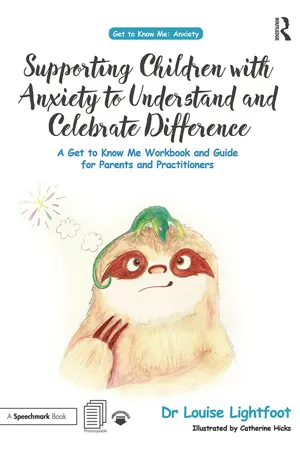
Supporting Children with Anxiety to Understand and Celebrate Difference
eBook - ePub

Supporting Children with Anxiety to Understand and Celebrate Difference

A Get to Know Me Workbook and Guide for Parents and Practitioners

  1. 80 pages
  2. English
  3. ePUB (mobile friendly)
  4. Available on iOS & Android
eBook - ePub

Supporting Children with Anxiety to Understand and Celebrate Difference

A Get to Know Me Workbook and Guide for Parents and Practitioners

About this book

The 'Get to Know Me' resources aim to support children, with those around them, who may have additional/special educational needs. They are designed to empower the professionals and adults who support those with identified needs. Developed by child psychologist Dr Louise Lightfoot, the series includes activities specific to anxiety, depression and Obsessive Compulsive Disorder (OCD). In supporting the social and emotional health of students, it equips them with the ability to thrive, personally and academically.

This book has been created for key adults (teachers, therapists and parents) as a complement to the picture book and draw along versions of Sammy Sloth – a traditional narrative story exploring thoughts, feelings and sensations experienced by many children with anxiety.

The activities in this book offer practical tools and strategies to support the child and those around them in addition to the information specific to the condition to improve understanding of a child's needs to promote empathy and acceptance.

Picture book and draw along versions of Sammy Sloth are available separately, and as part of the Get to Know Me: Anxiety set.

Frequently asked questions

Yes, you can cancel anytime from the Subscription tab in your account settings on the Perlego website. Your subscription will stay active until the end of your current billing period. Learn how to cancel your subscription.
No, books cannot be downloaded as external files, such as PDFs, for use outside of Perlego. However, you can download books within the Perlego app for offline reading on mobile or tablet. Learn more here.
Perlego offers two plans: Essential and Complete
  • Essential is ideal for learners and professionals who enjoy exploring a wide range of subjects. Access the Essential Library with 800,000+ trusted titles and best-sellers across business, personal growth, and the humanities. Includes unlimited reading time and Standard Read Aloud voice.
  • Complete: Perfect for advanced learners and researchers needing full, unrestricted access. Unlock 1.4M+ books across hundreds of subjects, including academic and specialized titles. The Complete Plan also includes advanced features like Premium Read Aloud and Research Assistant.
Both plans are available with monthly, semester, or annual billing cycles.
We are an online textbook subscription service, where you can get access to an entire online library for less than the price of a single book per month. With over 1 million books across 1000+ topics, we’ve got you covered! Learn more here.
Look out for the read-aloud symbol on your next book to see if you can listen to it. The read-aloud tool reads text aloud for you, highlighting the text as it is being read. You can pause it, speed it up and slow it down. Learn more here.
Yes! You can use the Perlego app on both iOS or Android devices to read anytime, anywhere — even offline. Perfect for commutes or when you’re on the go.
Please note we cannot support devices running on iOS 13 and Android 7 or earlier. Learn more about using the app.
Yes, you can access Supporting Children with Anxiety to Understand and Celebrate Difference by Louise Lightfoot,Catherine Hicks in PDF and/or ePUB format, as well as other popular books in Education & Education General. We have over one million books available in our catalogue for you to explore.

Information

Publisher
Routledge
Year
2019
Print ISBN
9780815349419
eBook ISBN
9781351164900
Edition
1

Chapter 1
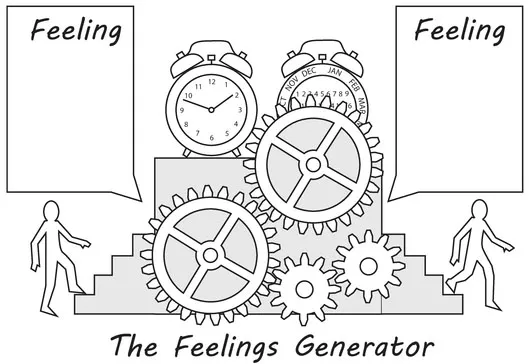
Feelings generator

The feelings generator can help us to understand the feelings that maybe causing our behaviour. There are often many different names used to describe the same feeling and this can make it tricky to understand and express how we are feeling.
Below is an example of how the feeling ‘angry’ can be described in different ways:
Angry = mad, grumpy, frustrated, annoyed, irritated, furious, cross, fuming, raging
Can you think of anymore?
Continue to find others names for the following feelings:
  • ◆ Scared
  • ◆ Anxious
  • ◆ Happy
  • ◆ Ashamed
  • ◆ Proud
  • ◆ Sad
  • ◆ Bad
Do you notice anything about the terms? Do some seem stronger than others? Do some fit into more than one category? Having a big emotional vocabulary can help to express our feelings and needs to others.
Using the flash cards provided overleaf, write down the different feelings and see if, when you mix them all together, you are able to group these feelings back with the initial term. For example, all feelings related to angry would be placed under the ‘angry’ flash card.

Additional activities:

  • ◆ Photocopy the flash cards so there are two sets of each feeling. Use these to play ‘snap’. This helps to improve word recognition.
  • ◆ Place the photocopied flash cards on a table in a random order paying close attention to the cards. Then turn them over and pick up two cards displaying the same feeling if you can remember where the cards are! Set aside each matched ‘pair’. This can be played alone or with others. The person with the most pairs wins! This game improves memory and attention.
  • ◆ Mix the cards up and use to play charades. Each person should pick a card and act out that feeling whilst the other players guess. This can be done in a pair or in teams. This is useful in supporting emotional intelligence and for recognising behaviours in ourselves and others.

Chapter 2
Blow up your worries!

Materials needed: Balloons and pens.
Purpose: Often children with difficulties around anxiety and control suffer to cope with these feelings and they can build up so they feel unmanageable. Helping them to confront their problems in a visual and practical way can help to put these feelings into perspective and make them seem more manageable.
Instructions: Give them a balloon and ask them to write a list of their current worries down. For example, the list of worries might be around school refusal. This might generate a list such as fear of:
  • ◆ Falling behind
  • ◆ Not getting any qualifications
  • ◆ Losing friends
  • ◆ Not being able to get a job
  • ◆ Disappointing parents
  • ◆ Not being able to buy a house or have a car/nice things
  • ◆ Being more anxious and needing to see a psychiatrist or to be made to take tablets.
Draw the word ‘worries’ on the balloon and ask them to blow up the balloon, naming each worry with each breath (if they are unable to generate a list themselves write down a list of things Tidy Tim may have (for example, not having friends, not knowing how to play, feeling like he has too much to do etc.). Keep blowing up the balloon until it pops. Explain to the child that if we don’t find a way to manage our feelings they can overwhelm us and make us ‘pop’. This might look like crying, having a panic attack, having a physical response such as shaking or becoming angry and shouting or destroying objects or attacking people. Then ask the child to write down on different balloons individual worries. Write down a list of what is worrying the child and try to help them to break it down.

Example: Falling Behind.

The worries around this might be:
  • ◆ Missing school means missing work
  • ◆ Missing work means not feeling confident in class and being scared to ask for help
  • ◆ Being afraid to seem ‘stupid’
  • ♦ Feeling like they are so behind they can't catch up
  • ♦ Knowing that missing school is making it worse and feeling guilty for allowing things to get worse.
Repeat the exercise (blowing up the balloon whist naming the individual worries until it pops).
Now go through the list and see if any of the things can be made better, who can help and what strategies can be employed to reduce anxiety. Some things will remain a worry and that’s ok.
  • ◆ Missing school means missing work: can school provide work that can be done at home or a tutor to summarise and prioritise so it is manageable?
  • ◆ Missing work means not feeling confident in class and being scared to ask for help: are there examples of other children who have had time off through sickness for example? Try to normalise feeling anxious and make arrangements with staff to ‘check’ that the child understands the task and adopt a nonverbal way for them to ask for help - for example placing a red pencil on the t...

Table of contents

  1. Cover
  2. Half Title
  3. Series Page
  4. Title
  5. Copyright
  6. Contents
  7. Acknowledgements
  8. Introduction to the Resource Pack
  9. CHAPTER 1 Feelings generator
  10. CHAPTER 2 Blow up your worries!
  11. CHAPTER 3 The ball of worries
  12. CHAPTER 4 Feelings sorter
  13. CHAPTER 5 Using puppets and play to explore emotions
  14. CHAPTER 6 Colour your feelings
  15. CHAPTER 7 Compliment cards, part 1
  16. CHAPTER 8 Compliment cards, part 2
  17. CHAPTER 9 The bridge to success
  18. CHAPTER 10 Always, never, everybody
  19. CHAPTER 11 The miracle question
  20. CHAPTER 12 The wrong is right game
  21. CHAPTER 13 Sammy Sloth's Activity Book
  22. CHAPTER 14 Sammy Sloth's Board Game
  23. CHAPTER 15 What happens next?
  24. CHAPTER 16 Alternate ending?