eBook - ePub
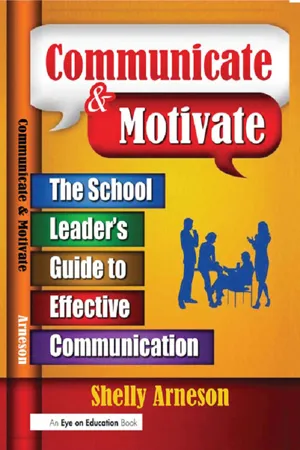
Communicate & Motivate
The School Leader's Guide to Effective Communication
- 128 pages
- English
- ePUB (mobile friendly)
- Available on iOS & Android
eBook - ePub
About this book
Develop the skills you need to communicate effectively and in ways that motivate your faculty towards success. Written especially for principals and other administrators, this book will empower you to communicate well as you work to promote a student-centered environment best suited to schoolwide achievement.
Information
1
Make Time for Courageous Conversations
First Things First—Be Seen as the School Leader
Before I was hired to be the principal at an elementary school in northwest Florida, I was the guidance counselor at the same school for several years. The principal who preceded me gave me some sound advice before he retired. “When you come back from lunch or after you’ve done a few classroom walkthroughs,” he said, “walk back to the office via a different route.” His point was that we need to get out of our routines and make sure we, as the leaders in our school, see everything and are seen everywhere. Leaders need to be visible. “When the cat is away, the mice will play” may sound like a silly analogy. The majority of good teachers don’t need the principal in their classrooms on a daily basis. They are self-starters, motivated instructors, who are going to do good, solid work regardless of who is in the building or in their classroom. But the necessity of having the presence of a principal in a school is most obvious when that leader is absent.
In an effort to cut costs, two local elementary schools were forced to share a principal. The parents, teachers, and students felt the absence. Discipline issues increased, test scores suffered, and faculty morale plummeted. Employees at one school even admitted that they had developed a code that signaled others when the principal was on their campus. The principal was well-trained, great at motivating teachers, and desperately wanted to make the school-sharing a success. However, it soon became obvious that consistent presence is a necessity. Educational leaders are crucial to a school’s well-being in many ways and the best way we can be a part of the culture is to observe and be observed.
But let’s be honest. Raise your hand if you have ever walked down the hallway and made a sharp left or right in a door or out a door when you suddenly saw that teacher who seemed to be the first in line at least once a week to come to your office with a concern or complaint. The point is that we have all experienced the desire to hide from what we need to do, at one time or another. Eleanor Roosevelt (1960) said, “You must do the thing you cannot do” (p. 30). This quote is a challenge to those of us who lead our schools. It is time to face the music of courageous conversations with all the teachers with whom we work at school, whether we want to or not. Rosanne Cash (1993) said, “The key to change is to let go of fear.” What are we doing today to let go of the fear that keeps us from changing?
But when and where shall we begin? Perhaps we should first start with when and where we should not hold these conversations. Just as we caution teachers to avoid having difficult talks with parents or co-workers in the hallways or in other public areas, we should make the commitment to avoid the same. What is the problem with these particularly public encounters? Not only is the tension likely to be exacerbated for the participants, but the air around the school can quickly become “poisoned” for the audience who unwittingly or purposefully overhears such talk. People feel uncomfortable hearing negative talk. It is, however, like the proverbial train wreck. “I can’t bear to see the horrific devastation,” we say as we peek through our fingers at the wreckage. But what do we do next? Go share the terrible details with 10 of our closest friends.
Difficult conversations are better off reserved for a private location behind closed doors. Parents and teachers joke that I have an always-open-door policy because I really do hate to shut it for fear that someone might have a concern that goes unasked or unsaid. Do you recall the scene in Dangerous Minds when Louanne Johnson, the spunky teacher played by Michelle Pfeiffer, finds out that the principal sent away one of her high school students who was trying to report someone trying to kill him because the student had walked in the office without knocking on the door? The victim ended up being killed that morning. When the counselor encourages Louanne to talk to her students about what had happened, she asks, “What should I tell them? If they don’t want to die, remember to knock?” School leaders, in my opinion, should be accessible to everyone.
Point to Ponder Are you accessible? How do you make time for conversations with students? Parents? Faculty?
The time the door should get shut, however, is during serious conversations with teachers or parents that don’t need to be witnessed by the rest of the school. The principal’s office should be a safe haven to share concerns, for students, parents, teachers, and the principal alike. Don’t think for an instant that people won’t hear those conversations you try to keep at a whisper level when your door remains open. The front-office/front-lines secretary at our school (let’s just call her the magical, Genie-in-a-bottle, tamer of wild beasts, wonder woman, for lack of a better term) and I have often remarked that if you talk about people, they will appear. I learned this lesson the hard way when new to counseling, and I must admit I still have to be reminded of the same lesson: shut your door if you need to have a private conversation because people do listen and they do hear, especially when we would rather they not. It is simply a life lesson we all must learn and heed, lest we lose credibility with our stakeholders. That reputation takes a good while to be built up, but only a split-second to be knocked down.
Finding Time
Another concern is finding the time to talk. Making the time for courageous conversations may sound like a great endeavor, but it is often a difficult task. A few years ago, I interviewed and subsequently hired a teacher from a neighboring school. While I could tell immediately that she was an excellent teacher, she began a habit of sending me e-mails, asking if she could make appointments with me on a regular basis. When we met at the designated time, she asked me questions that easily and quickly could have been answered in passing or via e-mail. When I questioned her about this issue, she confided to me that at her previous school, the principal seemed to never have time for her concerns. She had learned that the only way to get face time was to make an appointment. She had an excellent point. We work in a world of rapidly moving days that seem to fly by right in front of our very eyes. How many times do you find yourself looking at the clock only to realize that you have ten minutes until dismissal and you never got a chance to take a break or to even eat lunch? If we are not careful, we will fritter away our days without making the time for teachers—the very people who are most crucial to the success of our schools. As the school year draws to a close, we should not regret the time we spent at school and we won’t if the bulk of the time was spent with people. The paperwork is always going to be there and it’s probably going to be easier to do when our stakeholders are gone for the day, anyway. Therefore, even when the “frequent flyer award winners” come to our door to justify their reaction to a parent or to rationalize why they didn’t turn in their lesson plans the past weekend, we simply must make the time.
Suggestions for how principals can make time:
♦ Come before school a half hour early. Have you ever noticed how much work you can get finished when nobody else is around?
♦ Stay a bit later to catch up on e-mails, phone calls, etc.
♦ Delegate, delegate, delegate.
In other words, make sure your time at school is worthy of what you were hired to do and be, which is the instructional leading of the school. If we can take care of some of the minutia outside of the time when teachers and students are there, our time while they are there can be devoted to better student, staff, and parent interactions.
Sometimes we honestly don’t have the time at that moment. When this happens, we owe it to everyone to be upfront. Every year at the beginning of the school year, I make sure to tell parents and teachers one important note: “If you come to see me,” I advise them, “I might not be in my office. My most important role is to be out and about in the school with your children and your children’s teachers. Even if I am in my office, I will tell you right away if I have to leave shortly to attend another meeting, so we can make an appointment to talk. Listening to your concern is too important to talk about it when we don’t have time.”
Point to Ponder What is the difference between saying, “I don’t have time to talk right now. I have another appointment,” and, “I want to give your concern the time it deserves, so let’s make a plan to meet at 3:00 after I finish this next meeting”?
We must ask parents to give the same respect for time to teachers. The parent who wants to talk to the teacher while the teacher is getting class started is disrupting the very important routine process a la Harry Wong (2009). Telling a parent that their concern is so important that it deserves more time than you can give at the moment makes all the difference in the world. Furthermore, if we have spent the time building relationships with people as Stephen Covey (1989) says is so crucial for that emotional bank account between any two people, it won’t be so devastating to make a withdrawal here and there when you have to say, “Can we talk at 1:00 this afternoon? I have to rush out to do an observation now.” Building the emotional bank accounts with our stakeholders is time consuming, but it is worth it. Relationships matter.
Making time to talk is a sign of respect for our teachers and our profession, one we as educational leaders cannot afford to forsake.
How to Start Courageous Conversations
Now that you have the teacher locked in your office (just kidding; you should never lock teachers in your office), it is time to begin. Stephen Covey’s first habit of effective people is to be proactive (1989). This is an especially important step for educational leaders. A good start is the best indication of how well a conversation will turn out. But how shall we make that good start? Having made the mistake myself of beginning conversations without this forethought or pre-planning, I am sad to report that lack of preparedness shines through like a beacon in the night.
After hearing an extremely talented and strong teacher make a comment that sounded quite negative (something about “sometimes good is good enough—we don’t have to be great teachers”) in front of a group of other teacher leaders, I wanted to find out what was going on. But instead of starting the conversation by asking a question, I made the mistake of making a statement instead. “I was surprised and even a little disappointed,” I began, “to hear you say that you thought ‘good was good enough.’ ” Even though I immediately noticed her visibly bristle, I felt I had a point I needed to make. Therein lies the rub with so many conversations that go awry. Sometimes, we are so bent on pressing our own agenda, we forget that in order for the message to be received, the other party must be in receiving mode. Anyway, what difference does it make if you are right when the other person doesn’t hear you? Ensuring the receiver is in the mode to receive is a vital part of the preparation.
In the previous instance, a question might have been a much more appropriate beginning for the conversation. Can you think of one I could have used? Naturally, it’s always easier when you are the not the one on the hot seat. That’s the point of the proactive, pre-planning. We think ahead to how we might react if someone started a talk with us the way we are proposing to start the pending conversation.
Clearly, hindsight truly is 20/20 and I could later more easily see that I might have started with a question like, “How did you feel the meeting went yesterday?” She might have even had a general sense that what she had said had not been well-received by other parties, and beginning with a question might have been just the opening she needed to admit her ill-chosen words. As it was, I had to respect that she had said what she said out of a bit of frustration in trying to do it all, and she was able to ultimately see how I could have been a bit frustrated with her comment.
Point to Ponder Think of the last time you told a teacher something they “needed to hear.” Can you think of a question you could have asked instead that might have opened the door to better communication? How might it have changed the outcome of the conversation?
Perhaps it is helpful to try to frame our concerns as open-ended questions in situations like this. For example, “How did you think the meeting went?” or “How do you feel your comment was received by the group?”
Planning for difficult conversations is a step not to be missed. How, when, and where you plan is a matter of taste. I often find myself pre-planning for what I anticipate will be a difficult conversation by using my husband to role-play. We have even found these role-plays beneficial in helping us with our own communication as well. After all, how can we role-play an effective communication and then turn around and be ugly to one another? As a side-note, what we practice in our professional lives bleeds over into our personal lives and vice-versa.
Obviously, you can’t plan for all the variables that may occur. Keep in mind we are dealing with human beings. Human beings are fallible, unpredictable, and sometimes even just a little “nuts.” However, being proactive can eliminate many communication mistakes. In my experience, no conversation ever ended worse after preparing for it. On the contrary, most end up being much more productive. The following are simple tips to prepare for the difficult conversation.
♦ Think of your opening line. “I’m so glad you came in to talk about this,” works so much more effectively than, “You know why I asked you to come see me, don’t you?”
♦ Practice those tough sentences you have to say. Clearly, it is better to state, “I will look forward to hearing how your talk with that parent goes by the end of this week,” than it is to say, “You’re going to take care of that, right, so I don’t get another phone call?”
♦ Put good thoughts in and you’ll likely experience better success. Hopefully, it doesn’t sound trite to be reminded that if we want good to come out, we need to put good in.
♦ Establish ground rules. Ground rules set the tone for the upcoming meeting. They might be as simple as, “Listen to each other without interrupting,” and, “Keep an open mind even if you think you might disagree,” but they allow all participants to be on a level playing field.
Point to Ponder What good do you put in before a tough conference with a teacher or parent? My suggestion is to play some uplifting music, get in a calm state of mind, find a great quote you want to use, and think ahead to how you envision the conversation ending (and “quickly” doesn’t suffice for how you wish it to end).
Pull the Elephant Out From Underneath the Rug
A few years back, a principal friend of mine had a problem with the school’s guidance counselor. The counselor was reportedly talking behind the principal’s back. This principal found herself frustrated with the behind-the-back chatter she was hearing. Unfortunately, instead of making time to confront the counselor, she began doing the same thing—she found herself “leaking” to teachers that the counselor couldn’t be trusted. We must go to the source immediately and get things out on the table. Behind-the-scenes assumptions will only further the misunderstandings. Direct communication can often be difficult, particularly if there are some inherent differences in opinion between two people, but the longer the delay in initiating the communication, the more volatile the environment becomes. In the previous instance, the principal and guidance counselor never did resolve their problems and the guidance counselor simply left to take another position.
Point to Ponder Think of a misunderstanding you have experienced. What could have prevented it? Did it ever get resolved? Do you still maintain hurt feelings over it? Do you avoid the person with whom you had the disagreement or misunderstanding?
This scenario probably happens more often than we care to admit—when we can’t resolve our differences, sometimes we just walk away. What remains, however, are the hurt feelings and lingering blame that never really heal because we didn’t talk about them.
Instead, we need to take some time to face our fears and talk about the elephant that sits under the rug. You know he’s there, everyone knows he’s there, but not one person says, “Hey elephant. Come out from underneath that rug!”
I recently sat in on a parent/teacher conference in which the teacher was trying to let the parents know how much their son was struggling to focus in the classroom. Donna, the teacher, was doing a very nice job until the parents began...
Table of contents
- Cover
- Title Page
- Copyright Page
- Dedication
- Biography
- Table of Contents
- Preface
- Introduction
- 1 Make Time for Courageous Conversations
- 2 It’s Not What You Say, But How You Say It
- 3 What You Say Matters, Too, So Choose Your Words Carefully
- 4 Seek First to Understand
- 5 One-on-One Conversations
- 6 Avoid Defensiveness
- 7 Let’s Not Call the Whole Thing Off …Yet
- 8 Improving Parent/Teacher Communication From the Inside-Out
- 9 When to Use and Avoid Online Communication
- 10 The Legacy of Effective Communication
- Bibliography
Trusted by 375,005 students
Access to over 1.5 million titles for a fair monthly price.
Study more efficiently using our study tools.
Frequently asked questions
Yes, you can cancel anytime from the Subscription tab in your account settings on the Perlego website. Your subscription will stay active until the end of your current billing period. Learn how to cancel your subscription
No, books cannot be downloaded as external files, such as PDFs, for use outside of Perlego. However, you can download books within the Perlego app for offline reading on mobile or tablet. Learn how to download books offline
Perlego offers two plans: Essential and Complete
- Essential is ideal for learners and professionals who enjoy exploring a wide range of subjects. Access the Essential Library with 800,000+ trusted titles and best-sellers across business, personal growth, and the humanities. Includes unlimited reading time and Standard Read Aloud voice.
- Complete: Perfect for advanced learners and researchers needing full, unrestricted access. Unlock 1.5M+ books across hundreds of subjects, including academic and specialized titles. The Complete Plan also includes advanced features like Premium Read Aloud and Research Assistant.
We are an online textbook subscription service, where you can get access to an entire online library for less than the price of a single book per month. With over 1.5 million books across 990+ topics, we’ve got you covered! Learn about our mission
Look out for the read-aloud symbol on your next book to see if you can listen to it. The read-aloud tool reads text aloud for you, highlighting the text as it is being read. You can pause it, speed it up and slow it down. Learn more about Read Aloud
Yes! You can use the Perlego app on both iOS and Android devices to read anytime, anywhere — even offline. Perfect for commutes or when you’re on the go.
Please note we cannot support devices running on iOS 13 and Android 7 or earlier. Learn more about using the app
Please note we cannot support devices running on iOS 13 and Android 7 or earlier. Learn more about using the app
Yes, you can access Communicate & Motivate by Shelly Arneson in PDF and/or ePUB format, as well as other popular books in Education & Education General. We have over 1.5 million books available in our catalogue for you to explore.