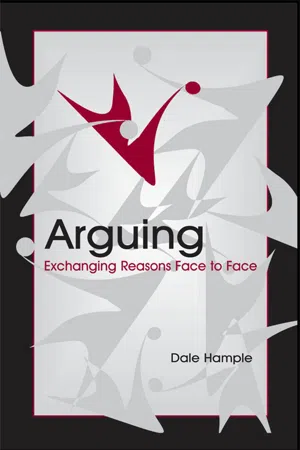
Arguing: Exchanging Reasons Face to Face describes the process and products of face-to-face argument. Author Dale Hample presents arguing as a type of interpersonal interaction, rather than as a kind of text or a feature of a public speech. He focuses primarily on argument production, and explores the rhetorical and philosophical traditions of arguing, keeping as the volume's main focus the integration of arguing into the literatures on message production, conflict management, and interpersonal communication.
Distinctive in its approach, this volume offers:
*a synthesis of empirical research on situational and individual differences in arguing;
*an exploration of argument frames--perceptions and expectations about arguing;
*an examination of the conversational and rational natures of argument products;
*a psychological description of inventional processes; and
*a full chapter on the emotional experience of arguing.
This unique work is appropriate for scholars and graduate students in argumentation, discourse, persuasion, conflict management, interpersonal communication, organizational communication, and message production.
- 400 pages
- English
- ePUB (mobile friendly)
- Available on iOS & Android
eBook - ePub
About this book
Information
Chapter 1: Definition of Argument
An argument is a conclusion supported by a reason. Normally, the conclusion is something that is controversial (or at least not obvious) before the argument is absorbed. Consequently, some element of the reason—the part normally called the evidence or the data—should be immediately acceptable. That way, the argument moves from the known to the unknown, or from the taken-for-granted to the doubtful. Arguing is something that can only be done by people. Paragraphs do not argue, and neither do propositions. Arguing is a fundamental human activity, perhaps the primary means of coming to new understandings.
Argumentation began its academic life as a part of rhetoric and did not really take on any distinct academic identity until the final decades of the 20th century. Consequently, its heritage and definitions derive from several ancient traditions. One of these is rhetoric, of course, but its contributions are intertwined with those of the other disciplines.
Dialectic is an important contributory literature. For Aristotle, rhetoric was an offshoot of dialectic (Rhetoric, 1354a). This remark has been the subject of much discussion. Dialectic is a mode of philosophical inquiry, in which (prototypically) two people try to work out the solution to a deep problem—for instance, what is the nature of justice? Although each dialectician may begin with a point of view, once a position is expressed, neither person advocates. Instead, each interlocutor takes the standpoint as something to be tested argumentatively. Definitions are exposed and tested, evidence is sought, and all reasoning is explicit and available for criticism. Nothing personal is supposed to be involved, so the parties’ status, reputations, prior commitments, and other attributes are set aside. Knowledge is shared, rather than being husbanded as a rhetorical resource. The object is truth, not victory, and the means is clear argumentation.
Dialectic, then, is supposed to be purified argumentation. The arguers do not seduce, they do not entertain, and they do not express themselves remarkably. Stylistic figures, in particular, are often seen as out of bounds. To the degree possible in a human conversation, dialecticians exchange logical propositions. They follow the standards for formal logic (which, in fact, were often contained in books about dialectic, frequently having a title like Topics). The precision with which dialecticians are required to define gave rise to elaborate treatments of definition as well as fallacies and logical form.
Logic was for millennia seen as the skeleton of argument. Aristotle identified two main sorts of rhetorical argument, the enthymeme and the example. These are both varieties of logical forms, varieties often thought to be inferior to their models. Even today, some philosophers are contemptuous of ordinary argument on the grounds that syllogistic deductions and explicit inductions are superior.
The enthymeme is modeled on the syllogism. Perhaps a logician would say, “The United Nations is an assembly of people with disparate interests; no assembly of people with disparate interests can reach firm conclusions; therefore, the United Nations cannot reach firm conclusions.” That, of course, is a fully explicit syllogism. A rhetor, on the other hand, would probably express an enthymeme, perhaps “The United Nations is an assembly of people with disparate interests, so it has no chance to reach any firm conclusions.” Unexpressed in this instance is the logician’s second premise. For centuries, enthymemes were commonly defined as incomplete or truncated syllogisms, and this view was sensible. However, that definition misses the key point. The interesting thing about enthymemes is that audiences fill them in (Bitzer, 1959). This idea has been understood for centuries, although not so clearly expressed as in Bitzer’s classic paper. For instance, Averroës, the great 12th century Arab commentator on the Rhetoric, says about enthymemes:
The forms of syllogisms become conclusive according to unexamined opinion by not being strict with regard to them and by omitting from them the thing which causes the conclusion to follow necessarily, the way the multitude is usually content (to do) when speaking to one another. (Averroës, Rhetoric, sec. 5)
Simply to understand the rhetor’s enthymeme, listeners or readers need to supply something much like the logician’s second premise. Enthymemes are the core of human arguing, and so the act of arguing is a human one, involving two active people rather than a series of propositions.
Examples are rather like inductions because a conclusion is drawn from one or two specific instances. “I’m going to start by outlining my essay because the last time I did that the writing was easy” reasons from a single example. A fully defensible induction may involve application of the scientific method, a sampling of many writers, and comparisons to other composition methods. However, whereas a logician or dialectician seeks a firm, generalizable conclusion, an ordinary arguer is trying to achieve only enough reason to move forward. An example does not serve very well as the basis for theory, but it will often do as a foundation for action, particularly when the stakes are low.
Enthymemes and examples, then, are intended to satisfy the needs of people who, situated as they are, need to advance either in thought or in action. Neither sort of argument is essentially aimed at meeting formal standards of validity or science. One of the most fundamental things about humans is that we are cognitive misers: We do not think hard if we can avoid it. Once we have enough reason to satisfy ourselves, we don’t really wish to have more. This reality is what gives birth to enthymemes and examples, yet it puts people at risk of drawing poor conclusions. Syllogisms and inductions generate more secure conclusions than enthymemes and examples. Logicians test syllogisms with truth tables, and scientists test inductions against the standards for empirical investigation. Arguers test arguments against one another. Arguments of importance are always part of an ongoing conversation. Even in a public speech, an argument is a moment in a political controversy or continuing public dialogue. Arguments are answered by other arguments, and arguers by other arguers. The sociality of argument makes it self-correcting. Some examples are genuinely persuasive, and these arguments survive. Some enthymemes make illegitimate leaps, and these arguments are eventually exposed or set aside.
Whereas logic and dialectic focus only on the propositional content of an argument, argumentation takes the people seriously as well. Arguments take on their full meanings only when the way people fill in enthymemes is accounted for, and arguments are sound when they provide a satisfactory basis for thought or action. Rhetoric and argumentation go one step further in distancing themselves from their drier brethren: They also take the arguers’ language seriously.
Logic insists on the use of sterile, purified vocabulary. For instance, one can syllogize about all of something, none of it, or some of it, but not about most or quite a few. If one thing occurs, then another must, but “if/maybe” confounds logical analysis. Synonyms have to be done away with, and pronouns replaced. Figures are not permitted, so “your eyes are like the constellations of the night” has to be rendered as something like “your eyes have positive aesthetic value.” Both of these issues—the limited vocabulary for key terms, and the effort after stylistic neutrality—are serious problems with logic as applied to people. The problem of limited vocabulary is perhaps obvious, but the other requires some comment.
Figures of speech and thought are not mere decorations; they express content and therefore constitute or contribute to arguments. Getting rid of a metaphor, for instance, may purify an argument into nonexistence (Perelman & Olbrechts-Tyteca, 1969, sec. 87).
I provide an example. One of the earliest surviving English speeches, originally preserved by Bede, was made in 627 to the court of Edwin of Diera by a man now known only as the Alderman. He advocated Christianity, still new to the people. Here is the whole speech:
The present life of man on this earth, oh king, in comparison to that existence which is not revealed to us, appears to me like the very swift flight of a sparrow, which for a moment flies through the room in which you, your leaders, and ministers on a wintry day are seated at supper around a warm fire, while out of doors rage the whirling storms of wintry rains and snows; the bird entering through one door quickly passes out through the other. For the brief moment it is within the room, it is safe from the wintry blast, but after a moment of calm from the storm, it quickly returns from winter to winter, and slips away from sight. So, for such a little time, seems this present life of man. But what has gone before, and what comes after, we know not. Therefore if this new doctrine can dispel the mystery, there seems to be merit in following it. (Bryant, Arnold, Haberman, Murphy, & Wallace, 1967, p. 7)
Does anyone seriously believe that this speech can be converted to a series of literal propositions, and still have all its meanings preserved? An informal logician would probably say that the last two sentences are the whole of the real argument. Perhaps these express the main ideas of the argument, but what has happened to the sense and feel of the argument? These topics are not incidental because they provide nuance, emphasize humility, and situate the appeal in the natural condition of humankind.
Metaphors are condensed analogies and arise from the ratios of two things, the theme and the phoros. For example, the metaphor “this is a bankrupt idea” is a reduction of “as financial value is to bankruptcy, so is intellectual value to this idea.” Purcell (1987, 1996) showed that the doctrine of transumptio, especially well developed in several medieval artes poetriae, is an essentially syllogistic way of passing meaning from one term to another. Thus, the phrase snowy teeth operates by transferring the unstated “white” from “snow” to “teeth.” In its full form, an enthymematic argument is made by a stylistic figure. In its condensed form, the same thing should be apparent. Rhetorical figures can highlight things otherwise expressed, but they can also make assertions, connections, and claims. To understand human arguing, one must not study it in ignorance of the full range of human expression.
ARGUMENT SUBSTRUCTURE
Considerations such as those just summarized led Toulmin (1958) to suggest that formal logic does an inadequate job of representing ordinary language arguments. He proposed instead what has come to be known as the Toulmin model of argument. Although his departure from formal logic is not as complete as is often supposed (Hample, 1977b), his model is a genuine advance in the effort to understand the elements of arguments.
His model specifies six parts of a full argument: the claim, the qualifier, the data, the warrant, the backing, and the reservation. None of these parts requires any translation from ordinary language into the strict formulae of logic. The elements appear in the model in the same form as they had when expressed or understood. No part of an argument, in Toulmin’s theory, has a particular propositional form. To begin, I examine the six elements individually.
The claim is the conclusion of the argument—its point, its persuasive or epistemological goal. As with any other part of the argument, it may or may not be explicit in discourse. However, it must be understood, or the discourse is not recognized as an argument at all.
Normally, the claim is at least somewhat controversial and is true or false in some degree, not absolutely (absolutely true or false conclusions are better modeled by formal logic). Therefore, Toulmin included the qualifier, or modal term, as a part of the model. Qualifiers express the force with which claims are made. Something may be probably so, or perhaps so, or in effect only on Tuesdays. The qualifier is not arbitrarily chosen. It reflects the strength of support the rest of the argument provides for the claim. A technically good argument is one whose qualifier precisely matches the strength and applicability of the reason.
A key component of the reason is the data, the evidence that supports the claim. The data must be less doubtful than the conclusion because the object is to make the claim more secure than it was prior to the argument. Toulmin described the data as factlike, which is helpful so long as one does not worry much about defining fact. The argument must begin with data that the hearer or reader is willing to take for granted. If the arguer wishes to use controversial data, they must be established as the claim from a prior argument. Thus one can anticipate the possibility of chains or lemma organizations for elaborate arguments. Also, the reliability of the data is established by the receiver, not by any appeal to philosophical standards. One hopes, of course, that people reason well, but even within this analysis of the substructure of argument, people have the focal role. Regardless of its propositional form (or lack of it), regardless of its inductive or syllogistic rationale, evidence is only evidence if the receiver sees it as such.
The warrant links the data to the claim. No matter how it is expressed, the warrant always has the function of asserting that if the data are so, then the claim is so. The warrant declares the relevance (and at least hints at the sufficiency) of the evidence to the conclusion. If, on hearing an arguer’s data, a listener were to object, “What has that to do with the claim?” the arguer’s answer should express a warrant. For example, if “everyone uses computers for all their work today” were offered as evidence for the claim that “computers have systematically wrecked the quality of handwriting of everyone I know,” the warrant is something like “people have little practice at handwriting today and little need to be legible.”
In ordinary exchanges, warrants are rarely bare statements that if the evidence is so, then the conclusion is so. Usually warrants have substantive content themselves, as in the handwriting example, and therefore may be controversial. Toulmin therefore included backing in the model. Backing supplies reason to accept the warrant. Toulmin originally said that backing, like data, is factlike. However, the backing really needs to be a complete argument for the warrant and therefore must contain both subordinate evidence and a subordinate warrant (Hample, 1977b). The backing is aimed only at the warrant, not at any other element of the argument.
The final element of Toulmin’s model is the reservation or rebuttal. This part of an argument expresses exceptions to the warrant. A reservation suggests that even if the warrant may generally be so, in at least some circumstances it may be inapplicable. In Toulmin’s examples, reservations typically begin with unless, and this is a useful way to understand their function. Like backing, reservations are focused only on the warrant.
The qualifier is supposed to reflect the quality of support that the reason provides for the conclusion. The qualifier should therefore display the degree of confidence that an arguer should have in the data and the warrant and may directly reflect some reservation. The Toulmin model focuses quite a lot of attention on the warrant (both the backing and reservation concern themselves exclusively with it). This is because the evidence is assumed to be acceptable in the first place, not because the warrant is more important, more complex, or potentially more vulnerable.
It is important to emphasize that these six elements are not kinds of statements; rather, they are functions. They must somehow happen when a full argument is made or reconstructed. One cannot examine propositional form and determine that some statement is evidence or a warrant. People naturally think of arguments as verbal things, but a gesture or photograph can serve as a reason or conclusion, too. Although I know of little literature on the topic, I suspect that the qualifier function is often accomplished through vocal pauses, volume, or gestures in ordinary talk. People have a sense of how insistent a conversational partner is, and this sense is stimulated by all of the partner’s behaviors, not merely the verbal ones.
An important implication of this emphasis on function, rather than propositional form, is that arguments need not be linear. A linear argument moves straightforwardly from premise to premise, substituting one notion for another, until a novel statement is attained. A syllogism is linear. The simple categorical syllogism “all dogs are affectionate; Rover is a dog; so Rover is affectionate” begins with a general premise, then substitutes “Rover” into the class of “all dogs,” and then adds “affectionate” to what is assigned to Rover in the second premise. Formal logic is clearly linear, and informal logic has a nearly irresistible tendency to be linear as well (but see Gilbert, 1997, for an exception).
Stories, in particular, do not work this way, yet they can serve as arguments. In a book far too rarely read, one of the major logicians of the late 19th century made these remarks near the end of his career:
The natural procedure in argument does not appear to resemble linear inference. It is a common observation that syllogisms do not occur either in conversational discussion or in argumentative treatises. . . . When a barrister opens his case, or a theorist introduces us, in his initial statement, to the basis of his doctrine, we do not as a rule find ourselves confronted with the first premises of a chain of syllogisms. We find something quite different. An exposition is set before us which at first sight reads more like a description than an argument; and it is only as we enter further into the proposed construction that we observe it to be in fact the development of a subject, intended to introduce us to a scheme of consequences which, if we accept the initial description, we shall be unable to deny. (Bosanquet, 1920, p. 105)
A narrative without discernible linear structure can lead to conclusions.
This point has been very nicely illustrated in studies of Senator Edward Kennedy’s Chappaquiddick speech. Kennedy had been driving home from a party and had an accident; a passenger was killed. He neglected to inform police for some time, and this became a delicate political issue for him. He made a speech in which he explicitly took responsibility for the accident. However, Ling (1970) and Kneupper (1981) showed that the central narrative of the speech is structured in such a way as to move guilt from Kennedy to the circumstances. Ling and Kneupper both made use of K. Burke’s (1969) pentadic description of human behavior. Every act, according to Burke, has an agent, an agency, a scene, a purpose, and a name. In describing an act, one can form ratios of these five elements to feature one over another, to make one foreground and another background. Kennedy’s speech is full of concrete descriptions of the road, the bridge, the night, the water, and so forth, which overwhelm the much more limited descriptions of himself. In other words, he created a scene/ agent ratio that emphasized the setting. In this way, Kennedy managed to suggest that the blame for the accident lay in the scene, even though he said he took responsibility. The disconnect between his explicit acceptance of blame and the situational conclusion his audience is naturally drawn to makes him seem noble, taking blame where he may not need to.
Fisher (1987) offered an elaborate treatment of the argumentative possibilities of narrative. A storyteller presents a sound argument to the degree that the narrative has fidelity (i.e., each part seems true or probable) and coherence (i.e., it is consistent with other discourse elements, other stories, and the characters of the actors involved). Fisher’s claim that the narrative is the fundamental sort of human communication and that other forms need to be assimilated to it has been controversial, and need not detain me here. It is enough to see that storytellers argue, that stories are nonlinear, and that evaluative standards for them are nonetheless available.
Although Goodwin (1990) did not apply Fisher’s analysis, her commentary on a children’s exchange invites it. A group of boys are playing, and one initiates a reasonably linear challenge–response sequence with another boy:
Tony: Why don’t you get out my yard.
Chopper: Why don’t you make me get out the yard.
After several predictably fruitless exchanges of this sort, Chopper interrupts himself (“No you won’t you little—”), with an in-turn initiation of a damaging story about Tony, alleging Tony’s cowardice. After the story has been told in outline, Tony begins to protest that he did not do certain of the (no doubt exaggerated) actions Chopper describes. Chopper reasserts his narrative claims, and these are certified by the laughter of the other boys. In Fisher’s terms, Tony disputes the fidelity of some elements of Chopper’s story. Although I have not illustrated it, when one reads Goodwin’s transcripts, it is clear that Chopper defends himself implicitly by saying that his version is coherent because it matches Tony’s cowardly character. A claim is at stake—that Tony acted cowardly—and it is both disputable and disputed. Fisher’s critical apparatus is straightforwardly applicable, but it would be little trouble to identify data, claim, warrant, and other argumentative functions in the exchange, even if most of these functions are implicit.
Some believe that the possible argumentativeness of a story requires that a separate analytical system be applied to narrative, but I am not convinced. In my judgment, it is possible to identify the same argumentative functions in a narrative (an understood narrative) as there are in a more linear text. That narratives take on very distinct discourse form (often nonlinear) has, I bel...
Table of contents
- Cover Page
- Lea’s Communication Series
- Title Page
- Copyright Page
- Dedication
- Preface
- Chapter 1: Definition of Argument
- Chapter 2: Frames for Arguing: What Do People Think They’re Doing When They Argue?
- Chapter 3: Invention of Argumentative Substance
- Chapter 4: Editing Arguments
- Chapter 5: The Emotional Experience of Arguing
- Chapter 6: Individual and Situational Differences in Arguing
- Chapter 7: Arguing in Conversations
- Chapter 8: Impossible Arguments
- Chapter 9: A Closing Editorial About the Importance of Arguing
- References
Trusted by 375,005 students
Access to over 1.5 million titles for a fair monthly price.
Study more efficiently using our study tools.
Frequently asked questions
Yes, you can cancel anytime from the Subscription tab in your account settings on the Perlego website. Your subscription will stay active until the end of your current billing period. Learn how to cancel your subscription
No, books cannot be downloaded as external files, such as PDFs, for use outside of Perlego. However, you can download books within the Perlego app for offline reading on mobile or tablet. Learn how to download books offline
Perlego offers two plans: Essential and Complete
- Essential is ideal for learners and professionals who enjoy exploring a wide range of subjects. Access the Essential Library with 800,000+ trusted titles and best-sellers across business, personal growth, and the humanities. Includes unlimited reading time and Standard Read Aloud voice.
- Complete: Perfect for advanced learners and researchers needing full, unrestricted access. Unlock 1.5M+ books across hundreds of subjects, including academic and specialized titles. The Complete Plan also includes advanced features like Premium Read Aloud and Research Assistant.
We are an online textbook subscription service, where you can get access to an entire online library for less than the price of a single book per month. With over 1.5 million books across 990+ topics, we’ve got you covered! Learn about our mission
Look out for the read-aloud symbol on your next book to see if you can listen to it. The read-aloud tool reads text aloud for you, highlighting the text as it is being read. You can pause it, speed it up and slow it down. Learn more about Read Aloud
Yes! You can use the Perlego app on both iOS and Android devices to read anytime, anywhere — even offline. Perfect for commutes or when you’re on the go.
Please note we cannot support devices running on iOS 13 and Android 7 or earlier. Learn more about using the app
Please note we cannot support devices running on iOS 13 and Android 7 or earlier. Learn more about using the app
Yes, you can access Arguing by Dale Hample in PDF and/or ePUB format, as well as other popular books in Languages & Linguistics & Communication Studies. We have over 1.5 million books available in our catalogue for you to explore.