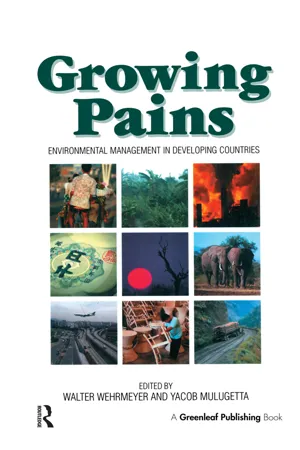
Growing Pains
eBook - ePub

Growing Pains

Environmental Management in Developing Countries

  1. 288 pages
  2. English
  3. ePUB (mobile friendly)
  4. Available on iOS & Android
eBook - ePub

Growing Pains

Environmental Management in Developing Countries

About this book

Environmental management is a global phenomenon, embracing all businesses in all countries, whether or not there already exists an organised response to managing environmental impacts.

Today, there are gross inequalities between the world's richest and poorest nations in terms of income distribution, consumption patterns, access to resources and environmental impact. Yet both the developed north and the developing south are committed, at least in words, to achieving sustainable development.

Public awareness of environmental issues in the North has been rising in recent years and further degradation is now largely minimized through more stringent regulatory regimes, voluntary agreements and growing consumer and stakeholder pressure on corporations. Still, the north is continuing to lead an environmentally unsustainable lifestyle as environmental improvements are nullified by overall increases in consumption levels. In the south, a billion people still do not have access to the most basic needs. Poor countries need to accelerate their consumption growth if they are to ensure that the lives of their people are enriched. However, with rapid economic growth and corresponding increases in consumption now under way, their environmental impact is soon to become substantially greater. In a world that strives towards stemming global crises such as climate change, the path already taken by the rich and high-growth economies over the past century cannot be repeated by the south if the desired objective is to create a future that is truly sustainable.

Growing Pains examines environmental management in the south from a number of perspectives. It is designed to stimulate the discussion about the role that corporations and national and international organizations play in sustainable development. It does not offer panaceas, as each country has its own problems and opportunities; and, after almost 50 years of failed panacea-oriented economic development policy transfer from the north to the south, it is time to abandon hope for universal solutions and instead look to individual approaches that work.

The book is divided into five themes: globalization; the role of business; a focus on national strategies; trade and the environment; and the organizational and structural challenges of sustainable development.

With contributions from an outstanding collection of authors in both the developed and developing worlds including UNIDO; the Thailand Environment Institute, Arthur D. Little, Inc., Shell Peru; IUCN, the Russian Academy of Sciences and IIED, this important and unique new book presents a body of work that will provide essential reading for businesses working in developing countries, environmental and developmental NGOs and researchers engaged in the debate and sharing of best practice in this increasingly critical subject area.

Frequently asked questions

Yes, you can cancel anytime from the Subscription tab in your account settings on the Perlego website. Your subscription will stay active until the end of your current billing period. Learn how to cancel your subscription.
No, books cannot be downloaded as external files, such as PDFs, for use outside of Perlego. However, you can download books within the Perlego app for offline reading on mobile or tablet. Learn more here.
Perlego offers two plans: Essential and Complete
  • Essential is ideal for learners and professionals who enjoy exploring a wide range of subjects. Access the Essential Library with 800,000+ trusted titles and best-sellers across business, personal growth, and the humanities. Includes unlimited reading time and Standard Read Aloud voice.
  • Complete: Perfect for advanced learners and researchers needing full, unrestricted access. Unlock 1.4M+ books across hundreds of subjects, including academic and specialized titles. The Complete Plan also includes advanced features like Premium Read Aloud and Research Assistant.
Both plans are available with monthly, semester, or annual billing cycles.
We are an online textbook subscription service, where you can get access to an entire online library for less than the price of a single book per month. With over 1 million books across 1000+ topics, we’ve got you covered! Learn more here.
Look out for the read-aloud symbol on your next book to see if you can listen to it. The read-aloud tool reads text aloud for you, highlighting the text as it is being read. You can pause it, speed it up and slow it down. Learn more here.
Yes! You can use the Perlego app on both iOS or Android devices to read anytime, anywhere — even offline. Perfect for commutes or when you’re on the go.
Please note we cannot support devices running on iOS 13 and Android 7 or earlier. Learn more about using the app.
Yes, you can access Growing Pains by Walter Wehrmeyer,Yacob Mulugetta in PDF and/or ePUB format, as well as other popular books in Business & Business General. We have over one million books available in our catalogue for you to explore.

Information

Publisher
Routledge
Year
2017
eBook ISBN
9781351283106

1
Globalisation

1
The Environmental Challenge of Going Global
*

Gilbert S. Hedstrom, Ronald A.N. McLean and Bernhard H. Metzger
CONVENTIONAL WISDOM holds that, as transnational companies expand into new sites and markets, they leave behind North America’s and Northern Europe’s stringent environmental, health and safety performance requirements. The reality is quite different. Leading transnational companies have known for some time that sound EHS performance is vital to success wherever they operate. Host countries expect the best from firms with global resources. The financial community is very sensitive to the risks and liabilities of mediocre environmental performance. Advocacy groups don’t hesitate to hold companies accountable for lapses in EHS practices wherever they occur. And consumers—especially in Europe—can be motivated to punish companies at the cash register when they perceive them as environmentally irresponsible.
When transnational companies first took the measure of the global EHS challenge, many took steps to review and revise their worldwide corporate policies (Prism 1994). Now, as companies become more familiar with the ongoing reality of managing EHS performance globally, they are applying these standards in the light of newly won insights and best practices.

The challenges to industry

Our experience suggests that major transnational corporations in a range of industries face similar challenges in managing EHS globally. These challenges include split-level expectations, public scrutiny and demand for consistent performance and business effectiveness.

Split-level expectations

Many of the countries into which transnationals are expanding have extensive EHS regulations on the books. Often—in the former Soviet Union, for example—these regulations may include stricter standards on matters such as site contamination and emissions than those in Germany, the Netherlands or the US. In other cases, as in some Latin American countries, the standards may he borrowed from existing US or European regulatory codes. Transnationals have found, however, that, under these regulatory schemes, compliance expectations are often very different for themselves than for domestic firms. While much is expected of the transnationals, who are seen as technically and financially equipped to achieve high environmental performance, much is overlooked among domestic firms.

Public scrutiny

Just as officials in developing countries are increasingly aware of the EHS requirements and expectations transnational companies meet in Europe and North America, consumers and advocacy groups are increasingly paying attention to how these companies operate worldwide. In a number of instances, non-governmental organisations are working with local communities and officials in developing regions to help them use political processes to ensure that environmental performance requirements are part of business deals with transnational firms. These organisations are deeply sceptical about transnational companies’ global EHS commitment and performance. Any company that takes pride in its EHS record or promotes it at home should be certain that its operations anywhere in the world can stand up to public scrutiny.

Demands for consistent performance

Worldwide EHS standards and policies have become common among transnational corporations. The challenge now is to strike a balance among competing priorities—especially in energy chemicals, pharmaceuticals and other industries that have undergone corporate downsizing, restructuring and decentralisation. Boards of directors and senior management need to be certain that, in newly decentralised structures, their companies’ EHS performance continues to provide long-term worldwide protection from liability. At the same time, heads of the businesses and regional managers want flexibility to adapt quickly to competitive shifts in local and global markets, and they need assurance that corporate policies support business and financial targets while minimising risk.

Demands for business effectiveness

Corporate approaches to environmental, health and safety issues must make business sense as well as EHS sense. Internally, EHS managers are being challenged to link EHS performance issues to the business matters that take priority with most line managers. Externally, companies should be prepared to negotiate with officials and other stakeholders in terms of risk-based approaches that provide cost-effective solutions to EHS problems.

Best practices

To address these challenges, leading companies have developed a number of best practices. Some examples follow.

Know what your values are.

Companies with strong internal cultures find it much easier to sustain environmental, health and safety controls worldwide. Robust corporate values provide a consistent basis for negotiating with local regulators, maintaining a consistent approach across diverse local standards and building trust with stakeholders at home and abroad. Environmental values are well established among leading multinationals. Conoco, for example, believes that considerations of sustainability must drive future development and operations, especially in fragile or sensitive environments such as rainforests and tundra. At Alcoa, six core values—including a commitment to environmental, health and safety excellence—help shape the company’s decision-making.
Applying strong corporate values to specific real-world industrial situations is not always simple. Alcoa’s company policy (see Chapter 6) mandates that its facilities everywhere meet or exceed the requirements of local law and of internal company standards, which, in many cases, are stricter than regulatory standards. In some instances, this approach has compelled the company to weigh the environmental benefits against other social benefits of a specific investment. What should a company do when a facility provides otherwise scarce jobs and income to local residents but cannot rapidly be improved environmentally without capital costs that would make it non-competitive? Environmentally, the ideal decision may be to shut the plant down. Economically and socially, the benefits may be greater if the plant keeps operating. One solution is to spread the environmental investment over a period of years, so that production costs remain competitive, jobs are retained and clear progress is being made toward a higher standard of environmental performance.
At Novartis, the life sciences company created by the merger of Ciba and Sandoz, worldwide EHS standards are based on Swiss, European Union and US models, according to Dr Kaspar Eigenmann, Head of Corporate Health, Safety and Environment. Novartis finds that adhering to these standards seldom requires the company to back out of a venture. Instead, when problems have been identified at one of its partner facilities, Novartis focuses on improving environmental performance. To make this approach work, Novartis looks for partners that share its view of environmental issues and are prepared to apply Novartis’s standards.

Integrate EHS into your global growth strategy.

One EHS activity that has long been a part of transnational business procedure is environmental due-diligence assessment of acquisition targets. Dr Max Kogelnig, Technical Director, Environment and Safety at Solvay, the Belgian multinational chemical and pharmaceutical company, indicates that Solvay requires at least a Phase I due-diligence assessment for all acquisitions of industrial property. For many acquisitions where significant contamination is suspected, Phase II sampling for soil and groundwater is conducted. These assessments are also used as a basis for establishing environmental improvement action plans.
These activities cover now-familiar aspects of the total potential risk and liability picture for a project. A next step for some companies is to integrate risk-based approaches to environmental health and safety issues into business risk analysis and decision-making. One initial effort in this area has been made by Scotford, a US importer and distributor of petrochemicals and a subsidiary of Shell Canada Chemicals Company. Scotford decided to expand its distribution and sale of monomer styrene throughout the US. The company used a study of the EHS risks of various transport options in its present operations to obtain a baseline understanding of potential risks in future, expanded operations. Scotford then integrated semi-quantitative comparisons of these EHS risks in various transport alternatives with business-related factors. The company used the results of the integrated analysis to incorporate EHS risk thinking in major long-range strategic planning.
Overall, however, companies could be doing more to include EHS issues fully in their planning for expansion. Most of the time, technical and financial staff members review new projects first, and EHS staff contribute their review only later, after many parameters with EHS implications have already been set. To include EHS thinking earlier, companies will need to change mind-sets about EHS matters among business and technical staff, a shift that EHS staff must help to drive. Conoco is approaching this challenge by decentralising many of its EHS functions and establishing a five-member worldwide project group whose mission is, in part, ‘to get safety, health and environment staff in on the ground floor with new projects’, in the words of Dennis Parker, the company’s Vice-President for Safety Health and Environment. Conoco’s operational managers give the new approach favourable reviews.

Put performance first

Many in industry believe and hope that performance-oriented environmental regulation and management will increasingly displace the command-and-control approach to environmental protection. Choosing their own route toward regulatory standards, companies are often able to use cost-effective technologies and approaches, freeing up resources that can be applied to other EHS priorities.
In terms of global expansion, a focus on performance gives companies an opportunity. In many countries, environmental, health and safety regulation and enforcement are still evolving. When transnational companies negotiate performance-based approaches with regulators and then excel at meeting agreed-upon standards, they build credibility not only for themselves but for the performance-based approach.
A performance-based focus also means accepting—within reason—host-country expectations that ventures backed by transnationals will set an EHS example and perform at a higher level than domestic firms. Benefits of this ‘high-road’ strategy include access to important natural resources, the opportunity to set the standard and influence external and domestic firms to come up to the same lev...

Table of contents

  1. Cover
  2. Half Title
  3. Title
  4. Dedication
  5. Contents
  6. Foreword
  7. Introduction
  8. Section 1: Globalisation
  9. Section 2: Focus on Business
  10. Section 3: National Focus
  11. Section 4: Trade and Environment
  12. Section 5: Environmental Management and Sustainable Development
  13. Bibliography
  14. Biographies
  15. Index