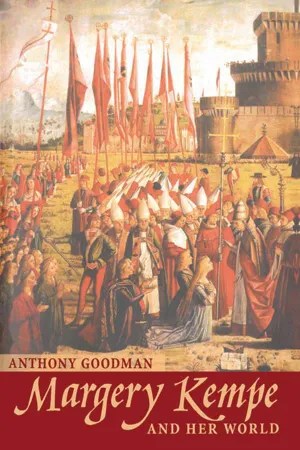
- 304 pages
- English
- ePUB (mobile friendly)
- Available on iOS & Android
eBook - ePub
About this book
Daughter of a mayor of King's Lynn, wife of a burgess there and mother of fourteen children, Margery Kempe (c. 1373-post 1438) was also a religious mystic and hysteric, who dictated her 'autobiography' to a scribe at the end of her life. In this history of her life, Anthony Goodman examines "The Book", to reconstruct as much of her conventional biography as the materials allow. Including her spiritual experiences, but focusing most particularly on her day-to-day life, he builds an intriguing picture of bourgeois society in late medieval Lynn, and the wider world of late medieval towns in England and Europe more generally.
chapter 1
INTRODUCTION

The subject of this study is an account, unique in character, of the life in devotion of a medieval Englishwoman, Margery Kempe, of King’s Lynn, Norfolk, who was born in the early 1370s and was alive in 1438. A manuscript volume which the Butler-Bowdon family, of Pleasington Hall, Lancashire, found among their possessions in 1934 was identified as The Book of Margery Kempe. It is now in the British Library (Additional MS 61823).
The manuscript dates from the mid-fifteenth century; the writing is in a neat and clear hand, and the language is Middle English in a Norfolk dialect of the period.1 This is not the original manuscript but a fair copy, probably copied directly from the original, with some personal and place names probably abbreviated. The scribe is called Salthows.2 The only indication of early ownership is the inscription in a late fifteenth-century hand, ‘Liber Montis Gracie’, which identifies it as having been in the library of Mount Grace priory (Yorkshire, North Riding), a Carthusian house.3 A prominent set of marginal annotations of the text (of an approving and devout nature) has been attributed to a monk of the house.4
A few other manuscripts from the priory’s library have been identified. Dom David Knowles concluded from their subject matter, and evidence of the literary activities of some of the monks, that this priory most fully exemplified the engagement of the Carthusian Order in England with late medieval English spirituality in the last phase of monasticism.5 At this devotional powerhouse, The Book appears to have been reverenced. There is not much evidence that The Book made an impact anywhere else except within this community of remote and exceptionally austere monks – though they constituted a large and probably devotionally influential community, twenty-seven strong at the dissolution of the priory in 1539.6 However, no copy of The Book has been identified among those surviving from the libraries of two monasteries which had extensive collections of devotional manuscripts in the fifteenth century – the Charterhouse of Sheen (now Richmond, Surrey) and the Briggetine convent of Syon (Middlesex).7
Yet we must bear in mind how deeply impoverished our perceptions of late medieval English spirituality are as a consequence of the enormous destruction of religious texts during the Reformation. It may betoken a more widespread valuation of The Book that, after the dissolution of Mount Grace, a pensioned-off monk or a religiously conservative lay person considered the work to be a precious devotional testimony, and that subsequent Roman Catholics risked preserving a compromising work which might have been used to support accusations of subversiveness. There is evidence that extracts from the text had circulated at the end of the fifteenth century and, indeed, continued to be regarded as spiritually uplifting in subsequent decades. The London printer Wynkyn de Worde put together excerpts taken from nineteen passages in The Book, c. 1500, under the title A shorte treatyse of contemplacyon taught by our lorde Ihesu cryste, or taken out of the boke of Margerie Kempe of Lynn. It is not clear whether Worde was printing from Salthows’s copy: the printed extracts are in contemporary London English. As Professor Sanford Meech pointed out, all seven pages of them are meditative, excluding descriptions of experiences in the secular world with which they are interlarded in The Book.8 Worde probably judged that his readership would find meditations devotionally rewarding, but that they might be indifferent to, or even repelled by, the accounts of their author’s worldly tribulations. Moreover, aspects of The Book – its bewildering chronological jumbles and its homely loquacity – might have jarred on some potential readers in a period when humanist canons were influencing the form and content of vernacular literature and educational curricula. Besides, in the early Tudor period, public discourse insisted with increasing emphasis on the propriety of harmonious obedience to hierarchical prescriptions. Women should know their place – which, The Book shows, some of Margery’s contemporaries thought on occasion she did not. Besides, there were renewed concerns about the spread of Lollard heresies. In this climate of opinion, The Book’s harping on its subject’s defiances of ecclesiastical and lay authorities, and on her susceptibility to charges of heresy, would have ruffled some sensibilities. To the conventionally devout, the repeated need for The Book’s role model to be distinguished from Lollards might then (when their profiles were very clearly established) have seemed puzzling, perhaps, indeed, alarming. However, Worde’s meditative extracts may have been well received, though only one copy survives; another London printer, Henry Pepwell, reprinted them in 1521, in a volume containing seven devout treatises.9
The first modern translation of the text was published in 1936 by Colonel Butler-Bowdon: he acknowledged that the American scholar Hope Emily Allen had identified firmly the ‘authoress’ as the hitherto obscure Margery Kempe of King’s Lynn. There is only one reference to her full married name in The Book, ‘Mar. Kempe of Lynne’, but a number of times she is referred to by her Christian name. She is also identified as ‘John of Burnamys daughter of Lynne’, and elsewhere in the text he is said to have been ‘mayor five times of that worshipful borough and alderman [of Holy Trinity Gild] also many years’.10 The original text, with a full scholarly apparatus, was published four years later by Professor Sanford Meech and H.E. Allen.11 This exemplary edition is the foundation for studies of The Book. Its introductory material, footnotes and appendices contain a mass of information, indispensable to students of the subject. Dr B.A. Windeatt published a modern version in 1985, which has brought knowledge of The Book to a much larger readership.12 However, for the three decades or so after Meech and Allen’s publication of the text, studies of it were fitful. It may be that the editors’ mastery of the subject for some time had the effect of ring-fencing it. Historians tended to ‘cherry pick’ examples from it, though paying the text the compliment of accepting what it said literally.
Perhaps some of the main thrusts in the historiography of fifteenth-century England for long sidelined The Book as a historical source. K.B. McFarlane, doyen of historians of later medieval England, put studies of the nobility to the forefront, using as prime source material the documentary evidence of their own and other relevant archives, with a heavy prosopographical emphasis. Though McFarlane’s works on John Wycliffe and the Lollards produced a new understanding of the social significance of the heretical movement, he was steely in his secular approach to devotional matters and steered clear of using The Book as evidence.13 So, perhaps surprisingly, did the growing numbers of British historians interested in exploring mentalités – with the electrifying example of Emanuel Le Roy Ladurie’s reconstitution of the Pyreneen community of Montaillou in the later thirteenth and early fourteenth centuries, based on an inquisitorial register, as an encouragement.14
The Book is unique in the nature and richness of the testimony it gives as a construction of a town dweller’s mentality in medieval England. Its scope is remarkable. It has a huge cast (though mostly anonymous and unidentifiable) and reflects on experiences in major English cities and some of the great cities of Christendom. However, urban historians have preferred to reconstruct religious and other aspects of their societies by using record evidence. Wariness in using The Book is understandable, for, though (as the selection of documents printed by Dr Owen shows), King’s Lynn is rich in documentation from the period, it remains difficult to position The Book within its social and cultural milieux and hazardous, therefore, to use it as evidence for urban mentality, except in the most general ways. Documentation has not even yielded information placing Margery Kempe securely within broad family and social networks. The disappearance of the records of most wills made in King’s Lynn in the fifteenth century has robbed us of a vital source. Lynn was an ecclesiastical ‘peculiar’, with its own court, outwith the ordinary diocesan jurisdiction of the see of Norwich. The records of the Lynn court do not appear to have survived: we have only a few stray wills proved before and recorded by diocesan officials.15 Meech and Allen made identifications of Margery’s father and her husband from the borough records, but the figure of The Book still remains, as a consequence of the dearth of other evidence, one which floats detached from much of what we know about Lynn society.
From the 1970s onwards, studies of The Book, particularly by American scholars and by scholars of literature, have proliferated. Medievalists have seen it as an important piece of evidence in a variety of related contexts, notably those of gender, individual consciousness and religious sensibility.16 The figure of Margery, in this post-Annaliste historio-graphical climate, has taken on a rich significance which it lacked in the perception of its earliest modern commentators. Father Thurston, S.J., who reviewed Butler-Bowdon’s edition in The Tablet and more fully in The Month in 1936, was cautious in his assessment of the significance of the devout personality projected in The Book. He wrote in The Tablet that ‘it is impossible to forget the hysterical temperament revealed in every page of the narrative portions’. In The Month he asserted: ‘That Margery was a victim of hysteria can hardly be open to doubt, for apart from her weeping fits, she was constantly subject to mysterious illnesses from which she suddenly recovered.’ However, he showed appreciation of the good qualities of ‘these queer mystics’, especially their genuine love of God.17 These judgements have a ‘modern’ flavour, but also reflect the Church’s traditional distrust of unusual manifestations of religious enthusiasm, using a fashionable medical term to express some of the adverse judgements which, according to The Book, were made about Margery’s disturbing exhibitions of devotion at the time. However, Father Thurston’s diagnostic bent is one which has been followed more recently as a consequence of the burgeoning studies on the history of medicine. The Book has a good deal of evidence about the illnesses and disfunctionality of its subject, particularly intriguing for the psychologist. It projects Margery’s growing inability to fulfil with equanimity some basic normal requirements of society. The visions which are at the heart of its subject matter might be judged, from some modern viewpoints, as delusional. The descriptions of trance-like ecstasies emphasise the accompanying physical symptoms. Spiritual progression is described within the context of mental and bodily ills, and physical symptoms (such as ringing in the ears or spots before the eyes) are given a spiritual significance. A temptation nowadays would be to put the Margery of The Book on the couch or in the surgery.18
Let us now consider aspects of the composition of The Book. The text is divided into two parts; the first, the bulk of the work, comprising eighty-nine short chapters, the second, ten. The text in the form we have it was first written down in 1436, copied from an earlier, badly written version. The copying, we are told, commenced on the day after the feast of St Mary Magdalene (23 July). The date was probably symbolic, associating the depiction of Margery as a reformed sinner embraced by Christ with its supreme female role model.19 The circumstances of the first book’s composition are explained in a very brief preface and are amplified in the preceding, more expansive proem. The preface starts off rather laconically: ‘A short treatise of a creature set in great pomp and pride of the world, which since was drawn to our Lord by great poverty, sickness, shames, and great reproofs in many divers countries and places, of which tribulations some shall be showed after, not in order as it is fallen but as the creature could have mind of them [remember] when it were written.’20 The proem had input from the priest who transcribed the existing text, in order to ‘express more openly’ what it was about than was done in the earlier introduction. It is much more eloquent and well considered, beating the drum for Margery’s spiritual struggles and attainments, and providing an ambitious rationale for the work. It commences: ‘Here beginneth a short treatise and a comfortable one for sinful wretches, wherein they may have great solace and comfort to them and understand the high and unspeakable mercy of our sovereign Saviour Christ Ihesu, whose name be worshiped and magnified without end, that now in our days to us unworthy deigneth to exercise his nobility and his goodness.’21 The proem appears to reflect a change of intention for the text, perhaps made at the behest of her clergyman-amanuensis and his superiors. For Margery had contracted with the previous scribe (a briefly engaged second amanuensis) that he was ‘never to reveal it [the book] as long as she lived’.22 She had, therefore, intended publication after her death, in the hope, one assumes, of posthumously confirming her holiness. Presumably, when the opaque content of the first draft (which had been written down in a semi-literate scrawl) at last became clear to the better educated clergyman who became her amanuensis and his and to Margery’s mentors among the clergy, they impressed upon her the desirability of instant publication. My assumption is that the good news conveyed in The Book was thought to merit it. In the proem, the treatise is advertised as a utilitarian one, a helpful spiritual handbook which demonstrated Christ’s continued benevolent bustling down orthodox channels – at a time when heretics were claiming to have authoritatively rediscovered the true route to his grace. The proem is also strongly justificatory, emphasising that Margery’s spirituality has the imprimatur of impeccably orthodox clerical authorities, and that some of the great and the good among them had long urged her to have a written account made.
The second book was a new composition recorded by the same clergyman-amanuensis, by then a seasoned collaborator with Margery. Unlike the first book, it does not have separate introductions, but in its first chapter the writer recorded that he commenced work on the feast of St Vitalis Martyr (28 April) 1438. Vitalis had been a Roman bureaucrat, a family man who spoke out against the persecution of Christians, declared his own faith and accepted his martyrdom with dignity – a good role model, perhaps, for borough officers and chaplains in Lynn who thought their superiors were behaving wickedly.23 This writer of the second book ‘held it expedient to honour of the blissful Trinity that his holy works [the Saviour’s] should be notified and declared to the people, when it pleased him, to the worship of his holy name’.24 The book dwelt on events in Margery’s life in the 1430s which were not covered in Book One. Its concluding chapter consisted of a well-composed set of her prayers, which handily distils the essence of her devotion. The intention here was presumably to show the moyen homme sensuel and his female counterpart, and how they might relate to and benefit from the vaulting devotion of the treatise.25
Why was an extended second book composed? The first amply – and often repetitively – demonstrated the special character of Margery’s devotional life and its background. In its sequel there were no extended dialogues with Christ or visions of sacred scenes; it is mostly concerned with her family affairs an...
Table of contents
- Cover
- Half Title
- Title Page
- Copyright Page
- Dedication
- Table of Contents
- SERIES EDITOR’S PREFACE
- AUTHOR’S PREFACE
- LIST OF ILLUSTRATIONS AND PLATES
- CHRONOLOGY OF THE LIFE OF MARGERY KEMPE
- GENEALOGICAL TABLE AND MAPS
- ABBREVIATIONS
- GLOSSARY
- chapter 1 INTRODUCTION
- chapter 2 LYNN AND THE BRUNHAM FAMILY
- chapter 3 MARGERY AND URBAN GENDER ROLES
- chapter 4 ECCLESIASTICAL AUTHORITY AND RELIGIOUS CULTURE IN LYNN
- chapter 5 THE PIETY OF THE BOOK OF MARGERY KEMPE
- chapter 6 ENGLISH TRAVELS AND CONTEXTS
- chapter 7 A WIDER WORLD
- chapter 8 GREAT CITIES AND SACRED SOIL
- chapter 9 CONCLUSION
- NOTES
- SELECT BIBLIOGRAPHY
- INDEX
Trusted by 375,005 students
Access to over 1.5 million titles for a fair monthly price.
Study more efficiently using our study tools.
Frequently asked questions
Yes, you can cancel anytime from the Subscription tab in your account settings on the Perlego website. Your subscription will stay active until the end of your current billing period. Learn how to cancel your subscription
No, books cannot be downloaded as external files, such as PDFs, for use outside of Perlego. However, you can download books within the Perlego app for offline reading on mobile or tablet. Learn how to download books offline
Perlego offers two plans: Essential and Complete
- Essential is ideal for learners and professionals who enjoy exploring a wide range of subjects. Access the Essential Library with 800,000+ trusted titles and best-sellers across business, personal growth, and the humanities. Includes unlimited reading time and Standard Read Aloud voice.
- Complete: Perfect for advanced learners and researchers needing full, unrestricted access. Unlock 1.5M+ books across hundreds of subjects, including academic and specialized titles. The Complete Plan also includes advanced features like Premium Read Aloud and Research Assistant.
We are an online textbook subscription service, where you can get access to an entire online library for less than the price of a single book per month. With over 1.5 million books across 990+ topics, we’ve got you covered! Learn about our mission
Look out for the read-aloud symbol on your next book to see if you can listen to it. The read-aloud tool reads text aloud for you, highlighting the text as it is being read. You can pause it, speed it up and slow it down. Learn more about Read Aloud
Yes! You can use the Perlego app on both iOS and Android devices to read anytime, anywhere — even offline. Perfect for commutes or when you’re on the go.
Please note we cannot support devices running on iOS 13 and Android 7 or earlier. Learn more about using the app
Please note we cannot support devices running on iOS 13 and Android 7 or earlier. Learn more about using the app
Yes, you can access Margery Kempe by A.E. Goodman in PDF and/or ePUB format, as well as other popular books in History & Historical Biographies. We have over 1.5 million books available in our catalogue for you to explore.