- 544 pages
- English
- ePUB (mobile friendly)
- Available on iOS & Android
eBook - ePub
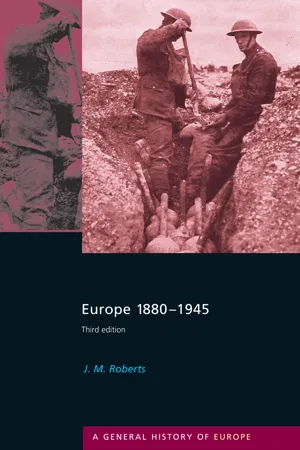
Europe 1880-1945
About this book
Suitable for 19th and 20th century Europe/modern Europe undergraduate courses.This well-established and immensely successful book provides a standard introduction to the subject by one of Britain's most popular historians. Social, economic and social history are skillfully integrated within a framework of political narrative history.
Trusted by 375,005 students
Access to over 1.5 million titles for a fair monthly price.
Study more efficiently using our study tools.
Chapter 1
What this book is about
European and world history
One big difference between ourselves and our predecessors centuries ago, is that we now take historical change for granted. We are no longer surprised by it; it is taking place all the time, and more rapidly and widely than ever before. The growth of population in the last 200 years is enough by itself to make much of previous history seem almost static. Yet of this sort of change comparatively few people, perhaps, are aware; others have been much more spectacular. Since the first edition of this book was published, men have gone to the moon and walked about on it. Yet among those who watched them on television screens as they did so were many who had been born before there were aeroplanes, and even before the motor-car had become a familiar object.
Another great change which has come about since 1880 has been the establishment of communications and international relations which have made the whole globe ‘one world’. In 1880 the Americas were in large measure hardly touched by political events in other continents. Great tracts of them were, if not undiscovered, still unexplored. The rest of the known world was mainly dominated politically and economically, directly or indirectly, by a few European states. That dominance outside the Americas grew into a world supremacy which reached a climax before the outbreak of the first world war and began to crumble before the end of the second. As it crumbled, a new world appeared in which Europe was overshadowed by two super-states and jostled by a throng of new nations. These great innovations are central to what this book is about.
Because these changes were worldwide, Europe’s history is inseparable from world history between 1880 and 1945. Yet we can still distinguish a ‘European’ history worth examination in these years. Since her Muslim invaders turned back from Tours in the eighth century, the decisions made in Europe had increasingly been the decisions which altered the history of the world. At least until 1917, and in a measure until 1941, Europe was the place where most of world history was decided. However many millions it ruled, Akbar’s great seventeenth-century Indian empire in the end changed history less than the foundation of the East India Company; the Declaration of the Rights of Man and the French Citizen of 1789 has had greater repercussions than all the thousand-volume encyclopedias of China.
The omission from this book of the history of most of the globe can also be defended because political power was the most important determinant of European history. For all her heritage of shared civilization, Europe was not an economic, nor a social, nor a racial or national entity. Such identity and unity as she possessed in these years was essentially the identity and unity of a system of power, though one already perhaps beginning to decay in 1880. Yet Europe contained, for most of the years between then and 1945, the most important forces in world politics. In it were focused the arrangements which governed the world: these arrangements left unregulated only the western hemisphere (and even there the British Royal Navy tacitly provided the under-writing of power needed by the Monroe Doctrine).1 The nature of these arrangements was determined mainly by events in Europe itself, and not outside it. So, European history is a distinguishable and meaningful topic in these years.
At some time after 1880 came a turning point in world history. By 1945 the decisions taken in Washington and Tokyo were already as important as those taken in London, Moscow or Berlin; soon, the decisions made in Peking would be important too. But this book must include only such non-European history as is necessary to explain the shattering of the European preponderance of power. Traditionally, historians of Europe write about Russia: for all her vast Asian territories, she was a European before she was a world power. The domestic history of the United States, on the other hand, can be, for the most part, left out. Important as it is to the understanding of the world today, it was in these years only occasionally decisive for Europe. For most of them the United States played little part in the organization of world power except in the Far East. At the same time, while Europe has the limelight, the stage of its history must be worldwide. The steamship and the railway and the expansive power of commerce make this inevitable. So, above all, does the fact of European imperial dominion. Great multi-national empires were the most striking features of the political landscape in 1880, and this remained true for a long time, most of them being ruled by Europeans or peoples of European descent.
If one theme of this book is the ebbing of Europe’s pre-eminence in the system of world power, another must be the passing of an epoch in European civilization, something even harder to measure. It is not easy to characterize civilizations. They contain legacies from very different eras, contradictory elements, importations and survivals from other cultures, and it is very difficult to delimit them geographically or chronologically. Yet a European civilization existed between 1880 and 1945, which was European in its origins although already transplanted to North and South America and the British white colonies and although unevenly spread among European countries themselves. It reached its greatest coherence and strength before 1914 and may be distinguished from others by the emphasis it placed on the individual, by its increasing separation of social and political institutions, by its material wellbeing, and by its growing rationality. Another way of characterizing it is to describe its fundamental institutions, such as the sovereign state, the self-regulating market and the scientific method.2 Some have called it liberal bourgeois civilization. A fuller picture of its nature will emerge later in this book. All we need do here is to remark that by 1914 it had carried the control of violence and unreason in national and international life further than ever before, and brought Europeans to a previously unmatched level of material and mental achievement.
None the less, its success was followed by a decline in the vitality of this civilization. This was accompanied by an intensification of a process which had already begun, the adoption of European institutions and standards in other parts of the world. European civilization was the first to impose itself on the whole surface of the globe. In 1880, some of its greatest successes in diffusing its institutions and ideas were still to come. When they did, the clarity of outline of European civilization gradually blurred into a culture increasingly called ‘western’. Later still, as some of its features were more and more picked up in countries round the world which were seeking to modernize, its distinction was increasingly lost.
The cultural change in Europe during this world trend is another major theme of this book, but it is not easy to separate it from the political story. Nor, indeed, can it be easily disentangled from social and economic, or even technological history. This book is not, therefore, divided on traditional lines. A mixture of analytical and narrative chapters has been adopted in order to bring out, whenever possible, the general rather than the local and particular characteristics of European history in this period. Wherever possible, statistics have been cited to condense general changes which cover long periods. The criteria of relevance to the central themes of European history have also led me to set aside some topics often included in textbooks of this kind. The history of the Ottoman empire, for example, is only dealt with here in so far as it immediately affects what was once Ottoman Europe. The smaller nations of the continent may also seem to get short shrift. In so far, though, as they are affected by general trends, their history resembles that of the major states and can hardly justify lengthy discussion when the major states themselves are dealt with only summarily. The criterion of historical effectiveness must almost always mean that their detailed history has to be ignored to give space to explain that of bigger and more effective nations. This is not mere deification of success; many of the most important facts of European history have been its great disasters and failures. They have, none the less, been disasters and failures which have affected large numbers of people, and this is the only standard of importance the historian can discover within the confines of his own subject in the long run.
International relations pose special difficulties. There is much more to them than diplomatic negotiation. Yet the diplomacy itself must be adequately rendered, and it is its nature to be very detailed and complicated. An American who has written some of the major works of diplomatic history of this century, noted this. ‘The more I saw of . . . the doings of an official generation slightly older than my own’, he writes, ‘the more it was borne in upon me that the genuine image of the diplomatic process is hardly to be recaptured in historical narrative unless the lens through which it is viewed is a sharp one and the human texture of which it consists becomes visible in considerable detail.’3 Coming as it does from a historian who spent many years as a professional diplomatic officer, this judgement must command respect. But narrative on the scale which it demands is impossible in a book like this. Accepting, therefore, that selection is bound to falsify, I have adopted the compromise of treating diplomacy only within a general context of international relations. The main concern of the chapters on international relations is with facts revealing the changes of states’ attitudes. I have tried to confine diplomatic narrative to major episodes to which diplomacy was central. At such points, quotation and a slightly closer narrative attempt to give the reader some idea of the reality behind the colourless abstractions of ‘England’, ‘Germany’ or ‘Russia’.
For the rest, recent history raises no fundamental or peculiar questions of historical criteria not familiar to historians of earlier times. There is no reason to re-fight battles over history and moral judgement in this book. Perhaps it may now be accepted that so long as historians are acting as historians, their criteria must arise from their own study and must not be imported from some other autonomous field. They must make decisions about what was historically important, not about, let us say, what was theologically or aesthetically important, significant though that might be to a believer or an artist. Once again, they must look for what had the most far-reaching effects whether good or bad. History is not the story of success, but the story of what was effective, for good or ill, in shaping human behaviour. (This is one reason for giving more attention to economic movements and social structure than our predecessors would have done.) In this book, that means more analytical and less narrative material than there would have been in a book written half a century ago.
Problems of content nonetheless go beyond questions about criteria. In the first place, the historian of recent times has a subject-matter different in kind from that studied by some of his colleagues. Recent history has, for example, a mass character more marked than the history of earlier times. Historians have to concern themselves more and more with the disentangling of mass trends and less and less with the exploration of the work of individuals. This certainly does not mean that individual men do not count. The twentieth century would have been very different without the decisions taken by Hitler and Stalin, the speculations of Freud and Einstein. But we have become more aware of the web of necessity in which even exceptional men must move, especially if they are men of action (as, indeed, recent discussion of the role of Hitler abundantly makes clear). We are more aware, too, of how much greater, usually, is the influence of social and economic institutions – the strategic factors shaping society – than that of conscious policy. Nor, we realize, do statesmen operate in private mental worlds; climates of opinion, received ideas, even intellectual crazes and failures, all influence them, sometimes unconsciously. One way in which modern history is distinctive is that it deals with societies which are increasingly aware of such facts as these, and therefore try to come to terms with them.
The self-consciousness of modern Europe raises another problem. Some of the emphasis which is placed on general and mass trends in modern history arises from a sort of optical illusion, because we have so much more information about the general nature and working of recent societies than we have for earlier periods. This is one of the difficulties posed by the evidence available to the modern historian. Ancient historians or medievalists have often to wring their conclusions from fragmentary and inadequate sources. At best, their work is defined by what is known to be available as source material. Their characteristic attitude is one of close scrutiny and interrogation; they put their documents on the rack, as it were. Where evidence is thin, individual men seem to stand out heroically, taking decisions which drastically and simply shape historical events. Modern historians, on the other hand, tend to see individuals confronted by the inertia of history and society.
Perspectives
Copiousness of information confronts us with problems of perspective and proportion. The temptation is always to follow the evidence and to believe that where it is abundant it is also important. It can easily be concluded that its mere abundance must make matters easier to understand. We have also the additional hazard of access to information of a kind not available for earlier times. The twentieth century can supply much more apparently objective data than hitherto (for example, about ‘public opinion’, a notion very hard to grasp in earlier times). It is tempting, too, to think we know much more about the history of ideas; we often have, after all, much more information than in the past about what the great originators of new thoughts in recent times actually thought and said.
This does not, though, necessarily make things clearer. In spite of the now enormous output of historical books and studies, for instance (already far too large for everything which might be of relevance to this book to have been read by the author), general historians are always likely to find that in some part of a chosen field there still do not exist the secondary and monographic works which they need to find a way through the dense body of potential evidence. More relevant still, it remains as hard as ever to judge between facts in order to establish which are those most relevant to the historian’s purpose. If we turn for a moment to the history of ideas, for example, it is easy to find the texts of what Freud wrote and said. It is easy, too, to guess that it must have been important. But how important? What part, for example, did his teaching play in the increasing secularization of modern society? Was it more important than, say, anti-clerical propaganda or urbanization? Such questions cannot be answered without many more secondary studies. We can assess roughly the impact of Freud’s teaching and doctrine on the academic and clinical mind, but it is an immense task to document the slow, informal irrigation of society at large by new ideas. Yet millions of Europeans who may never have heard of Freud’s name are now affected by his work, even when this is grotesquely misinterpreted. Further, when his influence on educated people is considered, there remain huge problems of discrimination. To say the very least, it seems likely, for instance, that some of Freud’s work affected widely held views on sexual matters. Most educated people in this country now believe, in a vague sort of way, that we ought to be less sexually prudish than the Victorians are alleged to have been, and that sexual morality should be guarded rather by example and exhortation than by penal sanctions. This change is revolutionary, and it began during the period dealt with in this book. It is hard to believe that Freud had nothing to do with it (though, possibly, through misunderstandings of what he said). Yet it may also owe much to John Stuart Mill in an earlier generation, to the decline of religious discipline, or to the invention of cheap and efficient contraceptives. When influences of this sort have to be considered by general historians, they cannot go far for themselves. Yet they must make a tentative judgement on inadequate evidence, for such a matter is of fundamental importance. Modern communications make the diffusion of ideas in a largely literate population so rapid that Freud was undoubtedly a name more widely known in his own lifetime than was Newton a hundred years after his death. Moreover, ideas and assumptions circulate in disguised and concealed forms, once they have achieved a certain currency. Novels, newspapers and films feed the public with the ideas of a Freud without ever invoking his name.4
To the problems posed by such phenomena we shall often have to return. In some areas they have actually created virtually new topics for study. At the least they have transformed earlier notions of the way the historical landscape is arranged and the comparative importance we should attach to different kinds of history. Women’s history is an example of a topic transformed even since the first edition of this book appeared. What happens in such historical re-orientations (and there is nothing new about them in principle; there have been many across the centuries) is not merely that people turn to the study of particular areas of the past with new vigour and intensity, but that they bring to bear on them new concerns, approaches and ideas. These bring in their train new conceptions both of what can be discovered and of what is important. They were not part of the accepted subject-matter of older history but now the past is re-valued. The sheer volume of publication continues to make it hard to keep up with such changes and no author can be sure he has given an adequate impression of them. But they inevitably affect the ways in which earlier accounts were cast, so that the proportions given in the past to different themes in the narrative are altered and other stories, too, have to be told in different ways. That poses a difficulty for those who like their views of the past cut and dried. But they are not the audience for which books like this one should be written, in any case.
1 For the Monroe Doctrine, see H. Hearder, Europe in the Nineteenth Century 1830–1880 (2nd edn, London, 1988), p. 373 for a succinct summary.
2 Another choice of fundamental institutions can be found in K. Polanyi, Origins of Our Time (London, 1945), p. 13 and a more informal discussion in J. M. Roberts, The Triumph of the West (London, 1985).
3 George F. Kennan, Soviet-American Relations, 1917–1920, vol. I, Russia Leaves the War (Princeton, NJ, 1956), p. vii.
4 The example of Freud, raw evidence of whose impact surrounds us, should make us cautious about assertions about the influence of intellectuals in more remote ages.
Chapter 2
Europe in 1880
States and peoples
Europe’s political structure in 1...
Table of contents
- Cover
- Title
- Copyright
- Contents
- List of abbreviations and acknowledgements
- Preface
- Maps
- 1 What this book is about
- 2 Europe in 1880
- 3 The ancien régime
- 4 International competition, 1880-1901
- 5 Before 1914: Constitutional states
- 6 Autocracy and conservatism
- 7 Anti-traditional forces
- 8 International relations, 1901-14
- 9 The Great War
- 10 Postwar Europe
- 11 Economy and society, 1918-39
- 12 Democratic Europe
- 13 Totalitarianism and dictatorship
- 14 Social and cultural change, 1918-39
- 15 The approach to the second world war
- 16 Europe and the second world war
- 17 Beyond this book: reading further
- Appendix
- Index
Frequently asked questions
Yes, you can cancel anytime from the Subscription tab in your account settings on the Perlego website. Your subscription will stay active until the end of your current billing period. Learn how to cancel your subscription
No, books cannot be downloaded as external files, such as PDFs, for use outside of Perlego. However, you can download books within the Perlego app for offline reading on mobile or tablet. Learn how to download books offline
Perlego offers two plans: Essential and Complete
- Essential is ideal for learners and professionals who enjoy exploring a wide range of subjects. Access the Essential Library with 800,000+ trusted titles and best-sellers across business, personal growth, and the humanities. Includes unlimited reading time and Standard Read Aloud voice.
- Complete: Perfect for advanced learners and researchers needing full, unrestricted access. Unlock 1.5M+ books across hundreds of subjects, including academic and specialized titles. The Complete Plan also includes advanced features like Premium Read Aloud and Research Assistant.
We are an online textbook subscription service, where you can get access to an entire online library for less than the price of a single book per month. With over 1.5 million books across 990+ topics, we’ve got you covered! Learn about our mission
Look out for the read-aloud symbol on your next book to see if you can listen to it. The read-aloud tool reads text aloud for you, highlighting the text as it is being read. You can pause it, speed it up and slow it down. Learn more about Read Aloud
Yes! You can use the Perlego app on both iOS and Android devices to read anytime, anywhere — even offline. Perfect for commutes or when you’re on the go.
Please note we cannot support devices running on iOS 13 and Android 7 or earlier. Learn more about using the app
Please note we cannot support devices running on iOS 13 and Android 7 or earlier. Learn more about using the app
Yes, you can access Europe 1880-1945 by J.M. Roberts in PDF and/or ePUB format, as well as other popular books in History & 19th Century History. We have over 1.5 million books available in our catalogue for you to explore.