The past two decades have seen a rapidly growing involvement of psychologists and psychiatrists in legal proceedings for criminal cases, divorces, and traffic and industrial accidents. Mental health professionals are traditionally not trained to cope with the legal responsibilities that arise from their routine clinical work and are eager to learn the professional skills that are needed in forensic settings. There is presently no book which focuses entirely on the strategies and verbal tactics employed by attorneys who critically examine and challenge the testimony of mental health professionals. If psychologists and psychiatrists can familiarize themselves with the kind of questions and verbal exchanges that take place in the courtroom, they would be better prepared to provide their expertise in an effective manner. This book fills that need.
Designed as a practical handbook to assist practitioners from all mental health disciplines, it focuses on typical courtroom dialogue between attorneys and mental health professionals who testify regarding their psychotherapy clients and also those who are hired by attorneys specifically to provide expert opinions. The authors, who have extensive experience in the courtroom, offer well-thought-out, effective responses as contrasted with impulsive and weak answers to attorneys' queries. Actual cases are employed to illustrate typical challenges in various legal areas, including criminal law, child custody hearings, and personal injury cases. Certain forensic issues such as the scientific bases of expert opinions, the accuracy of psychological vs. medical tests, and malingering, are emphasized throughout the chapters.
The book is based on the belief that exposure to courtroom dialogue enhances the awareness of appropriate professional responses to an attorney's cross-examination and greatly alleviates fear toward a situation well-known to provoke intense levels of anxiety. Although it is written alluding to the forensic psychologist or psychiatrist, the strategies for the witness are readily applicable in most instances to all mental health professionals. Issues such as therapist bias, unconfirmed observations, and cultural and ethnic factors are clearly relevant to all who provide mental health services.
eBook - ePub
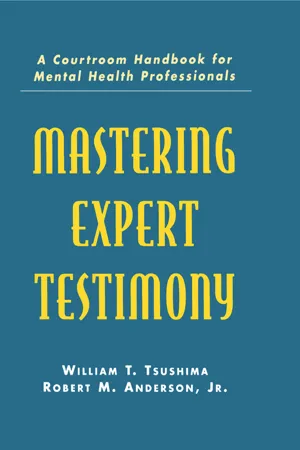
Mastering Expert Testimony
A Courtroom Handbook for Mental Health Professionals
- 232 pages
- English
- ePUB (mobile friendly)
- Available on iOS & Android
eBook - ePub
Mastering Expert Testimony
A Courtroom Handbook for Mental Health Professionals
About this book
Information
CHAPTER 1
THE ART OF EXPERT WITNESSING
“Who is an expert witness and what does an expert do?”

In this initial chapter, we present a description of the expert witness and basic guidelines for the mental health professional who is called in to provide expert testimony in the courtroom. Several books have been published by those experienced in forensic work, and their many suggestions are summarized here.
CHARACTERISTICS OF EXPERT WITNESSES
The definition of an expert witness is, by law, a well-defined concept, yet it is poorly understood by many. During the “trial of the century,” People v. O.J. Simpson, the defense called as a witness, Robert Huizenga, MD, a specialist in internal medicine. Regarding Mr. Simpson’s rheumatoid arthritis condition, Dr. Huizenga was asked if he would defer to the opinion of a pre-eminent expert who was a Stanford University professor and author in a standard textbook on rheumatoid arthritis. Dr. Huizenga would not yield, and quipped that there are many definitions of an expert and that he had heard as a Harvard University medical student that an expert was “a bastard from Boston with slides.” In a court of law, an expert is defined more precisely.
According to Rule 702 of the Federal Rules of Evidence, an expert is a person who, due to specialized training and experience, may provide testimony to assist the trier of fact in understanding evidence that is beyond the layperson’s knowledge, or to determine a fact in issue (Moore, 1985). Thus, the expert must be knowledgeable with the scientific literature in the area of expertise and have the ability to explain technical information in a clear and comprehendible manner. (And in the Simpson example, Dr. Huizenga, who had conducted a physical examination of the defendant, was correct in not deferring to the “pre-eminent expert” who had never examined Simpson.)
A mental health professional can become involved as an expert in legal matters in three different ways. First, practitioners may become expert witnesses inadvertently, when their client is embroiled in litigation, such as in divorce proceedings and personal injury cases. In these situations, therapists may be ordered to appear in court to provide testimony regarding the client’s mental health condition. Second, mental health professionals could be hired by one of the parties in litigation to provide an opinion about someone not previously seen or treated. Finally, mental health professionals can be appointed by the court to provide expert testimony, such as in sanity proceedings. The latter two situations often involves professionals who regularly participate in forensic examinations.
The expert witness should be thoroughly informed about the specific facts and issues in a legal case, so that the testimony can be proffered in a competent and professional manner. The expert is able to form opinions based on known facts and objective evidence, not only on theory. Testimony should be presented in a confident but not arrogant or condescending way. A glib and witty style may impress some courtroom intellectuals but would not be well received by the average juror.
Although often hired by one side in a legal matter, the expert witness does not serve as an advocate, as do the attorneys involved, but remains completely objective and impartial. Having strong convictions based on a professional analysis is a good thing; arguing to win a case for the client or attorney is not. The expert’s role is to help the jury understand the case and not to decide its outcome.
The expert witness is able to communicate opinions in a clear, succinct, and persuasive manner, while avoiding technical terminology and jargon. The expert can answer questions directly and completely without volunteering unsolicited information. When faced with a challenging cross-examination, the expert remains calm and responds constructively to vigorous inquiry. Even when the questioning turns hostile, the expert witness’ demeanor should remain polite and nonargumentative.
Mental health professionals approach the task of testifying with a range of concerns and emotions. Many have an appropriate fear of dealing with a strange and unknown professional experience. Others look on testifying with painful levels of anxiety and apprehension, with the perceived threat of being publicly embarrassed or feeling helpless, whereas still others consider the experience of testifying with the same fondness they have for proctoscopic examinations. Not all professionals have such negative perceptions about going to court. There are those who relish the intellectual and personal challenges presented in testifying and regard the activity as invigorating and rewarding. Sharing one’s professional knowledge and assisting in the search for truth can be an uplifting experience for many.
GUIDELINES FOR THE MENTAL HEALTH EXPERT
Most mental health professionals have had little or no experience in legal activity, and few are prepared to cope effectively with the various phases of the court process. Those who take on forensic responsibilities should consider the following facets of expert witnessing: (a) preparations for forensic practice and testifying, (b) consulting with the referring attorney, (c) forensic evaluations, (d) direct examination by the referring attorney, and (e) cross-examination by the opposing attorney.
Preparations for Forensic Practice and Testifying
1. Obtain education and training pertinent to forensic practice (Grisso, 1988b).
Psychologists, psychiatrists, and other mental health professionals typically do not have, as an integral part of their graduate education, formal courses in forensics. In the absence of doctoral, internship, or postdoctoral training and experience, professionals should undertake their own self-study program. This could involve planned readings and consultation with an experienced forensic psychologist, psychiatrist, or other mental health professional—a mentor. Didactic sessions with the mentor and observation of the mentor in depositions and courtroom testifying would lead to doing cases under the supervision of the mentor. Periodic workshops and symposia on forensic activity would also increase skills in this area.
2. Become and stay current in your area of expertise (Applebaum & Gutheil, 1991; Brodsky, 1991).
As an expert, your opinion and the information you are providing the court should issue from a thorough and current knowledge base in your area of expertise. With the increasing presence of mental health experts in legal matters, attorneys themselves are becoming more sophisticated in their grasp of psychological issues, and you want to be able to respond with state-of-the-science information. Your ongoing education will help you in the courtroom as well as in your clinical practice.
3. Be clearly aware of the limits of your knowledge and do not venture beyond them (Pope, Butcher, & Seelen, 1993).
It is important to clearly understand the limits of your expertise and to make these limits clear to attorneys, other individuals, or institutions who wish to make use of your services as an expert. You should refrain from accepting cases outside your area of expertise. For example, being a clinical psychologist does not automatically confer expertise in neuropsychology or behavioral medicine. Having these limits clearly in mind can also be helpful when a cross-examining attorney asks questions outside your area of expertise. You can respond that the question is outside your area of expertise and that you do not know the answer. Finally, within your scope of specialized knowledge, testify with opinions based on reasonable probability as contrasted with speculations, gut feelings and hunches.
4. Become familiar with the legal terms and law relevant to your area of expertise (Ewing, 1985; Hambacher, 1994).
Know what terms like subpoena, deposition, competency, joint custody, and disability mean. This can be accomplished by reading, attending seminars, and obtaining supervision. Certain cases, such as in criminal law and divorce court, will have specific relevant legal terminology. To assist you, the referring attorney may be able to define the legal terms and issues relevant to a given case. Although it is important to understand basic aspects of the law, never assume to be an expert in anything other than your own field, and confer with the attorney on important points of law. Let the lawyers be the legal professionals and you remain the mental health professional.
5. Maintain a copy of organizationally endorsed guidelines for forensic work in your specialty.
For psychologists, the American Psychology–Law Society and Division 41 of the American Psychological Association have adopted Specialty Guidelines for Forensic Psychologists (Committee on Ethical Guidelines for Forensic Psychologists, 1991).
6. Familiarize yourself with the courtroom (Brodsky, 1991; Maloney, 1985).
Know where the courthouse is, what parking is available, and how the courtroom is structured. This can involve visiting the courtroom and observing a seasoned expert witness, possibly your mentor, testifying in court. Pope et al. (1993) recommended reading books such as The Trial Lawyers (Couric, 1988), The Litigators (Jenkins, 1989), The Best Defense (Dershowitz, 1982), and The Trial Masters (Warshaw, 1984) to obtain an understanding and feel for the legal process. Trials of an Expert Witness (Klawans, 1991) describes the process from the point of view of an expert witness. A relatively recent development, Court TV, a network television channel, provides frequent opportunity to watch psychiatrists and psychologists in well-publicized trials, such as the trials of O. J. Simpson and the Menendez brothers in Los Angeles, usually with reviews by experienced trial lawyers and judges.
Consulting With the Referring Attorney
1. Maintain objectivity (Applebaum & Gutheil, 1991; Brodsky, 1991). Avoid becoming an advocate (Group for the Advancement of Psychiatry, 1991; Shapiro, 1991).
When working closely with a client or the attorney, it is easy to become emotionally involved and to want to please the parties you are working with. Avoid partiality and advocacy. The role of the expert is to provide an objective, scientific opinion. Ideally, your opinion would be the same regardless of which side of a dispute is retaining you. Your job is to present truthful testimony, not to win the case for the attorney.
2. Request all available information that is relevant to the legal case (Sadoff, 1988).
Forensic evaluations must be thorough and based on all of the available relevant information. Thus, criminal experts will review arrest records, and personal injury specialists will peruse various medical and psychological documents in preparation for their testimony. Educational and work records can be extremely pertinent. When possible, verify information by interviewing family members, coworkers, and the like.
3. Reserve your opinion until after you have received sufficient information and have conducted your evaluation (Ewing, 1985).
Attorneys may invite the expert to commit to a position prior to examining the client and all information. This may involve an attempt to determine whether the expert will provide an opinion favorable to the attorney’s client or perhaps to ensure that the expert will not be able to play any role in the case (Pope, Butcher, & Seelen, 1993). Try to obtain as much relevant information as possible before forming any conclusions. The expert who changes diagnoses, even when legitimate because of additional relevant data, may be perceived as unreliable or lacking in certainty.
4. If possible, obtain a retainer or a written agreement of your fee from the attorney. Never work on a contingency fee basis (Applebaum & Gutheil, 1991; Ewing, 1985; Pope et al., 1993; Shapiro, 1991).
Although most attorneys and clients are honorable in terms of their payment for professional services rendered, sometimes it is difficult to collect your fees after the fact, especially when the outcome is not favorable. A written agreement avoids any disputes or misunderstandings. It is unethical to link your fees to the outcome of the trial. By not working on a contingency fee basis, you are able to maintain objectivity and avoid the charge of advocacy.
5. Have some information that can be used by the attorney to establish your expertise (Brodsky, 1991).
Attorneys may not be aware of your relevant training and experience, or any teaching or research you conduct. Your resume or curriculum vitae (CV) can be very handy for the hiring attorney to inform the court about your specialized professional knowledge, as well as the limits of your expertise.
Forensic Evaluations
1. Be sure that the examinee understands the nature and circumstances of the evaluation and the limits on confidentiality (Pope et al., 1993).
It may not be obvious to the client that you will be sharing your findings with the referring attorney and eventually the court. The usual restrictions pertaining to client confidentiality may not apply when legal proceedings are involved. If there is any doubt, you may want to consult your attorney to be certain of your responsibilities and the client’s rights.
2. Be thorough in your evaluation (Ewing, 1985).
In any legal case—in criminal court, civil court, and family court—the consequences are substantial, and the expert must perform a competent and thorough examination. Obtain all relevant documents, including health, education, work, and criminal records, and when possible interview individuals familiar with the client to verify information.
3. Know precisely the chain of reasoning that leads from your data to your conclusions (Brodsky, 1991).
Be prepared to explain to laypersons how you used your findings to arrive at your conclusions. The average juror does not share the same assumptions and beliefs as yourself, and will need careful and clear explanations of your conclusions.
4. Consider the role that faking and malingering may play in the evaluation (Brodsky, 1991; Pope et al., 1993).
Assessing the honesty of an examinee may be one of the most difficult tasks for the mental health professional, but it is a vital aspect of your testimony. Be familiar with the research related to the detection of faking and whatever methods you can rely on to assess the client’s honesty and attempts at impression management.
Direct Examination by the Referring Attorney
1. Before the trial, prepare the attorney (Applebaum & Gutheil, 1991; Shapiro, 1991).
It is perfectly acceptable to meet with the attorney before going to court so that you can be apprised of the critical issues in the case and so that the attorney is thoroughly familiar with your testimony. Assist the attorney with the kinds of questions that should be asked in order to elicit your opinion most effectively. Anticipate the challenges that may be made to your opinion and help the attorney in determining...
Table of contents
- Cover
- Half Title
- Title Page
- Copyright Page
- Table of Contents
- Foreword
- Preface
- 1 The Art of Expert Witnessing
- 2 Witness Qualification
- 3 The Clinical Examination
- 4 Psychological Testing
- 5 Psychotherapy
- 6 Criminal Law
- 7 Child Custody Disputes
- 8 Personal Injury
- 9 Mental Competency and Dangerousness
- 10 Faking and Malingering
- 11 Neuropsychological Assessment
- 12 The Nondoctoral Witness
- 13 Deposition
- Appendix: Annotated Reference List
- References
- Author Index
- Subject Index
Trusted by 375,005 students
Access to over 1.5 million titles for a fair monthly price.
Study more efficiently using our study tools.
Frequently asked questions
Yes, you can cancel anytime from the Subscription tab in your account settings on the Perlego website. Your subscription will stay active until the end of your current billing period. Learn how to cancel your subscription
No, books cannot be downloaded as external files, such as PDFs, for use outside of Perlego. However, you can download books within the Perlego app for offline reading on mobile or tablet. Learn how to download books offline
Perlego offers two plans: Essential and Complete
- Essential is ideal for learners and professionals who enjoy exploring a wide range of subjects. Access the Essential Library with 800,000+ trusted titles and best-sellers across business, personal growth, and the humanities. Includes unlimited reading time and Standard Read Aloud voice.
- Complete: Perfect for advanced learners and researchers needing full, unrestricted access. Unlock 1.5M+ books across hundreds of subjects, including academic and specialized titles. The Complete Plan also includes advanced features like Premium Read Aloud and Research Assistant.
We are an online textbook subscription service, where you can get access to an entire online library for less than the price of a single book per month. With over 1.5 million books across 990+ topics, we’ve got you covered! Learn about our mission
Look out for the read-aloud symbol on your next book to see if you can listen to it. The read-aloud tool reads text aloud for you, highlighting the text as it is being read. You can pause it, speed it up and slow it down. Learn more about Read Aloud
Yes! You can use the Perlego app on both iOS and Android devices to read anytime, anywhere — even offline. Perfect for commutes or when you’re on the go.
Please note we cannot support devices running on iOS 13 and Android 7 or earlier. Learn more about using the app
Please note we cannot support devices running on iOS 13 and Android 7 or earlier. Learn more about using the app
Yes, you can access Mastering Expert Testimony by William T. Tsushima,Robert M. Anderson, Jr.,Robert M. Anderson in PDF and/or ePUB format, as well as other popular books in Psychology & Clinical Psychology. We have over 1.5 million books available in our catalogue for you to explore.