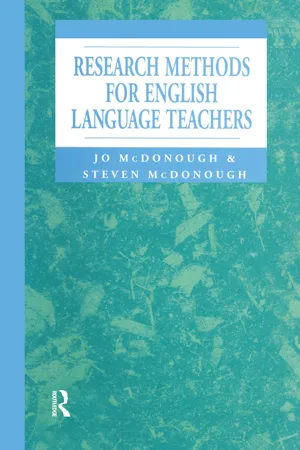
This book offers a lively introduction to the research methods and techniques available to English language teachers who wish to investigate aspects of their own practice. It covers qualitative and quantitative methodology and includes sections on observation, introspection, diary studies, experiments, interviews, questionnaires, numerical techniques and case study research.
Each method is illustrated with examples in language teaching contexts, and techniques of data collection and analysis are introduced. The authors focus particularly on research in the classroom, on tests, materials, the effects of innovations, and they discuss methods appropriate to research in various collaborative modes as well as by individuals. A key feature of the book is an introduction to the debate surrounding different approaches to research, with an evaluation of traditional research in relation to the paradigms associated with reflective practice and action research.
The book is ideal for teachers on initial training and post-experience courses, students on degree programmes in applied linguistics and TEFL and, of course, practising teachers with an interest in research methods in language teaching.
- 272 pages
- English
- ePUB (mobile friendly)
- Available on iOS & Android
eBook - ePub
Research Methods for English Language Teachers
About this book
Information
Part 1: principles and perspectives
1
Teachers in action
Introduction
A worldwide profession like that of TEFL is much too richly diverse to be neatly captured in an introductory chapter of this kind. Rather, the aim here is to offer a small variety of teaching situations – ‘instances’ – which, if not representative, at least give a flavour of teachers’ working environments and professional concerns. These ‘instances’ are not case studies carefully chosen to illustrate models and possibilities for teacher research, and much of the rest of this book is anyway given over to this goal: indeed, in a number of these instances, ‘research’ is not obviously centre-stage at all. Our starting point, then, and a theme that underpins our arguments throughout, is a belief that research in language teaching must be predicated on an understanding of a wide range of contextual variables that will interact with and even determine both research perspectives and research methodology: they may of course also help to explain an absence of any research interest by participants whatsoever.
We hope to be able to show from the six instances briefly described a little later in this chapter that research possibilities for English language teachers can be seen on a broad spectrum. At one end there are well-formulated research questions which are then implemented as a concrete set of procedures with an actual research outcome. At the other end, and undoubtedly representing the majority of teaching situations, research remains an unrealized potential, though we would argue strongly that this research potential is in fact inherent by definition in every context, because no classroom and no group of people working together is without problems to solve, questions to resolve, grey areas to clarify and development areas to pursue. We have seen in the introduction to this book that a minimalist view of a ‘research stance’ requires the systematization and formalization of professional issues out of the complexity of day-to-day action: the idea that research possibilities are embedded in any teaching situation is well expressed by Fujiwara (quoted in Richards and Lockhart, 1994: 81), a teacher who writes: ‘It is only when I look at these visions [of the class] that I can begin to analyze why I am doing what I’m doing … so my planning process is based on layers and layers of assumptions, experiences and knowledge. I have to dig deep down to find out why I make the decisions I do.’ We shall also come to see this spectrum as the book develops in terms of the crucial concepts of ‘reflection’ and ‘action’.
We now turn to a short discussion of teachers’ roles and contexts, which leads to the illustrative ‘instances’ each with a short commentary. In the final part of the chapter we draw out their key implications as far as research is concerned.
Context and roles
The notion of a ‘context’ is at the same time a simple and yet far-reaching one. It provides a framework in which to describe the diversity of approaches and methods in language teaching and their more specific and local interpretations (see, for example, Richards, 1985). It goes some way towards explaining the possibilities open to teachers, their freedom to manoeuvre, as it were, as well as the inevitable constraints and pressures upon them. It is through this route crucially linked to the teachers’ perspectives on research, whether in terms of research opportunity, content areas, or methods acceptable and available. To stress the importance of contextual reference points for a great deal of the research activity carried out by teachers is also to confront directly such problematic and controversial issues as generalizability and validity. Definitions of ‘context’ also connect paradigms in educational research to their foundations and derivations in sociology and anthropology. We shall be exploring these broader areas of principle in subsequent chapters in this part of the book, and the implications of what Bryant (1993: 3) neatly refers to as the ‘reading of settings’.
Context
For the moment it will be useful to note the very large number of factors operating at national, institutional and classroom level (Malamah-Thomas, 1987) that cluster together in various permutations to give each context its own particular set of characteristics. There are factors to do with the setting itself, which include:
• source of policy decisions
• status and training of teachers
• role of English in the country and the curriculum
• time available
• physical environment of classroom and school
• student: teacher ratio
• class size
• resources available
• anticipated methodology
• choice or imposition of coursebook
and so on. Other variables concern the learners themselves, for example:
• proficiency levels
• age
• interests
• motivation and attitude
• needs and goals
• learning styles
• mother tongue.
(For a fuller discussion, see McDonough and Shaw, 1993.)
Roles
Although a teacher’s role is unlikely to be unique, it will clearly be influenced and in varying degrees determined by the nature of the context in which he/she works. All human beings (except presumably hermits and recluses) operate within a ‘role set’ inhabited by others (Handy, 1985), and a teacher’s typical professional role set will therefore include colleagues, students, senior staff, secretaries, technicians, parents, sponsors and so on. This interactive network affects not only the details of a job specification but also individuals’ perceptions of their roles.
Role theory is a complex subject, and this is certainly not the forum to elaborate on it. An awareness of ‘role’ is, however, important for the present discussion because a teacher’s professional activities – research possibilities therefore included – are conditioned by what is expected of them and how they see themselves, through sociocultural norms, rules and regulations, attitudes, status and training. Classroom interaction patterns, for instance, may be based on a norm of social distance between teachers and learners (Wright, 1987; see also Richards and Lockhart, 1994), or alternatively one of a student-focused environment, so the kinds of issues that might be prioritized and investigated by teachers are likely to be very different in each case. Again, the apparently straightforward matter of where research is initiated and how it is subsequently pursued will be related to the teacher’s position in the educational hierarchy, as will the associated possibilities for change and innovation.
This, then, is the framework for teachers’ professional actions and assumptions, and a starting point for an assessment of the relative importance and appropriateness of different approaches to research in TEFL. The ‘instances’ that now follow are intended to show that typical teaching situations have research implications of many disparate kinds, determined to a considerable extent by the variables of context and teacher role. The authors offer a brief commentary to accompany each, and readers might also wish to draw their own implications. (It must be added here that no one type of situation is necessarily restricted to, or characteristic of, a particular geographical area, and no such implication is intended.)
Instances
For each of the instances described here the authors offer a brief commentary, intended simply to highlight points that seem to us to stand out: readers, of course, may well make other inferences.
Kenji Matsuda has taught in a Japanese Junior High School for eight years. He teaches for about 18 hours per week, Monday through Saturday, and, like all his colleagues, has a range of ancillary duties related to the smooth running of the school. There are regular staff meetings, and quite a lot of the time is spent discussing the new syllabus and the revised coursebooks that accompany it. This new syllabus derives from a policy decision made at Ministry of Education level that the country’s English-language programmes should be designed to introduce a more communicative methodology into the school system alongside the rigorous teaching of English grammar. Examinations nevertheless remain an important element. KM uses both English and Japanese in the classroom, the latter particularly as a metalanguage for classroom instructions and linguistic explanations, as well as occasionally for the translation of new vocabulary. There are 35 students in his class. He sometimes has the opportunity to work alongside a native speakèr Assistant English Teacher (AET), who visits the school for two weeks every three months on a peripatetic basis and who acts primarily as a language informant and ‘resource person’. KM is occasionally required to attend talks at a local teachers’ group, the most recent one given by a teacher just back from a training course in the USA. KM is himself interested in this scheme, arranged at Prefecture level through the Ministry.
Comment: On the face of it, KM’s working environment is relatively constrained, and overtly ‘top-down’ in the sense that main course materials derive from centralized decision-making. Examinations are important. This teacher is also very busy ‘at the chalk face’ for six days a week. There is nevertheless some space for interpreting the national syllabus, and plenty of opportunity for peer contact and dissemination of information within the school and also locally. A chance for ‘time out’ to study abroad may be available, and it is noticeable that KM would be motivated to take advantage of this.
Ann Barker worked for several years on short contracts in various European countries and then, after successfully completing the RSA Cert TEFLA,1 was offered a longer-term post in a private language school in Oxford teaching 25 hours per week. The school mainly organizes year-round courses for adults, with a big summer programme for younger learners. Management is currently looking at the possibility of developing more specialized programmes, particularly – following suggestions made by teachers informally and at staff meetings – in English for doctors and for business purposes. Within the school’s budgetary constraints, some teachers may be given a reduction in teaching load in order to develop these new courses. AB’s original background in nursing makes her an obvious candidate to contribute to this initiative. The school is a member of ARELS2 and of the local EFL teachers’ association, so it is at least possible to find out what other language schools offer in these areas, with obvious commercial restrictions. The school does not belong to any other national organization, and does not subscribe to EFL publications such as the EL Gazette or ELT Journal, so access to a broader information base is somewhat limited.
Comment: AB is on quite a typical EFL career track for native-speaker teachers, moving from the gathering of some limited experience (probably immediately after graduation) to an internationally accepted qualification, the first step on a recognized route into the profession. She has an interesting background in a different work area which, juxtaposed with TEFL, suggests a possible niche in ESP (English for Specific Purposes). It is worth noting that the school is willing to provide development opportunities, though so far in a rather limited way, and also that management is responsive to proposals from the teachers’ group – an incipient symbiosis of individual and institutional opportunities.
Irina Petrov is one of 10 English language teachers attached to the Engineering Faculty of a large city university in central Europe. Other big departments, such as the School of Medicine, also have their own language teaching staff. There is no one section in which all English teachers of the university are based, with its own premises and resources. IP teaches for 16 hours per week, with an average class size of 15–20, although this is likely to increase. Students range from first year undergraduates to postgraduates (and even staff) hoping to spend a period in an English-speaking country. There is a growing demand for English throughout the country, following the rapid pace of political and social change in eastern and central Europe. IP is expected to produce her own teaching materials geared to the needs of engineers. She typically writes tasks and exercises based on readings taken from subject-specific textbooks, sometimes drawing on English language teaching material published some years ago and focusing on specialist terminology. The only material otherwise available is a small collection of commercially produced coursebooks donated by publishers or bought from the Faculty’s limited bud...
Table of contents
- Cover
- Title Page
- Copyright Page
- Table of Contents
- Preface
- Dedication
- Acknowledgements
- Introduction: setting the scene
- Part 1: principles and perspectives
- Part 2: topics and methods
- Conclusion
- Appendix
- References
- Index
Trusted by 375,005 students
Access to over 1.5 million titles for a fair monthly price.
Study more efficiently using our study tools.
Frequently asked questions
Yes, you can cancel anytime from the Subscription tab in your account settings on the Perlego website. Your subscription will stay active until the end of your current billing period. Learn how to cancel your subscription
No, books cannot be downloaded as external files, such as PDFs, for use outside of Perlego. However, you can download books within the Perlego app for offline reading on mobile or tablet. Learn how to download books offline
Perlego offers two plans: Essential and Complete
- Essential is ideal for learners and professionals who enjoy exploring a wide range of subjects. Access the Essential Library with 800,000+ trusted titles and best-sellers across business, personal growth, and the humanities. Includes unlimited reading time and Standard Read Aloud voice.
- Complete: Perfect for advanced learners and researchers needing full, unrestricted access. Unlock 1.5M+ books across hundreds of subjects, including academic and specialized titles. The Complete Plan also includes advanced features like Premium Read Aloud and Research Assistant.
We are an online textbook subscription service, where you can get access to an entire online library for less than the price of a single book per month. With over 1.5 million books across 990+ topics, we’ve got you covered! Learn about our mission
Look out for the read-aloud symbol on your next book to see if you can listen to it. The read-aloud tool reads text aloud for you, highlighting the text as it is being read. You can pause it, speed it up and slow it down. Learn more about Read Aloud
Yes! You can use the Perlego app on both iOS and Android devices to read anytime, anywhere — even offline. Perfect for commutes or when you’re on the go.
Please note we cannot support devices running on iOS 13 and Android 7 or earlier. Learn more about using the app
Please note we cannot support devices running on iOS 13 and Android 7 or earlier. Learn more about using the app
Yes, you can access Research Methods for English Language Teachers by Jo McDonough,Steven McDonough in PDF and/or ePUB format, as well as other popular books in Éducation & Développement professionnel. We have over 1.5 million books available in our catalogue for you to explore.