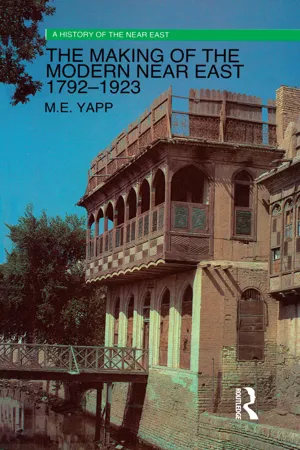
This clear, and authoritative text surveys the history of the region from the collapse of the Ottoman Empire to the present day.
It contains a general regional introduction, followed by a series of country-by-country analyses, and a section which places the Near East in the international context. Professor Yapp' s new edition covers recent dramatic events including the end of the Cold War, the Kuwait Crisis of 1990/91, and the continuing conflict in Israel, as well as assessing the huge social and economic changes in the region. It will be essential reading for students and scholars concerned with modern middle eastern history and politics of the middle east.
Society, Economy and Politics in the Nineteenth-century Near East
Introduction
This first chapter will provide an outline of the main features of the social, economic and political condition of the Near East in 1800 and a sketch of the principal changes which took place during the course of the period down to 1923. Before embarking upon that task it will be helpful to say what is meant by the Near East.
The term “Near East” appeared towards the end of the nineteenth century, when it was used as a convenient expression to describe the Ottoman empire and the territories which had until recently formed part of it. The companion term “Middle East” appeared a few years later and was used to indicate the territories which extended from Iran to Tibet. These two terms were used in those senses down to the end of the First World War. The core of this study therefore is the political unit which Europeans called Turkey and which the Ottomans referred to as mamalik-i‛O
maniye (the Ottoman lands) or devlet-i‛aliye (the exalted state). In this book it will be referred to as the Ottoman empire.
The Ottoman empire in 1880 extended from Bosnia to Arabia and from the Zagros mountains to Algeria. However, it is not intended to devote equal attention to the whole of that territory but to concentrate on the central Ottoman lands. In 1800 Algeria, Tunisia and Libya were autonomous and only a brief account will be given of their fortunes. Little will be said also of the Sudan, which was independent in 1800 but conquered by Egypt in the nineteenth century; and Arabia will receive modest attention. The Balkan lands, which are usually referred to as Rumelia, although the term is not conterminous with the Balkan countries, were of great importance to the Ottomans and are given due prominence during the time they remained part of the empire. But as the Balkan states begin on their careers of autonomy little attention is given to their domestic affairs. The heart of the book is Anatolia, Greater Syria, Egypt and Iraq to which is added one area from outside the Near East, namely Iran, which, because of its size and because of the interest of comparing developments in Iran with those in more western areas, deserves inclusion. Finally, a few references are made to Turkestan in the east for the sake of comparison and completeness.
One major problem which besets any writer on the modern history of the Near East is what place to give to the activities of the European powers. To ignore their role is to distort the history of the Near East, yet to understand it fully requires a detailed consideration of purely European problems and space which is not available; and the effort distracts attention from the changes within the Near East which are the central concern of this book. Some compromise is essential but no compromise is likely to please.
Society
Writing at about the beginning of our period the Egyptian chronicler, al-Jabartī, described society in terms of five hierarchically arranged categories ranging from the Prophet Muḥammad to the masses. What is interesting about his arrangement is the criterion he used to determine the rank of each category, for he did not use wealth or birth or political power but instead applied the concept of justice (‛adl). Social status is determined by the propensity of each group to behave justly. The concept is set out in the Ottoman Civil Code, the Mejelle: “The ‛adl person is one in whom good impulses prevail over bad.” Of course, Muslims recognized that in this evil world social rank was not founded on justice but on power, but in stating the ideal Jabartī was also indicating that deviations were essentially impermanent; ultimately society must depend upon justice if there was to be stability. It is implicit also in his view that the just society was a Muslim society for only the believer had accepted the guidance which was necessary in order to behave with justice.
Another common view of the social order depicted it as related to the four elements. Society was composed of four classes: men of the pen, men of the sword, merchants and peasants. The classes were bound together in mutual dependence – the state rested on the military; the military on the peasants, the peasants on justice which was guaranteed by the Sharī‛a and the Sharī‛a required the support of the state.
It is useful to set out contemporary Near Eastern views of society in order to show how essentially anachronistic is the analysis which follows for modern analysis begins with the idea of describing the actual mechanisms of society in order to propound a view of the way it coheres or is organized.
To modern Western readers the term social organization suggests a pyramid wherein social classes are arrayed in a hierarchy according to wealth and status. That image will not do for the Near East in the early nineteenth century. According to one view there was no hierarchy but two distinct horizontal layers consisting of the rulers and the ruled. Applied to Near Eastern towns that scheme has some merit, but it fails when applied to the countryside for it overvalues the interest and influence of the rulers. The shadow of government certainly extended into the countryside, but it was there refracted through various prisms which themselves represent social groupings.
Another, valuable concept which has been applied to Near Eastern society is that of the mosaic. In this view Near Eastern society is seen as a mosaic of autonomous corporations existing side by side and not arranged in any particular order of eminence, or at least not an order accepted throughout the society. Government itself may be regarded as one such corporation and, like the others, defined partly by inheritance and partly by function – the provision of defence and some modest administrative services.
Birth was certainly the primary criterion which determined to which corporation within Near Eastern society an individual belonged. It was not impossible to achieve membership of another corporation, and in earlier periods a large part of the ruling group within the Ottoman empire was recruited by lifting children from one group and enrolling them among the rulers, but it was exceedingly difficult and it was an ambition which few cherished. In the nineteenth century the one substantial group which did not have its status determined by birth was the slaves. Slavery in the Near East chiefly involved the importation of pagan Blacks for domestic duties. White slaves were used primarily as soldiers or concubines but in the nineteenth century Circassian slaves were also employed, unusually, in agricultural work. Slavery was, however, also a door to the highest positions in the state: of twelve Ottoman grand viziers in the period 1785–1808 at least five were by origin the slaves of pashas. But for the most part people lived their lives within the group in which they were born and their children followed them in it.
The basic social group was the family. In the absence of any censuses or any system of registration we know regrettably little about the size of the Near Eastern family in 1800. It is usually assumed that the common pattern was that of the extended family and the isolated examples such as the Serbian zadruga which are recorded support that assumption.
The family was the basis of tribal organization. “Tribal” does not mean “nomadic” in the Near East; it is a much broader category, and may be regarded as a spectrum extending from settled peoples such as those in Syria who retained a memory or myth of Arab tribal descent, through settled tribes such as the Khazā‛il or Marsh Arabs of Iraq or the bedouin of the western provinces of Egypt through to the true pastoral nomads of Arabia. Even nomadism itself should be regarded as a spectrum rather than an absolute category for it embraced both those who confined their movements to the summer and cultivated grain or were sedentary stock-breeders in the winter and those aristocrats of central Arabia, the camel-herding tribes like the Ḥarb and the Shammar who looked down on those who merely herded sheep. It was the camel nomads who especially cherished their genealogies, but descent as well as occupation determined the status of all who retained a tribal identity. For them society was governed by categories such as the family, the segmentary lineage, the clan, the division, the group and the tribe (qabīla) itself, by traditional alliances, by an established hierarchy of tribal authority and by tribal obligations and customs, notably the blood feud. What proportion of the population of the Near East in 1800 may be classified as tribal is difficult to estimate, but the number would include most of the population of Arabia, half that of Iraq, a third of that of Iran and substantial proportions of the populations of Egypt, Syria and Anatolia, especially the eastern areas. Tribal groups also existed in the European provinces of the Ottoman empire, in Albania and Montenegro.
The category of peasant overlaps with that of tribesman but it embraces much more and peasants formed the largest socio-economic category in the Near East in 1800. Beyond the family the peasant looked to the village, which was the common focus of loyalty through much of the Near East and was a centre of economic as well as social life. The village created its own hierarchy, composed of the elders or heads of families who met in council under a village headman and took decisions affecting the village as a whole. The village was an enclosed community; a feature underlined by its appearance through most of the region. The description of an Egyptian village by Lady Duff Gordon in 1862 may convey something of the style:
The villages look like slight elevations in the mud banks cut into square shapes. The best houses have neither paint, whitewash, plaster, bricks nor windows, nor any visible roofs. They don’t give one the notion of human dwelings at all at first, but soon the eye gets used to the absence of all that constitutes a house in Europe.1
Single-storey mud and timber constructions were the norm; apart from houses a Muslim village would have a few handicraft shops, a mosque and a Ṣūfī lodge. Christian villages would be similar with a church substituted for the mosque and Ṣūfī residence. Until the fashion of urban romanticism created the legend of the simple and deserving peasant, peasants were everywhere regarded with contempt in the Near East and held to be stupid and ignorant; civilization was an urban phenomenon and the countryside the realm of barbarism. Peasants were certainly illiterate, ignorant of the outside world and prone to superstition, although not necessarily more so than many town-dwellers: they were not, however, so submissive as they were often depicted to be and the history of the Near East contains many accounts of violent peasant uprisings against attempted impositions.
In the towns the focuses of social (and economic) life were the guild and the urban quarter, two institutions which tended to coincide. A quarter consisted of several narrow lanes with a single gated entrance which was closed at night. Within it were grouped the shops of people practising the same trade, who were usually organized in a guild. A guild was composed of apprentices, journeymen and masters and had elaborate regulations and ceremonies to control and celebrate passage from one grade to another. The guild masters formed a council and had a headman who represented the guild to outside bodies. Apart from its economic and governmental functions the guild also fulfilled social purposes, organizing parades, picnics, feasts and other ceremonies. Many, but not all, townspeople belonged to guilds; there was also a floating population of recent immigrants who were not absorbed into the guild structure and who constituted the element commonly described as the town riff-raff and who provided the muscle in the frequent urban riots. In addition, of course, the town was also a centre of government with the apparatus of bureaucrats and military garrison and of religion with a complement of religious teachers, lawyers, officials and students.
Cutting across the social divisions of the Near East described in the preceding paragraphs was the religious division. In 1800 the majority of the population of the Near East was Muslim: Turkestan, Iran and Arabia were almost wholly Muslim; a small Christian and Jewish minority lived in Iraq; a larger Christian minority (the Copts) lived in Egypt together with a smaller Jewish community; most of the rest of North Africa was Muslim but with a substantial pagan element in the south; a sizeable Christian minority (over 10% of the population) lived in Greater Syria; another sizeable Christian minority of Greeks and Armenians lived in Anatolia; and there was a Christian majority of over two to one in Rumelia, the European provinces of the Ottoman empire. In Rumelia Muslims were especially the townspeople, with the exception of Bosnia, where there was a large class of Muslim landlords and free peasants, of Albania, where the rural areas contained a majority of Muslims, and of Macedonia, Bulgaria and Thrace, where there had been substantial Muslim settlement and conversion and there were many Muslim villages. There were no Muslim landholding in the principalities of Moldavia and Wallachia, where the Ottoman presence was confined to the fortress garrisons: in Serbia there was, apart from the garrisons, an urban Muslim population of about 20,000 composed of administrators, craftsmen and feudal landlords (sipahis): and in Greece about 65,000 Muslim landholders controlled about half the land of the future Greek state of 1830. By contrast, in Istanbul and the towns of the Asian provinces non-Muslims were represented disproportionately.
The Christian population of the Ottoman empire was divided into many sects but by far the largest group, concentrated especially in Rumelia, was the Greek Orthodox community. For organizational purposes the Greek Orthodox were divided into four patriarchates (Istanbul, Antioch, Jerusalem and Alexandria) of which the most important was that of Istanbul. For many purposes the Ottomans dealt with the Greek population through the patriarch in Istanbul, who was regarded as a high Ottoman official, entitled to a standard of two horsetails.
It is usually suggested that the Christian and Jewish communities of the Ottoman empire were organized in so-called millets and that the Ottoman government dealt with each millet through its hierarchical head. This did indeed become the practice during the nineteenth century, but in earlier periods the Ottomans commonly dealt with smaller groups (ṭā’ifas) of non-Muslims for most purposes and rarely used the term “millet” except in relation to the Muslim community. It is also suggested that all non-Muslims paid a special tax, the jizye, but in fact there was considerable discrimination between non-Muslim groups, depending upon age, status and services to the state and it has been calculated that no more than one-third of non-Muslims actually paid the tax.
In dealing with non-Muslims through their religious communities the Ottomans were also recognizing a social reality: religion was not merely a matter of church organization, worship and rites of passage but the religious communities also provided the two major social services of law and education. Personal law to the people of the Near East was the law of their religious community, and the authority of the religious community also penetrated other areas of civil law and occasionally even criminal law when cases involved members of the community alone. Such education as existed was provided almost entirely by the religious community through elementary schools attached to churches and through seminaries for higher education. Similarly with the Muslim community: although law was administered through the qāḍī’s court, education was provided through the mosque and the madrasa.
The Muslim community was far from uniform. In the first place it was divided into sects; Sunni (the majority of Ottoman Muslims), Sunnī (the majority of Iranian Muslims), and a variety of smaller sects mainly of Shī‛ī origin. In the second place it was divided into what may be termed high Islam and popular Islam. High Islam was the religion of the madrasa and firmly rooted in the Sharī‛a and elaborated in the opinions of the most learned, the muftīs and (among Shī‛īs) the mujtahids. In the Ottoman empire, unlike other Muslim states, there existed by the late eighteenth century something approaching a Muslim hierarchy, led by the Shaykh al-Islām in Istanbul, to represent high Islam. Popular Islam was especially the Islam of the Ṣūfī orders which formed a major element in the social fabric of the Near East. A large proportion of the Muslim inhabitants of the Near East belonged to one or other of the many Ṣūfī orders which were extensive organizations owning property and providing a variety of social services for their adherents. Ṣūfī orders were of many types: some essentially religious, contemplative, literary organizations like the Naqshbandiyya and the Khalwatiyya in Istanbul; others were more like friendly societies, offering everyday services and appealing to the masses; many were distinctly heterodox like the Bektāshiyya; some had close links with particular guilds or professions; and some espoused the cause of social revolution. What is striking about the Ṣūfī orders is not only their diversity but their vigour. Far from being an old and decaying form of social organization they were entering, in the nineteenth century, a period of vigorous expansion when new orders were founded and older orders assumed novel aspects. The Ṣūfī shaykhs were powerful men in society.
Against that background it is possible to begin to sketch the social hierarchy of the Near East. At the top were those connected with government who comprised the military (almost entirely Muslim) and the bureaucracy (mainly Muslim but heavily penetrated with Christian and Jewish groups, for example the Copts, Armenians and Greeks who played a large part in financial administration in Egypt and the Ottoman empire as a whole). Without doubt this group enjoyed the greatest rewards. The second group was the religious establishment which included those claiming descent from the Prophet (the sharīfs and sayyids), those especially distinguished for their learning and the excellence of their behaviour, and those who held offices of importance, such as the imams of the leading mosques, the guardians of the great shrines, the principal muftīs and the members of the official Ottoman hierarchy. The existence of this...
Table of contents
Cover
Half Title
Title Page
Copyright Page
Table of Contents
List of Genealogical Tables and Maps
Note: Names, Titles, Dates and Currencies
Preface
1. Society, Economy and Politics in the Nineteenth-century Near East
2. The Eastern Question
3. Reform in the Near East 1792–1880
4. Nationalism and Revolution in the Near East 1880–1914
5. The Near East in the First World War
6. The Remaking of the Near East 1918–1923
Bibliographical Guide
Glossary
Genealogical Tables
Maps
Index
Trusted by 375,005 students
Access to over 1.5 million titles for a fair monthly price.
Study more efficiently using our study tools.
Frequently asked questions
Yes, you can cancel anytime from the Subscription tab in your account settings on the Perlego website. Your subscription will stay active until the end of your current billing period. Learn how to cancel your subscription
No, books cannot be downloaded as external files, such as PDFs, for use outside of Perlego. However, you can download books within the Perlego app for offline reading on mobile or tablet. Learn how to download books offline
Perlego offers two plans: Essential and Complete
Essential is ideal for learners and professionals who enjoy exploring a wide range of subjects. Access the Essential Library with 800,000+ trusted titles and best-sellers across business, personal growth, and the humanities. Includes unlimited reading time and Standard Read Aloud voice.
Complete: Perfect for advanced learners and researchers needing full, unrestricted access. Unlock 1.5M+ books across hundreds of subjects, including academic and specialized titles. The Complete Plan also includes advanced features like Premium Read Aloud and Research Assistant.
Both plans are available with monthly, semester, or annual billing cycles.
We are an online textbook subscription service, where you can get access to an entire online library for less than the price of a single book per month. With over 1.5 million books across 990+ topics, we’ve got you covered! Learn about our mission
Look out for the read-aloud symbol on your next book to see if you can listen to it. The read-aloud tool reads text aloud for you, highlighting the text as it is being read. You can pause it, speed it up and slow it down. Learn more about Read Aloud
Yes! You can use the Perlego app on both iOS and Android devices to read anytime, anywhere — even offline. Perfect for commutes or when you’re on the go. Please note we cannot support devices running on iOS 13 and Android 7 or earlier. Learn more about using the app
Yes, you can access The Making of the Modern Near East 1792-1923 by Malcolm Yapp in PDF and/or ePUB format, as well as other popular books in History & Asian History. We have over 1.5 million books available in our catalogue for you to explore.