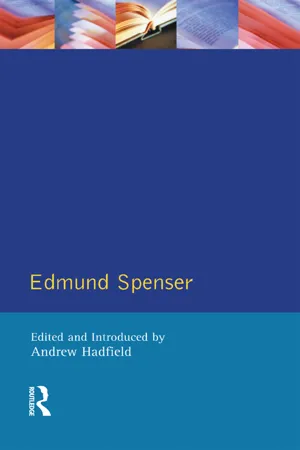
This collection represents some of the best recent critical writing on Edmund Spenser, a major Renaissance English poet. The essays cover the whole of Spensers work, from early literary experiments such as The Shepeardes Calendar, to his unfinished crowning work,The Fairie Queene. The introduction provides an overview of critical responses to Spenser, setting his work and the debates which it has generated in their perspective contexts: new historicist, post-structural, psychoanalytic and feminist. His study also covers the critical responses of leading British, Irish and American scholars.
- 252 pages
- English
- ePUB (mobile friendly)
- Available on iOS & Android
eBook - ePub
Edmund Spenser
About this book
Information
1 Introduction
Exiles from the main street: Spenser and Joyce
Edmund Spenser has never fitted easily into critical categories and his contemporaries found it hard to judge his literary merit. A major problem was his style. Even whilst praising his work, critics showed an undercurrent of nervousness and incomprehension. Francis Meres commented that Spenser was one of the poets who had ‘the English tongue … mightily enriched and georgeouslie invested in rare ornaments and resplendent abilments’; Thomas Churchyard called Spenser ‘the spirit of learned speech’; and Richard Barnfield argued in a verse epistle that Spenser's ‘deepe conceit is such, / As passing all Conceit, needs no defence’. Ben Jonson was more direct in his criticism: ‘Spenser, in affecting the Ancients, writ no language’ [emphasis added], although he recommended that he be ‘read for his matter’.1
Early readers were unsure what to make of Spenser: many admired his poetry but they were not at all clear what it meant (as the paradoxical defence by Richard Barnfield suggests) and, like Ben Jonson, were uncertain whether Spenser fitted into any sort of tradition or was a curious one-off. Contemporary reactions to Spenser's poetry, especially his magnum opus, The Faerie Queene, bear a curious resemblance to some early responses to two monuments of twentieth-century literary experimentalism, Ulysses and Finnegans Wake. Jane Heap replied to one puzzled and hostile reader of Ulysses that if that person was blind to ‘the luminosity of his genius … nothing will help you but a work of equal magnitude which no one could write and which you would again not understand’, a defence which resembles Richard Barnfield's; Arland Ussher sounds more like Ben Jonson in describing Joyce as ‘a Duns Scotus splitting hairs and mangling words’ in Finnegans Wake.2
In many ways, Spenser and Joyce are regarded similarly by academic establishments: both have had a massive influence on a select group of initiates and inspire lifelong critical devotion, but tend to remain outside a central critical tradition because they are largely unread. At the risk of pushing the analogy too far, it is perhaps no accident that both were exiles: Joyce from his native Ireland and Spenser in Ireland, where he lived from 1580 until his death in 1598, the period during which all his majority poetry was published (see below, p. 3).
It is remarkable how F. R. Leavis, probably the single most influential English literary historian, who helped not only to establish a usable canon of English literary texts, but also to gain recognition for the subject itself as a university discipline,3 treats Spenser and Joyce in almost identical ways. In his study of the English novel, The Great Tradition (1948), Leavis acknowledges Joyce as a remarkable stylist, but terms him, ultimately, ‘a dead end’ whose work has ‘no organic principle determining, informing, and controlling into a vital whole, the elaborate analogical structure, the extraordinary variety of technical devices’ and leads only to a series of sterile experimental writers. Hence Joyce, for all his linguistic flair, is not considered part of ‘the great tradition’ of English novel-writing.4 In his earlier study of the development of English poetry, Revaluation (1936), Leavis damns Spenser with faint praise, suggesting that he does not require revaluation as he is ‘in his own way a fact of the first importance in the tradition of English poetry … too simple a fact to need examining afresh’. However, Leavis then associates Spenser with Milton, claimng that ‘I think the way in which, as powers in the English tradition, Milton and Spenser are associated is sufficiently conveyed in the chapters on Milton and Keats’.5 Given that Revaluation's most polemical and influential chapter was Leavis's attempt to remove Milton from the canon of English Literature – or, rather, to sum up an already completed process: ‘Milton's dislodgement, in the past decade, after two centuries of predominance, was effected with remarkably little fuss’6 – for his dead experimentalism, his tedious use of language and poisonous influence on the next generation of poets, the association of Milton and Spenser would seem to question Spenser's place within the canon rather than confirm it. Leavis argues that reading Milton is a matter ‘of resisting, of standing up against, the verse-movement, of subduing it to something tolerably like sensitiveness’ and in the end we are worn down by the monotony of the grand style because Milton ‘exhibits a feeling for words rather than a capacity for feeling through words’ [Leavis's emphasis].7 One has to ask whether Leavis is displaying a sly piece of wit – a quality Revaluation endorses, at least in poetry – or simply pulling any trick to avoid discussing Spenser and so contradicting himself. Either way, Spenser is damned by association and silence.
‘An Englishman in love with England … afraid of Ireland's impenetrability’: some contexts for Edmund Spenser8
Spenser's paradoxically canonical yet marginalised role – an unread ‘classic’ – corresponds to his position during his lifetime. His writing displays all the signs of massive ambition: he had the temerity to publish his early correspondence with Gabriel Harvey, announcing plans to reform the whole course of English poetry (see Chapter 2 below): he took the trouble to oversee his works through the press leaving no manuscripts: his progression from pastorals to epic appears to foreshadow Virgil's and set him up as the great English poet of nationhood: he invented his own verse forms, style and vocabulary.9 His poetry clearly has significant designs upon the reader, as the well-known statement of his intention in the letter to Raleigh published with the first edition of The Faerie Queene (1590) indicates – ‘The generali end therefore of all the book is to fashion a gentleman or noble person in vertuous and gentle discipline’10 – to say nothing of the manipulative and dangerous project of presuming to represent the Queen.11 His works were presented at court, he appears to have been one of the very few writers who was awarded a pension by the Queen and he was buried in Westminster Abbey, near Chaucer, the most celebrated English poet.12
But, as has already been noted, Spenser spent most of his adult life in Ireland, something he lamented bitterly on occasions, notably in his poem Colin Clouts Come Home Againe (1595), a fictionalised account of his return to London with Sir Walter Raleigh (1589–91).13 Spenser was appointed to a series of important positions in Ireland, enjoying the colonial government's patronage in Dublin and later Cork, where he lived from about 1588, possessing the substantial estate of Kilcolman despite litigation with the Anglo-Irish Lord Roche. It is a matter of considerable controversy whether Spenser was exiled to Ireland against his will, having committed some sort of misdemeanour – possibly having offended Lord Burghley, Elizabeth's Principal Secretary, in an early manuscript version of the satirical complaint, Mother Hubberds Tale – or whether he chose to pursue a lucrative career as an official in Ireland.14 The very facts of Spenser's life seem to mirror the reactions of contemporaries – as well as of later readers – to his poetry. On the one hand Spenser appears to be an important and central figure, both poetically and politically; on the other, an obscure and strange phenomenon, perhaps admired, but certainly kept at arm's length. Perhaps the grand ambition of Spenser's poetry, culminating in the romance epic of The Faerie Queene, precluded the widespread audience he expressed a hope for in the letter to Raleigh. Spenser appears to have had in mind three separate poetic traditions: a classical heritage which manifested itself in poetic models to imitate – Virgil, Homer, Ovid, etc. – and legend, via the story of Aeneas's great grandson, Brutus, who founded and named Britain, thus linking the contemporary English to the legacy of the Trojan Wars and the founding of Rome; a native English tradition of Protestant satire and eclogue, principally Chaucer, Langland and Skelton, the inventor of one of Spenser's most frequently adopted masks, the poet, Colin Clout; and the sophisticated European courtly cultures of France and Italy, principally the poets Ariosto and Tasso, whose work is reformulated in large sections of The Faerie Queene's narrative’.15 In The Faerie Queene he deliberately sets out to...
Table of contents
- Cover Page
- Half Title page
- Title Page
- Copyright Page
- Contents
- General Editors’ Preface
- Acknowledgements
- Dedication
- 1 Introduction
- 2 ‘Barbarous tongues’: the ideology of poetic form in Renaissance England
- 3 ‘The perfecte paterne of a poete’: the poetics of courtship in The Shepheardes Calender
- 4 Spenser’s Complaints: ‘Into each secrete part’
- 5 Spenser’s poetics: the poem’s two bodies
- 6 To fashion a gentleman: Spenser and the destruction of the Bower of Bliss
- 7 Singing unsung heroines: androgynous discourse in Book III of The Faerie Queene
- 8 ‘Endlesse worke’
- 9 Praise and defence of the Queen in The Faerie Queene, Book V
- 10 The ‘sacred hunger of ambitious minds’: Spenser’s savage religion
- 11 The colonisation of language: narrative strategy in The Faerie Queene, Book VI
- 12 Mapping mutability: or, Spenser’s Irish plot
- Notes on Contributors
- Further reading
- Index
Trusted by 375,005 students
Access to over 1.5 million titles for a fair monthly price.
Study more efficiently using our study tools.
Frequently asked questions
Yes, you can cancel anytime from the Subscription tab in your account settings on the Perlego website. Your subscription will stay active until the end of your current billing period. Learn how to cancel your subscription
No, books cannot be downloaded as external files, such as PDFs, for use outside of Perlego. However, you can download books within the Perlego app for offline reading on mobile or tablet. Learn how to download books offline
Perlego offers two plans: Essential and Complete
- Essential is ideal for learners and professionals who enjoy exploring a wide range of subjects. Access the Essential Library with 800,000+ trusted titles and best-sellers across business, personal growth, and the humanities. Includes unlimited reading time and Standard Read Aloud voice.
- Complete: Perfect for advanced learners and researchers needing full, unrestricted access. Unlock 1.5M+ books across hundreds of subjects, including academic and specialized titles. The Complete Plan also includes advanced features like Premium Read Aloud and Research Assistant.
We are an online textbook subscription service, where you can get access to an entire online library for less than the price of a single book per month. With over 1.5 million books across 990+ topics, we’ve got you covered! Learn about our mission
Look out for the read-aloud symbol on your next book to see if you can listen to it. The read-aloud tool reads text aloud for you, highlighting the text as it is being read. You can pause it, speed it up and slow it down. Learn more about Read Aloud
Yes! You can use the Perlego app on both iOS and Android devices to read anytime, anywhere — even offline. Perfect for commutes or when you’re on the go.
Please note we cannot support devices running on iOS 13 and Android 7 or earlier. Learn more about using the app
Please note we cannot support devices running on iOS 13 and Android 7 or earlier. Learn more about using the app
Yes, you can access Edmund Spenser by Andrew Hadfield in PDF and/or ePUB format, as well as other popular books in Literature & English Literary Criticism. We have over 1.5 million books available in our catalogue for you to explore.