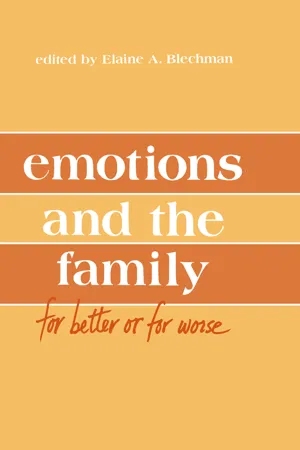
This book presents, for the first time, a full range of perspectives on emotions and the family from the radical behaviorist to the intrapsychic. B.F. Skinner begins the volume by examining the role of feelings in applied behavior analysis, thus laying the groundwork for the reactions of many distinguished contributors. Offering both opposing and favorable comments, contributors also present their own original empirical, theoretical, and clinical perspectives. Finally, the editor integrates the contributors' positions into an expanded behavioral perspective on the study of emotions and suggest a model for effective family communication.
eBook - ePub
Emotions and the Family
for Better Or for Worse
- 254 pages
- English
- ePUB (mobile friendly)
- Available on iOS & Android
eBook - ePub
Emotions and the Family
for Better Or for Worse
About this book
Information
Chapter 1
Outlining a Science of Feeling*
B.F. Skinner
Areview of Gerald Zuriff's Behaviorism: A conceptual reconstruction in the TLS of July 19, 1985, begins with a story about two behaviourists. They make love, and then one of them says, "That was fine for you. How was it for me?" The reviewer, P. N. Johnson-Laird, insists that there is a "verisimilitude" with behaviourist theory. Behaviourists are not supposed to have feelings, or at least to admit that they have them. Of the many ways in which behaviourism has been misunderstood for so many years, that is perhaps the commonest.
A possibly excessive concern for "objectivity" may have caused the trouble. Methodological behaviourists, like logical positivists, argued that science must confine itself to events that can be observed by two or more people; truth must be truth by agreement. What one sees through introspection does not qualify. There is a private world of feelings and states of mind, but it is out of reach of a second person and hence of science. That was not a very satisfactory position, of course. How people feel is often as important as what they do.
Radical behaviourism has never taken that line. Feeling is a kind of sensory action, like seeing or hearing. We see a tweed jacket, for example, and we also feel it. That is not quite like feeling depressed, of course. We know something about the organs with which we feel the jacket but little, if anything, about those with which we feel depressed, We can also feel of the jacket by running our fingers over the cloth to increase the stimulation, but there does not seem to be any way to feel of depression. We have other ways of sensing the jacket, and we do various things with it. In other words, we have other ways of knowing what we are feeling. But what are we feeling when we feel depressed?
William James anticipated the behaviourist's answer: what we feel is a condition of our body. We do not cry because we are sad, said James, we are sad because we cry. That was fudging a little, of course, because we do much more than cry when we feel sad, and we can feel sad when we are not crying, but it was pointing in the right direction: what we feel is bodily conditions. Physiologists will eventually observe them in another way, as they observe any other part of the body. Walter B. Cannon's Bodily Changes in Pain, Hunger, Fear, and Rage (1929) was an early study of a few conditions often felt. Meanwhile, we ourselves can respond to them directly. We do so in two different ways. For example, we respond to stimuli from our joints and muscles in one way when we move about and in a different way when we say that we feel relaxed or lame. We respond to an empty stomach in one way when we eat and in a different way when we say that we are hungry.
The verbal responses in those examples are the products of special contingencies of reinforcement. They are arranged by listeners, and they are especially hard to arrange when what is being talked about is out of the listener's reach, as it usually is when it is within the speaker's skin. The very privacy which suggests that we ought to know our own bodies especially well is a severe handicap for those who must teach us to know them. We can teach a child to name an object, for example, by presenting or pointing to the object, pronouncing its name, and reinforcing a similar response by the child, but we cannot do that with a bodily state. We cannot present or point to a pain, for example. Instead, we infer the presence of the pain from some public accompaniment. We may see the child take a hard fall, for example, and say, "That must have hurt", or we see the child wince and ask, "Does something hurt?" We can respond only to the blow or the wince, but the child also feels a private stimulus and may say "hurt" when it occurs again without a public accompaniment. Since public and private events seldom coincide exactly, words for feelings have never been taught as successfully as words for objects. Perhaps that is why philosophers and psychologists so seldom agree when talking about feelings and states of mind, and why there is no acceptable science of feeling.
For centuries, of course, it has been said that we behave in given ways because of our feelings. We eat because we feel hungry, strike because we feel angry, and in general do what we feel like doing. If that were true, our faulty knowledge of feelings would be disastrous. No science of behaviour would be possible. But what is felt is not an initial or initiating cause. William James was quite wrong about his "becauses." We do not cry because we are sad or feel sad because we cry; we cry and feel sad because something has happened. (Perhaps someone we loved has died.) It is easy to mistake what we feel as a cause because we feel it while we are behaving (or even before we behave), but the events which are actually responsible for what we do (and hence what we feel) lie in the possibly distant past. The experimental analysis of behaviour advances our understanding of feelings by clarifying the roles of both past and present environments. Here are three examples.
LOVE. A critic has said that for a behaviorist "I love you" means "You reinforce me." God behaviorists would say "You reinforce my behavior" rather than "You reinforce me," because it is behavior, not the behaving person, that is being reinforced, in the sense of strengthened; but they would say much more. There is no doubt a reinforcing element in loving. Everything lovers do that brings them closer together or keeps them from being separated is reinforced by those consequences, and that is why they spend as much time together as they can. We describe the private effect of a reinforcer when we say that it "pleases us" or "makes us feel good," and in that sense "I love you" means "You please me or make me feel good." But the contingencies responsible for what is felt must be analyzed further.
The Greeks had three words for love, and they are still useful. Mentalistic psychologists may try to distinguish among them by looking at how love feels but much more can be learned from the relevant contingencies of selection, both natural selection and operant reinforcement. Eros is usually taken to mean sexual love, in part no doubt because the word erotic is derived from it. It is that part of making love that is due to natural selection; we share it with other species. (Many forms of parental love are also due to natural selection and are also examples of eros. To call mother love erotic is not to call it sexual.) Erotic lovernaking may also be modified by operant conditioning, but a genetic connection survives, because the susceptibility to reinforcement by sexual contact is an evolved trait. (Variations which have made individuals more susceptible have increased their sexual activity and hence their contribution to the future of the species.) In most other species the genetic tendency is the stronger. Courtship rituals and modes of copulation vary little from individual to individual and are usually related to optimal times of conception and seasons for the bearing of offspring. In homo sapiens sexual reinforcement predominates and yields a much greater frequency and variety of lovemaking.
Philia refers to a different kind of reinforcing consequences and, hence, a different state to be felt and called love. The root phil appears in words like philosophy (love of wisdom) and philately (love of postage stamps), but other things are loved in that way when the root word is not used. People say they "love Brahms" when they are inclined to listen to his works—perform them, perhaps, or go to concerts where they are performed, or play recordings. People who "love Renoir" tend to go to exhibitions of his paintings or buy them (alas, usually copies of them) to be looked at. People who "love Dickens" tend to acquire and read his books. We say the same thing about places ("I love Vienna"), subject-matters ("I love astronomy"), characters in fiction ("I love Daisy Miller"), kinds of people ("I love children"), and, of course, friends in whom we have no erotic interest. (It is sometimes hard to distinguish between eros and philia. Those who "love Brahms" may report that they play or listen to his works almost erotically, and courtship and lovemaking are sometimes practiced as forms of art.)
If we can say that eros is primarily a matter of natural selection and philia of operant conditioning, then agape represents a third process of selection—cultural evolution. Agape comes from a word meaning to welcome or, as a dictionary puts it, "to receive gladly." By showing that we are pleased when another person joins us, we reinforce joining. The direction of reinforcement is reversed. It is not our behaviour, but the behaviour of those we love that is reinforced. The principal effect is on the group. By showing that we are pleased by what other people do, we reinforce the doing and thus strengthen the group.
The direction of reinforcement is also reversed in eros if the manner in which we make love is affected by signs that our lover is pleased. It is also reversed in philia when our love for Brahms, for example, takes the form of founding or joining a society for the promotion of his works, or when we show our love for Venice by contributing to a fund to preserve the city. We also show a kind of agape when we honour heroes, leaders, scientists, and others from whose achievement we have profited. We are said to "worship" them in the etymological sense of proclaiming their worth. (When we say that we venerate them the ven is from the Latin venus, which meant any kind of pleasing thing.) Worship is the commoner word when speaking of the love of god, for which the New Testament used agape.
A reversed direction of reinforcement must be explained, especially when it calls for sacrifice. We may act to please a lover because our own pleasure is then increased, but why should we do so when it is not? We may promote the works of Brahms or help save Venice because we then have more opportunities to enjoy them, but why should we do so when that is not the case? The primary reinforcing consequences of agape are, in fact, artificial. They are contrived by our culture and contrived, moreover, just because the kind of thing we then do has helped the culture solve its problems and survive.
ANXIETY. Very different states of the body are generated by aversive stimuli, and they are felt in different ways. Many years ago W. K. Estes and I were rash enough to report an experiment in the Journal of Experimental Psychology (1941, 29, pp 390—400) under the title, "Some quantitative properties of anxiety", although we were writing about rats. A hungry rat pressed a lever at a low, steady rate, under intermittent reinforcement with bits of food. Once or twice during an hour-long session, we sounded a tone for three minutes and then lightly shocked the rat through its feet. At first neither the tone nor the shock had any marked effect on the rate of responding, but the rat soon began to respond more slowly while the tone was sounding and eventually stopped altogether. Under rather similar circumstances a person might say, "I stopped what I was doing because I felt anxious".
In that experiment, the disrupted behaviour was produced by intermittent operant reinforcement, but the disruption would usually be attributed to respondent (classical or Pavlovian) conditioning. There is a problem, however. A change in probability of responding or rate of responding is not properly called a response. Moreover, since the shock itself did not suppress responding, there was no substitution of the stimuli. The reduced rate seems, paradoxically, to be the innate effect of a necessarily conditioned stimulus.
A paraphrased comment of Freud's begins as follows: "A person experiences anxiety in a situation of danger and helplessness." A "situation of danger" is a situation that resembles one in which painful things have happened. Our rat was in a situation of danger while the tone was sounding. It was "helpless" in the sense that it could do nothing to stop the tone or escape. The state of its body was presumably similar to the state a person would feel as anxiety, although the verbal contingencies needed for a response comparable to "I feel anxious" were lacking.
The paraphrase of Freud continues: "If the situation threatens to recur in later life, the person experiences anxiety as a signal of impending danger." (It would be better to say "impending harm", because what threatens to recur is the aversive event—the shock for the rat and perhaps something like an automobile accident for the person, but what actually recurs is the condition that preceded that event— the tone, or say, riding with a reckless driver.) The quotation makes the point that the condition felt as anxiety begins to act as a second conditioned aversive stimulus. As soon as the tone began to generate a particular state of the rat's body, the state itself stood in the same relation to the shock as the tone, and it should have begun to have the same effect. Anxiety thus becomes self-perpetuating and even self-intensifying. A person might say, "I feel anxious, and something terrible always happens when I feel that way", but the contingencies yield a better analysis than any report of how self-perpetuated anxiety feels.
FEAR. A different result would have followed in our experiment if the shock had been contingent upon a response—in other words, if pressing had been punished. The rat would also have stopped pressing, but the bodily state would have been different. It would probably have been called fear. Anxiety is perhaps a kind of fear (we could say that the rat was "afraid another shock would follow"), but that is different from being "afraid to press the lever" because a shock will follow. A difference in the contingencies is unmistakable.
Young behaviourists sometimes contribute an example of fear, relevant here, when they find themselves saying that something pleases them or makes them angry and are embarrassed for having said it. The etymology of embarrassment as a kind of fear is significant. The root is bar, and young behaviourists find themselves barred from speaking freely about their feelings because those who have misunderstood behaviourism have ridiculed them when they have done so. An analysis of how embarrassment feels, made without alluding to antecedents or consequences, would be difficult if not impossible, but the contingencies are clear enough. In general, the more subtle the state felt, the greater the advantage in turning to the contingencies.
Such an analysis has an important bearing on two practical questions: how much can we ever know about what another person is feeling, and how can what is felt be changed? It is not enough to ask other people how or what they feel, because the words they will use in telling us were acquired as we have seen, from people who did not quite know what they were talking about. Something of the sort seems to have been true of the first use of words to describe private states. The first person who said, "I'm worried" borrowed a word meaning "choke" or "strangle". ("Anger", "anguish" and "anxiety" also come from another word that meant "choke".) But how much like the effect of choking was the bodily state the word was used to describe? All words for feelings seem to have begun as metaphors, and it is significant that the transfer has always been from public to private. No word seems to have originated as the name of a feeling.
We do not need to use the names of feelings if we can go directly to the public events. Instead of saying, "I was angry", we can say, "I could have struck him". What was felt was an inclination to strike rather than striking, but the private stimuli must have been much the same. Another way to report what we feel is to describe a setting that is likely to generate the condition felt. After reading Chapman's translation of Homer for the first time, Keats reported that he felt "like some watcher of the skies/When a new planet swims into his kin". It was easier for his readers to feel what an astronomer would feel upon discovering a new planet than what Keats felt upon reading the book.
It is sometimes said that we cart make direct contact with what other people feel through sympathy or empathy. Sympathy seems to be reserved for painful feelings; we sympathize with a person who has lost a fortune but not with one who has made one. When we empathize, we are said to project our feelings into another person, but we cannot actually be moving feelings about, because we also project them into things—when, for example, we commit the pathetic fallacy. What we feel of Lear's rage is not quite what we feel in a raging storm. Sympathy and empathy seem to be effects of imitation. For genetic or personal reasons we tend to do what other people are doing and we may then have similar bodily states to feel. When we do what other things are doing, it is not likely that we are sharing feelings.
Sympathy and empathy cannot tell us exactly what a person feels, because part of what is felt depends upon the setting in which the behaviour occurs, and that is usually missing in imitation. When lysergic acid diethylamide first attracted attention, psychiatrists were urged to take it in order to see what it felt like to be psychotic, but acting like a psychotic because one has taken a drug may not create the condition felt by those who are psychotic for other reasons.
That we know what other people feel only when we behave as they behave is clear when we speak of knowing what members of other species feel. Presumably we are more likely to avoid hurting animals if what they would do resembles what we should do when hurt in the same way. That is why we are more likely to hurt the kinds of animals— fish, snakes and insects, for example—which do not behave very much as we do. It is a rare person, indeed, who would not hurt a fly.
To emphasize what is felt rather than the feeling is important when we want to change feelings. Drugs, of course, are often used for that purpose. Some of them (aspirin, for example) break the connection with what is felt. Others create states that appear to compete with or mask troublesome states. According to American television commercials, alcohol yields the good fellowship of agape and banishes care. But these are temporary measures, and their effects are necessarily imperfect simulations of what is naturally felt in daily life because the natural settings are lacking.
Feelings are most easily changed by changing the settings responsible for what is felt. We could have relieved the anxiety of our rat by turning off the tone. When a setting cannot be changed, a new history of reinforcement may change its effect. In his remarkable book Emile, Rousseau described what is not called desensitization. If a baby is frightened when plunged into cold water (presumably an innate response), begin with warm water and reduce the temperature a degree a day. The baby will not be frightened when the water is f...
Table of contents
- Cover
- Title
- Copyright
- Dedication
- Contents
- INTRODUCTION
- ACKNOWLEDGMENTS
- Chapter 1 OUTLINING A SCIENCE OF FEELING
- Chapter 2 EMOTIONS: A TRINITY
- Chapter 3 COMMUNICATION AND COPING IN FAMILIES
- Chapter 4 THE DEVELOPMENT OF EMOTION REGULATION: EFFECTS ON EMOTIONAL STATE AND EXPRESSION
- Chapter 5 SOCIAL SUPPORT AND THE FAMILY
- Chapter 6 COMMUNICATION AND NEGATIVE AFFECT REGULATION IN THE FAMILY
- Chapter 7 TOWARD A BEHAVIORAL CONCEPTUALIZATION OF ADULT INTIMACY: IMPLICATIONS FOR MARITAL THERAPY
- Chapter 8 EMOTIONAL CHANGE PROCESSES IN COUPLES THERAPY
- Chapter 9 CONTEXTUAL EFFECTS IN MOTHER-CHILD INTERACTION: BEYOND AN OPERANT ANALYSIS
- Chapter 10 INFLUENCES OF PARENTAL MOOD ON PARENT BEHAVIOR
- Chapter 11 A NEW LOOK AT EMOTIONS AND THE FAMILY
- AUTHOR INDEX
- SUBJECT INDEX
Trusted by 375,005 students
Access to over 1.5 million titles for a fair monthly price.
Study more efficiently using our study tools.
Frequently asked questions
Yes, you can cancel anytime from the Subscription tab in your account settings on the Perlego website. Your subscription will stay active until the end of your current billing period. Learn how to cancel your subscription
No, books cannot be downloaded as external files, such as PDFs, for use outside of Perlego. However, you can download books within the Perlego app for offline reading on mobile or tablet. Learn how to download books offline
Perlego offers two plans: Essential and Complete
- Essential is ideal for learners and professionals who enjoy exploring a wide range of subjects. Access the Essential Library with 800,000+ trusted titles and best-sellers across business, personal growth, and the humanities. Includes unlimited reading time and Standard Read Aloud voice.
- Complete: Perfect for advanced learners and researchers needing full, unrestricted access. Unlock 1.5M+ books across hundreds of subjects, including academic and specialized titles. The Complete Plan also includes advanced features like Premium Read Aloud and Research Assistant.
We are an online textbook subscription service, where you can get access to an entire online library for less than the price of a single book per month. With over 1.5 million books across 990+ topics, we’ve got you covered! Learn about our mission
Look out for the read-aloud symbol on your next book to see if you can listen to it. The read-aloud tool reads text aloud for you, highlighting the text as it is being read. You can pause it, speed it up and slow it down. Learn more about Read Aloud
Yes! You can use the Perlego app on both iOS and Android devices to read anytime, anywhere — even offline. Perfect for commutes or when you’re on the go.
Please note we cannot support devices running on iOS 13 and Android 7 or earlier. Learn more about using the app
Please note we cannot support devices running on iOS 13 and Android 7 or earlier. Learn more about using the app
Yes, you can access Emotions and the Family by Elaine A. Blechman, Alan M. Delamater, Elaine A. Blechman,Alan M. Delamater in PDF and/or ePUB format, as well as other popular books in Psychology & Clinical Psychology. We have over 1.5 million books available in our catalogue for you to explore.