eBook - ePub
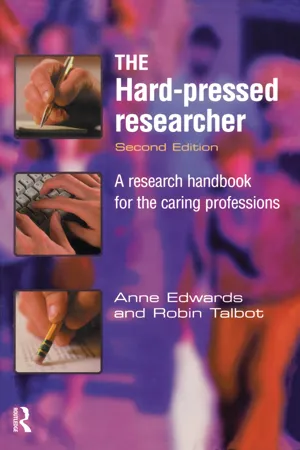
The Hard-pressed Researcher
A research handbook for the caring professions
- 232 pages
- English
- ePUB (mobile friendly)
- Available on iOS & Android
eBook - ePub
About this book
Working in the fields of education, health and social care demands a great deal of energy, effort and commitment on the part of the practitioner or trainee. When a research project is added to a workload the pressures can be great, particulary if the would-be-researcher is not confident about the process involved.
The Hard-pressed Researcher provides practical guidance on how to undertake a research project. It has been written specially for practitioners and students in the fields of education, health and social care and assumes no specific knowledge of the research process.
This revised and updated version of the first edition covers the major modes of research (experimental research, survey work, case study, interpretative research and action research) and provides step-by-step guidance from conceptualization through to report writing. Each chapter provides sources for further reading and the book ends with a series of statistical tables.
All those studying or working in the caring professions will welcome the very straightforward and sympathetic approach of the authors, both of whom have considerable experience in the supervision of research work.
Information
Chapter 1
Finding direction
Why do research?
This question may well come to mind on more than one occasion over the period of your research project. It is, therefore, as well to be sure of what can be gained from undertaking a research-based study or from simply taking a research perspective in your pursuit of a deeper understanding of an initiative or situation at work.
If you have embarked on the research quest in order to receive a qualification, that may seem a sufficient end in itself. But, increasingly, employers are seeing the advantages that research enquiries bring to organisational development and are harnessing the professional development of employees to wider institutional, team or corporate ends. It is therefore likely that most researchers would wish, and even be encouraged, to consider how research might impact on their professional lives and the organisations in which they work.
We do not intend, in our enthusiasm for the topic, to overclaim the benefits that a research perspective on workplace problem solving might bring. Nevertheless there are certain key features that a research framework and considered use of well-proven methods for gathering and analysing data can add to practitioners’ enquiries. At the same time, these features act as criteria for high-standard reports or dissertations. They are:
• the situation of the problem within current contexts of knowledge base and policy and political frameworks,
• a clarification of the real issues,
• the use of the best evidence available,
• analysis which goes beyond description,
• interpretations which relate the here and now to past and future.
At first reading, these may appear quite modest claims, but we hope that as we elaborate them in this and later chapters this modesty will be revealed as false. Our moderation is enhanced by what we have not claimed for a research perspective on practitioner problem solving. Constant objectivity is the most obvious omission and will be discussed later. Similarly we have not proposed that research will find the answer. The variety of approaches to research that we shall be discussing do not allow such a wide-reaching assertion.
Taking a research perspective therefore means being orderly, considered, scholarly and scientific when setting your research agenda. This agenda will include selecting a question, designing the research study, choosing data-gathering techniques and deciding on appropriate methods of analysis and interpretation. A research perspective encourages attention to the appropriateness of data-collection methods and the soundness of the information gathered. It attempts, above all, to keep a focused yet responsive route in the quest for greater understanding of the issues under scrutiny. An orderly, considered and scientific emphasis is the key to gathering the sound information that is essential if decisions on practice are to be made on the basis of practitioner research.
So in answer, in part, to the question ‘why do research?’ our reply is that changes in practice need to be justified, monitored and often adjusted. Modifications consequently have to be based on evidence. By taking a research perspective we can at least feel that we have tackled the issues in a rigorous way. The other part of our answer takes us to what can be gained by practitioners who engage with existing research as part of the research process. Practitioner researchers are unlikely to have the time to make ground-breaking discoveries but they are likely to gain a great deal personally from becoming acquainted with work that has already been undertaken and from considering its relevance for their practice (see Edwards in press a and b for discussions of how engagement in research enhances professional practice). Evidence-based practice is becoming increasingly important in education, health, social work and related fields. The evidence base for practice in these fields is already enormous. Practitioner research which builds on these bases is one way of ensuring both more informed practice, and the continuing development of the relevant knowledge bases as practitioners add to them.
The development of practice and of the knowledge bases that inform it can be very rewarding, but it can also provide its own tensions. This is particularly so if colleagues are not sharing the insights that research can offer. Researcher motivation is therefore an important concern. With that in mind we turn to the first and fundamental rule of practitioner research survival.
Be selfish
Being selfish is something few adults would, openly at least, admit to. Yet it is central to the sanity of the hard-pressed researcher. At the start of your project you are about to take on a considerable commitment which is probably in addition to many continuing demands on your time. We talk of ‘your project’ and ‘your time’ with reason, as in order to get the most out of a research project you will need to make personal investments of time and single-mindedness. The last thing you should want to happen is that you become bored or disenchanted with the study. Consequently it is sensible to ensure that the research project is focused around something that interests you and is not imposed by others.
But initial interest alone is not enough. The issues may turn out to be less gripping than you thought, or your own situation or professional interests may change. It is therefore important that you choose your topic and title with an eye to your own career development. Your study will probably be one stage in your developing professional expertise. It is perhaps wise to expend the energy to be invested in the project in propelling yourself in the direction you would wish to take. If all other motivation then fails you at least have the ‘means to an end’ pull of your own career development to encourage your completion.
Most people become so engrossed in their projects that motivation does not appear a problem. Usually over-motivation is closer to reality as family and friends have to take second place to the new obsession. But when motivation is lost it may be due to lack of selfishness or investment of self in the study at the outset.
So be selfish, focus on what interests you, think about your curriculum vitae and your future professional development as well as the impact your study might have on the workplace, and then step forward with confidence.
Personal support
The researcher, however selfish, need never be entirely isolated in his or her endeavours. Of course you will have the opportunity to demonstrate initiative, problem-solving, perseverance and even perhaps creativity, all of which are individual qualities. In addition you should also make sure that you have people with whom you can discuss your developing ideas. We will be examining the critical friend relationship in action research in Chapter 4. At this point we want to encourage you to join research discussion or seminar groups. Any opportunity to clarify your own ideas in discussion with others can only be advantageous to your own understanding and you should seize any chance to exercise your current research preoccupations. The availability of local discussion groups will vary, but your supervisor may be able to put you in touch with national networks and to recommend newsletters and conferences which match your own interests.
But of all the relationships you form while engaged in your project, that with your supervisor should have the potential to be the most useful. Its ultimate effectiveness lies more in your hands than in his or hers. Supervisors are busy people with many other concerns, and consequently the selfish researcher may find it necessary to assert his or her right to supervisor time and advice. Demand it! By and large the support you will receive from your supervisor will be in direct proportion to the amount you request. Do not try to be independent or be diffident about bothering him or her. Supervisors are professionals with valuable advice to give. You will save a lot of your time if you seek and use that advice.
Having arranged your tutorial sessions use them well. Write your own agenda and work through it. Let your tutor know if you don’t understand any jargonistic shorthand, aim always at feeling clearer about your project and next actions. Don’t leave the tutorial if you are still confused. If possible also arrange an e-mail link with your supervisor. But remember that supervisors do sometimes need time to reply. The message is that your supervisor is there to be used as a resource for you, so use the resource.
Keeping a research diary
Many supervisors encourage the use of a research diary. It can become the most important prop in the research process if you use it well. We would urge you to do that. We shall be looking at the more extensive reflective diaries used in action research in Chapter 4. Some researchers engaged in other forms of research also find reflective diaries of the kind outlined under data collection methods in Chapter 4 of considerable use. It may, therefore, be wise to read that section after reading this one if the idea has strong appeal.
An effective format for a research diary is a small, probably hard covered, notebook. Working from the front of the book you can note ideas and observations as they occur to you. We have warned you about obsessionality! Included in these notes might be ideas developed during case conferences or conversations with clients and colleagues, issues raised by reading reports, or thoughts that occur while looking at what is going on in your workplace. The diary might include your reactions to these ideas and so provide a record of the focusing process of deciding upon and developing a research topic. Working from the back of the notebook you can keep other factual information. This might include ...
Table of contents
- Cover
- Title Page
- Copyright Page
- Table of Contents
- Acknowledgements
- Introduction
- 1 Finding direction
- 2 Making notes and using a library
- 3 Designing a study
- 4 Action research
- 5 Selecting the method
- 6 Analysis and interpretation of data
- 7 Writing up
- Glossary
- Bibliography
- Appendices
- Index
Trusted by 375,005 students
Access to over 1.5 million titles for a fair monthly price.
Study more efficiently using our study tools.
Frequently asked questions
Yes, you can cancel anytime from the Subscription tab in your account settings on the Perlego website. Your subscription will stay active until the end of your current billing period. Learn how to cancel your subscription
No, books cannot be downloaded as external files, such as PDFs, for use outside of Perlego. However, you can download books within the Perlego app for offline reading on mobile or tablet. Learn how to download books offline
Perlego offers two plans: Essential and Complete
- Essential is ideal for learners and professionals who enjoy exploring a wide range of subjects. Access the Essential Library with 800,000+ trusted titles and best-sellers across business, personal growth, and the humanities. Includes unlimited reading time and Standard Read Aloud voice.
- Complete: Perfect for advanced learners and researchers needing full, unrestricted access. Unlock 1.5M+ books across hundreds of subjects, including academic and specialized titles. The Complete Plan also includes advanced features like Premium Read Aloud and Research Assistant.
We are an online textbook subscription service, where you can get access to an entire online library for less than the price of a single book per month. With over 1.5 million books across 990+ topics, we’ve got you covered! Learn about our mission
Look out for the read-aloud symbol on your next book to see if you can listen to it. The read-aloud tool reads text aloud for you, highlighting the text as it is being read. You can pause it, speed it up and slow it down. Learn more about Read Aloud
Yes! You can use the Perlego app on both iOS and Android devices to read anytime, anywhere — even offline. Perfect for commutes or when you’re on the go.
Please note we cannot support devices running on iOS 13 and Android 7 or earlier. Learn more about using the app
Please note we cannot support devices running on iOS 13 and Android 7 or earlier. Learn more about using the app
Yes, you can access The Hard-pressed Researcher by Anne Edwards,Robin Talbot in PDF and/or ePUB format, as well as other popular books in Social Sciences & Research in Education. We have over 1.5 million books available in our catalogue for you to explore.