- 192 pages
- English
- ePUB (mobile friendly)
- Available on iOS & Android
eBook - ePub
Teaching Science
About this book
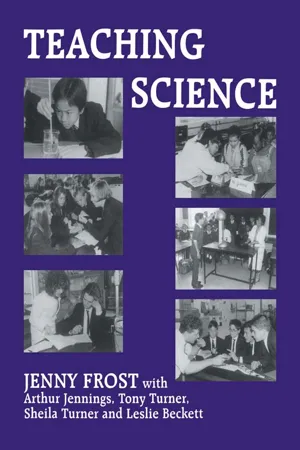
First published in 1995.This teaching book is packed with practical ideas and advice for the beginning science teacher. It is based on three simple principles regarding teaching methods: a principle of variety; a principle of careful and appropriate choice; and a principle of skilful and carefully prepared implementation. Through a wide range of examples, the authors discuss in richly illustrated detail what these principles involve in practice. All the examples are real ones taken from recent classroom experience, made more vivid by a large collection of photographs documenting the steps and phases involved in each kind of approach.
Information
1
INTRODUCTION
Learning to teach
This book about the teaching of science in secondary schools is written mainly for beginning teachers1 and for the teacher trainers who work with them. The latter group will include not only people like the authors, who are tutors in a university department of education and who work with and supervise beginning science teachers, but the increasing number of science teachers who will carry a wider responsibility for teacher training2 than hitherto.3
When training for any profession, beginners start with a tentative picture in their minds of what the work entails and the skills that will have to be learned. The pictures of teaching brought to the start of training are probably more vivid than for most other professions, because everyone spends about eleven years of their formative years on the ‘other side’ of teaching; that is, eleven years of ‘teacher watching’. The dominant memory for most people is of the teacher at the front talking to the whole class. Even where teachers spent only a small proportion of their time on this, it is still the image least likely to fade. Memories of what teachers might have been doing while classes were busy on practical work, or engaged in writing or discussion are hazier, and there are virtually no ideas of what was involved in lesson preparation merely because this was not seen. Teaching science, like teaching any subject, does, however, require a wide range of professional skills and knowledge; standing at the front talking to the whole class is only one of the many skills that beginning teachers have to learn. Part of becoming a teacher must therefore involve developing a greater awareness and understanding of the tasks that teachers undertake both during lessons and in preparation beforehand than can be gained simply by relying on memory of one's own teachers.
Teacher watching can also be misleading in another way, especially if the teacher is good. Good teachers appear to perform effortlessly; they have resources ready to hand; questions that intrigue and challenge their classes come readily to their minds; they select appropriate explanations, analogies and metaphors for almost any situation that arises; their timing and organisation are flawless; they respond to the needs of the class and of individuals; the environment in which they work is stimulating. Their ease of performance masks the knowledge they have and the complexity of the task:
Teachers have knowledge which enables them to undertake complex tasks in the day-to-day events of their professional lives. Much of this knowledge drives routines which are put into action in an almost unthinking way and teachers are unable to explain what they have done during a lesson or why they have done it. Teachers obviously have a great amount of tacit or intuitive knowledge which influences what they and their students do in classrooms. (Tobin, Butler Kahle, Fraser, 1990, p.35)
Anyone who has been in teacher training will be able to give examples of how an analysis of a lesson surprised the teacher concerned. For instance, one of the writers of this book, working with a group of beginning teachers in a school, had asked the group to record everything a particular teacher did in the first few minutes of a lesson. The laboratory had movable tables in the centre and fixed benches round the edge. The teacher moved the tables rapidly to form a circle, asking the class to wait quietly outside. As the class came in members took their places at the tables, which placed them and the teacher automatically in an appropriate position for a class discussion which occupied the first twenty minutes of the lesson. The reorganisation of the room and moving the class in had taken less than three minutes. When the teacher listened to the analysis of his actions afterwards he commented: ‘That's interesting, I never noticed I was doing it … but yes you're right, it was important.’
For the purposes of this book we have focused on one area of science teachers' expertise, namely the ability not only to use a range of teaching strategies but to be flexible in the use of the strategies, changing from one to the other as the situation requires. Ability depends partly on having a picture of what these strategies might be and the tasks associated with each. We have selected different types of lessons to illustrate a considerable repertoire of the strategies that would be part of the routine ‘stock-in-trade’ of an effective science teacher. The organisation and management of time, spaces and resources associated with the strategies, the relevant planning and the reasons for using the strategies are all explored. General points are supported by examples of specific lessons or series of lessons, some of which are illustrated with photographs.
The selection shows teachers frequently undertaking some task other than standing at the front and talking to the whole class and may help to address the question often asked by beginning teachers: ‘What do I do if the students are getting on by themselves?’
The descriptions may seem obvious, even trivial at times, especially to experienced science teachers, but they are none the less essential for a beginner, just as the descriptions of how to start a car and put it into gear, obvious and apparently intuitive to the experienced driver, are essential to the learner driver.
The organisation of the book
The chapters can be read as self-contained units, although it would pay to read Chapters 1 and 2 before any of the others. There is inevitably some repetition, but this does not matter because it is useful for beginning teachers to find that skills learned in one context are applicable in another.
The descriptions start in Chapter 2, ‘Teaching skills’. Arthur Jennings takes the reader on a tour of science lessons showing snapshots of the varied work of a science teacher; asking questions; demonstrating; giving an exposition; arranging for students to watch a videotape; listening to students reporting investigations; marking students' work; and considers the possible purpose a teacher might have for selecting each strategy. Arthur Jennings asks the reader to keep in mind two questions: first, ‘What is the teacher's intention and how is the intended learning encouraged?’ and second, ‘What demand is being made on the students and what learning is occurring?’.
Chapter 3 identifies the scope and limitations of four different types of practical work. It considers the teacher's role not only in the management of up to thirty students engaged in practical laboratory activities, but also in making the experience meaningful, in order to avoid practical work becoming no more than recipe following. The chapter shows safety considerations, the need for the ‘prepared mind’ on the part of the student and the need for allowing enough time to talk through the significance of any practical experience. The three lessons photographed all lasted approximately fifty minutes: the ability to use a range of teaching strategies within that relatively short space of time is abundantly clear, particularly in the lesson on fire fighting.
Chapter 4 on scientific investigations and technological tasks continues the theme of practical work. Their justification is given not so much in terms of their simulating what scientists and technologists do but in terms of their providing yet another situation in which students can take responsibility for their own learning. The phases of the investigations and tasks are described along with the roles of students and teachers during each phase. This chapter is the only one which contains photographs from a series of lessons (three lessons on a technological task) and hence has more photographs than any other chapter. The sequence is important because it shows how a teacher broke a task into sections that had some coherence in themselves and fitted the time slots, and yet provided continuity between one lesson and the next Mention is also made of the need for explicit teaching necessary for students to learn how to investigate. Of particular significance is the potential for a teacher to develop learning related to the nature of science and the nature of evidence.
Tony Turner's Chapter 5 on ‘The Circus’ provides a bridge between the chapters on practical work and on independent learning. A ‘circus’ is a series of activities focused upon one particular theme, and this is illustrated by his varied examples. Students move from activity to activity without continual reference to the teacher. The activities are not necessarily practical in the traditional sense but must engage the student in active learning. A circus often lasts for about an hour but may spread over three or four double lessons, and hence it is rather like short-term independent learning. It calls for particular management skills. The roles a teacher plays in initiating and introducing a circus, in helping while the circus is in progress and in drawing ideas together at the end are similar to those required for more full-scale independent learning.
Leslie Beckett in Chapter 6 then explores the potential and management of independent learning in greater detail. He highlights the need for the appropriate collection, preparation, labelling, storage and maintenance of resources, especially book resources, if this method of learning is to be successful. He reiterates Tony Turner's points about the need for clear written instructions and the ability on the part of the teacher to know when and how to intervene. Many of the skills of the teacher described in the snapshots of separate lessons in Chapter 2 are still part of the armoury of a teacher operating an independent learning scheme. The teacher on occasions gives an exposition to the whole class, demonstrates, marks books. The chapter is illustrated by examples drawn from the lower, middle and senior parts of secondary school.
Sheila Turner's Chapter 7 on games and simulations starts with a classroom debate on fluoridation of water. This chapter provides examples of children actively playing with abstract ideas removed from the ‘distracting clutter of reality’ often produced by practical work:
Science deals with theoretical concepts and their interrelationships. They are abstract and manipulated in the abstract. It is essential that these concepts are separated from their concrete reality if the maturing scientific mind is to gain mastery over them. (Woolnough and Allsop, 1985, p.39)
Sheila Turner shows how games and simulations (including computer-based ones) can allow students to manipulate and confront abstract ideas in an educationally stimulating and enjoyable context. We see parallels to the example of a circus where students manipulate models of isomers. In all her examples she highlights the preparation needed beforehand, questions of classroom management, the briefing and debriefing required and how to fit these activities into a longer learning sequence.
Discussion forms an important strategy in all contexts. In Chapter 8 Arthur Jennings considers ways in which it can be used by teachers. He emphasises the importance of a classroom climate where students are prepared to listen to each other and entertain each other's ideas. In his six examples of small group discussions the need for adequate preparation of the participants' prior knowledge of the subject under discussion is apparent, showing that discussion is not a ‘one-off’ activity but part of a sequence of learning. The summary phase of the class discussion reveals the possibility for drawing out three different messages, similar to the varied learning that can be drawn from a problem solving exercise.
Beginning teachers who trained at the London Institute of Education will see a similarity between the structure of this book and a session run at the start of the PGCE course (Post Graduate Certificate in Education). The main objective of the session is to provide a way for beginning teachers to confront their own beliefs about teaching and learning. The 80 or so beginning teachers are divided into classes and attend a series of science ‘lessons’, given by different tutors. Each tutor uses a different teaching strategy. Beginning teachers move from ‘lesson’ to ‘lesson’ at specified times like students in school. Photographs of these lessons were taken and used to produce descriptions, in poster form, of what each teacher was doing at different phases of the lesson. The photographs often illustrated the introduction, activity and summary phases but it was possible to infer what had gone on at the planning stage and what might be suitable consolidation or follow-up. This was repeated for several years and each year the descriptions of a particular type of lesson revealed similarities with those from previous years. To some extent this stability can be attributed to the limited turnover of staff in that period, the fact that the same person produced the posters and that a group of people teaching together subconsciously grow like each other. But some changes in staff and a different person taking the photographs did not significantly alter the situation. These analyses, which were made of tutors teaching adult graduates, have been mirrored in our observations of teachers in schools; hence the origin of the book.
Understanding the learner's perspective
Understanding the learner's perspective is of course important for teaching and plays a significant part in professional training. Reflecting on one's own experience as a learner, learning from the experience of observing students in school and reading about learning provide the knowledge base for this understanding. Important amongst the reading is the extensive literature on the ‘constructivist’ approach to teaching and learning in science, which views learners as active constru...
Table of contents
- Cover
- Half Title
- The Woburn Education Series
- Title Page
- Copyright Page
- Table of Contents
- Acknowledgements
- Notes on Contributors
- List of Plates
- List of Figures
- Preface
- 1 Introduction
- 2 Teaching Skills
- 3 Practical Work
- 4 Scientific Investigations and Technological Tasks
- 5 Circus
- 6 Independent Learning
- 7 Simulations
- 8 Discussions
- Appendix, National Curriculum in Science
- Index
Trusted by 375,005 students
Access to over 1.5 million titles for a fair monthly price.
Study more efficiently using our study tools.
Frequently asked questions
Yes, you can cancel anytime from the Subscription tab in your account settings on the Perlego website. Your subscription will stay active until the end of your current billing period. Learn how to cancel your subscription
No, books cannot be downloaded as external files, such as PDFs, for use outside of Perlego. However, you can download books within the Perlego app for offline reading on mobile or tablet. Learn how to download books offline
Perlego offers two plans: Essential and Complete
- Essential is ideal for learners and professionals who enjoy exploring a wide range of subjects. Access the Essential Library with 800,000+ trusted titles and best-sellers across business, personal growth, and the humanities. Includes unlimited reading time and Standard Read Aloud voice.
- Complete: Perfect for advanced learners and researchers needing full, unrestricted access. Unlock 1.5M+ books across hundreds of subjects, including academic and specialized titles. The Complete Plan also includes advanced features like Premium Read Aloud and Research Assistant.
We are an online textbook subscription service, where you can get access to an entire online library for less than the price of a single book per month. With over 1.5 million books across 990+ topics, we’ve got you covered! Learn about our mission
Look out for the read-aloud symbol on your next book to see if you can listen to it. The read-aloud tool reads text aloud for you, highlighting the text as it is being read. You can pause it, speed it up and slow it down. Learn more about Read Aloud
Yes! You can use the Perlego app on both iOS and Android devices to read anytime, anywhere — even offline. Perfect for commutes or when you’re on the go.
Please note we cannot support devices running on iOS 13 and Android 7 or earlier. Learn more about using the app
Please note we cannot support devices running on iOS 13 and Android 7 or earlier. Learn more about using the app
Yes, you can access Teaching Science by Jenny Frost, Richard B. Ingle, Jenny Frost,Richard B. Ingle in PDF and/or ePUB format, as well as other popular books in Education & Education General. We have over 1.5 million books available in our catalogue for you to explore.