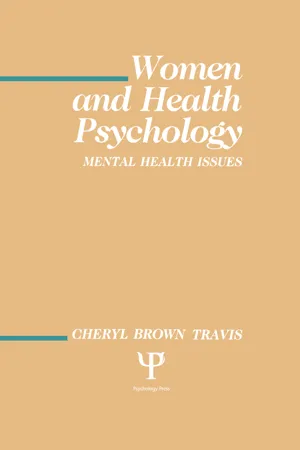
The author proposes that the conditions, events, and experiences that contribute to serious mental health problems for a percentage of women, will at some point be experienced by all. Mental Health Issues presents two basic themes: that social contexts and frameworks are experienced and expressed, and then subconsciously internalized as part of the self; and that specific diagnostic conditions, such as depression, alcoholism, or eating disorders, can emerge from dynamics that are experienced by most women.
- 290 pages
- English
- ePUB (mobile friendly)
- Available on iOS & Android
eBook - ePub
About this book
Information
Publisher
Psychology PressYear
2014Print ISBN
9781138987203
9780805802535
Edition
1eBook ISBN
9781317785293
1
The Psychology of Gender: Mental Health Implications
FEMINIST ANALYSES
Liberal
Radical
Socialist/Marxist
VISIONS OF WOMEN
Psychoanalytic Frameworks
Feminist Object Relations
Relational Androgyny
Social Constructionism
ANDROGYNY
Definition and Measurement
Correlates of Androgyny
Mental Health Implications
Criticisms of Androgyny
SUMMARY AND CONCLUSIONS
The social psychological construction of gender plays a major role in the definition and diagnosis of illness, timing and expression of symptoms, treatment strategies, and theoretical explanations. Thus, mental illness is as much a social as a personal event. Understanding, treating, and preventing psychological dysfunction is conceptualized here to fall within both self and social frameworks. The major feminist perspectives allocate different levels of significance to self and social frameworks but collectively offer a method for integrating many related issues.
In this chapter, basic feminist perspectives are reviewed, views of women and the nature of male-female relationships are summarized and contrasted with a model of androgyny. The following chapters on depression, use of psychotropic drugs, alcoholism, and eating disorders each illustrate the complexity of integrating self and social events.
Feminist Analyses
Divisions between various feminist perspectives are always arbitrary to some degree, and other reviews have offered different classifications (Firestone, 1970; Fee, 1975; Jagger & Struhl, 1978; Sayers, 1982). Individual advocates typically incorporate perspectives, methods, and objectives of more than one approach. Although there is considerable overlap and blurring of boundaries, each perspective does have a general core that distinguishes it from others. A more extensive version of this review is also presented in volume I of this series but is reiterated here because feminist analyses provide a valuable context in which to view the more specialized theories of gender and mental health discussed in the following chapters.
Liberal
Liberal and radical positions can be partly distinguished by their focus on the nature and source of differences between the sexes. The liberal position holds that the biological basis for sex differences is minimal. Those differences that do appear may be understood best in terms of the social construction of gender and more generally in terms of sexism. Sexism is defined as “the entire range of attitudes, beliefs, practices, policies, laws, and behaviors discriminating against women (or against men) on the basis of their gender” (Safilios Rothschild, 1974, p. 1). The main problem is that society has segregated women and men in virtually all life experiences: personal sense of self, friendships, sexuality, work, play, and religion. This segregation has invariably led to conditions whereby men have more power, access to financial resources, status, autonomy, and choice than women. It is enforced by official policies and de facto social conditions. The implications and consequences of this sexism (segregation and discrimination) have been explored by several feminists, Friedan (1963) and Bird (1968).
The problem is defined as both situational and personal, involving self and social frameworks. It is situational because women and men have been assigned discrete, nonoverlapping roles. Men work outside the home and publicly demonstrate their ability to achieve; women work privately inside the home and often achieve by nurturing others. It is personal because characteristics thought appropriate for the performance of these discrete roles have been idealized as masculinity and femininity. Men are strong, aggressive, instrumental, confident, and active. Women are submissive, communal, expressive, careful, and quiescent. Thus, the very experience of self is involved; however to some extent, it is an arbitrary experience based on a social construction of work roles and relationships.
Three concerns have characterized liberal analyses: (a) the sexist division of labor justified on the basis of supposed biological differences between the sexes, (b) barriers to equal opportunity as they have emerged in educational and occupational settings, and (c) limited choices in the expression of self imposed by categorical definitions of masculinity and femininity. These concerns incorporate issues addressed on molar levels in terms of social-situational frameworks and in terms of personal-self frameworks.
The liberal position tends to minimize the role of biology and evolution in sex differences. In contrast, popular accounts of evolution and sociobiology have relied heavily on biological arguments for current divisions of status and power (Ardrey, 1966; Morris, 1967; Tiger & Fox, 1971). These renditions of human evolution suggest that the current sexual division of labor is firmly based in biology, reflecting an appropriate natural order. The chauvinism of popular sociobiology has been amply demonstrated (Morgan, 1972; Fisher, 1979; Hubbard, Henifin & Fried, 1979; Hubbard & Lowe, 1979; Tobach & Rosoff, 1978). Feminists, many of whom are fine biologists, do not discount biology as a legitimate science; rather, they argue for careful formulation of hypotheses, methodology, and analyses of data. The tendency to overgeneralize and extrapolate from a two or three animal species to human behavior is severely criticized. It has been argued that “Not the biological facts but man’s social attitudes toward women—attitudes that are based on prejudiced interpretation of the facts—require revisions” (Montague, 1952, p. 55). Liberal feminists argue that biology is very much a social phenomena (Sayers, 1982). This perspective is supported by research on sex differences (O’Leary, Wallston, & Unger, 1985; Hyde, 1985; Hyde & Linn, 1986).
Psychological research on the nature and extent of sex differences, for example, in spatial perception, verbal memory, and mathematical reasoning, has been critiqued by feminist scientists as biased and sexist from initial inception to final interpretation (Unger, 1979; Block, 1984; Wallston, 1985). Empirical support for supposed sex differences has been extensively reviewed elsewhere (Maccoby & Jacklin, 1974). Sex differences appear to be influenced by the nature of the task and several other variables, including the sex of authors of articles (Eagly, 1983). These findings have led feminists to focus on situational and personal factors rather than biological ones.
Because sex differences are judged to be minimal from a liberal perspective, problems of equal opportunity, prejudice, and discrimination become political-economic and personal events. Equal opportunity issues have been addressed in the areas of equal protection in law (Schulder, 1970; DeCrow, 1974), education (Serbin, 1973; Frey, 1979), language (Lakoff, 1973; Schulz, 1975), and numerous other areas, including the practice of medicine. The liberal position is generally based on an assimilation model of social change (Rossi, 1976) where integration is the key element. The focus here is to facilitate the entry of women into full citizenship and the transactions of commerce, law, politics, education, and so on.
Personal redress has been proposed in new conceptions of gender. Masculinity and femininity are no longer conceived as mutually exclusive characteristics. Tests and measures that construct gender as a single bipolar phenomenon are criticized (Constantinople, 1973). A variety of instruments and scales have been developed in psychological research based on this new conception of integrated gender, androgyny (Bern, 1974; Spence & Helmreich, 1978). The concept of androgyny has strongly influenced feminist models of mental health and will be presented in more detail in Chapter 6. Although there are problems with the popularization of androgyny (Wallston, 1985), it has been an unspoken assumption that if women and men could be more personally and psychologically integrated, social-situational integration would be facilitated.
The impact of liberal analysis on women’s health has been evidenced in several areas. By law, admissions to all health training and education programs must be nondiscriminatory. Increased access to training and certification for women professionals in the health area has been a major goal. A liberal analysis advocates an informed consumer role for women seeking counseling or therapy (Strickland, 1984). Providing information about therapists and counselors in consumer manuals is one type of activity related to this goal. Making health care available to more women, for example through community funded centers and haven houses for victims of abuse, is another goal consistent with the liberal focus.
Additionally, liberal feminists maintain a critical appraisal and monitoring of federal funding for health care programs and health-related research. For example, much of the theory development, research, and federally funded treatment programs on alcoholism have been designed around men, with only limited attention to women. Efforts to insure better educated and better trained clinical therapists are also reflected in a liberal focus, which encourages the inclusion of courses on the psychology of gender in the graduate curriculum of accredited programs, in particular advocating training in crisis intervention for problems typically experienced by women and in areas of reproductive decision making.
Radical
Radical perspectives give greater emphasis to essential differences between the sexes and thus maximize the unique features of maleness and femaleness. According to radical perspectives, there is less overlap between the sexes, and core differences tend to precipitate conflict, especially conflict over power and status. Women are seen as representing a perspective and style that is uniquely feminine. This style is characterized by trust, cooperation, and creativity. Men are seen as more likely to adopt destructive competitive styles, to exploit others in a zero-sum strategy, and to have difficulty in trusting others. Representative works include Firestone’s Dialectics of Sex (1970), Millet’s Sexual Politics (1970), and Frankfort’s Vaginal Politics (1972). A broad sampling of radical feminism is available in an edited volume by the same title (Koedt, Levine, and Rapone, 1973).
The radical perspective recognizes at the outset that biology itself is the key factor in sexual dualism. Radical feminists argue that in order to eliminate the sexual class system, women must seize control of reproduction and reassert ownership of their own bodies (Firestone, 1970). The objective is not to simply provide adequate services for women but to restore to women the power to look after themselves.
At least one school of thought locates the conflict within the psyche of men, who universally are awed by women, envious of women, and simultaneously fear women (Lederer, 1968; Dinnerstein, 1976; Daly, 1978). Women are held in awe as being intimate with the most powerful forces of nature and creation, for example, Earthmother and Mother Nature. The images of women as potential destroyers, for example, Medussa, amazons, sirens, and harpies, are seen as a partial reflection of the fear of women and the power of that which is female.
Partly because of the psychological flaws of men (their fear, envy, and contempt of women), radical feminists have encouraged women to look to other women for emotional sustenance and as collaborators in social change. Consciousness raising through personal sharing has legitimated the experiences of women, and women’s feelings have become a valid basis for political analysis.
Causes of conflict and frustration are no longer located totally within the personalities of women but are seen as products of a male-dominated system. Additionally, leadership, authority, and influence have been reconsidered. The nature of power relations has been interpreted as corrupting to all parties; therefore, it is not adequate simply to replace men with women in positions of power. The process of reaching and implementing decisions and allocating resources must be reconstructed.
Consistent with the focus on female biology, much of the radical impact of women’s health care has been in the areas of gynecology and reproductive health. Male domination in the area of childbirth has especially been criticized (Ostrum, 1975; Rich, 1977). Access to safe contraception has also been a major concern (Dowie & Johnston, 1977; Seaman, 1977). Freedom of choice regarding abortion has been consistently supported on the basis that forced gestation violates the integrity of women. Control of one’s body is seen as a primary requirement for other freedoms. To the extent that women’s choices are restricted by laws made by men, men are in a position to dominate women.
Radical innovations in women’s health care have included the development of cooperative health care centers for women. In these centers women discuss their personal health concerns and learn elements of self-help in group settings. Individual therapy is often supplemented by support groups, and problem analysis incorporates issues of social political origin rather than simply focusing on intraindividual explanations. Further, the focus tends to be on promoting broad-based change in social institutions rather than adaptation on the part of the individual.
Criticisms of the radical perspective include the fact that not all women experiencing mental health problems are prepared to explore them from such a broad perspective. Often, the implications of therapy produce threats to longstanding marital and family relationships, which for some women may create more traumatic conflict than the presenting symptoms.
The potential of radical strategies to instigate effectively broad-based social change is another problem of radical analyses. One of the more common attacks made by critics of women’s liberation is to accuse public advocates of being man-haters and lesbians. Disregarding the accuracy of such attacks, the fact remains that in the public eye these claims have been, to some degree, accepted. One result is that radical feminists have lost credibility and effectiveness as advocates of social change. Additionally, grassroots support has been undermined. Women who could enthusiastically support equal pay for comparable work may be subdued by the implication that to do so they must renounce emotional ties with traditionally significant others. Thus, the integration of self and social frameworks has been a significant problem among feminist analyses in general and is addressed in repeatedly in the following chapters.
Socialist/Marxist
Socialist and Marxist perspectives are not completely overlapping but have a common orientation and are discussed jointly here for purposes of convenience. Both emphasize a structural, rather than personal, basis for sexism and discrimination (Robinson, 1978). Marxist analyses propose that all societies are identified by the mode of production characteristic of that society; all manifestations of power, status, or conflict can be traced to the mode of production. The essential divisions in society are divisions of class. The key historical period in this analysis is the shift from a feudal system to capitalism (Hamilton, 1978). Marxist analyses point out that women do not represent a single class. Working and middle class women are divided on a number of issues based on economic rather than sexist factors (Sayers, 1982). The family is a unit within the capitalist system, which helps maintain order, replenish the supply of workers, and serves as a unit for consumption of goods. Significant change in society, therefore, must also include significant changes regarding the family.
Socialist analyses argue that sex-gender systems constitute a level of reality more basic than economic class and thus share an orientation similar to radical analyses. Gender is seen as the master class, extending across all other divisions (Laws, 1979), structuring personal, social, and political realities. Sex-gender systems have permeated societies throughout history, from the concepts of yin and yang to more recent divisions elaborated by Western society. The discovery of paternity and the associated transition from group to pair marriage is seen as the origin of sex-gender systems practiced today. Forces that require women to devote their energies to child rearing and caring for husbands result in reduced choices for women and eventually a diminished sense of self-esteem and competence (Rossi, 1964; Jones, 1970). Socialists point out that these patriarchal family systems continue to exist even in working class (proletariat) families and in socialist societies.
Socialist and Marxist analyses agree that modes of production and reproduction are often parallel in their consequences and, therefore, may be inextricably entertwined (Chodorow, 1979). Current constructions of production and sex-gender systems result in divisions whereby men are associated with the work of production and women with that of consumption. Men accomplish their tasks in public settings and women perform household chores in isolation. Underlying explanations rely on structural, not personal, factors. Thus, from both perspectives, patriarchy and the nuclear family are major factors in the oppression of women. The compatibility of the two analyses is suggested by the title of a volume edited by Eisenstein (1979), Capitalist Patriarchy and the Case of Socialist Feminism. Since the source of oppression is institutionalized, collective action is a prerequisite for effective social change (Dunbar, 1971).
A major theme of the socialist/Marxist analysis is that the medical system has become a means of social control utilized by the capitalist state (Ehrenreich & Ehrenreich, 1974). The state and the medical system operate in an interlocking system of support. The state uses health care as an instrument of social control by increasing funding and offering programs during periods of protest and unrest, but these are quickly withdrawn as the impetus for social change is dissipated (Navarro, 1975). The medical system is also used to control social change by defining what is healthy, what is reasonable care and what is hazardous to health. The direction of benefit is mutual, and the state approves or blocks legislation according to principles that insure a profit base for the medical system (Felkner, 1982).
Socialist/Marxist analyses regarding the status of women and women’s health are only tangentially concerned with women’s biology. Socialist analyses see the discovery of paternity as the origin of patriarchy; and, therefore, the biological role of women as reproducers of male property is an important factor in the subsequent low status of women. Marxist analyses have encouraged women to view themselves as part of a larger conflict and to share the goals of other exploit...
Table of contents
- Cover
- Title
- Copyright
- Dedication
- Contents
- PREFACE
- 1 THE PSYCHOLOGY OF GENDER: MENTAL HEALTH IMPLICATIONS
- 2 GENDER AND MENTAL HEALTH STATUS
- 3 INTRODUCTION TO PSYCHOTROPIC DRUGS
- 4 PSYCHOTROPIC DRUGS: TREATMENT ISSUES
- 5 EPIDEMIOLOGY OF ALCOHOLISM
- 6 ETIOLOGY AND TREATMENT OF ALCOHOLISM AMONG WOMEN
- 7 OVERVIEW OF EATING DISORDERS
- 8 EATING DISORDERS: ETIOLOGY AND TREATMENT
- 9 ISSUES IN THERAPY
- 10 FEMINIST ALTERNATIVES
- REFERENCES
- AUTHOR INDEX
- SUBJECT INDEX
Trusted by 375,005 students
Access to over 1.5 million titles for a fair monthly price.
Study more efficiently using our study tools.
Frequently asked questions
Yes, you can cancel anytime from the Subscription tab in your account settings on the Perlego website. Your subscription will stay active until the end of your current billing period. Learn how to cancel your subscription
No, books cannot be downloaded as external files, such as PDFs, for use outside of Perlego. However, you can download books within the Perlego app for offline reading on mobile or tablet. Learn how to download books offline
Perlego offers two plans: Essential and Complete
- Essential is ideal for learners and professionals who enjoy exploring a wide range of subjects. Access the Essential Library with 800,000+ trusted titles and best-sellers across business, personal growth, and the humanities. Includes unlimited reading time and Standard Read Aloud voice.
- Complete: Perfect for advanced learners and researchers needing full, unrestricted access. Unlock 1.5M+ books across hundreds of subjects, including academic and specialized titles. The Complete Plan also includes advanced features like Premium Read Aloud and Research Assistant.
We are an online textbook subscription service, where you can get access to an entire online library for less than the price of a single book per month. With over 1.5 million books across 990+ topics, we’ve got you covered! Learn about our mission
Look out for the read-aloud symbol on your next book to see if you can listen to it. The read-aloud tool reads text aloud for you, highlighting the text as it is being read. You can pause it, speed it up and slow it down. Learn more about Read Aloud
Yes! You can use the Perlego app on both iOS and Android devices to read anytime, anywhere — even offline. Perfect for commutes or when you’re on the go.
Please note we cannot support devices running on iOS 13 and Android 7 or earlier. Learn more about using the app
Please note we cannot support devices running on iOS 13 and Android 7 or earlier. Learn more about using the app
Yes, you can access Women and Health Psychology by Cheryl Brown Travis in PDF and/or ePUB format, as well as other popular books in Psychology & History & Theory in Psychology. We have over 1.5 million books available in our catalogue for you to explore.