- 224 pages
- English
- ePUB (mobile friendly)
- Available on iOS & Android
eBook - ePub
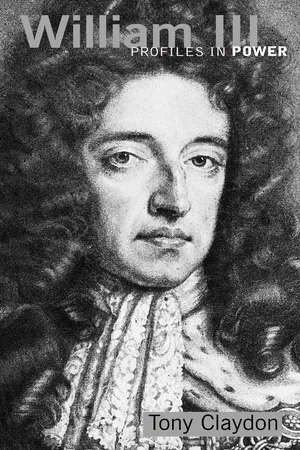
William III
About this book
William III, William of Orange (1650-1702), is a key figure in English history. Grandson of Charles I and married to Mary, eldest daughter of James II, the pair became the object of protestant hopes after James lost the throne. Though William was personally unpopular - his continental ties the source of suspicion and resentment - Tony Claydon argues that William was key to solving the chronic instability of seventeenth-century Britain and Ireland. It took someone with a European vision and foreign experience of handling a free political system, to end the stand-off between ruler and people that had marred Stuart history. Claydon takes a thematic approach to investigate all these aspects in their wider context, and presents William as the crucial factor in Britain's emergence as a world power, and as a model of open and participatory government.
William’s Life
Chapter One
An Orange: William’s career, 1650–88
The shape of William’s Dutch career
William’s life began inauspiciously on 4 November 1650. Although born in the grand surroundings of the Binnenhof Palace in The Hague, and born into two of Europe’s premier dynasties, events immediately preceding his arrival cast a deep shadow over his prospects. Most dramatically, his father, William II, Prince of Orange, had died eight days earlier from smallpox and had left his wife, Mary Stuart, alone with her child. As importantly, the elder William had damaged his son’s prospects by acts of political folly. To start, he had lent heavily to Charles I of England during Britain’s civil wars. This had landed the family in financial trouble once Charles had been defeated and executed in 1649; and had also fostered opposition to the dynasty in their native lands. In that republican state – the United Provinces of the Netherlands – popular sentiment had baulked at Orange support for a royal cause. Worse still, the old prince had attempted a coup in Holland the autumn of 1650. When this failed (the Dutch resisted William’s armed demands that they pay for a larger military), the clan’s reputation sunk further. An anti-Orange ‘states’ party mobilised and managed to deny the family the offices it had traditionally held in the republic. Thus, although the baby’s christening in The Hague’s Great Church on 5 January 1651 was a glittering affair, the service was pure bluster. At two months old, the new Prince of Orange was the head of a greatly weakened house. The essential key to analysing William’s subsequent career is to appreciate exactly what had been squandered towards the end of his father’s life. Had it not been for the disasters of 1649–50, the infant prince could have expected a high status within Europe’s ruling elites. Much of his energy would therefore be devoted to recovering positions he should simply have inherited, and all his actions must be understood in this context.
The first position William had forfeited was as a member of the British ruling family. His mother had been a daughter of King Charles I, so if that king had not been deposed, the infant prince would have gained considerable influence as the grandchild of the reigning British monarch. Charles’s execution greatly weakened the baby William, both by undermining his associations with royalty, and ensuring he would have no support from powerful relatives in London. This lost Stuart heritage remained important to William throughout his life. He was to spend much energy trying to restore the family’s fortunes, both in his early career and, more obviously, once he wore the Stuart crown. Thus although he was too young to help his relatives back onto the throne in 1660 (beyond making a public appearance as they travelled back to England); in the decades after the restoration he gave political advice to his uncles – the kings Charles II and James II; and he married back into the clan in 1677. In 1688, William’s concern for his mother’s family was part of his reason for invading England, and he tried to uphold the powers and dignities of the royal house once he reigned in London.
However, while the prince’s Stuart inheritance was near the heart of his identity, it was not the central focus of his ambition. Given that he was brought up in Holland, rather than England; and given that his uncles at first overshadowed him in the British realms, it was always the loss of his father’s status that he felt most keenly. Before 1650, the Orange family had dominated the Netherlands, and had cut considerable figures on the world stage. For example, they were the hereditary and sovereign princes of Orange, the city-state in Provence. They were also major landowners and nobles elsewhere, holding a string of estates and titles across France, the Low Countries, Burgundy and Germany. Moreover, Orange leadership of the struggle for Dutch independence from Spain had made the family appear the founders of the new nation. Although they had never been crowned kings, their charisma had allowed them to bask in popular adulation and to attain a quasi-monarchical status in the Netherlands. As we shall see below, the United Provinces remained a republic, governed by a network of committees and assemblies dominated by representatives of urban merchants. However, such was the status of the Orange dynasty, that it enjoyed considerable sway in these bodies, and had an almost automatic claim on some of the crucial offices of the state. For instance, William’s ancestors had usually been made the captain-general and the admiral of the republic, and had thus gained command of the state’s armed forces. Similarly they had been appointed stadholders of most of the individual provinces. These stadholderships – remnants from the days of the Habsburg viceroys – bestowed huge powers of patronage and the right to maintain internal order. In addition, the Orange family’s battle with Spain had given them a providential claim to be the godly champions of European Protestantism. It had also constructed a heroic image as resisters of continental hegemony, the last great hope of battling and oppressed nations. Taken together, this Orange identity offered the most glittering prizes to the infant William. Being part of the British ruling family might bring some prestige, but if he could recover his father’s family from the disasters which had robbed it of its wealth, reputation and offices, he would cut a far more impressive figure than a minor Stuart.
If restoring Orange power in Europe would be the new prince’s central objective, the circumstances in which this recovery would be attempted provide further keys to understanding the man. The first of these was William’s need to oppose Louis XIV. From the 1660s, this French monarch engaged in a vigorous territorial expansion on his eastern border. This not only threatened the small states and principalities in its path, but also promised to allow France to dominate Europe, as it involved military and diplomatic offensives which cowed most of the powers of the continent. This French aggression was central to William’s career. While it posed a threat to the recovery of his position, it also provided an opportunity for his own advance. Louis endangered virtually all the foundations of Orange influence – but at the same time opposing him would allow William to perform all the roles which had traditionally brought his house such prestige.
At the most personal level, the French threatened William’s own patrimony. Eastward expansion would absorb many of his family’s lordships in Burgundy, Flanders and along the Rhine; and Louis added insult to injury when he first occupied and then annexed the city of Orange. As worryingly, France endangered the basis of William’s political power in the Netherlands. Given that the United Provinces stood in the way of Louis’s encroachments, the French were determined to neutralise the republic, and especially to emasculate the Orange family who had stiffened its resistance in the past. For much of the time the court at Versailles did this by encouraging the anti-Orange ‘states’ party in Dutch politics. This grouping, centred on the commercial city of Amsterdam, and therefore reluctant to see trade-disrupting warfare, promoted a policy of appeasing Louis and worked to exclude the more bellicose supporters of the prince from power. Between 1650 and 1672, the alliance between France and the states party was triumphant, keeping the Orange faction away from any real influence in the Provinces. In the early 1680s, the pact was almost as successful, effectively blocking William’s attempts to mobilise against Versailles. In other periods, however, Louis’s hostility to Orangeism was less subtle. For two periods during William’s lifetime (from 1672 to 1678, and again from 1689 to 1697), Versailles tried to control the Netherlands simply by wiping them off the map. The French waged war on the republic, sometimes coming close to total conquest, or exhausting the Dutch to the point of collapse. Thus if Louis was not attempting to prevent William leading the Netherlands, he was trying to ensure there would be no Netherlands to lead. Opposing the French king was therefore essential to Orange survival.
Yet while Louis posed a threat, he also provided an opportunity. Countering the French would allow William to claim the charismatic mantle of his ancestors. For example, he could appeal, as they had done, to Dutch patriotism. Leading the struggle for national survival, William could ape the earlier princes of Orange who had inspired the republic to free itself from Spain. Furthermore, the new leader of the house could claim, like his forefathers, to be the godly champion of protestantism. Since Louis’s territorial expansion coincided with persecutions of the reformed faith – both in France and in the newly conquered lands – William could present himself as the providential protector of the Protestant religion. He could reprise the role of his ancestors who had vanquished the Habsburg inquisition in the Low Countries, and had weighed in on the Protestant side of the Thirty Years War (1618–48). Finally, the new prince could lead resistance to single-power hegemony in Europe, just as his house had traditionally done. In the sixteenth and early seventeenth century, the Orange family had built alliances against the potential ‘universal monarchy’ of Spain. Now, the Spanish threat may have subsided, but William could point to the danger of French domination, and again present his dynasty as the champion of freedom-loving nations. Taken together, these roles would burnish the image of the house of Orange. Magnified, as they would be, by propaganda, they could re-ignite the Dutch popular enthusiasm, and regain the heroic status, on which the clan had thrived.
After Louis’s expansionism, the second important context in which William would try to restore the fortunes of his house was the peculiar constitution of the Netherlands. As has already been suggested, the United Provinces was a structurally complex republic, in which the Orange family only exercised power through appointment to public office, and popular support. No individual could monopolise authority within this structure, since the location of this ultimate authority was impenetrably obscure. Technically, sovereignty in the Netherlands rested with the seven individual provinces. It was therefore supposed to lie in the provincial assemblies, or ‘states’, which governed each of these: but many factors disordered this basic arrangement. First, the provincial states were dominated by delegates from the Dutch towns, meaning that individual municipal councils were very influential. Second, each province could appoint a ‘stadholder’, whose authority could parallel and challenge that of the states, especially since this person had the right to appoint town magistrates. Third, an ‘estates general’ took decisions for the United Provinces at the federal level: though whether its power overrode the sovereignty of its constituent provinces was endlessly debated. Fourth, certain offices, such as the captain-generalship, parallelled the estates general in the federal sphere, and so confused authority there, just as the stadholderships did in each province. Fifth, traditions of unanimity – both within provincial states and the estates general – meant that individual towns or provinces could claim a veto on policy. Sixth, the fact that most state revenue came from the province of Holland – and within Holland from the city of Amsterdam – gave these two entities a disproportionate power. They had to be squared before anything was done. Overall, therefore, gaining the traditional Orange influence in the Netherlands would be nightmarishly complicated. It would be troubled further by Dutch pride in their republicanism, which meant that any attempt to clarify the system by establishing a monarchy, or other regal office, would result in deep unpopularity. William would need to develop a dazzling array of political skills in order to dominate his native land.
Most obviously, the young prince would have to learn to work with representative assemblies. Since the United Provinces had such a diffuse power structure, William could not expect to command obedience, but rather had to become a sort of persuader-in-chief. Certainly, the traditional Orange offices would bestow authority, but the prince would need to get himself appointed to these by the states or estates general and, even if he were put in post, many of his powers could only be used effectively with the co-operation of the assemblies. For example, the captain-general’s command of the army was supervised by a committee of the estates general, and his authority would anyway be meaningless if Amsterdam refused to provide finance for the military. Thus William would have to learn the arts of collaboration with representative bodies. Above all he would have to learn the two essential skills of compromise and public relations. The first was needed because he would never gain all that he wanted from such a complex network of committees and particular interests. He would therefore need know what his core aims were – and be willing to sacrifice subsidiary desires – as the price for securing his fundamental objectives. William would need an ability in public relations because propaganda played a vital role in Dutch politics. It is true that, while republican, the United Provinces were hardly democratic. The sovereign assemblies were drawn from the landed nobility and wealthy merchant oligarchies, not ordinary people. Nevertheless, popularising political positions would still be crucial. With power dispersed among a relatively large number of people, persuasion would be a key tool of power, and there were moments when popular opinion could sway the political elites. As we shall see, street demonstrations could make Dutch towns ungovernable. At these points, even urban oligarchs would be forced to bend, and fall in behind the men or policies who had swayed the mob.
Considered together, there is one striking feature about these circumstances which would shape the infant prince of Orange’s career. That was the overwhelmingly Dutch and European focus of the future monarch of Britain and Ireland. William was a Stuart, and would be interested in the Stuart realms – but his ambitions would always be continental, and his formative political experiences would be in the Netherlands. Recovering his father’s position meant gaining authority in the United Provinces; it meant leading a house with interests which stretched from Provence to Germany; and it meant posing as the hero of international Protestantism. Restoring his family’s fortunes also meant opposing the continent-embracing ambitions of the ‘universal monarch’ Louis XIV and learning to master a fiendishly confused Dutch political system. Thus while William would ultimately gain his greatest formal power from his coronation in Westminster Abbey, the British islands would rarely be at the centre of his thoughts. His destiny and identity as an Orange dictated different and far wider horizons.
The course of William’s Dutch career
Of course, lying in his cradle in The Hague in 1650, William was unaware of these considerations, and was unable to do much to advance his cause. Indeed, for the first eighteen years of his life, his fate was in the hands of squabbling pretenders to leadership of the Orange house, whose political incompetence weakened the clan even further than it had been damaged under William II. Until the new prince began to take his own initiatives in the later 1660s his recovery was plotted by his mother; by his paternal grandmother Amalia; by his uncle Frederick William of Friesland; and by members of William’s own household. However, these conspirators were so determined to do one another down, and were so incapable of building political alliances, that the states party outmanoeuvred them easily. Led by the strategically brilliant John de Witt, the republicans ensured that the federal and provincial offices which had traditionally been held by the princes of Orange remained vacant. In 1654, for example, they secured an ‘act of exclusion’ by which Holland agreed never to appoint William stadholder. In 1662 they persuaded Holland and Zeeland to reject appointment of the young prince to any office for at least six years, and got this extended by an extra half decade when this period was up. In 1667 they voted a ‘perpetual edict’ through the governing assembly in Holland which abolished the province’s stadholdership, and committed the states to reject William’s appointment as federal captain-general if he had become a stadholder anywhere else. Perhaps the greatest personal humiliation came in 1666. Then de Witt proved strong enough to storm the young prince’s own household. Removing William’s governor and personal servants, he insisted on supervising the raising of the child himself, and attempted to indoctrinate him in republican principles.1
The only advantages gained from this period of William’s life were determination and experience. Repeated disasters can only have focused the prince on the need to reverse his fortunes, and this sense of dynastic destiny would have been reinforced by his upbringing. Until 1666 William was raised by a coterie of loyal family servants. These people, led by Frederick van Zuylestein, an illegitimate son of William’s grandfather, instilled a keen sense of his paternal clan’s proper, but squandered, dignities. They reminded William of the glories of his Orange heritage, and trained him in theory and practicalities of warfare – the mastery of which would befit the great military aristocrat they hoped he would become. They also taught the prince a love of hunting, and probably weakened any Stuart identity bestowed by William’s mother Mary. She anyway spent much of her time away with her exiled brother, the future Charles II, and died before William was ten. Yet while William was being raised as a proud (and personally somewhat haughty) prince of Orange, the manner of his guardians’ political defeats was teaching valuable lessons about dealing with an open political system. Mary, Amalia and the rest had failed because they had stood on their dignity as they campaigned for their heir. They had insisted uncompromisingly on the rights of his family in public, and had conspired incompetently in private, rather than trying to build wide or popular alliances. For instance, in 1650, William’s mother had written to the states of Holland demanding that her newborn son be appointed stadholder immediately. This was in spite of the surge of republican sentiment which dictated tact, and the absurdity of asking a baby to exercise this difficult office. Similarly, members of William’s household had been exposed plotting against the states party regime in the mid-1660s. This had destroyed the servants’ credit just as de Witt was preparing to remove them, and made it easy for him to control the young prince. Orange shenanigans had thus alienated the Dutch public, and allowe...
Table of contents
- Cover Page
- Half Title page
- Title Page
- Copyright Page
- Contents
- Acknowledgements
- Introduction: William III in British and Irish History
- One William's Life
- Two William and the Stuart Realms
- Bibliography
- Index
Trusted by 375,005 students
Access to over 1.5 million titles for a fair monthly price.
Study more efficiently using our study tools.
Frequently asked questions
Yes, you can cancel anytime from the Subscription tab in your account settings on the Perlego website. Your subscription will stay active until the end of your current billing period. Learn how to cancel your subscription
No, books cannot be downloaded as external files, such as PDFs, for use outside of Perlego. However, you can download books within the Perlego app for offline reading on mobile or tablet. Learn how to download books offline
Perlego offers two plans: Essential and Complete
- Essential is ideal for learners and professionals who enjoy exploring a wide range of subjects. Access the Essential Library with 800,000+ trusted titles and best-sellers across business, personal growth, and the humanities. Includes unlimited reading time and Standard Read Aloud voice.
- Complete: Perfect for advanced learners and researchers needing full, unrestricted access. Unlock 1.5M+ books across hundreds of subjects, including academic and specialized titles. The Complete Plan also includes advanced features like Premium Read Aloud and Research Assistant.
We are an online textbook subscription service, where you can get access to an entire online library for less than the price of a single book per month. With over 1.5 million books across 990+ topics, we’ve got you covered! Learn about our mission
Look out for the read-aloud symbol on your next book to see if you can listen to it. The read-aloud tool reads text aloud for you, highlighting the text as it is being read. You can pause it, speed it up and slow it down. Learn more about Read Aloud
Yes! You can use the Perlego app on both iOS and Android devices to read anytime, anywhere — even offline. Perfect for commutes or when you’re on the go.
Please note we cannot support devices running on iOS 13 and Android 7 or earlier. Learn more about using the app
Please note we cannot support devices running on iOS 13 and Android 7 or earlier. Learn more about using the app
Yes, you can access William III by A.M. Claydon in PDF and/or ePUB format, as well as other popular books in History & Historical Biographies. We have over 1.5 million books available in our catalogue for you to explore.