eBook - ePub
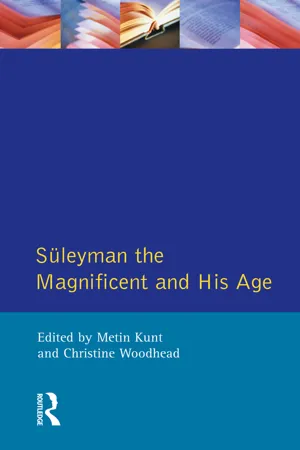
Suleyman the Magnificent and His Age
The Ottoman Empire in the Early Modern World
- 232 pages
- English
- ePUB (mobile friendly)
- Available on iOS & Android
eBook - ePub
Suleyman the Magnificent and His Age
The Ottoman Empire in the Early Modern World
About this book
Sultan Suleyman the Magnificent (r.1520-1566) dominated the eastern Mediterranean and Ottoman worlds - and the imagination of his contemporaries - very much as his fellow sovereigns Charles V, Francis I and Henry VIII in the west. He greatly expanded the Ottoman empire, capturing Rhodes, Belgrade, Hungary, the Red Sea coast of Arabia, and even besieging Vienna. Patron and legislator as well as conqueror, he stamped his name on an age. These specially-commissioned essays by leading experts examine Suleyman's reign in its wider political and diplomatic context, both Ottoman and European.
The contributors are: Peter Burke; Geza David; Suraiaya Faroqhi; Peter Holt; Colin Imber; Salih Uzbaran; Metin Kunt; Christine Woodhead; and Ann Williams.
Part I
Sixteenth-century Ottoman policies and problems
Introduction
In the introductory chapter a view was expounded of Ottoman state and society based on ‘livings’ (dirliks) allocated at all levels from the sultan down to the simple provincial cavalrymen, requiring the holders to maintain their own households, and pay the daily wages and expenses of household officers and retinues. A dirlik-holder, however small his living, was an independent official; a household officer, however high his rank, served his own master. The emphasis that livings and households were twin aspects of the military-administrative ümera organisation, and that even the ruler’s royal reserves should properly be seen in this context, differs somewhat from other analyses of Ottoman state structure. The second significant point is that ümera administration was supported by ulema magistrates (kadιs) who applied not only the Muslim şeriat but also state regulations and sultanic law, with a common conception of the supremacy of justice and the rule of law.
As a consequence of dirlik allocation there were different sorts of revenue collectors in provincial administration. A district governor, for instance, was the commander of the troops throughout the whole of his sancak, but he directly administered only those sections of his district, towns and villages, whose revenues had been included in his own hass income. If the district happened to have within it taxes allocated to the hass of the provincial governor, beylerbeyi, or to a vezir of the imperial council, or to the ruler’s havass-ι hümayun, the revenue collection-cum-administration of these was in the hands of the agents, usually household officers, of the beylerbeyi or the vezir or the sultan. The sancakbeyi’s authority did not extend to such agents who acted free from local interference. What regularised the administrative activities of all these various officials was the check and control of the provincial kadι magistrates.
Suraiya Faroqhi refers to the issue of categorising this Ottoman system of revenue collection in universal terms. Was it a feudal arrangement? Can it be considered under the Marxist rubric of ‘the Asiatic Mode of Production’? As the debate continues, proponents of these two schools agree that historians should no longer be content to view the Ottoman case as sui generis, that our historiography should be sharpened and enriched by reference to social theory and by means of a comparative look at other imperial systems. One can only agree, but also note that the debate involves refinements and further definitions of the models no less than the discernment of Ottoman features.
As in feudalism, the Ottoman dirlik-household system developed in the context of inadequate supplies of precious metals, and of relatively meagre means of transportation for rural levies in kind to reach markets. Revenues were allocated at the source and became the responsibility of the holder to collect and consume in lieu of pay. As opposed to feudalism, however, what was allocated was not land as such but the right to collect revenues, rural as well as urban. Nor were the dirlik-grants hereditary: the descendants of dirlik-office holders could expect to have their own appointments eventually but not to inherit what their fathers held. In the active career of an official, too, there were occasions – demotion and promotion as well as other reasons – when the dirlik assignment was changed, augmented, or cancelled. Higher dirlik-grants were specific not to persons but to office, though balanced by considerations of rank and seniority. Looking at things from the ‘bottom up’, the peasants were not the serfs of a dirlik-holder but owned their plots of arable land. On the other hand, they did have some servile obligations, a few relics of earlier, non-Ottoman feudal regimes and, more seriously, suffered limitations on their freedom of movement. It is also important to note that especially in larger dirliks, commercial revenues in cash made up a significant portion of hass revenues. Ottoman sultans and their highest officials therefore had a direct interest in the free flow of trade and were sensitive to issues with a bearing on long-distance commerce. Flourishing trade was important not just for the overall prosperity of the realm but directly for the wealth and therefore the power of the sultan and the ruling elite.
This model comes closest to full historical reality in the ‘classical age’ of the empire in the fifteenth and sixteenth centuries and in the ‘core provinces’ – very roughly the Anatolian and Balkan areas held before the large-scale conquests of Selim I. Again as Suraiya Faroqhi mentions, the complete ‘Ottomanisation’ of territories went through certain stages. A period of suzerainty was followed by conquest in earnest, at which time Ottoman officials and scribes arrived with their regulations and their registers to take stock of the population and resources of the area. Once revenues were estimated, taking into consideration local custom and production, they were allocated in dirliks. Then kadι magistrates arrived, together with the newly-appointed dirlik-holders: thus began Ottoman administration. But this process of Otto-manisation was not inevitable; certain areas difficult to conquer because of terrain or distance were brought into the Ottoman sphere as vassals and remained as such for many generations or even for centuries. Géza Dávid provides examples of this two-tier arrangement in Ottoman Europe. Elsewhere, the Crimea was left in the hands of the Tartar khans; Kurdish chiefs in the mountainous border zone between the Ottomans and the Safavids were also recognised in nuanced degrees of autonomy. The aim of full conquest remained but, at least in these cases, in abeyance. The Ottoman ideal was to establish central authority without local intermediaries, but in practice Ottoman statesmen were pragmatic.
Sixteenth-century conditions led to certain other arrangements, somewhere in between the two types of full Ottomanisation and vassalage, as we shall soon discuss. The reasons for such new administrative measures had partly to do with the administration of far-flung territories and partly with naval commitments in a much broader compass. The articles by Ann Williams and Salih Özbaran both attest to the heightened significance of the high seas in Ottoman strategic perceptions. Ottoman struggle in the Mediterranean first against Venice and later, in epic proportions, against the Spanish Habsburgs, continued throughout the century. After the failure to capture Malta in Süleyman’s last years, even with the disastrous rout at Lepanto in 1571, the Ottoman navy renewed the fight to conquer Cyprus; in 1574 Spain could not prevent the definitive Ottoman conquest of Tunis. Ottoman encouragement to English and Dutch merchants and envoys was a consequence of the struggle against Spain. At the same time, Ottoman fleets were active in the Indian Ocean to counterbalance the Portuguese presence and to insure the flow of South Asian goods through Ottoman-controlled West Asia, and also as part of their newly-assumed leadership of Sunni Islam. We have already seen the conquest of Egypt in this context. The quickest communication between the capital and Cairo was through the Mediterranean; the conquest of Rhodes – Süleyman’s first act as sultan – removed the Hospitaller menace to this route as well as allowing the naval struggle to be carried in earnest to the western Mediterranean.
The dirlik-household model also applied in districts assigned to the navy. Such districts, whether Aegean islands or mainland sancaks surrounding the Aegean, were required to provide a number of galleys in proportion to the revenues of the district. The sultan also paid for a central, household, navy out of his hass revenues. Yet as naval commitments were carried beyond the Mediterranean and expenditures increased to much higher levels, new methods of funding emerged, most significantly the saliyane system Özbaran discusses. The provincial and district governors in areas where this method came into practice did not collect their own revenues but were paid an annual amount out of taxes raised in that locality by other agents. Neither were there any other provincial dirlik-holders in these areas: other officers and troops were also paid in cash, soldiers receiving daily wages just as if they were household retinues. Cash levies not allocated to these officers were at the disposal of the central government to be spent on the spot for naval bases or for fitting of fleets. Any surplus cash would be sent annually to Istanbul, to the sultan’s treasury. Saliyane literally means ‘annual’; dirliks, too, were always given in annual figures, but here the difference is the direct cash payment rather than dirlik-style revenue collection in cash and in kind.
The saliyane system applied in areas at some remove from the heartlands where a handful of high-ranking Ottoman officials administered through locally recruited agents. This could only be possible in areas such as Egypt or Yemen with a relatively high cash yield in revenues, mainly because of significant long-distance trade. The saliyane provinces were not vassal areas with local chiefs; they were areas of direct Ottoman rule but without the dirliks. This is almost a contradiction in terms, yet the saliyane method is an example of the resilience and pragmatism of Ottoman administration. It also happened in some cases that when an area was first conquered there might not be sufficient revenues to support the Ottoman officials appointed there: the warfare before the conquest might have left the area in some disarray so that the peasantry might be allowed tax exemptions for a number of years, or frontier conditions after the conquest might require expenditure on defensive measures. (Géza Dávid mentions the example of the beylerbeyi of Budin who, at first, received his income from interior districts.) Or, in frontier provinces such as Budin or Yemen, the expense of maintaining fortresses or naval bases could not always be met out of local levies; in such situations the sultan could divert hass revenues from neighbouring provinces, for example from Cairo to Yemen, or send funds directly from Istanbul, until such time that local resources might suffice. Ottoman administration was prudent and patient as well as pragmatic.
The changes sketched above had implications which need to be brought out. The availability of larger amounts of cash, both from the ...
Table of contents
- Cover Page
- Half Title page
- Title Page
- Copyright Page
- Contents
- Preface
- Note on spelling and pronunciation of Turkish
- List of abbreviations
- Notes on contributors
- Introduction
- Part I Sixteenth-century Ottoman policies and problems
- Part II Ideal sultan, ideal state
- Ottoman sultans to mid-seventeenth century
- Glossary of Ottoman Turkish terms
- Bibliographical guide
- Maps
- Index
Trusted by 375,005 students
Access to over 1.5 million titles for a fair monthly price.
Study more efficiently using our study tools.
Frequently asked questions
Yes, you can cancel anytime from the Subscription tab in your account settings on the Perlego website. Your subscription will stay active until the end of your current billing period. Learn how to cancel your subscription
No, books cannot be downloaded as external files, such as PDFs, for use outside of Perlego. However, you can download books within the Perlego app for offline reading on mobile or tablet. Learn how to download books offline
Perlego offers two plans: Essential and Complete
- Essential is ideal for learners and professionals who enjoy exploring a wide range of subjects. Access the Essential Library with 800,000+ trusted titles and best-sellers across business, personal growth, and the humanities. Includes unlimited reading time and Standard Read Aloud voice.
- Complete: Perfect for advanced learners and researchers needing full, unrestricted access. Unlock 1.5M+ books across hundreds of subjects, including academic and specialized titles. The Complete Plan also includes advanced features like Premium Read Aloud and Research Assistant.
We are an online textbook subscription service, where you can get access to an entire online library for less than the price of a single book per month. With over 1.5 million books across 990+ topics, we’ve got you covered! Learn about our mission
Look out for the read-aloud symbol on your next book to see if you can listen to it. The read-aloud tool reads text aloud for you, highlighting the text as it is being read. You can pause it, speed it up and slow it down. Learn more about Read Aloud
Yes! You can use the Perlego app on both iOS and Android devices to read anytime, anywhere — even offline. Perfect for commutes or when you’re on the go.
Please note we cannot support devices running on iOS 13 and Android 7 or earlier. Learn more about using the app
Please note we cannot support devices running on iOS 13 and Android 7 or earlier. Learn more about using the app
Yes, you can access Suleyman the Magnificent and His Age by I M Kunt,Christine Woodhead,I.Metin Kunt in PDF and/or ePUB format, as well as other popular books in History & Early Modern History. We have over 1.5 million books available in our catalogue for you to explore.