- 552 pages
- English
- ePUB (mobile friendly)
- Available on iOS & Android
eBook - ePub
About this book
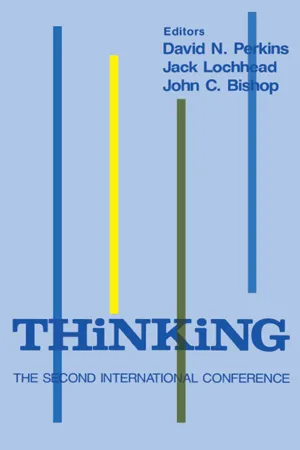
First published in 1987. Toward the end of August 1984, when most people were enjoying the last beaches and breezes of summer holidays, over 700 people gathered from all parts of the world at the Harvard Graduate School of Education, Cambridge, MA, to hear about, talk about, and think about thinking. The present volume offers a selection of papers from the many more presented at the 1984 International Conference on Thinking, continuing the tradition established by its predecessor volume.
Information
Topic
EducationSubtopic
Education Theory & PracticeI | Philosophical and Conceptual Orientation |
Contributions to the 1984 Conference on Thinking at the Harvard Graduate School of Education covered a very wide range of topics, and this breadth is reflected in the papers chosen for inclusion in this volume. Although doubtless alternative groupings would have been justifiable, the order in which we have presented the papers selected does indicate one useful way of exhibiting their interconnections.
All of our authors are in varying degrees concerned with thinking and its teaching, but some are more directly engaged with educational issues than are others. Accordingly, Sections C and D group contributions that belong primarily to educational psychology, philosophy of education, and the actual practice of training thinking skills. Sections A and B, by contrast, address issues that arise when we seek to understand what thinking is, how it is conditioned, and how it varies from context to context. Thus, these Sections deal with the psychology (and philosophical psychology) of thinking, and have their rightful place at the start, because we are unlikely to make much progress in understanding the teaching of thinking until we have considered the nature of thinking itself.
In Section A, we collect together a group of papers treating highly general questions about the nature of thinking. Although each paper is informed by empirical studies, the aim here is to provide a philosophical and conceptual orientation on which to ground our understanding of thought. In Chapter 1, John Bishop surveys the development of modern physicalist philosophies of mind, whereas, in Chapter 2, Kenneth Gilhooly appeals against the tendency in psychology to compartmentalize different aspects of thinking, and suggests a unified account in terms of “mental modelling.” In Chapter 3, Benny Shannon challenges the extent to which we can model mind as a matter of computations performed upon representations and proposes a dialectic between representational and nonrepresentational aspects of cognition.
A major focus of interest during the Conference were the two symposia on the nature of intelligence. Chapter 4 brings together the contributions of Richard Herrnstein, Arthur Jensen, Jonathan Baron, and Robert Sternberg on the prospects for developing human intelligence, whereas Chapter 5 contains Howard Gardner’s talk on his Theory of Multiple Intelligences and an edited version of the discussion that followed. These two chapters provide valuable background against which we may consider some later contributions in Sections C and D that offer suggestions about how thinking skills might be developed.
The final three chapters in this opening section remind us, in very different ways, of the danger of delineating too narrowly the realm of real thinking. E. P. Brandon and C. A. Nolan, in Chapter 6, highlight the social and political dimensions of thinking with their study of the way in which our elliptical habits of reasoning provide room for a usually unnoticed ideological shaping of our thoughts. In Chapter 7, Victor Kobayashi renews Gregory Bateson’s plea for including within the wider class of “thinking,” not just deductive, inductive, and scientific reasoning generally, but also the intelligent use of metaphor. William Maxwell and Jack Lochhead provide us, in Chapter 8, with an example of just this type of metaphorical reasoning: they draw an analogy between some aspects of neural organization in the brain and the mechanisms they believe should motivate our thinking about organizations and groups. Thus, Section A ends in a fitting way with a personal statement of values, reminding us that our concern as thinkers and as teachers is not just with how things are, but with how they ought to be.
1 | Thought, Action and the Natural Order |
University of Auckland, New Zealand
No examination of recent research into the nature of thinking, however selective, could fairly omit reference to developments in Philosophy. This may surprise some, to whom Philosophy’s institutional place as a specialised discipline within the humanities suggests that it can have little to contribute to empirical scientific research. Yet there should be no surprise because the philosophical task has always been to seek to unify human understanding. It is true, ironically enough, that the philosopher–synthesiser has been isolated within the academic community. Yet, although there may be many explanations for this, it is clear that one of the standard justifications for setting Philosophy apart is largely unwarranted. ‘Purely conceptual’ issues were thought to be essentially separate from empirical ones; and philosophers (generally by their own self-conception) operated in a division of labour in which their concerns were to be defined by “having nothing to do with mere facts.” But the sharp distinction between the conceptual and the empirical has been challenged, partly on theoretical grounds (see Quine, 1951), and partly in the practice of recent philosophers who, adhering to the Socratic tradition of following the inquiry wherever it leads, have recognised the vital interrelationship of ‘scientific’ and ‘philosophical’ issues. This is not to say that now there are no distinctively philosophical questions but it is to say that any philosophical inquiry is now regarded as limited and self-stultifying if it ignores developments in the scientific disciplines.
The Monist Philosophy of Mind
Questions about the nature of thinking fall under the philosophy of mind, an area notable for its interconnection with empirical disciplines, such as cognitive psychology and the neurosciences. Some philosophers have even come to think that many issues in philosophical psychology are as Churchland (1984) states: “ultimately empirical in character; they will be decided by the comparative success and the relative progress displayed by alternative scientific research programs” (p. 6)1. There is now a concern that the interrelationship between philosophy and psychology at the research level should be reflected in a reorganisation of the curriculum, so that related questions about mind and behavior are no longer presented as if they belonged to the domains of two quite distinct disciplines2.
But what are the distinctively philosophical problems about the nature of thought? The most fundamental is to understand how it is possible for there to exist, within the causal regularities of the natural order, systems capable of intentional action based on reasoning from their conscious awareness of their environments. Traditionally, this problem has been conceived as the question whether the universe must be more than purely material in order to accommodate conscious agents within it. The famous dualism of Descartes affirms that it must; consciousness and voluntary action are held to bear testimony to the existence of a nonphysical realm somehow (and problematically) related to the physical order. But Descartes’ view can be regarded as a solution only at the cost of allowing that nature is radically split into an irreducibly mental and an irredeemably material order. This option does not strike many philosophers as attractive, for their ideal is to understand reality as a unity, and the faith that in principle this may be achieved is widespread. Accordingly, naturalistic or monist theories have been sought that will display the mind as part of a natural system that may be open to comprehension as a unified whole. Thus, what may be called the monist philosophy of mind is widely advocated. It may also be called ‘physicalist’, given that Physics investigates the basic ‘stuff’ of reality; the name ‘materialism’ is perhaps a little outdated because, for modern Physics, matter as popularly conceived is not as fundamental as once supposed. But, whatever its name, the central commitment is clear; nature is one and our understanding ought to aim to grasp it as one. It is the counsel of despair to adopt dualisms like Descartes’.
Tasks for the Monist
There are, I suggest, three focal tasks that philosophers of this monist persuasion need to accomplish.
First, an account is required of what mental states and events are, which will smoothly fit them into the ontology of our general science of nature. If, as is likely, mental items are not a basic feature of our natural ontology, it must be shown how they may be constructed from, or at least realised in, a system constituted of items that are ontologically basic.
Second, because reference to mental states is crucially important in the explanation of behavior, the monist must try to understand how such explanations are related to scientific explanations generally. When a mental and a physical explanation appear to apply to the same phenomenon, what account of their relationship is to be given? Do they compete, or are they compatible? If the former, which deserves to count as the ‘real’ explanation; if the latter, is their compatibility merely a matter of one’s being reducible to the other, or are they distinct yet coapplicable? Of course, this second task is linked to the first because an account of what mental states are will have to allow for their causal roles—in being produced by environmental stimulation, as well as in producing behavioral responses.
The third task is to consider what implications a monist stance on the mind’s place in nature has for our ethical perspective. Our practice of assigning moral responsibility seems to require that agents be answerable only for those occurrences that are under their control—in other words, only for their own actions. But an action is essentially a product of thought, though not necessarily conscious thought. So, to be responsible for our actions, it seems we must be responsible for the thoughts—the intentions and volitions—that produce them. (Indeed, some philosphers follow the Kantian tradition of supposing that this is the sole locus of our responsibility. For an interesting discussion of this view see Nagel, 1976.) Yet, if our intentions and volitions are items within the natural order, how can their occurrence genuinely be our responsibility? Will it not be the laws of nature, and their antecedent causes, which determine them? How, then, is responsible action possible? (For a presentation of this ‘metaphysical problem of freedom,’ see Chisholm, 1966.)
What Mental States Are and How They Explain: the Growth of Functionalism
Logical Behaviorism. One celebrated means of satisfying the monist commitment to place the mind in the natural order is to ‘dissolve’ mental states into logical constructs out of behavioral dispositions, so that, for example, thinking that it’s soon going to rain is understood as a complex disposition to behave in certain ways—seek shelter, bring in the washing, and so on. It was this logical behaviorism that that famous ‘ghostbuster’ Gilbert Ryle found himself left with as his positive theory of mind (see Ryle, 1949). But, as a positive account, it has some awkward features; can we really accept that to be in pain is simply to be disposed to cry out, rub the affected area, and so forth? Besides, if believing it’s going to rain is just the disposition to seek shelter (among other things), how can reference to this belief genuinely explain any particular instance of shelter–seeking behavior?
The Mind–Brain Identity Theory. The suggestion of the central state materialists was that such explanations have their force because the mental attribution (of belief, in this case) actually refers to certain states of the brain that produce the sheltering behavior. Mental states are thus held to be contingently identical with neural states, in much the same way, for example, that the temperature of a gas is identical with a certain excitation state of its molecules. Despite the obvious fact that pains, beliefs, hopes, and the like have strikingly different properties from brain states, proponents of this ‘identity’ theory, such as J. J. C. Smart, have been able to defend its coherence, and argue that, by familiar standards forjudging hypotheses, the hypothesis that mental states are brain states is the best available theory of mind (Smart, 1959).
The Analogy with Computers: Functionalism. Central state materialism has not, however, been able to sustain its original presumption that every distinguishable type of mental state might in principle be identified with a distinct type of neural state. It is here that cross fertilisation from computer science becomes evident. One favourite way to pose the question whether a physicalist theory of mind can be sustained is to ask whether machines can think. A.M.Turing’s famous paper offered a suggestion about how to deal with this question, and so made way for the proposal that the mental states of a person might be understood on a strong analogy with the logical or functional states of a Turing machine or general purpose computer (Turing, 1950). (Putnam, 1960, advances such a proposal, and gives an account of the notion of a Turing machine. See also Hofstadter, 1981.) This position retains one feature of logical behaviorism, namely, the goal of characterising mental states in terms of their causal role, yet it includes interrelationships with other mental states as part of this causal role, and so doesn’t reduce the mental to a logical construct from behavior. On this functionalist view, just as the same computer program may be run in indefinitely many different types of machine, so the same type of mental functional organisation may have quite different physical embodiments. Because physically different systems may be functionally identical, the ‘type-type’ identity theory must be abandoned; there need not be a given neural condition correlated with each type of mental state. Nevertheless, functionalists remain within the monist philosophy of mind because no mental (functional) state can exist unless it is somehow physically realized. So there may be an identity between mental and physical states at the level of particulars, even if not at the level of general types. Functionalism has thus driven a wedge between two theses that were often supposed to be inextricably linked; the thesis of monism (or physicalism) that we have discussed, and the thesis of reductionism, which holds that what it means for a system to be in a mental state can be successfully analysed as a matter of the system’s having certain physical characteristics. (For further discussion, and an account of the variety of functionalist views, see Block 1980b. For more on the relation between functionalism and reductionism, see Fodor 1974 and Boyd 1980.)
Functionalism and Cognitive Science: Difficulties for the Program. Research into artificial intelligence has been directed towards developing computer programs whose operations mimic intelligent behavior. Modern cognitive science goes further, and treats as an empirical hypothesis about the mind the suggestion that its processes are computer-like. To quote Jerry Fodor (1983): “Contemporary cognitive theory takes it for granted that the paradigmatic psychological process is a sequence of transformations of mental representations and that the paradigmatic cognitive system is one which effects such transformations” (p. 29). Fodor has been influential in developing the notion of a “language of thought”—a system of language-like internal representations on whose syntactic features the procedural mechanisms of the brain operate (see Fodor, 1975). This approach to cognitive psychology seems naturally affiliated with functionalism. But this functionalist–cognitive-science program is not without its difficulties.
For one thing, there is the suspicion that functionalism has ignored what is arguably the most intransigent problem for any physicalist philosophy of mind, the problem of consciousness. As well as being open to characterisation in terms of their role in a system’s functional economy, many (though not all) mental states have a qualitative ‘feel’ to them; it makes sense to ask what it is like to be in them. It is sometimes suggested that mental qualia, the ‘raw feels’ of experience, just cannot be fitted into a physicalist picture (see Nagel, 1974). Critics have argued that, in any case, functionalism doesn’t explain how this can be done b...
Table of contents
- Cover
- Half Title
- Title Page
- Copyright Page
- Table of Contents
- Preface
- Foreword
- PART I: PHILOSOPHICAL AND CONCEPTUAL ORIENTATION
- PART II: CONTEXTS OF THINKING
- PART III: THEORETICAL PERSPECTIVES ON THE TEACHING OF THINKING
- PART IV: DESIGNS FOR THE TEACHING OF THINKING
- Author Index
- Subject Index
Trusted by 375,005 students
Access to over 1.5 million titles for a fair monthly price.
Study more efficiently using our study tools.
Frequently asked questions
Yes, you can cancel anytime from the Subscription tab in your account settings on the Perlego website. Your subscription will stay active until the end of your current billing period. Learn how to cancel your subscription
No, books cannot be downloaded as external files, such as PDFs, for use outside of Perlego. However, you can download books within the Perlego app for offline reading on mobile or tablet. Learn how to download books offline
Perlego offers two plans: Essential and Complete
- Essential is ideal for learners and professionals who enjoy exploring a wide range of subjects. Access the Essential Library with 800,000+ trusted titles and best-sellers across business, personal growth, and the humanities. Includes unlimited reading time and Standard Read Aloud voice.
- Complete: Perfect for advanced learners and researchers needing full, unrestricted access. Unlock 1.5M+ books across hundreds of subjects, including academic and specialized titles. The Complete Plan also includes advanced features like Premium Read Aloud and Research Assistant.
We are an online textbook subscription service, where you can get access to an entire online library for less than the price of a single book per month. With over 1.5 million books across 990+ topics, we’ve got you covered! Learn about our mission
Look out for the read-aloud symbol on your next book to see if you can listen to it. The read-aloud tool reads text aloud for you, highlighting the text as it is being read. You can pause it, speed it up and slow it down. Learn more about Read Aloud
Yes! You can use the Perlego app on both iOS and Android devices to read anytime, anywhere — even offline. Perfect for commutes or when you’re on the go.
Please note we cannot support devices running on iOS 13 and Android 7 or earlier. Learn more about using the app
Please note we cannot support devices running on iOS 13 and Android 7 or earlier. Learn more about using the app
Yes, you can access Thinking by D. N. Perkins,J. Lochhead,J. C. Bishop in PDF and/or ePUB format, as well as other popular books in Education & Education Theory & Practice. We have over 1.5 million books available in our catalogue for you to explore.