- 250 pages
- English
- ePUB (mobile friendly)
- Available on iOS & Android
eBook - ePub
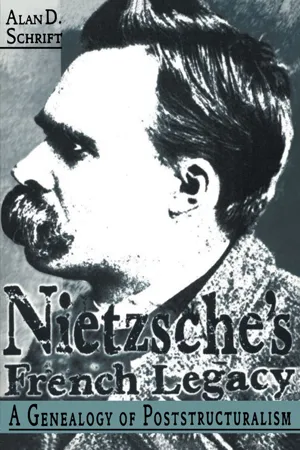
Nietzsche's French Legacy
About this book
More than any other figure, Friedrich Nietzsche is cited as the philosopher who anticipates and previews the philosophical themes that have dominated French theory since structuralism. Informed by the latest developments in both contemporary French philosophy and Nietzsche scholarship, Alan Schrift's Nietzsche's French Legacy provides a detailed examination and analysis of the way the French have appropriated Nietzsche in developing their own critical projects. Using Nietzsche's thought as a springboard, this study makes accessible the ideas of some of the most important and difficult of contemporary French poststructuralist theorists including Jacques Derrida, Gilles Deleuze, Michel Foucault and Helene Cixous. Through a careful analysis and close reading of the texts of Nietzsche and French poststructuralism, Schrift illuminates the ways in which Nietzsche's thought prefigures certain poststructuralist motifs. He demonstrates how several dominant themes in contemporary French philosophy emerge out of Nietzsche's own thinking. As one of the first books to critically examine the work of the new French anti-Nietzschean's, Schrift defends the value of poststructuralism and Nietzsche as critical resources for confronting the present.
Information
CHAPTER ONE
Derrida: The Critique of Oppositional Thinking and the Transvaluation of Values

This is not the censorship but the criticism of reason, whereby not its present bounds but its determinate [and necessary] limits, not its ignorance on this or that point but its ignorance in regard to all possible questions of a certain kind, are demonstrated from principles, and not merely arrived at by way of conjecture.
—KANT, Critique of Pure Reason
[O]ppositional thinking… is out of step with the most vital modes of postmodern knowledge.
—LYOTARD, The Postmodern Condition
THERE CAN BE NO QUESTION THAT FRIEDRICH NIETZSCHE STANDS AS ONE OF THE central figures to whom Jacques Derrida traces his own intellectual genealogy. Throughout his career, Nietzsche appears at crucial points in the development of Derrida’s thought and, among the themes which Derrida credits Nietzsche for having first addressed, one finds “the systematic mistrust as concerns the entirety of metaphysics, the formal vision of philosophical discourse, the concept of the philosopher-artist, the rhetorical and philological questions put to the history of philosophy, the suspiciousness concerning the values of truth (‘a well applied convention’), of meaning and of Being, of the ‘meaning of Being,’ the attention to the economic phenomena of force and of the difference of forces, etc.”1
In his earlier works, particularly up to and including La carte postale (1980), Derrida appeals regularly to Nietzsche in his own attempt to deconstruct the logocentric tendencies of metaphysical thinking. More specifically, Nietzsche often appears in the Derridean text as an alternative to the nostalgic longing for full presence that Derrida locates at the core of Western metaphysics.2 In fact, “Nietzsche” comes to serve a talismanic function as a proper name for the very possibility of thinking otherwise, a shorthand marker for the other of logocentrism.3 The most famous example here is, of course, the concluding paragraphs of “Structure, Sign, and Play in the Discourse of the Human Sciences,” where “Nietzsche” appears as the name of that other interpretation of interpretation, of structure, of sign, of play that, unlike the interpretations of logocentrism, is able to affirm the play of interpretation in a way that “determines the noncenter otherwise than as loss of the center.”4 But as we will see, this is by no means the only example.
Otherwise than Being, or Nietzsche contra Heidegger
In Spurs: Nietzsche’s Styles, as I have argued elsewhere, Derrida again offers Nietzsche as an example of thinking otherwise, this time with respect to the nostalgic tendencies he locates in Heidegger’s thinking.5 While his next text “on” Nietzsche—Otobiographies: The Teaching of Nietzsche and the Politics of the Proper Name6—takes the problematic of the name itself as its central focus, Derrida returns to the Heideggerian landscape in a subsequent Nietzschean text—“Interpreting Signatures (Nietzsche/Heidegger): Two Questions”7—in which he addresses the question of the unity of the proper name as this question is prompted by the opening of Heidegger’s preface to his two-volume Nietzsche: “‘Nietzsche’—der Name des Denkers steht als Titel für die Sache seines Denkens [‘Nietzsche’—the name of the thinker stands as the title for the matter of his thinking].”8 According to Derrida, the placing of Nietzsche’s name between quotation marks signals Heidegger’s metaphysical “desire” to impose a unitary interpretation on that “totality” he calls “the history of metaphysics.” In response to Heidegger’s “interpretive decision” to impose the unity of the proper name “Nietzsche” on a writing machine that remains multiple, Derrida replies:
who ever has said that a person bears a single name? Certainly not Nietzsche. And likewise, who has said or decided that there is something like a Western metaphysics, something which would be capable of being gathered up under this name and this name only? What is it—the oneness of a name, the assembled unity of Western metaphysics? Is it anything more or less than the desire (a word effaced in Heidegger’s Nietzsche citation) for a proper name, for a single, unique name and a thinkable genealogy? Next to Kierkegaard, was not Nietzsche one of the few great thinkers who multiplied his names and played with signatures, identities, and masks? Who named himself more than once, with several names? And what if that would be the heart of the matter, the causa, the Streitfall [point of dispute] of his thinking?9
It has been a common gesture in France to appeal to Nietzsche when distancing oneself from the Heideggerian project of recuperating Being from its metaphysical oblivion. And Derrida, perhaps more than anyone else, chose Nietzsche’s texts as a site on which to confront Heidegger’s thinking. This confrontation was not restricted to the politics or metaphysics of signatures and proper names, however. Nor was it restricted to his few brief texts “on” Nietzsche. In fact, the central position Nietzsche was to occupy in Derrida’s Aus-einander-setzung with Heidegger and the history of philosophy in general was made clear as early as Of Grammatology, as we see in the following remark whose importance warrants a lengthy citation:
Radicalizing the concepts of interpretation, perspective, evaluation, difference, and all the “empiricist” or nonphilosophical motifs that have constantly tormented philosophy throughout the history of the West, and besides have had nothing but the inevitable weakness of being produced in the field of philosophy, Nietzsche, far from remaining simply (with Hegel and as Heidegger wished) within metaphysics, contributed a great deal to the liberation of the signifier from its dependence or derivation with respect to the logos and the related concept of truth or the primary signified, in whatever sense that is understood. Reading, and therefore writing, the text were for Nietzsche “originary” operations… with regard to a sense that they do not first have to transcribe or discover, which would not therefore be a truth signified in the original element and presence of the logos, as topos noetos, divine understanding, or the structure of a priori necessity. To save Nietzsche from a reading of the Heideggerian type, it seems that we must above all not attempt to restore or make explicit a less naive “ontology,” composed of profound ontological intuitions acceding to some originary truth, an entire fundamentality hidden under the appearance of an empiricist or metaphysical text. The virulence of Nietzschean thought could not be more completely misunderstood. On the contrary, one must accentuate the “naiveté” of a breakthrough which cannot attempt a step outside of metaphysics, which cannot criticize metaphysics radically without still utilizing in a certain way, in a certain type or a certain style of text, propositions that, read within the philosophic corpus, this is to say according to Nietzsche ill-read or unread, have always and will always be “naivetés,” incoherent signs of an absolute appurtenance. Therefore, rather than protect Nietzsche from the Heideggerian reading, we should perhaps offer him up to it completely, underwriting that interpretation without reserve; in a certain way and up to the point where, the content of the Nietzschean discourse being almost lost for the question of being, its form regains its absolute strangeness, where his text finally invokes a different type of reading, more faithful to his type of writing: Nietzsche has written what he has written. He has written that writing—and first of all his own—is not originally subordinate to the logos and to truth. And that this subordination has come into being during an epoch whose meaning we must deconstruct. Now in this direction (but only in this direction, for read otherwise, the Nietzschean demolition remains dogmatic and, like all reversals, a captive of that metaphysical edifice which it professes to overthrow. On that point and in that order of reading, the conclusions of Heidegger and Fink are irrefutable), Heideggerian thought would reinstate rather than destroy the instance of the logos and of the truth of being as “primum signatum.”10
In this passage, we see the complexity of Derrida’s position vis-à-vis both Nietzsche and Heidegger. While the historical moment in which Heidegger’s interpretation appeared can explain his intention to save Nietzsche from a biologistic, vitalist, or racist reading that remains focused on the theme of life, Derrida notes elsewhere that Heidegger can save Nietzsche from the Nazis only by losing him to the history of metaphysics.11
For his part, Derrida confesses to having no interest in “saving” Nietzsche from his fate in the hands of Heidegger. Nevertheless, he wants to show how Nietzsche’s text exceeds the Heideggerian reading of it. In a recent interview, he has made the point explicitly:
It is important in this context to take Heidegger’s Nietzsche and show that there are other possibilities in Nietzsche which are not programmed by a history of metaphysics, that there are moves which are stronger, which go further than what Heidegger calls the history of the completion of metaphysics; moves which actually put in question Heidegger himself: his reading of Nietzsche in particular and his philosophical orientation in general. Briefly, there exists a reserve in Nietzsche which allows one to read Heidegger’s own thought genealogically.12
As the passage cited earlier from Of Grammatology indicates, Derrida locates this reserve in Nietzsche’s affirmation of “interpretation, perspective, evaluation, difference,” for it is this affirmation that exceeds a metaphysical determination governed by the logos or truth and, in so doing, exceeds the Heideggerian reading. “There is, for Nietzsche, no entity which is not interpretable as both an active and a reactive form of life. It is this which distinguishes Nietzsche from Heidegger: everything is, for Nietzsche, interpretation.”13
But from remarks such as these, it would be wrong to conclude, as did Hans-Georg Gadamer, for example, in his ill-fated “dialogue” with Derrida in Paris at their 1981 Goethe Institute meeting, that Derrida had simply chosen Nietzsche over Heidegger. Gadamer’s treatment of the Nietzsche-Heidegger-Derrida relationship is instructive, for it exemplifies a common misperception of Derrida’s position. In their encounter, Gadamer remarked that
Derrida has argued against the later Heidegger that Heidegger himself has not really broken through the logocentrism of metaphysics. Derrida’s contention is that insofar as Heidegger asks about the essence of truth or the meaning of Being, he still speaks the language of metaphysics that looks upon meaning as something out there that is to be discovered [vorhandenen und aufzufindenen]. This being so, Nietzsche is said to be more radical.14
In response to Derrida’s apparent conclusion in favor of Nietzsche’s “radicality,” Gadamer replies that he finds that the “French followers of Nietzsche have not grasped the significance of the seductive and tempting challenge of Nietzsche’s thought. Only in this way, [he continues,] could they come to believe that the experience of Being that Heidegger tried to uncover behind metaphysics is exceeded in radicality by Nietzsche’s extremism.”15 In other words, the only way the French could have concluded that Nietzsche is more radical than Heidegger would be if they misunderstood one or both of these thinkers. The question of Nietzsche’s radicality is thus, for Gadamer, not an open one. There is a correct answer, and the French, Derrida included, do not have it.
While Gadamer is willing to acknowledge a “deep ambiguity” in Heidegger’s “image of Nietzsche,” he fails here to acknowledge an equally deep ambiguity in Derrida’s relationships to Heidegger and Nietzsche. On several different occasions, Derrida has said that there can be no simple choice between Heidegger and Nietzsche. The undecidability of this choice is one of the threads woven throughout Spurs, Derrida’s most explicit Aus-einander-setzung with Nietzsche/Heidegger. It appears in other Derridean texts as well. Consider the following remark from “Structure, Sign, and Play in the Discourse of the Human Sciences:”
Nietzsche, Freud, and Heidegger, for example, worked within the inherited concepts of metaphysics. Since these concepts are not elements or atoms, and since they are taken from a syntax and a system, every particular borrowing brings along with it the whole of metaphysics. This is what allows these destroyers to destroy each other reciprocally—for example, Heidegger regarding Nietzsche, with as much lucidity and rigor as bad faith and misconstruction, as the last metaphysician, the last “Platonist.” One could do the same for Heidegger himself, for Freud, or for a number of others. And today no exercise is more widespread.16
It would appear that Gadamer came to Paris with the intention of engaging in just this sort of exercise.17 But this is not the point I want to emphasize. Instead, I want to draw attention to Gadamer’s failure to acknowledge that while Derrida does at times affirm that Nietzsche exceeds Heidegger in “radicality,” there are other occasions where Derrida credits Heidegger with being the “more radical.” In fact, we find an example of his privileging Heidegger shortly before the passage just cited from “Structure, Sign, and Play.” There, in the context of discussing Nietzsche, Freud, and Heidegger as exemplars of decentering or “thinking the structurality of structure,” Derrida follows brief references to Nietzsche’s critique of metaphysics and Freud’s critique of consciousness as self-presence by noting that we find the discourse of decentering structure “more radically [in] the Heideggerian destruction of metaphysics, of onto-theology, of the determination of Being as presence.”18
Nevertheless, it certainly warrants noticing, again as did Gadamer at the Paris meeting, that on occasions like those cited above, Derrida does argue that Nietzsche’s texts exceed Heidegger’s in radicality. And on those occasions, both with respect to Heidegger and in the broader context of his deconstructive reading of the history of philosophy in general, Derrida draws upon what he calls, in Of Grammatology, “the axial intention of [Nietzsche’s] concept of interpretation”: the emancipation of interpretation from the constraints of a truth “which always implies the presence of the signified (aletheia or adequatio).”19 Freeing interpretation from the constraints of a truth, freeing thought from the constraints of the logos, was an essential part of the Niet...
Table of contents
- Cover
- Half Title
- Title Page
- Copyright Page
- Dedication
- Table of Contents
- List of Abbreviations
- Preface
- Introduction
- CHAPTER ONE Derrida: The Critique of Oppositional Thinking and the Transvaluation of Values
- CHAPTER TWO Foucault: Genealogy, Power, and the Reconfiguration of the Subject
- CHAPTER THREE Deleuze: Putting Nietzsche to Work: Genealogy, Will to Power, and Other Desiring Machines
- CHAPTER FOUR Cixous: On the Gift-Giving Virtue as Feminine Economy
- CHAPTER FIVE Why the French Are No Longer Nietzscheans
- Notes
- Bibliography
- Index
Trusted by 375,005 students
Access to over 1.5 million titles for a fair monthly price.
Study more efficiently using our study tools.
Frequently asked questions
Yes, you can cancel anytime from the Subscription tab in your account settings on the Perlego website. Your subscription will stay active until the end of your current billing period. Learn how to cancel your subscription
No, books cannot be downloaded as external files, such as PDFs, for use outside of Perlego. However, you can download books within the Perlego app for offline reading on mobile or tablet. Learn how to download books offline
Perlego offers two plans: Essential and Complete
- Essential is ideal for learners and professionals who enjoy exploring a wide range of subjects. Access the Essential Library with 800,000+ trusted titles and best-sellers across business, personal growth, and the humanities. Includes unlimited reading time and Standard Read Aloud voice.
- Complete: Perfect for advanced learners and researchers needing full, unrestricted access. Unlock 1.5M+ books across hundreds of subjects, including academic and specialized titles. The Complete Plan also includes advanced features like Premium Read Aloud and Research Assistant.
We are an online textbook subscription service, where you can get access to an entire online library for less than the price of a single book per month. With over 1.5 million books across 990+ topics, we’ve got you covered! Learn about our mission
Look out for the read-aloud symbol on your next book to see if you can listen to it. The read-aloud tool reads text aloud for you, highlighting the text as it is being read. You can pause it, speed it up and slow it down. Learn more about Read Aloud
Yes! You can use the Perlego app on both iOS and Android devices to read anytime, anywhere — even offline. Perfect for commutes or when you’re on the go.
Please note we cannot support devices running on iOS 13 and Android 7 or earlier. Learn more about using the app
Please note we cannot support devices running on iOS 13 and Android 7 or earlier. Learn more about using the app
Yes, you can access Nietzsche's French Legacy by Alan Schrift in PDF and/or ePUB format, as well as other popular books in Philosophy & Literary Criticism Theory. We have over 1.5 million books available in our catalogue for you to explore.