![]()
Part I
Cooking as a tool for learning
![]()
Chapter 1
Introduction
My journey
When working as Early Years and Year One Leader, I introduced cooking as a tool for learning after reading Anna Ephgrave’s book The Reception Year in Action and teaching children how to make a cake independently. As soon as I introduced a cooking area into our learning environment you could see the engagement and learning opportunities it enabled. Cooking is so empowering for children, giving them the ability to work from start to finish to make something real and purposeful.
Wanting to build upon this learning, I started to create further opportunities in the cooking area, adding recipes for biscuits and bread. Creating a few simple recipes for children to follow independently, I soon realised the potential that independence within cooking creates. Providing a few simple recipes and introducing them to basic equipment and ingredients meant that children could follow instructions at a level which was suitable for them and achieve amazing results.
These basic recipes gave us a good starting point and as our confidence as a team grew, we encouraged the children to take more control in this area, to use their own ideas for recipes, bring in recipes from home and write their own. They began to move freely between provided recipes and each child began to produce unique products, even when they had followed the same recipe as their peers. Our cooking area became like any other of provision, where the children were in control of their own learning.
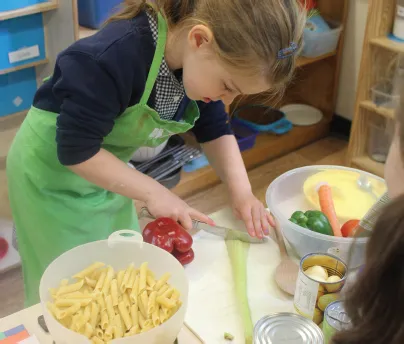
We also upgraded the snack area, adding chopping boards, knives, plates and bowls for children to prepare their own snacks. As we became more confident, we added simple recipe cards for the children to follow whilst they were preparing a snack. This changed the overall feel of the snack area as it enabled children to work on their physical skills, think carefully about the food they were preparing and explore combinations of tastes and textures, independently creating snacks they were proud of and excited to eat.
As a school we made the decision to introduce more continuous provision into Key Stage One and added a cooking area into Year One. We began making recipes for Key Stage One to reflect the next level of challenge. I strongly believe that children learn best when are given time to lead their own learning, follow their interests and work in collaboration with their peers. It is essential that as teachers we provide a rich learning environment where the children can access high quality learning experiences. In Key Stage One we need to give children time to apply the skills and concepts they have learnt in purposeful contexts to ensure they have the time to fully embed learning. Cooking is the perfect place for this as it is such an engaging area where children are eager to be involved.
When I observed children using the cooking areas I witnessed a high level of engagement and involvement. This level of engagement and involvement is crucial to children’s learning.
“When children are displaying deep levels of involvement there is increased brain activity and synapse formation (i.e. learning).”
Anna Ephgrave, Planning in the Moment with Young Children, Routledge, Oxon, 2018
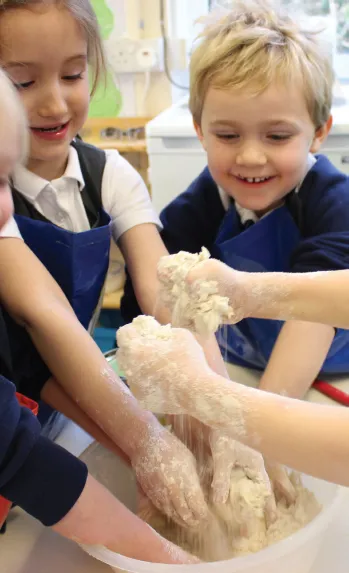
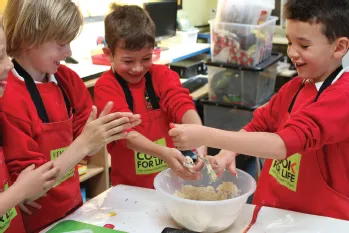
The children seemed to relish the responsibility they were given when cooking, and they loved the ‘realness’ of the experience, often staying on task for sustained periods of time and being fully involved in every aspect of the process.
The pleasure and pride shown by children when they had created something themselves was enchanting and cooking was soon a very popular area in both Reception and Year One.
The cooking project
Seeing children so heavily engaged and learning so much from the introduction of one area of learning gave me a small indication of the impact that cooking provision could have, and I decided I wanted to inspire other schools to introduce cooking into daily provision so that many children could benefit from the same rich learning opportunity.
In 2017/18 I embarked on a cooking project working with a variety of settings/schools who each introduced cooking areas into their provision. The settings included Pre-Schools, Nurseries and Schools. Each setting approached the project in a way which suited their own ethos and style of teaching and learning. Teachers, members of SLT, support staff and parents have all been involved in feeding back on the provision and recipes and throughout the project I observed the impact of introducing the provision, picking up practical tips and advice from teachers and staff working within each setting.
I created recipes for the settings to use from Nursery to Year Two. The recipes were designed to increase in challenge through the year groups, so they require different skills and match the challenge needed for different children. Each cohort is different so I encouraged teachers to select recipes based on the needs, interests and experiences of their own class rather than use a recipe because it was meant to be in a specific year group.
The recipes were there as a starting point, but it was up to teachers and practitioners how they were used. I encouraged teachers to keep them as open-ended as possible. Many of the recipes are designed to encourage children to be exploratory.
Throughout the project, the more the children were encouraged to experiment and design their own products, the more successful the area became. This might have been making their own unique smoothie, choosing their own pizza topping or writing their own recipe and following it. Once the basics for cooking had been established and the adults felt comfortable letting the children take control in the area, the children soon realised they could be inventive and initiate their own learning. They created their own products, adapted ones they had made before and thought of their own. Once the children become confident in this area the possibilities are endless and the project showed this time and time again.
“The children took ownership and wanted to test out their ideas for making cakes – what happens if we put hot chocolate in the cake? What happens if we put red and green food dye in? They would make predictions and discover if they were right or wrong. I think they adapted every recipe in some way after they were confident enough to follow the instructions.”
Hayley Simmons, EYFS lead, St Peter’s Catholic Primary School
The area is designed to be used a resource for learning. There have been many instances of children in the case studies using the cooking area, just like any other area of learning, to follow their own interests. Skilled adults have been able to use these interests and the cooking area to create wonderful learning opportunities. Here is an example of how the cooking area was used as a resource during child-initiated learning.
During the week of the royal wedding the children decided to hold a banquet in the mud kitchen. This led to discussions about the Royal Wedding and we began to find out more information together. As I had recently got married we used this as a tool to look at the component...