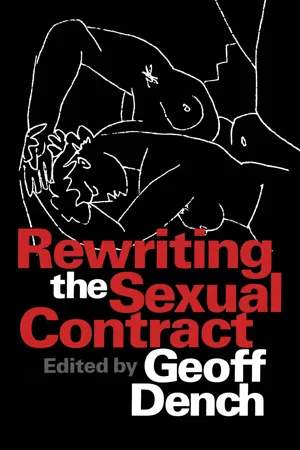
This book brings together a wide selection of viewpoints on what is happening to relations between the sexes and the sexual division of labor in contemporary society. The contributors look at the ways in which gender relationships are changing, the consequences of these changes for family life and society generally, and the part the state should play in future developments. Rewriting the Sexual Contract encompasses the views of people with widely differing orientations, stretching across the moral and political spectrum.
The contributors provide varied interpretations of what the recent sexual revolution means and where it may be leading us. The questions discussed include: Are the life-styles of men and women converging or polarizing? Do men and women place the same value on family life? Do most mothers want to work full-time while their children are young? Are families strengthened by a sense of differentiation and interdependence between the sexes? Does social policy need to recognize sexual differences in order to maximize social equality?
The contributors represent a wide range of viewpoints, but are all involved in analyzing and influencing public attitudes in this area. They include Carole Pateman, Roger Scruton, Ruth Lister, Fay Weldon, Michael Young, and Barbara Cartland, among others. Rewriting the Sexual Contract examines issues pertinent to the current social and political culture and will be of interest to sociologists, gender studies scholars, and political theorists.
Geoff Dench is a senior research fellow at the Institute of Community Studies and a visiting professor at Middlesex University. He is the author of Transforming Men and Minorities in the Open Society: Prisoners of Ambivalence.
- 289 pages
- English
- ePUB (mobile friendly)
- Available on iOS & Android
eBook - ePub
Rewriting the Sexual Contract
About this book
Information
THE STATE WE ARE IN
Sex in the Commodity Culture
Erotic feelings notoriously by-pass moral judgement, fixing themselves on the most bizarre or tawdry objects, and dragging down their victims, as Des Grieux is dragged down by Manon or Swann by Odette. At the same time, erotic love idealizes its object, strives to vindicate its vast investment by believing that the cause is worthwhile. The tension between desire and love has traditionally been resolved in marriage. The married couple are bound by an eternal vow, rather than a temporary contract, and the bond between them necessarily outlasts, therefore, their erotic desire, which becomes a ‘stage on the way’ - the means but not the end of their relationship.
Connotations of contract
In modem democracies love, marriage and friendship are increasingly marginalised and even disapproved. For they are sources of privilege, and therefore potentially offensive to those whom they exclude. In a democratic society what you are is less important than what you have agreed. Contract replaces status as the source of rights and powers. Gifts, which threaten the egalitarian order, are looked on askance, as are all forms of privilege which derive from family and friends. Relations based on contract replace the old relations based in loyalty. The very idea of a ‘sexual contract’ - conceived in the narrow sense of ‘contract’, as an agreement for mutual services - indicates the extent to which perceptions of sexuality have changed, so that physical desire, rather than erotic love, is now given the primary place in our sexual adventures. Contracts are not eternal but finite: there is a point at which they have been fulfilled, and therefore brought to an end. (That is why love requires a vow and not a contract, and why marriage, which is the expression of a vow, is a vanishing phenomenon. Vows are eternal, and make sense only if the Eternal is present to sanctify them.)
Secondly, contracts define a relationship of reciprocal rights. Friends do not, as friends, have rights against each other, and the duties of friendship, such as they are, remain open-ended and enquiring. Thirdly, contracts are undertaken and discarded by agreement, and need nothing but agreement for their validity. Although marriage, for example, is a kind of choice, it is also a choice to be bound by something other than choice.
Fourthly, contracts involve an exchange of goods or services. Nothing is given absolutely, and all the benefits of contract are conditional on the other party’s behaviour. Hence the matter of a contract is always defined independently of the contract: there cannot be a contract simply to be bound by a contract. The subject-matter of a marriage, however, is itself. It is marriage that is offered and received.
Democracy can be seen as a kind of universal contract - an extension of the contractual principle to society as a whole. As in any contract, there is formal equality between the participants, and the democratic order is one in which every person is open to a deal with every other. Democracy therefore promotes universal friendliness, an eagerness for good relations of the kind that we witness in a market-place. This friendliness is not a sign of friendship, in the higher sense praised by Aristotle - the relation founded in the mutual recognition of virtue. If there is friendship here, it is of the lower kind exemplified by business partnerships and day-to-day companionship. Friends in a democratic society tend to be either workmates, or ‘family friends’ whose significance does not reside in any special personal relation, but merely in an enhanced form of neighbour-love.
This does not alter the fact that people in a democratic society retain their admiration for the higher forms of human relation, and sustain themselves in their ever-increasing hours of leisure with fantasies of love. Such fantasies are both gratifying, since they lift us above the routine of calculation, and also troubling, since they cast judgement on our lives. Various stratagems have therefore evolved, with which to deal with the trouble caused by love and friendship, and to neutralize the privileges which they threaten to reintroduce. These stratagems are extremely interesting from the anthropological point of view.
Stratagems for dealing with emotion
The first stratagem is the sentimentalisation of the moral life. Sentimentality is not unique to democratic societies; nevertheless, it has assumed an importance in modem times that has no clear parallel among older and more aristocratic cultures. The most salient feature of a sentimental emotion is the prominence accorded to the subject, rather than the object, of the feeling. It is not the beloved who attracts the most intimate attentions of the sentimental lover, but the lover, who is the hero of a drama scripted by himself. The beloved has become the means to the lover’s exaltation, the excuse for his high emotion, and the proof of his noble soul. In short, the beloved is not the true object of emotion, but a mere occasion of it, in danger of dropping out of consideration altogether, as the subject bathes in his warm self-regard. (Hence sentimentality in literature is, as Leavis pointed out, characterised by vagueness and a lack of any concrete invocation of the object. The object of emotion has been veiled by the subject: the object is not truly observed, and, by the same token, the emotion is not truly felt.)
Sentimentalisation can be seen and heard in popular culture, and plays an important role in confining the individual within the sphere of his own interests, by persuading him that he is enjoying the higher forms of love, when he is in fact enjoying only a simplified and sanitised picture of them. By this means love, friendship and dignity become commodities, that can be bought and sold in the market. They are reduced to doll-like simulacra which can be possessed without any other cost than the price of purchase.
The second stratagem consists in the adoption of friendliness in place of courtesy. (Courtesy is a form of deference, and implies social hierarchy and unequal worth.) Each person in a democratic society stands on display in his invadable space. As little as possible is held in reserve, and anyone who knows the first name of the occupant can enter his space and examine the goods contained in it. Moral and social distinctions are discounted, and those things which must be held in reserve if they are to exist at all - love and friendship, for example - are replaced by more saleable plastic versions, which are as passionless and undemanding as dolls. The person who defends his territory, and who requires some moral or social qualification from those who seek to enter it, is condemned as ‘judgemental’. He is the enemy of the democratic order, and his space must be invaded by force if need be, so as to ensure that he is concealing nothing dangerous within it. As for the rest of us, our primary social duty is to put as much of ourselves on offer as possible, and to reassure our friendly visitors that whatever lies in the store behind the shop, is of the same kind and quality as the matter on display.
The third stratagem is directed specifically against erotic love, the traditional consequences of which - vows, unbreakable loyalties, families, and the consequent network of privilege, power and inheritance - threaten the egalitarian order from within. The stratagem is to replace erotic love with ‘sex’, construed as a commodity available to anyone and from anyone, regardless of the relation between them. Sex education and pornography have the function of removing from the democratic order any sense that sex is to be held in reserve, or treated as a gift, in which one person offers himself to another without terms and eternally. Sex must be deprived of its sacred quality, its personal intentionality, and its aura of moral tabu. The shamelessness of modem sex education is a necessary part of its function, which is to abolish shame, and to ensure that no child matures to the point where the sexual urge might flower into true erotic feeling.
By teaching children to ‘have sex’, rather than ‘make love’, and by insisting that there is no real moral question concerning who or whom, sex education helps to neutralise one of the greatest of anti-democratic forces, one of the greatest sources of privilege and inequality, and the greatest temptation to depart from the contractual norm in our relations with our kind. In order to be effective, sex education must not merely marginalise the old practices of marriage and erotic love, but emphasize those forms of sexual activity - ‘gay sex’, for instance - in which the sexual act has no relation to anything outside the two contracting partners, and in which the body becomes an instrument of localised and merchandisable pleasures.
Sex education is not the only device in this stratagem. Equally important, as I have suggested, is pornography, to the manufacture and defence of which most of the culture industry is now dedicated. Important too is pop music, the social function of which is to ‘lyricize’ the new conception of sex.
The fourth stratagem is perhaps less often noticed. This is to make the higher life of love and friendship into a purely philosophical pursuit, as Plato did in democratic Athens, and Allan Bloom in democratic Chicago. If we see the higher moral life as the privilege of bookish people, formed, fulfilled and also corrupted by a literary diet, then we remove friendship and love from the democratic market-place, render them immune to egalitarian subversion, and preserve them as pure icons, accessible through study, but remote from the empirical world. We resurrect the aristocratic idea, by placing a new and intellectual barrier before those who would aspire to membership. Not that this stratagem resurrects the old experiences of love: on the contrary, it replaces them, by exchanging heroic passion for a tissue of sophisticated gossip, and the human heart for a frozen monument.
One of the important components in this fourth stratagem is the loud denunciation of the rival stratagems, and the invocation of a world that is all but lost, thanks to the decline in education, the universal failure to read the Great Books, and the scorning of Western culture by the new barbarians (who, however, are usually themselves educated people, competing for their own position in the forum of philosophical debate, and aspiring to their own form of moral ‘tenure’). As everyone knows, however, the old experiences of love never depended upon education, still less on the Great Books which recorded them. The stratagem is not to restore the world of love and friendship, but to help us to live without it, by imagining it in purely literary form.
A choice of futures
The result of these stratagems is a new form of human happiness (although whether ‘happiness’ is exactly the word for it is a deep question which I must here pass over). People learn to put themselves on display, to live comfortably in their invadable space, and to feel free to engage in any act or relation, subject to the consent of the other parties. An academic industry is devoted to the theology of this new moral order - excreting theories of justice in the manner of Rawls, of law in the manner of Dworkin, and of culture in the manner of the deconstructionists. The agenda of such writers is to persuade us that all people and all cultures are of equal value - a result which follows logically, once it is established that no person and no culture is really worth anything at all. In the new world that these theories aim to justify you are absolutely safe, however second-rate you might be, so long as you deal openly and honestly in the market of desires. Jealousy, possession, grief and despair have been abolished, since their precondition was love, and love is only a sentimental memory.
On the other hand, a new kind of policing is required by the egalitarian order, especially in sexual matters. The separation of sex from eros is an elaborate artefact. It needs constant reinforcement if it is to persist. A continuous process of retraining and counselling is necessary if people are to live in the way required by the egalitarian culture. They may think they have managed it, only to be unexpectedly thrown from their dreaming orbit into another world, where love and shame are still realities. Then comes the desire for revenge against the person who betrayed them. New crimes are invented with which to punish the miscreant: ‘date rape’, ‘sexual harassment’, and so on. These crimes are necessary, in order to warn people against encounters in which the world of real emotion may erupt from the cupboard.
With the help of careful policing, many of our gurus believe, an equilibrium will be achieved. After a few decades, people will enter a peaceful world of thin attachments and purely contractual ties. In that world there will be eccentrics, whose space is filled with books and scores and liturgies. But they too will enjoy the friendly hilarity of neighbour-love, provided that they permit their space to be invaded, and scrupulously refrain from enacting what they read. Such is the vision of the future that has been encrypted in the sacred texts of the new academy - in such old testament prophets as Rawls and Habermas, as well as in new testament iconoclasts like Foucault and Derrida.
On the other hand, suppose we gave up the attempts at policing the new order. Suppose we ceased to indoctrinate children through sex education, ceased to allow pornography to be freely available, abolished the new crimes against the a-moral order, and allowed shame once again to grow at the heart of social experience. Suppose we encouraged young people to take love and loyalty seriously, to suffer from their absence, and to look with contempt on those who try to avoid them. Would human nature survive this act of collective violence? The evidence of history suggests that it would, since it did. And there is no evidence from history to suggest that our brave new world of disposable attachments has the ability to reproduce itself. On the contrary, however much we police it, this sentimental dream will surely fade into nothingness.
Was Feminism Wrong about the Family?
A cross-section of British newspapers in September 1997 revealed the usual spread of’state-of-the-sexes’ stories. The Daily Telegraph serialised Nicola Horlick’s book You Can have It All, a position hotly disputed by columnists in other newspapers. All the tabloids covered the court case of James Whyte who successfully sued his former employers for unfair dismissal after he had refused to do any more travelling for the firm because he would ‘miss seeing his baby girl grow up’. The Daily Mail, however, found evidence that these involved dads were not always welcome, quoting findings at the British Psychological Society Conference to the effect that, ‘Caring, sharing New men who get too involved in their partners pregnancies can give mothers the baby blues’. What was clear from the open-ended questions and the level of dispute between protagonists is that question of the most appropriate sex roles and ways of behaving in the family, the best way of being a parent, are still unrsolved; we are still living in the after-shock of the feminist revolution.
This uncertainty is at first glance surprising. These articles were written in the aftermath of Princess Diana’s funeral and elsewhere the newspapers were confidently claiming that this event was conclusive proof that British society was now ‘feminised’. Many commentators linked Diana’s funeral with evidence of new Britain. Like Tony Blair’s election victory the previous May, it signified that the British had finally embraced ‘modernity’ with all that implied for sexual relations. When the hundred new women MPs crowded round Tony Blair for their photo on the steps of the Houses of Parliament, this was meant to symbolise the end to the old male hierarchies in politics. The open emotion shown on the streets for Diana’s funeral similarly indicated the end to emotional repression, the behavioral manifestation of the social structure of the British patriarchal family.
But while there’s no doubt that both these phenomena were eruptions through the surface of something which had been growing under the soil for some time, they do not represent the end of the story. There have been many more complex shifts and changes between the sexes, not all presenting the same happy egalitarian picture, not all making the contribution of feminism feel like the enriching movement that its most com...
Table of contents
- Cover Page
- Title Page
- Copyright Page
- Contents
- Acknowledgements
- Introduction
- Where We Are Coming From
- The State We Are In
- Future Models & Options
- Appendices
- Notes
- References
- Contributors
Trusted by 375,005 students
Access to over 1.5 million titles for a fair monthly price.
Study more efficiently using our study tools.
Frequently asked questions
Yes, you can cancel anytime from the Subscription tab in your account settings on the Perlego website. Your subscription will stay active until the end of your current billing period. Learn how to cancel your subscription
No, books cannot be downloaded as external files, such as PDFs, for use outside of Perlego. However, you can download books within the Perlego app for offline reading on mobile or tablet. Learn how to download books offline
Perlego offers two plans: Essential and Complete
- Essential is ideal for learners and professionals who enjoy exploring a wide range of subjects. Access the Essential Library with 800,000+ trusted titles and best-sellers across business, personal growth, and the humanities. Includes unlimited reading time and Standard Read Aloud voice.
- Complete: Perfect for advanced learners and researchers needing full, unrestricted access. Unlock 1.5M+ books across hundreds of subjects, including academic and specialized titles. The Complete Plan also includes advanced features like Premium Read Aloud and Research Assistant.
We are an online textbook subscription service, where you can get access to an entire online library for less than the price of a single book per month. With over 1.5 million books across 990+ topics, we’ve got you covered! Learn about our mission
Look out for the read-aloud symbol on your next book to see if you can listen to it. The read-aloud tool reads text aloud for you, highlighting the text as it is being read. You can pause it, speed it up and slow it down. Learn more about Read Aloud
Yes! You can use the Perlego app on both iOS and Android devices to read anytime, anywhere — even offline. Perfect for commutes or when you’re on the go.
Please note we cannot support devices running on iOS 13 and Android 7 or earlier. Learn more about using the app
Please note we cannot support devices running on iOS 13 and Android 7 or earlier. Learn more about using the app
Yes, you can access Rewriting the Sexual Contract by Geoff Dench,Dench Geoff in PDF and/or ePUB format, as well as other popular books in Social Sciences & Social Policy. We have over 1.5 million books available in our catalogue for you to explore.