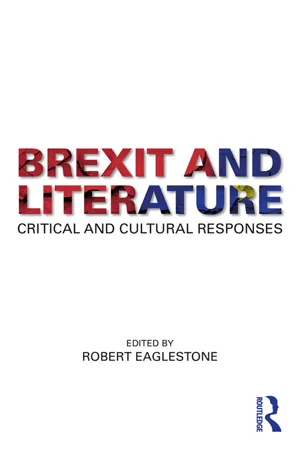
Brexit is a political, economic and administrative event: and it is a cultural one, too. In Brexit and Literature, Robert Eaglestone brings together a diverse range of literary scholars, writers and poets to respond to this aspect of Brexit. The discipline of 'English', as the very name suggests, is concerned with cultural and national identity: literary studies has always addressed ideas of nationalism and the wider political process. With the ramifications of Brexit expected to last for decades to come, Brexit and Literature offers the first academic study of its impact on and through the humanities. Including a preface from Baroness Young of Hornsey, Brexit and Literature is a bold and unapologetic volume, focusing on the immediate effects of the divisive referendum while meditating on its long-term impact.
- 218 pages
- English
- ePUB (mobile friendly)
- Available on iOS & Android
eBook - ePub
About this book
Information
1
The banality of Brexit
1
Stupid. Men too stupid to think about the consequences of their actions tricked the British into making a fatally stupid decision. This is how Brexit is most commonly described. In the UK our stupid politicians tend to actually look stupid. It’s a clever but dangerous deception. Boris Johnson, the boy with the flyaway hair and the love of a doting mother in his eyes, roaring and thumping the pride of Britain throughout the campaign, was left mouthing bland nothings the day after his success. On the same morning, buffoon-in-chief Nigel Farage, he of the marionette jaw and the patent shoes patterned with the Union Jack flag, exulted: “And we’ll have won it, without a single bullet being fired.” Barely 24 hours earlier the body of Jo Cox MP had been released to her family; the coroner recorded that she had died of ‘multiple stab and gunshot wounds’.
This is a dark and dangerous stupidity, all the more pernicious for the way it is worn so lightly by its perpetrators and tolerated, sometimes even indulged, by the rest of us. Bereft educated remainers have taken to consoling themselves with their cleverness, collectively rolling their eyes at the stupidity of others. This is not only arrogant; it is also stupid in its own way. The stupidity that is leading the UK out of the EU, the easy idiocy that has unleashed hate and intolerance, economic and political instability, is in fact a banality that we need to take very seriously.
Weightless, rootless, banality creeps like fungus, sticking to everything. Often you don’t know it’s there until the furniture of politics goes clammy and starts to rot.
Johnson and Farage take evident pleasure in performing their twitfuckery. By contrast, Adolf Eichmann thought of himself as a serious, even profound man. This was why when the political philosopher Hannah Arendt travelled to Jerusalem to confront the Nazi specialist face to face, she burst out laughing. The man was a buffoon, a vain cardboard cut-out of a person, unable to account for himself in anything other than clichés. Eichmann wasn’t banal because he was stupid, he was banal because he was radically thoughtless. The longer you listened to him, Arendt said, the more obvious it became that he was incapable of thinking from the standpoint of anyone else. He lacked the two-in-one dialogue with oneself, the classical Socratic definition of thought itself. It is thoughtlessness, not mere twittery, that is banal.
“Remember thinking?” asked a despairing former archbishop of England, Rowan Williams, at a meeting on antisemitism in Westminster days after the Brexit vote. Arendt thought that thinking was the precondition of political judgment. Thinking is not politics, but politics needs thinking if it is to thrive. Without thought there can be no moral responsibility. This is an old Athenian idea, another piece of European heritage that Britain appears to have turned its back on.
Banality is not just being wrong, it is being radically indifferent to the world. The point when many people think the Leave campaign finally crossed the line was when Boris Johnson attempted to justify President Obama’s opposition to Brexit by reference to a ‘part-Kenyan ancestral dislike of the British empire.’ This was a stupid thing to say. It was also a defining moment of banality. Johnson couldn’t understand the offence because he is incapable of thinking of a world where other lives, or views, really exist. Thoughtlessness like this is contagious. It was not only the casual racism of the remark that was shocking but the fact that so many people failed to understand – to think – that it was racist at all.
These are the people Arendt called the “nonwicked everybody” who, having “no special motives” are “capable of infinite evil” (Arendt, 1994). But it is the politicians whose thoughtlessness abrogates responsibility, the properly wicked, who in the end make evil possible. Philippe Sands QC, author of Lawless World (2005) the definitive takedown of Bush and Blair’s assault on international law, has argued that the path to Brexit began with Iraq (Sands, 2016). Another bad decision made by men who could not think out of their own prejudices. There has always been lying in politics, but the insouciant disregard for either process or reality then marked the beginning of the end of political trust for an entire generation.
And so it has continued. After Brexit came Trump, more bling than banal, perhaps, more of an idiot than Boris Johnson, probably, but the flatus of POTUS is similarly insidious. Across the West we are experiencing the zero-gravity political cultures that only two years ago we assumed belonged to other times and other places. The moral obscenities continue to mount up. In the spring of 2017 the UK Home Office reneged on its promise to take children from Calais (the Dubs’ Agreement) on the grounds that to do so would be encourage children to put their lives in danger. In the summer, the elected representatives of Kensington and Chelsea Council faced the survivors of the Grenfell Tower fire and rolled their eyes.
2
Literature, writing, poems, songs, and plays are the natural enemies of banality. Writing is the staging of two-in-one thinking. Novels, Bakhtin taught us, are dialogic. Poems remind us that language is a rich, complex, and surprising place to live in. Literature is where meanings and morals are put in place and put on trial. Literature is “world making” in Gayatri Spivak’s sense (Spivak, 1985). At times, those worlds collude with cruelly insouciant barbarism. Sometimes literature opens up new worlds, offering avenues of liberty. At first glance, at least, literary studies presents itself as an attractive alternative to the banality of Brexit. Here is where we do the thinking it seems that our political culture can no longer support.
All this is true – so true, perhaps, that in the long history of the relationship of literature to political culture, it almost seems banal to point it out just now. Is this really the moment to inflate the cultural, let alone political, power of literature?
This question was eloquently raised by a student at a meeting arranged by the alternative media organisation Norwich Radical in March 2017. The student was observing that in bestseller lists you have to go quite a long way down before you find a literary fiction title. The implication was that if literary fiction was more widely read, our political culture might be less banal. But then she smartly checked herself. Literariness might be an antidote to thoughtlessness; but might thoughtless assumptions about the value of some books over others, some ways of thinking over others, also be part of the problem, she wondered? Her family did not read literary fiction but were no less thoughtful for not having Ian McEwan on their shelves.
We are missing something important about what has happened over the past two years if we assume that literary liberalism is a plausible response to our current predicament. It was certainly not the debate on sovereignty that its good-faith supporters intended, and the lies told make its mandate precarious, but what is certain is that, at least in part, Brexit was a protest against some people assuming that other people were stupid. Eye rolling is not only the vice of the pantomime villains of neo-liberalism.
Although she was clear that thinking was the precondition of politics, Arendt too worried about the role of reflection in dark times. True, to think is to make words mean again – which is why literature has a special affinity with critical thinking; but thinking can also be a kind of retreat, an ‘inner emigration,’ perversely, a way of not taking moral responsibility for the world you live in. Rather than allowing escape, for Arendt thinking should lead to an unmediated comprehension of reality, however much – and especially when – we are revolted by that reality.
The revolting reality of Brexit Britain today is that the buffoons of ethno-nationalism have been allowed to crowd out the spaces where debates about inequality, disenfranchisement, fairness, participation, community, political facts, hopes, and histories should have taken place. That happened partly because some of us who like to think of ourselves as very thoughtful indeed were not thinking hard or widely enough. The consequence is that many of the most culturally enfranchised people in the country are currently, and unusually, experiencing what it feels like to be politically disenfranchised. That is an uncomfortable reality but a good starting point for reflection.
Before we offer literature as the antidote to banality, we need to think harder about the history of cultural and political belonging. In her early study of Rahel Varnhagen, the eighteenth-century Jewish salonnière, Arendt wrote of Varnhagen’s desire for “a new language where all the words have lost their banality” (Arendt-Stern, 1934). A woman and a Jew, Varnhagen believed that the universalism proposed by Goethe’s World Literature could make good the promise of equality for all offered by the European dream. She was wrong. By the time Arendt was finishing her reflections on Varnhagen’s life in the mid-1930s, by then a refugee in Paris about to be deported to Gurs detention camp, the eighteenth-century iteration of European universalism had crashed. Arendt never stopped believing that poetic language offered a means of creative being; but henceforth she would stake out a place for the tradition of pariahs – Jews, refugees, the others of European citizenry.
The task Arendt and others of her generation confronted at the end of the Second World War was to invent a humanism that could be universal and particular, collective and specific. This task required much more than tolerance, empathy, or being ‘mindful’ about difference. Imperialism, colonialism, racism, rapid economic expansionism, and the collapse of the state into nationalism had all created the conditions for totalitarianism. No humanism, literary or otherwise, could re-invent itself without at the same time reckoning with those histories which may, indeed, be why no Western humanism really bothered to try that hard; the humanism of anti- and post-colonial thinking is another matter (Gilroy, 2014). Nor can we confront the banality of Brexit today without acknowledging the realities of political and cultural dispossession.
As many of us have done over the past year, Arendt took Orwell into the classroom to help her and her students think about these matters. Nineteen Eighty-Four was on the syllabus of a course she taught at Berkeley in 1955 (she later taught Down and Out and Homage to Catalonia to students at the New School and Cornell). This was at the beginning of the Cold War and, like Orwell, Arendt was keen to understand the function of the political lie. Arendt thought Orwell was half right. Two plus two would never make five, she pointed out in Origins of Totalitarianism, mathematical reason will always be mathematical reason; the real point wasn’t the evident stupidity of totalitarian ideology but the way its banality created the loneliness that allowed totalitarianism to thrive. The original title of Orwell’s novel was The Last Man in Europe.
Much of this is newly resonant. But to turn to Nineteen Eighty-Four today without reckoning with the book’s own political and historical journey through and beyond the Cold War is to risk, once again, confusing the antidote with the symptom. For generations of Western schoolchildren who grew up during the Cold War, Nineteen Eighty-Four became the touch-text for liberal values, particularly those of compassion and emotional engagement with the suffering of others. That ideological legacy continued into the late twentieth and early twenty-first centuries, providing the basis for a liberalism based on pragmatism and humanitarian values. Martha Nussbaum described the novel as detailing the “death of pity” under a political regime, arguing that Orwell showed how human empathy was essential to the functioning of liberal democracies (Nussbaum, 2005). Similarly, Richard Rorty, writing just at the end of the Cold War, claimed the novel’s continued relevance lay in Orwell’s rejection of political reason as a means to a just end and his promotion, instead, of the intolerance of cruelty which marked post-war liberal thought (Rorty, 1993).
We hear less from these authors of Orwell’s intolerance of poverty, his contempt for colonialism, of the enraged critic of the faux humanism of the so-called liberal democracies who argued, as far back as 1939, that a democratic union of countries that refused to count the lives of those who made its wealth and privilege possible had no real moral grounds to deplore tyranny in such smugly shrill tones (Orwell, 2001). We need to hear more of this Orwell now.
Arendt did not ask her students to read Orwell so they could learn about how to pity those less fortunate than themselves. Thoughtfulness did not mean continuing to reap moral capital whilst brushing political reality to one side. She wanted them to read him in order to better understand what she called ‘Political Experience in the Twentieth-Century’ (the title of one of her most popular courses). The task, she noted in one of her introductory seminars, was not to empathise but to think, to use political judgment to comprehend a reality that was not their own (but “partly mine,” she also noted wryly).
In her essay on Nineteen Eighty-Four, Elaine Scarry describes thinking as follows:
The human ability to think freely – or, simply, to think – is premised on an ability to carry out two distinguishable mental practices, the practice of accurately identifying what is the case and the practice of entering mentally into what is not the case. The two familiar names for these practices are history and literature.
(Scarry, 2005)
Arendt would have approved of this description. Poetic language – and Nineteen Eighty-Four, so often read as a political text, is without doubt the most literary of Orwell’s writings – makes thinking possible. But without accurately identifying reality, without doing history too, contemplation can easily turn solipsistic. The ‘self-thinking’ that Varnhagen attempted in her misidentification with European literary life, Arendt argued, was an evasion of the reality of her situation. “Introspection and its hybrids engender mendacity,” she snapped (Arendt, 1997).
There’s nothing more mendacious on these islands just now than the contemporary politics of Brexit. But if we are to successfully teach ‘Political Experience in the Twenty-First Century’ – assuming that there is a ‘we’ who might want to do this – we are going to need something better than the literary liberalism bequeathed to us at the end of the Cold War. Encouraging people to read more literary fiction will not defeat the banality of Brexit. Creating the conditions for the return of political judgement, however, might help.
Norwich, June 2016/September 2017
The first part of this essay was written in June 2016 and published on the DiEM25 blog, with an introduction by Yanis Varoufakis: https://diem25.org/the-banality-of-leaving-the-eu/.
Bibliography
Arendt, Hannah. (1994). Eichmann in Jerusalem: A Report on the Banality of Evil (1963). Harmondsworth: Penguin.
———. (1997). Rahel Varnhagen: Life of a Jewess (1957), trans. Richard and Clara Winston. Baltimore: Johns Hopkins University Press.
Arendt-Stern, Hannah. (1934). Rahel Varnhagen et Goethe. Cahiers Juifs, 11–12 (October–December 1934), quoted and translated by Haun Saussy. The Refugee Speaks of Parvenus and Their Beautiful Illusions: A Rediscovered 1934 Text by Hannah Arendt. Critical Inquiry, 40.1 (Autumn 2013).
Gilroy, Paul. (2014). Race and the Value of the Human. In: The Meanings of Rights: The Philosophy and Social Theory of Human Rights, eds. Costas Douzinas and Conor Gearty. Cambridge: Cambridge University Press.
Nussbaum, Martha C. (2005). The Death of Pity: Orwell and American Political Life. In: On Nineteen Eighty-Four: Orwell and Our Future, eds. Abott Gleason, Jack Goldsmith and Martha C. Nussbaum. New York: Princeton University Press.
Orwell, George. (2001). Review: Clarence K. Streit, Union Now, July 1939. In: Orwell and Politics, ed. Peter Davison. Harmondsworth: Penguin.
Rorty, Richard. (1993). Contingency, Irony and Solidarity. Cambridge: Cambridge University Press.
Sands, Philippe. (2016). A Grand and Disastrous Deceit. London Review of Books, 38, p. 15, 28 July 2016.
Scarry, Elaine. (2005). A Defense of Poesy (The Treatise of Julia). In: On Nineteen Eighty-Four: Orwell and Our Future, eds. Abott Gleason, Jack Goldsmith and Martha C. Nussbaum. New York: Princeton University Press.
Spivak, Gayatri. (1958). Three Women’s Texts and a Critique of Imperialism, ‘Identities’. Kwame Appiah and Henry Louis Gates, Jr. eds., special issue, Critical Inquiry 12 (1).
Table of contents
- Cover
- Title
- Copyright
- Dedication
- Contents
- Contributors
- Preface
- Acknowledgements
- Introduction: Brexit and literature
- 1 The banality of Brexit
- 2 BrexLit
- 3 Autumn after the referendum
- 4 Do novels tell us how to vote?
- 5 Poetry and Brexit
- 6 English literature saved my life
- 7 Migrant Britain
- 8 Scratching the post-imperial itch
- 9 Cruel nostalgia and the memory of the Second World War
- 10 Brexit and the aesthetics of anachronism
- 11 Fake news literary criticism
- 12 The psychopolitics of Brexit
- 13 Brexit and the imagination
- 14 The lost nomad of Europe
- 15 Researching Britain and Europe, then and now
- 16 Brexit and the German question
- 17 Brexit: Thinking and resistance
- Epilogue: The immigrant at Port Selda
- Index
Trusted by 375,005 students
Access to over 1.5 million titles for a fair monthly price.
Study more efficiently using our study tools.
Frequently asked questions
Yes, you can cancel anytime from the Subscription tab in your account settings on the Perlego website. Your subscription will stay active until the end of your current billing period. Learn how to cancel your subscription
No, books cannot be downloaded as external files, such as PDFs, for use outside of Perlego. However, you can download books within the Perlego app for offline reading on mobile or tablet. Learn how to download books offline
Perlego offers two plans: Essential and Complete
- Essential is ideal for learners and professionals who enjoy exploring a wide range of subjects. Access the Essential Library with 800,000+ trusted titles and best-sellers across business, personal growth, and the humanities. Includes unlimited reading time and Standard Read Aloud voice.
- Complete: Perfect for advanced learners and researchers needing full, unrestricted access. Unlock 1.5M+ books across hundreds of subjects, including academic and specialized titles. The Complete Plan also includes advanced features like Premium Read Aloud and Research Assistant.
We are an online textbook subscription service, where you can get access to an entire online library for less than the price of a single book per month. With over 1.5 million books across 990+ topics, we’ve got you covered! Learn about our mission
Look out for the read-aloud symbol on your next book to see if you can listen to it. The read-aloud tool reads text aloud for you, highlighting the text as it is being read. You can pause it, speed it up and slow it down. Learn more about Read Aloud
Yes! You can use the Perlego app on both iOS and Android devices to read anytime, anywhere — even offline. Perfect for commutes or when you’re on the go.
Please note we cannot support devices running on iOS 13 and Android 7 or earlier. Learn more about using the app
Please note we cannot support devices running on iOS 13 and Android 7 or earlier. Learn more about using the app
Yes, you can access Brexit and Literature by Robert Eaglestone in PDF and/or ePUB format, as well as other popular books in Literature & English Literary Criticism. We have over 1.5 million books available in our catalogue for you to explore.